


Product name: Campesterol
Synonym name: Mieyajunsu A; Campest-5-en-3-ol
Catalogue No.: BP0307
Cas No.: 474-62-4
Formula: C28H48O
Mol Weight: 400.691
Botanical Source:
Physical Description:
Type of Compound: Steroids
Purity: 95%~99%
Analysis Method: HPLC-DAD or/and HPLC-ELSD
Identification Method: Mass, NMR
Packing: Brown vial or HDPE plastic bottle
Storage: Store in a well closed container, protected from air and light. Put into refrigerate or freeze for long term storage.
Whenever possible, you should prepare and use solutions on the same day. However, if you need to make up stock solutions in advance, we recommend that you store the solution as aliquots in tightly sealed vials at -20℃. Generally, these will be useable for up to two weeks.
The product could be supplied from milligrams to grams, up to kilograms
Inquire for bulk scale.
Descriptions:
Dietary campest-5-en-3-one (campestenone), an oxidized derivative of campesterol, can activate PPAR alpha, promote energy consumption and significantly reduce visceral fat weight and the concentration of triacylglycerol in serum and liver of rats.[1]
Campesterol oxidised derivatives and dihydrobrassicasterol have toxicity in U937 and HepG2 cells.[2]
Campesterol oxidation products have different antioxidant effects.[3]
At higher sterol concentrations, campesterol (Camp) and brassicasterol (Bras) are less miscible and less effective than cholesterol (Chol) at ordering the hydrocarbon chains of the sterol-enriched fluid DPPC bilayers, overall, these alkyl side chain modifications generally reduce the ability of Chol to produce its characteristic effects on DPPC bilayer physical properties. [4]
References:
[1] Ikeda I, Konno R, Shimizu T, et al.BBA-BiomembranesI?, 2006, 1760(5):800-7.
[2] O Callaghan Y, Kenny O, O’Connell N M, et al. Biochimie, 2013, 95(3):496-503.
[3] Kmiecik D, Korczak J, Rudzińska M, et al. Food Chem, 2011, 128(4):937-42.
[4] Benesch M G K, Mcelhaney R N. BBA-BiomembranesI, 2014, 1838(7):1941-9.
[5] Jia M Q, Tang H, Cui-Hua L I, et al. Food Sci Technol 2013, 12(4):651.
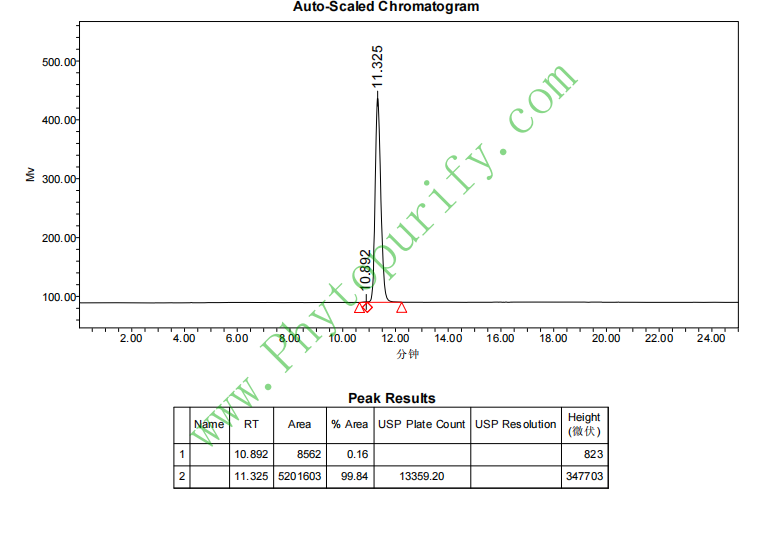
HPLC of Campesterol
Storage conditions:Short-term storage at 2~8℃, long-term storage at -20 ~ -80℃
Campesterol (CAS number: 474-62-4), as an important plant sterol, has attracted much attention in recent years due to its significant cholesterol lowering and anticancer activities. Phytosterols are widely present in plant cell membranes and are an important branch of steroid compounds. They are structurally similar to cholesterol but possess unique biological functions due to differences in their side chains. As a representative of 3 β - hydroxy Delta (5) - steroids and C28 steroids, brassinosteroids are widely present in vegetable oils such as rapeseed, corn, and soybean, and have multiple pharmacological effects such as regulating lipid metabolism, anti-inflammatory, and anti-tumor effects.
The purpose of this review is to systematically summarize the chemical structure, physical and chemical properties, plant sources and extraction methods of rapeseed sterol, focus on its pharmacological activity and molecular mechanism of action in atherosclerosis, inflammatory bowel disease, breast cancer, prostate cancer and other diseases, deeply explore its pharmaceutical and pharmacokinetic characteristics, and finally look forward to its clinical application potential and future research directions, providing theoretical basis and research reference for natural product pharmacology and new drug development.
The chemical name of campesterol is 3 β - hydroxy-Delta (5) - steroid, with a molecular formula of C28H48O and a molecular weight of approximately 400.67. Its structural core is a tetracyclic steroid skeleton, with a 3 β - hydroxy group and an unsaturated Δ 5 double bond, and the side chain is a hydrogenated derivative of brassinose. Its structure is highly similar to cholesterol, but with an additional methyl group on the side chain, giving it unique biological activity.
In terms of physical and chemical properties, the LogP value of campesterol is as high as 8.5, indicating its high hydrophobicity. It is difficult to dissolve in water and easily soluble in organic solvents. The polar surface area (TPSA) is 20.23 Å ², and the number of hydrogen bond acceptors is 1, indicating a low molecular polarity. Its molecular structure is stable and has no significant hepatotoxicity, cardiotoxicity, or hERG channel inhibition. The Ames test result is negative, indicating a low risk of genotoxicity. The low penetration of the blood-brain barrier limits its direct impact on the central nervous system.
Phytosterols are mainly found in various plant oils, especially rapeseed oil, corn oil, soybean oil, and palm oil, which are abundant in content. As an important component of plant cell membranes, the content of brassinosteroids in plants is greatly influenced by variety, environment, and processing technology.
In terms of extraction technology, traditional methods include solvent extraction, cold pressing, and supercritical CO ₂ extraction. Solvent extraction usually uses organic solvents such as ethanol and hexane to obtain high-purity brassinosteroids through steps such as separation, concentration, and crystallization. Supercritical CO ₂ extraction technology has gradually become the mainstream method for industrial extraction due to its green and environmentally friendly nature, strong selectivity, and good thermal stability. In addition, membrane separation technology and chromatographic purification technology have also been applied to the refining of brassinosteroids, ensuring their purity and biological activity.
As an important member of plant sterols, brassinosteroids can competitively inhibit intestinal cholesterol absorption and reduce plasma cholesterol levels. Its mechanism of action involves regulating cholesterol metabolism related targets, such as cholesterol ester transfer protein (CETP), 3-hydroxy-3-methylglutaryl-CoA reductase (HMGCR), low-density lipoprotein receptor (LDLR), apolipoprotein B (APOB), proprotein convertase subtilisin 9 (PCSK9), and bile acid synthase (CYP7A1). By promoting cholesterol transport and metabolism, rapeseed sterol can effectively reduce serum low-density lipoprotein cholesterol (LDL-C) and slow down the process of atherosclerosis.
Inflammatory bowel disease (IBD) is a type of chronic inflammatory disease, in which brassinosteroids exert anti-inflammatory effects by regulating multiple inflammation related signaling pathways. Its targets include AMP activated protein kinase (AMPK), NOTCH1, thymidine like proteases (CES1, CES2), TLR4, interleukin-6 (IL-6), protein tyrosine phosphatase 1 (PTPN1), signal transduction and transcription activator 3 (STAT3), and estrogen receptor beta (ESR2). Rapesterol inhibits TLR4 mediated inflammatory response, reduces the expression of pro-inflammatory cytokines, alleviates intestinal mucosal damage, and improves IBD symptoms.
Raposterol has significant anti proliferation and pro apoptosis effects in many tumor models, such as breast cancer and prostate cancer. Its targets include apoptosis regulatory protein BCL2, STAT3 signaling pathway, estrogen receptor beta (ESR2), drug efflux pumps ABCB1 and ABCG2, microtubule associated protein Tau (MAPT), topoisomerase I (TOP1), deacetylase SIRT1, nuclear factor kappa B subunit RELA, etc. By regulating these molecules, brassinosteroids can inhibit tumor cell proliferation, induce cell cycle arrest, and promote apoptosis. In addition, brassinosteroids also affect prostate cancer-related targets such as androgen receptor (AR), PI3K/AKT signaling pathway (PIK3CA), epidermal growth factor receptor (EGFR), and galectin-3 (LGALS3), enhancing anti-tumor effects.
Vegetable oil sterols have also been reported to have potential effects in regulating energy metabolism, antioxidation, and immune regulation. It may have adjuvant therapeutic value for diseases such as metabolic syndrome by activating the AMPK signaling pathway, promoting lipid metabolism and energy balance.
The multi-target mechanism of action of brassinosteroids is the basis of their pharmacological activity. Its main targets and mechanisms of action are as follows:
AMPK(PRKAA1)As a cellular energy sensor, AMPK activation promotes lipid metabolism and anti-inflammatory response. Vegetable oil sterols exert lipid-lowering and anti-inflammatory effects by activating AMPK, regulating lipid metabolism, and inhibiting inflammation.
Cholesterol metabolism related targets: Including HMGCR, LDLR, PCSK9, CETP, etc. Raposterol can reduce plasma cholesterol level and prevent atherosclerosis by regulating these targets.
Inflammatory signaling pathway Inflammation related molecules such as TLR4, IL-6, STAT3, PTPN1, etc. are regulated by brassinosteroids to alleviate inflammatory reactions and improve inflammatory bowel disease.
Tumor related targets:BCL2、STAT3、ESR2、ABCB1、ABCG2、MAPT、TOP1、SIRT1、RELA Wait, brassinosteroids inhibit tumor growth and drug resistance by regulating cell apoptosis, drug efflux, and signal transduction.
Hormone receptors and signaling pathways Like AR, CYP19A1, MAPK1, EGFR, PIK3CA, etc., brassinosteroids affect the signaling pathways of hormone dependent tumors and regulate the tumor microenvironment.
Immune regulatory targets Immunomodulatory molecules such as IDO1 participate in the immunomodulatory effects of brassinosteroids, enhancing the body's anti-tumor and anti-inflammatory capabilities.
In summary, brassinosteroids exhibit complex and diverse pharmacological activities through multi-target and multi pathway synergistic effects.
The pharmacological evaluation of campesterol shows that it has good safety and drug compatibility. A high LogP value (8.5) suggests strong lipid solubility and easy cell membrane penetration, but poor water solubility, which may affect oral bioavailability. Low polarity surface area and fewer hydrogen bond acceptors are beneficial for penetrating biological membranes, but may also lead to limited distribution in vivo.
In terms of safety, brassinosteroids have no hepatotoxicity, cardiotoxicity, or hERG channel inhibition effects, and the Ames test is negative, indicating a low risk of genotoxicity and suitability for long-term use. Low blood-brain barrier penetration reduces the risk of central nervous system side effects.
Pharmacokinetic studies have shown that brassinosteroids are slowly absorbed after oral administration, with a long plasma half-life. They are mainly metabolized through the liver, and the metabolites exhibit certain biological activity in mouse models. Its lipophilicity makes it easy to accumulate in adipose tissue, which may affect the distribution and clearance of drugs. Further research is needed on its metabolic pathways and drug interactions in the future.
As a natural plant sterol, campesterol has broad clinical application prospects due to its significant cholesterol lowering and anticancer activities. In the field of cardiovascular disease, rapeseed sterol provides auxiliary treatment for patients with hyperlipidemia and coronary heart disease by reducing serum cholesterol and inhibiting atherosclerosis. In the treatment of inflammatory bowel disease, its anti-inflammatory effect is expected to improve patient symptoms and reduce drug side effects.
In terms of anti-tumor, rapeseed sterol has potential adjuvant therapeutic value for breast cancer and prostate cancer, especially in overcoming tumor resistance and regulating tumor microenvironment. In the future, it can be combined with existing chemotherapy drugs to improve treatment efficacy.
However, the low water solubility and bioavailability of brassinosteroids limit their clinical promotion. The development of novel drug delivery systems such as nanocarriers, liposomes, and solid dispersions will help improve their pharmacokinetic performance. In addition, in-depth analysis of its molecular mechanism of action and clinical safety evaluation are key to achieving its clinical translation.
Future research should focus on:
As a plant sterol with multiple biological activities, brassinosteroids have demonstrated significant cholesterol lowering, anti-inflammatory, and anti-tumor potential. Its multi-target and multi mechanism pharmacological effects provide rich materials for natural product pharmacology research and open up new paths for new drug development. Despite the challenges of poor water solubility and low bioavailability, with the advancement of extraction technology and drug carriers, brassinosteroids are expected to become an important natural drug resource for the treatment of cardiovascular diseases, inflammatory diseases, and tumors. The pharmacological mechanism research and clinical validation of future systems will further promote their clinical application and industrialization process, and assist in the innovative development of natural product drugs.
