


Product name: Daidzin
Synonym name: Daidzein 7-O-β-D-glucopyranoside; Daidzoside
Catalogue No.: BP0446
Cas No.: 552-66-9
Formula: C21H20O9
Mol Weight: 416.382
Botanical Source: soya bean meal, roots of Pueraria lobata and shoots of Piptanthus nepalensis. Also from Baptisia spp., Glycine max, Medicago sativa, Thermopsis spp. and others in Leguminosae
Physical Description: Powder
Type of Compound: Flavonoids
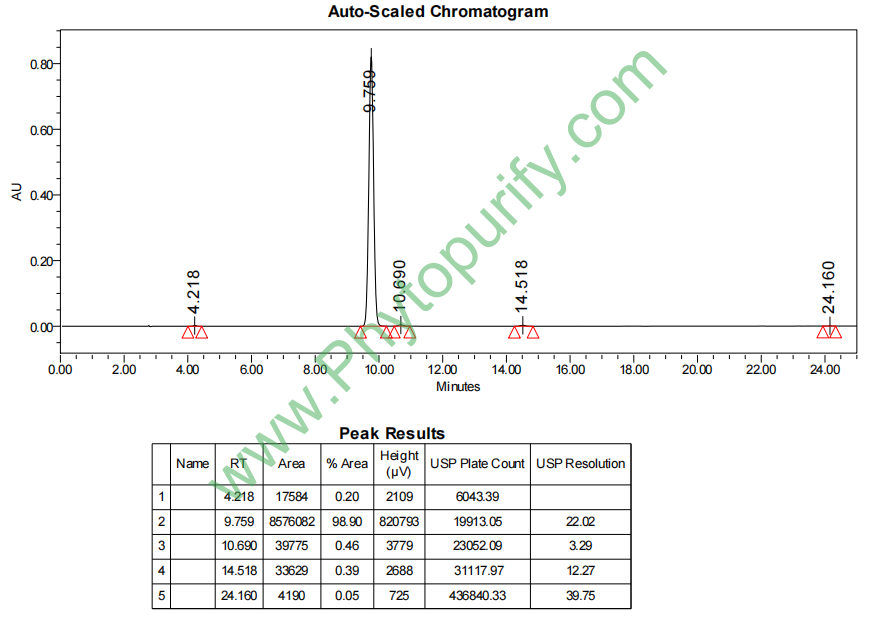
Purity: 95%~99%
Analysis Method: HPLC-DAD or/and HPLC-ELSD
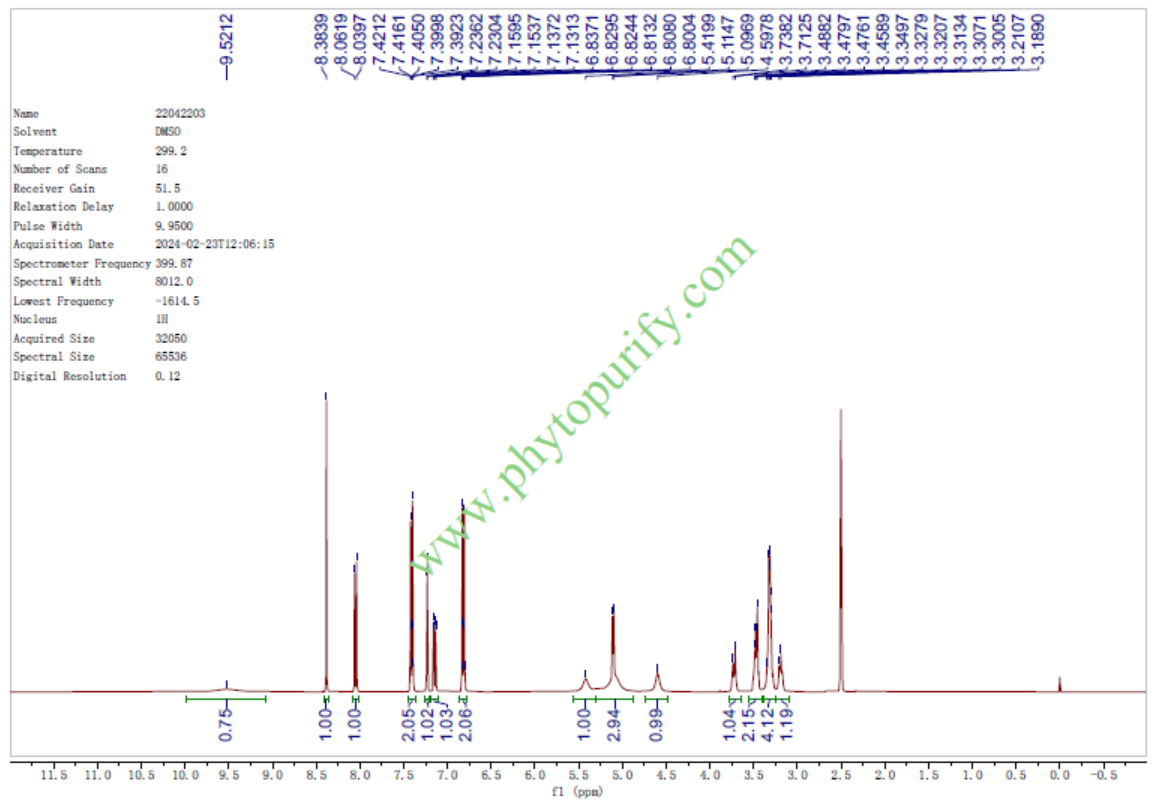
Identification Method: Mass, NMR
Packing: Brown vial or HDPE plastic bottle
Storage: Store in a well closed container, protected from air and light. Put into refrigerate or freeze for long term storage.
Whenever possible, you should prepare and use solutions on the same day. However, if you need to make up stock solutions in advance, we recommend that you store the solution as aliquots in tightly sealed vials at -20℃. Generally, these will be useable for up to two weeks.
The product could be supplied from milligrams to grams, up to kilograms
Inquire for bulk scale.
Descriptions:
Daidzin is a potent, selective inhibitor of human mitochondrial aldehyde dehydrogenase with a Ki of 40 nM, and uncompetitively with respect to the coenzyme NAD+. [1]
Daidzin has preventive effect on bone loss in ovariectomized rats appears to be due to suppression of bone turnover. [2]
Daidzin in the rhizome of Pueraria lobata are prodrugs, which has antiallergic and antithrombotic activities, can inhibit ADP- and collagen-induced platelet aggregation, produced by intestinal microflora.[3]
Daidzin and puerarin can induce a conformational change of beta-CD, which is compressed in one direction and stretched in the other. [4]
References:
[1] Keung W M, Vallee B L. P Nat Acad Sci USA, 1993, 90(4):1247-51.
[2] Ishida H, Uesugi T, Hirai K, et al. Biol Pharm Bull, 1998, 21(1):62-6.
[3] Choo M K, Park E K, Yoon H K, et al. Biol Pharm Bull, 2002, 25(10):1328-32.
[4] Zhang H, Feng W, Li C, et al. J Phys Chem B, 2010, 114(14):4876-83.
[5] Dong H W, Liu W H, Pharmacy S O, et al. J Pharm Res, 2014, 33(2):73-75.
HPLC of Daidzin
HNMR of Daidzin
Storage conditions:Short-term storage at 2~8℃, long-term storage at -20 ~ -80℃
149.8200
.2446
.2431
.9952
.5324
.2753
Low
80.5346
3.6596
Yes
No
Yes
No
Yes
No
1.5
Yes
Yes
Yes
Yes
Isoflavones, as a class of secondary metabolites widely present in leguminous plants, have attracted much attention due to their diverse biological activities. Daidzin, also known as 7-hydroxy-3- (4-hydroxyphenyl) -4H-1-benzopyran-4-one-7- β - D-glucoside, is one of the most representative members. Since its discovery from the traditional food soybean (Glycine max) and its products, its potential medicinal value has become a hot topic in natural product pharmacology research. Early research mainly focused on its effects as a plant estrogen, but with advances in molecular biology and pharmacological techniques, the activities of daidzein in cardiovascular protection, neuropsychiatric regulation, and cancer chemoprevention have gradually been revealed. Of particular note is its unique potential as an efficient and selective mitochondrial aldehyde dehydrogenase 2 (ALDH-2) inhibitor in reducing ethanol consumption, providing new insights for the treatment of alcohol dependence. This article aims to systematically review the chemical properties, plant sources, pharmacological activities, molecular mechanisms of action, pharmacological evaluation, and clinical application prospects of daidzein, in order to provide comprehensive scientific references for the in-depth research and development of this compound.
The chemical structure of daidzein consists of an isoflavone core (7-hydroxyflavone, also known as daidzein) connected to a β - D-glucosyl group via a glycosidic bond at position 7. Its molecular formula is C21H20O9 and its molecular weight is 416.3820. This glycosidic structure significantly affects its physicochemical properties. Compared with daidzein, the polarity of daidzein is significantly increased, and its topological polar surface area (TPSA) is as high as 149.8200 Å ². The calculated lipid water partition coefficient (LogP) is 0.2446, indicating that it has good hydrophilicity. The experimental data supports this point, with a water solubility of approximately 0.9952 mg/mL, which is beneficial for its dissolution and distribution in living organisms. However, its high polarity and TPSA also limit its ability to cross lipid bilayers, leading to a predicted "low" blood-brain barrier permeability. In the preliminary safety screening, daidzein showed no significant inhibitory effect on hERG potassium channels, indicating a low risk of causing QT interval prolongation in the heart. The Ames test result is 1.5, indicating that no significant mutagenicity was observed under the testing conditions, providing some preliminary evidence for its safety. Daidzein can be hydrolyzed under acidic or enzymatic conditions (such as β - glucosidase) to produce more active daidzein, which has a significant impact on its metabolism and pharmacological effects in vivo.
Daidzein mainly comes from leguminous plants, among which soybean (Glycine max) and its products (such as soybean meal, soybean milk, tofu, lobster sauce) are the most abundant and common dietary sources. In addition, traditional medicinal plants such as Pueraria lobata and Trifolium pratense also contain high levels of daidzein. In plants, daidzein often coexists with other isoflavone glycosides such as genistein.
Solvent extraction is commonly used to extract daidzein from plant materials. Methanol, ethanol, or their aqueous solutions (such as 70-80% ethanol) are commonly used extraction solvents because they can effectively dissolve polar glycoside compounds. The extraction process can be assisted by heating reflux, ultrasound or microwave-assisted extraction techniques to improve extraction efficiency. After filtration and concentration, the crude extract needs to be further purified to obtain high-purity daidzein. Conventional purification methods include:
1. Macroporous resin adsorption method Selective adsorption of isoflavones using resins (such as AB-8, D101) and enrichment by elution with different concentrations of ethanol.
2. Silica gel column chromatography Separation is carried out using gradient elution systems such as chloroform methanol or dichloromethane methanol.
3. Preparation type high-performance liquid chromatography method This is the most effective method for obtaining high-purity monomers, typically using a reverse phase C18 chromatography column with methanol water or acetonitrile water (containing small amounts of formic acid or acetic acid) as the mobile phase for separation.
In recent years, green extraction technologies such as supercritical CO2 extraction (with the addition of entrainers) have also been explored to improve selectivity and reduce the use of organic solvents.
A large number of pharmacological studies in vitro and in vivo have shown that daidzein has a wide range of biological activities, and its core research areas are focused on the following aspects:
Cardiovascular protective effect This is one of the most in-depth areas of research on daidzein. Research has shown that daidzein can improve endothelial function by upregulating endothelial nitric oxide synthase (NOS3) expression to promote nitric oxide (NO) production, thereby relaxing blood vessels. It can also inhibit the abnormal proliferation of vascular smooth muscle cells, reduce inflammatory reaction (such as inhibiting the expression of intercellular adhesion molecule-1/ICAM1 and vascular cell adhesion molecule-1/VCAM1), and regulate lipid metabolism (such as affecting the activity of 3-hydroxy-3-methylglutaryl coenzyme A reductase/HMGCR), so as to jointly play an anti atherosclerosis effect. Animal models have confirmed that daidzein can reduce the formation of atherosclerotic plaque induced by high-fat diet or drugs.
Anti alcohol dependence effect The most unique activity of daidzein is that it is a highly selective inhibitor of mitochondrial ALDH-2. Ethanol is metabolized into acetaldehyde in the body, and ALDH-2 is a key enzyme responsible for the oxidation of acetaldehyde to acetic acid. Daidzein inhibits ALDH-2, leading to rapid accumulation of acetaldehyde after drinking, causing discomfort symptoms such as flushing, nausea, and palpitations similar to the "disulfiram reaction", thereby forming conditioned aversion and reducing ethanol intake. This mechanism makes it a potential lead compound for developing alcohol withdrawal drugs.
Antioxidant and anti-inflammatory activities Daidzein can directly scavenge free radicals (such as DPPH, ABTS free radicals) and enhance the intracellular antioxidant defense system (such as upregulating the activity of superoxide dismutase and glutathione peroxidase). Its anti-inflammatory effect is related to the inhibition of inflammatory signaling pathways such as nuclear factor kappa B (NF - κ B) and the reduction of pro-inflammatory factors such as tumor necrosis factor alpha (TNF - α) and interleukin-6 (IL-6).
anticancer activity Research shows that daidzein can inhibit the growth and induce apoptosis of breast cancer, prostate cancer, colon cancer and other cancer cell lines. Its mechanism involves cell cycle arrest, regulation of Bcl-2/Bax protein ratio, inhibition of tyrosine kinase activity, and angiogenesis. It is worth noting that its anti-cancer effect may partially depend on the conversion into metabolites such as soy protein under the action of gut microbiota.
Other activities In addition, the study also suggests that daidzein has certain potential in improving postmenopausal osteoporosis (exerting weak estrogen like effect), neuroprotection, and anti diabetes.
The pharmacological effects of daidzein are the result of multi-target and multi pathway synergy. The molecular mechanism of action can be summarized as follows:
Direct target effect:
Regulation of key signaling pathways:
Epigenetics and Gene Expression Regulation Recent studies have found that daidzein and its metabolites may regulate the long-term expression of genes related to cell proliferation, apoptosis, and differentiation by affecting epigenetic mechanisms such as histone modification and microRNA expression.
Metabolic conversion and effects Daidzein itself is a prodrug, which is hydrolyzed into daidzein by β - glucosidase in the gut microbiota or tissues after oral administration. Soybean extract has stronger cell permeability and is a higher affinity ligand for estrogen receptor beta (ER β). Therefore, many estrogenic and partially anticancer and antioxidant effects of daidzein are actually mediated through its aglycones or further metabolites such as estrone. This "gut microbiota host" co metabolic pattern is an important characteristic of its mechanism of action.
Although daidzein has a wide range of biological activities, its medicinal properties still face some challenges, and pharmacokinetic characteristics are a key factor to consider in its development.
absorb After oral administration, daidzein is mainly absorbed in the upper small intestine through active transport (such as sodium dependent glucose transporter SGLT1) or passive diffusion, but due to its strong hydrophilicity, its absolute bioavailability is relatively low (usually<10%). When combined with soy protein or present in complex food matrices, absorption may be slower and incomplete.
distribution After absorption, daidzein exists partially in its original form in the blood and partially binds to plasma proteins (mainly albumin). Due to its low blood-brain barrier permeability, the distribution of the prototype drug in the central nervous system is limited, which may partially explain its weaker direct central nervous system effects. But its metabolic product, genistein, has higher lipid solubility and may be more easily able to enter tissues.
Metabolism This is the core link in the pharmacokinetics of daidzein. Its main metabolic pathways include:
excretion Daidzein and its metabolites are mainly excreted in urine through the kidneys, and some conjugates are excreted into the intestine through bile, possibly undergoing enterohepatic circulation.
Challenges and optimization of drug development:
The clinical application prospects of daidzein are broad, but it requires in-depth exploration and transformation from different dimensions.
Therapeutic Area:
Future research directions:
As a natural flavonoid glycoside derived from dietary sources, daidzein has demonstrated significant research and development value in various pharmacological activities, particularly in cardiovascular protection and unique selective ALDH-2 inhibition. From chemical structure to plant origin, from multi-target pharmacological mechanisms to complex in vivo metabolic processes, our scientific understanding of daidzein is constantly deepening. Despite facing challenges such as low bioavailability and complex metabolism in drug development, this also provides opportunities for innovation in the fields of medicinal chemistry and pharmacy. In the future, through interdisciplinary integration and modern drug research and development technology, daidzein is expected to transform from a traditional dietary ingredient into a clinically valuable drug or functional preparation in areas such as alcohol dependence and cardiovascular disease prevention. The research process also fully reflects the feasibility and enormous potential of exploring modern medical treasures from traditional dietary wisdom.
