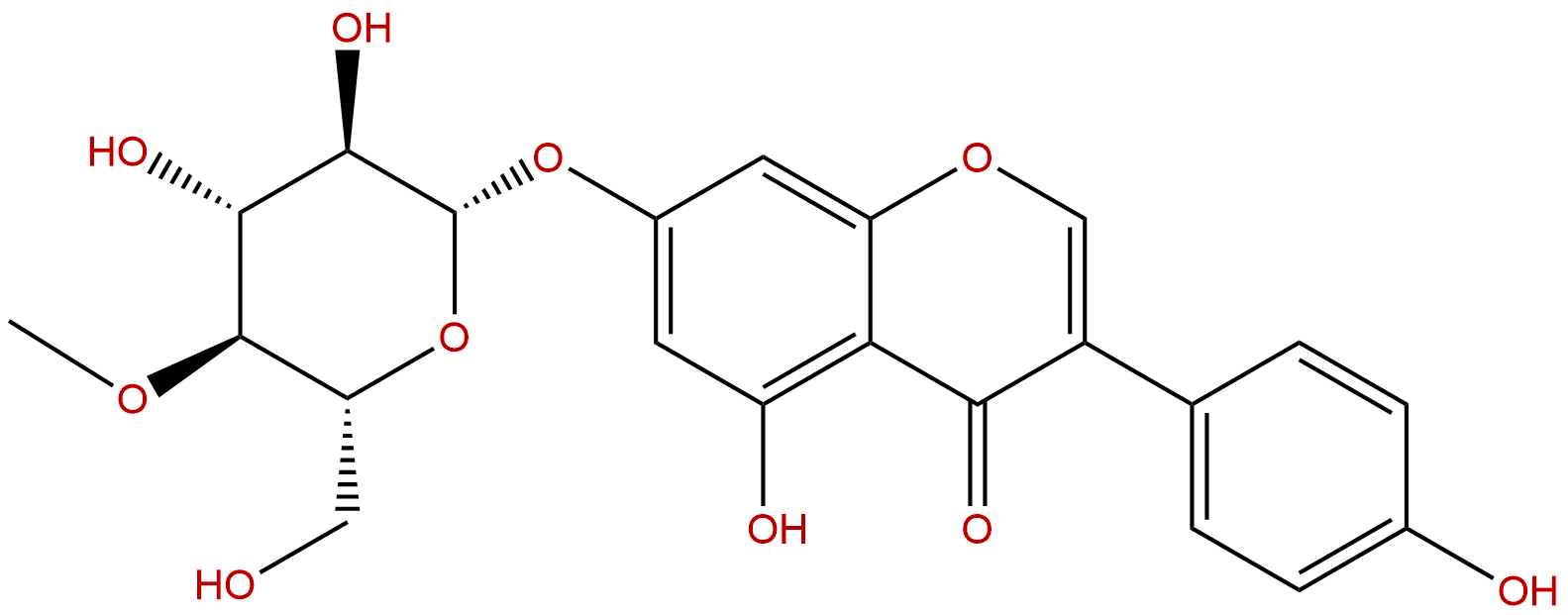


Product name: 4''-methyloxy-Genistin
Synonym name: Genistein 7-O-beta-D-glucoside-4''-O-methylate
Catalogue No.: BP1802
Cas No.: 950910-16-4
Formula: C22H22O10
Mol Weight: 446.408
Botanical Source: Citrus aurantium L.
Physical Description:
Type of Compound: Flavonoids
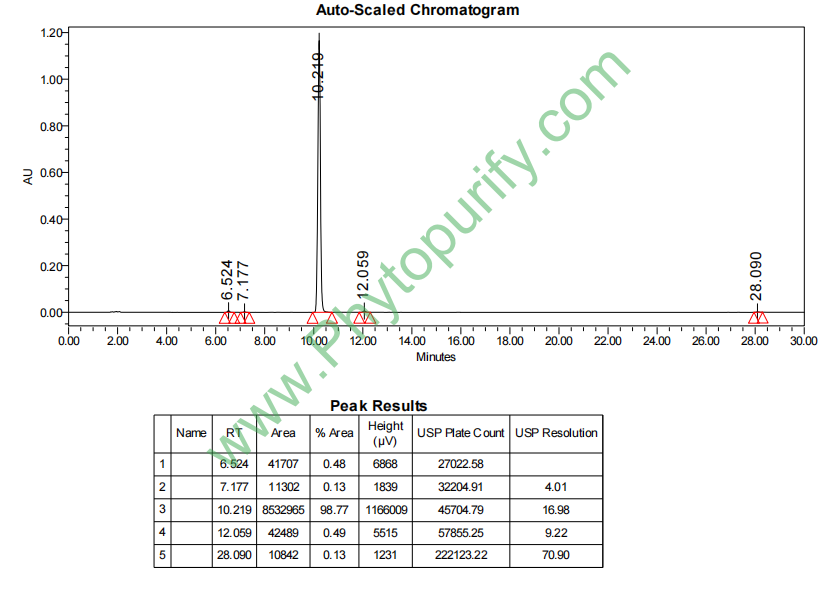
Purity: 95%~99%
Analysis Method: HPLC-DAD or/and HPLC-ELSD
Identification Method: Mass, NMR
Packing: Brown vial or HDPE plastic bottle
The product could be supplied from milligrams to grams. Inquire for bulk scale.
We provide solution to improve the water-solubility of compounds, thereby facilitating the variety of activity tests and clinic uses.
For Reference Standard and R&D, Not for Human Use Directly.
HPLC of 4''-methyloxy-Genistin
Storage conditions:Short-term storage at 2~8℃, long-term storage at -20 ~ -80℃
159.0500
.6140
.5991
1.1080
.7013
.6935
Low
84.2401
3.9247
Yes
No
No
No
Yes
No
1.2
Yes
Yes
Yes
No
Cardiovascular disease (CVD) is the leading cause of death and disability worldwide, with a complex pathogenesis involving multiple pathological processes such as inflammation, oxidative stress, endothelial dysfunction, lipid metabolism disorders, and thrombosis. Although modern medicine has made significant progress in the drug treatment of CVD, existing drugs still face issues such as side effects, drug resistance, and high costs. Therefore, finding efficient and low toxicity cardiovascular protectants from natural products has always been an important direction in drug development. Isoflavones, especially soy isoflavones, have attracted much attention due to their extensive cardiovascular benefits. 4 '' - methoxy Genistin (CAS number: 950910-16-4), as a structurally modified derivative of genistein, has shown unique potential in the field of cardiovascular protection in recent years. This article aims to systematically review the chemical properties, plant sources, pharmacological activities, mechanisms of action, pharmacological evaluation, and clinical application prospects of this compound, in order to provide comprehensive scientific basis for the in-depth research and development of this natural product.
4 '' - Methoxy dye lignan is an isoflavone glycoside compound, with the chemical name 7-hydroxy-3- (4-hydroxyphenyl) -4H-1-benzopyran-4-one-4 '' - methoxy - β - D-glucoside. Its parent nucleus structure is genistein, which is connected to a methoxy group (- OCH3) and a glucose group on the 4 '' hydroxyl group of the glycosidic ligand. This structural modification significantly altered its physicochemical properties and biological activity.
The basic physicochemical parameters are as follows: the molecular weight is 446.4080 g/mol, and the calculated lipid water partition coefficient (LogP) is 0.6140, indicating that the compound has moderate lipophilicity but overall leans towards hydrophilicity. The topologically polar surface area (TPSA) is as high as 159.050 Å ², mainly attributed to the presence of multiple hydroxyl, carbonyl, and oxygen atoms on the sugar ring in the molecule, indicating its strong hydrogen bonding ability. The water solubility value is 1.1080 (usually referring to a logS or similar scale, indicating a certain solubility in water, but not highly soluble). These properties collectively determine its absorption, distribution, and metabolic characteristics within the organism. For example, higher TPSA and polarity are usually unfavorable for passive transmembrane diffusion, which may affect its oral bioavailability. The predicted blood-brain barrier permeability is "low", which means that the compound is not easily able to enter the central nervous system. This may help reduce central nervous system side effects for drugs that mainly act on the peripheral cardiovascular system. Preliminary pharmacological screening showed that its hERG channel inhibitory activity was' no ', indicating a low risk of inducing QT interval prolongation and apical torsion ventricular tachycardia in the heart. The Ames test result is 1.2 (usually expressed as the ratio of the number of revertant mutant colonies to the control, close to 1.0 indicating no significant mutagenic signal under the conditions of this experiment), providing preliminary support for its safety.
4 '' - methoxy dye lignan is not the main isoflavone widely present in nature. It mainly exists as a methylated derivative of Genistin in specific leguminous plants, or is produced by plants under specific growth conditions or through microbial/enzymatic conversion. Previous studies have reported that in certain soybean (Glycine max) varieties, Trifolium pratense, and Pueraria lobata, which are rich in isoflavones, trace amounts of 4 '' - methoxy lignan or its analogues can be detected through high-sensitivity analytical techniques such as LC-MS/MS. In addition, it may also be an intermediate metabolite in the glycosylation and methylation modification of lignin in plants.
Due to its low natural abundance, directly extracting and isolating 4 '' - methoxy dye lignin from plants on a large scale is costly and inefficient. Therefore, the main way to obtain this compound for research at present is chemical synthesis or biotransformation Chemical synthesis methods typically start with dye lignin or dye lignin glycosides, and introduce methoxy groups at specific hydroxyl sites of the sugar group through selective protection and deprotection strategies. The biotransformation method utilizes the enzyme systems of certain fungi or bacteria, such as methyltransferases, to selectively methylate dye lignin. This method has mild conditions, good stereoselectivity, and is more in line with the concept of green chemistry. In terms of extraction and separation, if enriched from crude plant extracts rich in isoflavones, solvent extraction (such as methanol, ethanol water system), macroporous resin adsorption, and preparative high-performance liquid chromatography (HPLC) techniques are often used for purification. Structural identification relies on spectroscopic methods such as nuclear magnetic resonance (NMR, including 1H-NMR and 13C-NMR), mass spectrometry (MS), and ultraviolet spectroscopy (UV).
Numerous in vitro and in vivo studies have revealed that 4 '' - methoxy xyloside has multidimensional cardiovascular protective activity, and its strength or characteristics may differ from its parent compound xyloside due to its methoxy modification.
The cardiovascular protective effect of 4 '' - methoxy dye lignan originates from its interactions with multiple key molecular targets, forming a multi-target, networked mechanism of action.
In summary, 4 '' - methoxy xyloside forms a multi-level cardiovascular protection network by synergistically acting on multiple targets such as SELP, HMGCR, PPARG, ACE, AKT1, NOS3, ICAM1, VCAM1, etc., from improving endothelial function, regulating blood lipids and blood pressure, inhibiting inflammatory reactions to protecting myocardial cells.
Based on its physical and chemical properties and relevant predictive data, a preliminary evaluation of the pharmacological properties of 4 '' - methoxy dye lignin is conducted
At present, there are few reports on the pharmacokinetic studies of the 4 '' - methoxy dye lignin system, which is a key data gap that must be filled for its development.
4 '' - methoxy dye lignan, as a multi-target natural product derivative, has shown broad application prospects in the prevention and treatment of cardiovascular diseases
However, its development also faces challenges:① Low natural content, requiring the development of efficient and economical synthetic or biological preparation processes; ② The preclinical pharmacodynamics, pharmacokinetics, and toxicology data of the system urgently need to be improved; ③ Rigorous clinical trials need to be designed to validate its effectiveness and safety in the human body; ④ Clarify its optimal target population, dosage, and treatment course.
Future research directions should include: using computational chemistry and structural biology methods to elucidate their precise binding patterns with key targets such as PPARG and ACE; Conduct in-depth research on ADMET (absorption, distribution, metabolism, excretion, and toxicity); Establish animal models that are more closely related to human disease characteristics (such as ApoE -/- mice combined with high-fat diet) for long-term efficacy evaluation; Explore advanced drug delivery systems to overcome their bioavailability bottlenecks.
4 '' - methoxy genistein is a kind of isoflavone glycoside with unique methoxy modification. Through acting on multiple molecular targets closely related to cardiovascular diseases, such as SELP, HMGCR, PPARG, ACE, AKT1, NOS3, ICAM1, VCAM1, etc., it shows multiple pharmacological activities such as comprehensive endothelial protection, anti atherosclerosis, lipid regulation, blood pressure reduction, heart protection and antithrombotic. Its multi-target action characteristics are highly compatible with the therapeutic needs of modern cardiovascular disease complex pathological networks. Although there are challenges in terms of plant origin, medicinal properties, and especially oral absorption, its good preliminary safety and clear multi effect pharmacological mechanism make it an attractive lead compound and potential natural cardiovascular protective agent. With the continuous deepening of research on its synthesis, preparation, mechanism of action, pharmacokinetics, and clinical efficacy, 4 '' - methoxy dye lignin is expected to achieve the transformation from basic research to clinical application in the prevention and treatment of cardiovascular diseases, providing important scientific basis and candidate molecules for the development of new generation multi-target, high safety cardiovascular drugs.
