Introduction/Overview
Isoflavones, as a class of secondary metabolites widely present in leguminous plants, have attracted much attention due to their diverse biological activities. Among them, genistein and its glycoside derivatives are one of the most extensively studied groups of isoflavones. 6 '' - O-Malonylgenistin (CAS: 51011-05-3), as a form of malonylation modification of lignin, is one of the main naturally occurring isoflavone components in many leguminous plants, especially soybeans. Compared with the widely studied glycoside lignin and its glucoside (genistein), 6 '' - malonyl genistein introduces malonyl groups in its chemical structure. This modification not only significantly changes its physicochemical properties, but also may profoundly affect its bioavailability, metabolic pathways, and pharmacological activity. In recent years, with the in-depth development of natural product chemistry and molecular pharmacology, this compound has shown unique potential in the field of anti-tumor, especially in the prevention and treatment of breast cancer. Its mechanism of action involves the regulation of multiple targets such as AMPK, STAT3, BCL2, estrogen receptor beta (ESR2) and a variety of drug efflux pumps (such as ABCB1, ABCG2). This article aims to provide a systematic review of the chemical properties, plant sources, pharmacological activities, molecular mechanisms of action, and medicinal properties of 6 '' - malonyl dye lignan, in order to provide comprehensive scientific references for the in-depth research and potential drug development of this natural product.
Chemical structure and physicochemical properties
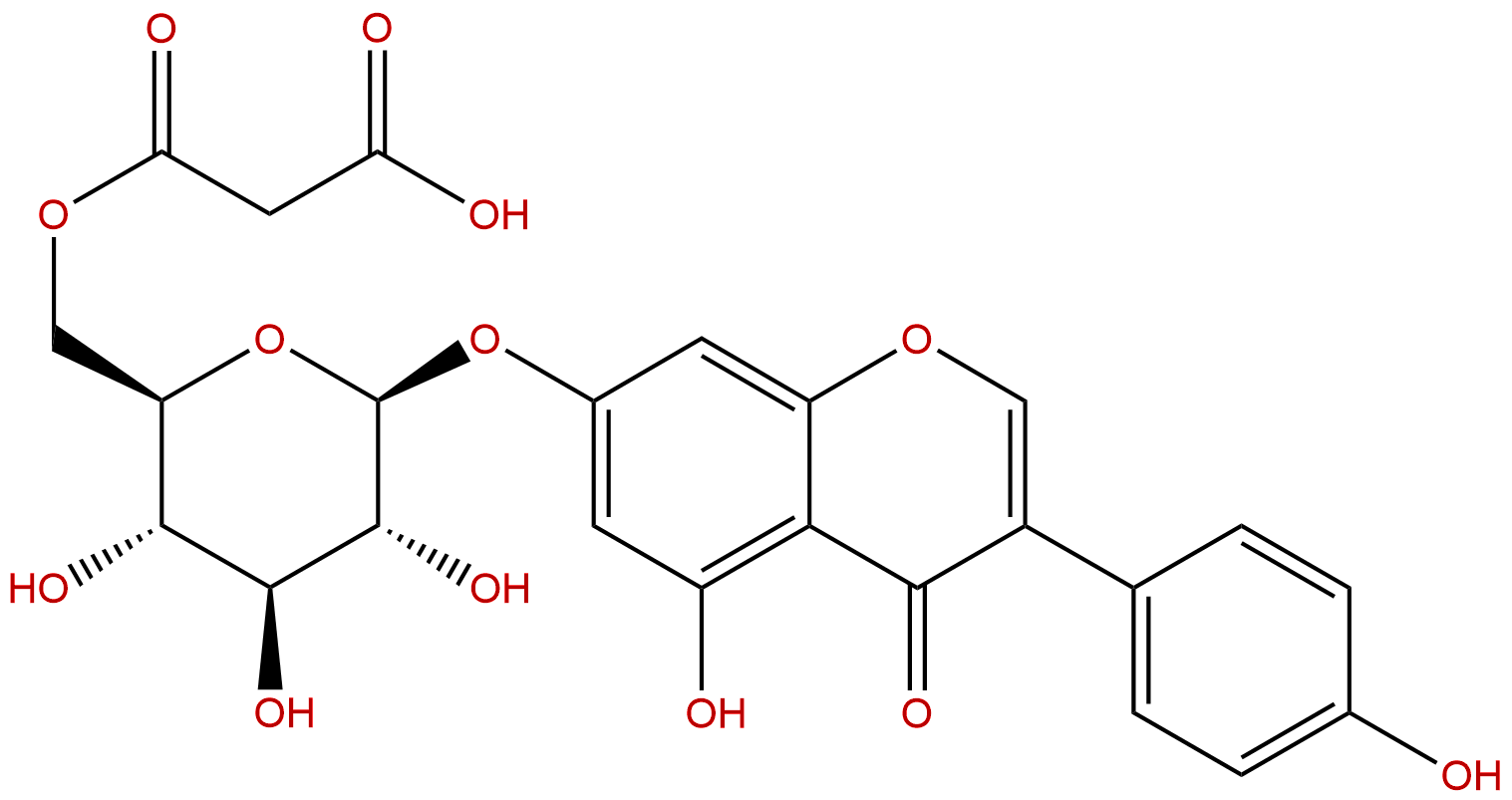
6 '' - propanedioyl genistein is a glycosylated flavonoid, and its chemical structure can be described as the 7-position hydroxyl group of genistein being linked to β - D-glucose through glycosidic bonds, and further forming ester bonds with propanedioyl on the 6 '' - position hydroxyl group of the glucose group. The system is named: 5-hydroxy-3- (4-hydroxyphenyl) -7- [(2S, 3R, 4S, 5S, 6R) -3,4,5-trihydroxy-6- [[(3-carboxypropionyl) oxy] methyl] oxahex-2-yl] oxy-4H-1-benzopyran-4-one. The molecular formula is C24H22O13 and the molecular weight is 518.4270.
The introduction of malonyl group endows the compound with unique physicochemical properties. Firstly, its lipid water partition coefficient (LogP) is 0.2538, indicating that it has relatively balanced hydrophilic and oleophilic properties. However, the strong polar carboxyl group of the malonyl group makes its overall polarity significantly higher than that of its parent dye, lignin. The topologically polar surface area (TPSA) is as high as 213.42 Å ², further confirming its high polarity characteristics. The predicted value of its water solubility is 1.8066 (usually measured in mg/mL or log mol/L, which needs to be interpreted in conjunction with specific models, but usually the larger the value, the better the solubility), indicating that it has a certain degree of solubility in water, mainly due to the multiple hydrogen bond donors and acceptors brought by the acetyl and sugar groups. However, high polarity and large TPSA also limit its ability to cross biofilms, predicting lower blood-brain barrier permeability. In terms of preliminary safety assessment, the hERG inhibition risk prediction is negative, indicating that the risk of cardiac toxicity may be low; The predicted value of Ames test is 0.6 (usually referring to the mutagenicity score, which needs to refer to the specific model threshold, but a value close to or lower than 1 usually indicates a low risk of mutagenicity), indicating that its potential genetic toxicity risk may be small. These basic pharmacological parameters provide important physical and chemical foundations for their subsequent biological activity research and development.
Plant sources and extraction methods
6 '' - malonyl dye lignan is mainly found in leguminous plants, especially abundant in soybean (Glycine max) and its products. It is one of the main storage forms of natural isoflavones in soybeans, usually coexisting with genistein, daidzein, and their malonylated and acetylated derivatives. Its content is significantly affected by soybean variety, growth environment, harvesting time, and processing technology. In unprocessed or lightly processed soybeans, the proportion of malonylated isoflavones is relatively high, and high temperature, fermentation, or alkaline treatment can easily cause the removal of malonyl groups and convert them into corresponding glucosides or aglycones.
The extraction of 6 '' - malonyl dye lignin from plant materials is usually carried out using organic solvent extraction method. Due to its high polarity, methanol, ethanol, or mixed solutions of methanol water and ethanol water are commonly used as extraction solvents. In order to maintain the stability of the malonyl group, the extraction process needs to be carried out under mild conditions, avoiding high temperatures and strong alkaline environments. The typical laboratory extraction process includes: extracting crushed soybeans or soybean meal with 70-80% ethanol solution at room temperature or low temperature (such as 40-50 ° C) using ultrasound or reflux, filtering and concentrating to obtain crude extract.
Due to the complex composition of plant extracts, further separation and purification techniques are required to obtain high-purity 6 '' - malonyl dye lignin. Column chromatography is often used, such as silica gel column chromatography, reverse phase C18 column chromatography (RP-HPLC) or Sephadex gel column chromatography (Sephadex LH-20). Among them, reverse phase high performance liquid chromatography (RP-HPLC) is one of the most effective methods for separating and identifying the compound, often using methanol water or acetonitrile water (containing a small amount of formic acid or acetic acid to inhibit ionization) as the mobile phase for gradient elution. Preparation HPLC can be used for the preparation of pure products ranging from milligrams to grams. In addition, high-speed countercurrent chromatography (HSCCC), as a liquid-liquid distribution chromatography technique, is also used for the separation and purification of natural products due to its advantages of irreversible adsorption and high recovery rate. During the extraction and purification process, it is necessary to track and monitor the purity through thin layer chromatography (TLC), high-performance liquid chromatography ultraviolet detection (HPLC-UV), or liquid chromatography-mass spectrometry (LC-MS).
Pharmacological activity research
A large number of in vitro and partially in vivo studies have shown that 6 '' - malonyl dye lignin has a wide range of pharmacological activities, especially in anti-tumor, antioxidant, and metabolic regulation, showing potential.
-
Antitumor activity This is the most highly anticipated area of activity for this compound. Studies have shown that 6 '' - malonylgenistein can inhibit the proliferation and promote apoptosis of many cancer cell lines, especially on hormone dependent and independent breast cancer cells (such as MCF-7, MDA-MB-231). Its strength of action is sometimes even better than that of its glycoside lignin, which may be related to its unique structure affecting cellular uptake and intracellular metabolism. In addition to directly inhibiting the growth of cancer cells, research also suggests that it may affect the invasion and metastasis ability of cancer cells.
-
Antioxidant and anti-inflammatory activities As a polyphenolic compound, 6 '' - malonyl dye lignin has the ability to scavenge free radicals (such as DPPH, ABTS free radicals) and exhibits antioxidant activity. Its anti-inflammatory effect is reflected in its ability to inhibit the excessive production of nitric oxide (NO) and prostaglandin E2 (PGE2) in macrophages induced by lipopolysaccharides (LPS), and downregulate the expression of inducible nitric oxide synthase (iNOS) and cyclooxygenase-2 (COX-2).
-
Metabolic regulation effect By activating the AMPK signaling pathway, this compound may be involved in regulating cellular energy metabolism, with potential benefits for improving insulin resistance and regulating lipid metabolism, providing clues for its application in metabolic syndrome related diseases.
-
Neuroprotective potential Despite its poor blood-brain barrier permeability, there are still studies exploring its potential role in neurodegenerative diseases. The mechanism may involve antioxidant, anti-inflammatory, and indirect effects on the aggregation of specific neuropathological proteins, such as tau proteins associated with MAPT.
-
Regulation of drug transporters Research has shown that 6 '' - malonyl dye lignan may act as a regulator of ABC transporters (such as ABCB1/P-gp, ABCG2/BCRP), affecting the intracellular accumulation of anticancer drugs and potentially reversing multidrug resistance in tumors.
Mechanism of action and molecular targets
The pharmacological effects of 6 '' - malonyl dye lignan are achieved by intervening in multiple cellular signaling pathways and molecular targets, forming a multi-target network. For diseases such as breast cancer, its key mechanisms and targets are as follows:
-
AMPK (PRKAA1) signaling pathway activation AMPK is a core sensor for cellular energy metabolism. 6 '' - malonyl dye lignan can activate AMPK, thereby inhibiting its downstream mammalian rapamycin target protein (mTOR) signaling pathway, leading to cell cycle arrest, reduced protein synthesis, and autophagy activation, thereby inhibiting tumor cell growth.
-
Inducing Cell Apoptosis and Regulating BCL2 Family This compound can downregulate the expression of anti apoptotic protein BCL2 and may upregulate the expression of pro apoptotic proteins (such as BAX), leading to a decrease in mitochondrial membrane potential, release of cytochrome C, and ultimately activating the caspase cascade reaction, inducing cancer cell apoptosis.
-
Inhibition of STAT3 signaling pathway STAT3 is an important transcription factor, and its sustained activation is closely related to tumor proliferation, survival, invasion, and immune escape. 6 '' - malonyl dye lignan can inhibit the phosphorylation (activation) of STAT3, suppress its nuclear translocation, and inhibit the transcription of downstream target genes (such as Cyclin D1 and Survivors), thereby exerting anti-tumor effects.
-
Regulation of estrogen receptor beta (ESR2)Similar to lignin, 6 '' - malonyl lignin has selective affinity for estrogen receptors and is more inclined to bind to ESR2 rather than ESR1. By activating ESR2, it can antagonize ESR1 mediated proliferation and activate the expression of a series of tumor suppressor related genes, which is of great significance in the prevention and treatment of hormone sensitive breast cancer.
-
Inhibition of matrix metalloproteinases (such as MMP2)MMP2 is a key enzyme that degrades the extracellular matrix and is involved in tumor invasion and metastasis. This compound can inhibit the expression and activity of MMP2, thereby reducing the invasion and migration ability of cancer cells.
-
Regulating drug transporters (ABCB1/P-gp, ABCG2/BCRP)Tumor multidrug resistance (MDR) is often associated with overexpression of ABC transporters. 6 '' - malonyl dye lignan may act as a substrate or regulator for these transporters, competitively inhibiting their efflux function, increasing the accumulation of traditional chemotherapy drugs in drug-resistant tumor cells, and restoring their sensitivity to drugs.
-
Potential effects on other targets The study also suggests that it may inhibit the activity of protein kinase C (PRKCA) and may indirectly affect tyrosinase (TYR) activity or tau protein (MAPT) pathology, but these mechanisms of action still require further research to confirm.
Evaluation of drug properties and pharmacokinetics
Although 6 '' - malonyl dye lignan exhibits good pharmacological activity, its drug like and pharmacokinetic (PK) properties are key to its successful development as a drug.
-
Absorption, Distribution, Metabolism, and Excretion (ADME):
- absorb As a highly polar glycoside complex, its oral bioavailability is expected to be low. Intestinal absorption may involve passive diffusion and active transport (such as SGLT1). More importantly, it is easily hydrolyzed by β - glucosidase and esterase in the gut microbiota and intestinal mucosal cells, removing acetyl and glucosyl groups and converting them into genistein. Therefore, the main form that enters the bloodstream after oral administration may be its metabolic product, lignin and its sulfate/glucuronic acid complex, rather than the original drug.
- distribution The prototype drug is expected to have a small distribution volume due to its high polarity and unknown but possibly high plasma protein binding rate (based on polyphenol properties), mainly distributed in blood and extracellular fluid. Its blood-brain barrier permeability prediction is low, which limits its direct effect on central nervous system diseases.
- Metabolism As mentioned earlier, hydrolysis is its main phase I metabolic pathway. The generated dye lignin subsequently undergoes extensive II binding reactions in the liver and intestines, including glucuronidation and sulfation. Propionine may also undergo metabolism.
- excretion Metabolites are mainly excreted through urine and bile.
-
Challenges and optimization strategies for drug development:
- Stability Propionyl groups are relatively unstable at physiological pH and temperature, and are particularly prone to hydrolysis in alkaline environments, posing challenges to formulation processes and in vivo delivery.
- bioavailability Low membrane permeability and first pass metabolism lead to low exposure of the prototype drug system, which is the main bottleneck in its development.
- Optimization Strategy To improve its medicinal properties, the following directions can be considered:
- Prodrug design Modification of carboxyl or hydroxyl groups to prepare lipophilic prodrugs for improved membrane permeability, which can then be converted into active forms in vivo.
- Formulation technology Using nano formulations (such as liposomes, polymer nanoparticles, solid lipid nanoparticles), microemulsions, or cyclodextrin inclusion techniques to improve their solubility, stability, and intestinal absorption, and potentially achieve targeted delivery.
- Structural modification Under the premise of retaining the core pharmacophore, minor modifications are made to the sugar or malonyl groups to balance solubility, stability, and membrane permeability.
Clinical application prospects and prospects
As a natural product with multi-target anti-tumor activity, the clinical application prospects of 6 '' - malonyl dye lignan are mainly reflected in the following aspects:
-
Chemoprevention and adjuvant therapy of breast cancer: Based on its selective activation of ESR2, inhibition of STAT3/AMPK pathway and induction of apoptosis, it is expected to be developed as a chemopreventive agent for high-risk groups of breast cancer, or as an adjuvant to traditional radiotherapy and chemotherapy, to enhance the efficacy and reduce side effects. Especially its potential to regulate ABC transporters and reverse multidrug resistance is of great value in solving clinical resistance problems.
-
Functional foods and dietary supplements As a natural ingredient in soybeans, soybean extracts rich in 6 '' - malonyl dye lignan or soy products specifically processed to retain this ingredient can be used as functional foods or dietary supplements to promote women's health, antioxidation, and regulate metabolism.
-
Combination therapy strategy Due to its multi-target nature and low expected side effects, the combination with existing chemotherapy drugs (such as doxorubicin, paclitaxel) or targeted drugs may produce synergistic effects, reduce chemotherapy drug dosage, and improve treatment index.
However, to achieve its conversion into clinical drugs, there are still many challenges and future research directions:
* In depth study on the mechanism of action More precise elucidation of its role in complex biological networks is needed, particularly in the analysis of the contributions of prototype drugs and metabolites, as well as their cross dialogue with other signaling pathways.
* Preclinical efficacy and safety evaluation of the system It is necessary to validate its in vivo anti-tumor efficacy in animal models of diseases that are closer to humans, such as human derived tumor xenograft models, and conduct comprehensive acute and subchronic toxicology studies.
* Breakthroughs in pharmacokinetics and formulation studies It is necessary to address the core issues of low bioavailability and poor stability, and develop dosage forms suitable for clinical administration.
* clinical research Ultimately, rigorous clinical trials need to be designed to evaluate its safety, tolerability, pharmacokinetic characteristics, and preliminary efficacy in humans.
Conclusion
As an important member of the soy isoflavone family, 6 '' - malonyl dye lignin exhibits unique physicochemical properties and biological activities distinct from its aglycone dye lignin due to its unique malonylation chemical structure. Its pharmacological action in anti breast cancer and other diseases, through regulating multiple key targets such as AMPK, STAT3, BCL2, ESR2 and ABC transporter, reflects the advantages of natural products in multi-component and multi target synergy. Despite facing challenges such as low bioavailability and stability in drug development, with the continuous development of modern medicinal chemistry, pharmacy, and molecular pharmacology, strategies such as prodrug design and novel delivery systems are expected to overcome these obstacles. In the future, in-depth research on 6 '' - malonyl dye lignan will not only help reveal the underlying material basis of the health benefits of soy food, but also provide valuable lead compounds and scientific basis for the development of new multi-target anti-tumor drugs or functional foods. The transformation from the dining table to clinical practice will be a vivid example of natural product pharmacology research.