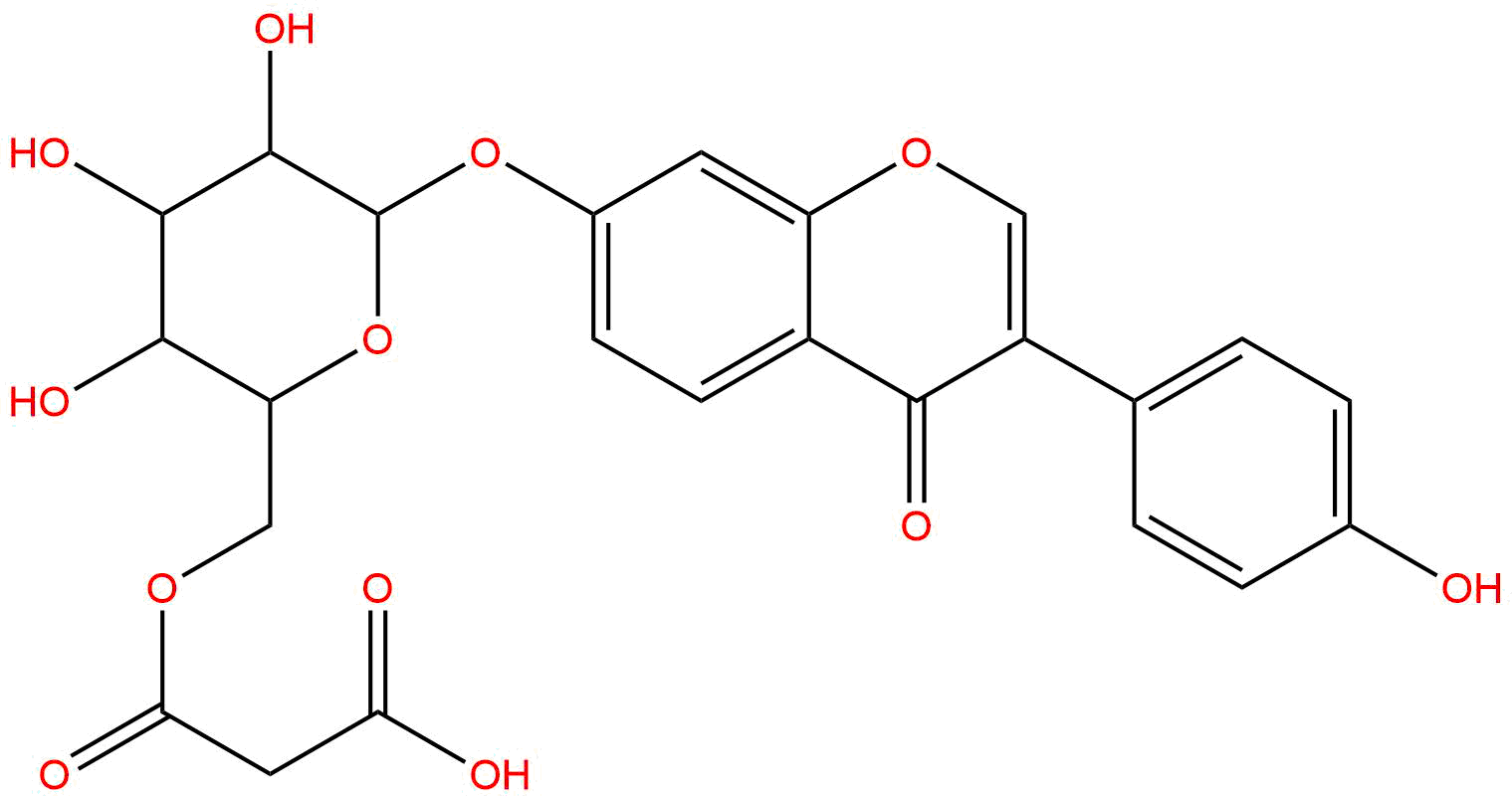


Product name: 6''-O-Malonyldaidzin
Synonym name: Malonyldaidzin;Daidzin 6''-O-malonate
Catalogue No.: BP4547
Cas No.: 124590-31-4
Formula: C24H22O12
Mol Weight: 502.428
Botanical Source:
Type of Compound: Isoflavones
Purity: 95%~99%
Analysis Method: HPLC-DAD or/and HPLC-ELSD
Identification Method: Mass, NMR
Packing: Brown vial or HDPE plastic bottle
Storage: Store in a well closed container, protected from air and light. Put into refrigerate or freeze for long term storage.
Whenever possible, you should prepare and use solutions on the same day. However, if you need to make up stock solutions in advance, we recommend that you store the solution as aliquots in tightly sealed vials at -20℃. Generally, these will be useable for up to two weeks.
The product could be supplied from milligrams to grams
Inquire for bulk scale.
For Reference Standard and R&D, Not for Human Use Directly.
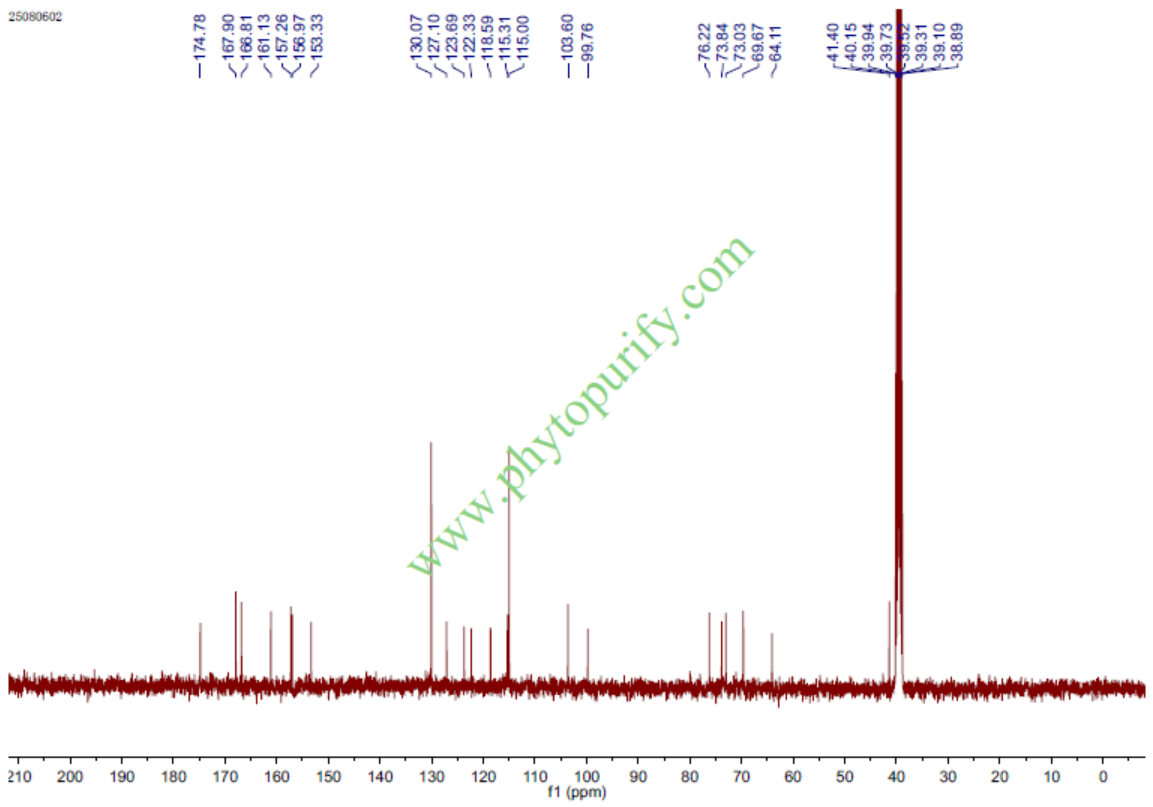
NMR of 6''-O-Malonyldaidzin
Storage conditions:Short-term storage at 2~8℃, long-term storage at -20 ~ -80℃
193.1900
.2905
-1.7495
1.6410
.5074
.1852
Low
82.0741
3.8971
Yes
No
Yes
No
Yes
No
0.6
Yes
Yes
Yes
No
Isoflavones, as a class of secondary metabolites widely present in leguminous plants, have attracted much attention due to their diverse biological activities. Among them, soy isoflavones and their derivatives have shown great potential in preventing and improving chronic diseases, especially those related to hormone metabolism. 6 '' - O-Malonyldaidzin (CAS: 124590-31-4) is a malonylated derivative of daidzin and one of the main naturally occurring forms of isoflavone glycosides in soybeans and their products. Compared to its deacetylated product Daidzein or glycosidic daidzein, 6 '' - O-malonyldaidzein is more abundant in plants, but its physicochemical properties are unstable and prone to de esterification or glycoside hydrolysis during processing, storage, or in vivo metabolism, which poses certain challenges for its research. In recent years, with the advancement of analytical techniques and the deepening of pharmacological research, the unique estrogenic regulatory activity of this compound and its potential application value in osteoporosis, menopausal syndrome, cardiovascular disease, and cancer prevention have gradually been revealed. This article aims to systematically review the chemical structure, plant origin, pharmacological activity, mechanism of action, pharmacological evaluation, and clinical application prospects of 6 '' - O-propanediol daidzein, in order to provide comprehensive scientific references for the in-depth research and development of this natural product.
The chemical name of 6 '' - O-propanediol daidzein is 7-hydroxy-3- (4-hydroxyphenyl) -4H-1-benzopyran-4-one 7-O - β - D-glucopyranosyl-6 '' - O-propanedioate. Its molecular formula is C24H22O12 and its molecular weight is 502.4280. Structurally, its parent nucleus is daidzein (7,4 '- dihydroxyisoflavone), which is connected to a β - D-glucosyl group via an O-glycosidic bond on the C-7 hydroxyl group. The 6 '' - hydroxyl group of the glucose group further undergoes esterification reaction with malonic acid to form a malonyl group (- O-CO-CH2-COO -), which is the key structural feature that distinguishes it from daidzin and acetylated daidzin.
This unique malonylation modification profoundly affects its physicochemical properties. Firstly, the introduction of malonyl groups significantly increases the polarity and water solubility of the molecule. Its topological polar surface area (TPSA) is as high as 193.19 Å ², the calculated LogP value is only 0.2905, and the predicted water solubility is 1.6410 mg/mL, indicating its good hydrophilicity, which is consistent with its storage form in plant cell vacuoles. However, the malonyl bond is highly sensitive to heat, acid, base, and enzymes such as β - glucosidase and esterase. During heating, fermentation, or gastrointestinal digestion, this compound is highly susceptible to deprotonation to produce daidzein, or further hydrolysis to produce daidzein. This instability is a key consideration factor in the fluctuation of its content in processed foods and in the study of its bioavailability in vivo. In addition, based on its molecular weight and polarity parameters, its ability to penetrate the blood-brain barrier is predicted to be low, suggesting that the direct action of the central nervous system may be limited. The preliminary in vitro safety assessment shows that the hERG channel inhibition risk is negative, and the Ames test result is 0.6 (usually considered negative if it is less than 2), indicating that its potential mutagenic risk is low and has a safety basis for further development.
6 '' - O-propanediol daidzein is mainly found in leguminous plants, especially in soybean (Glycine max) seeds where it is most abundant. It is the main storage form of natural isoflavones in soybeans, and its content is usually much higher than its corresponding non acylated glycosides (such as daidzein) and aglycones (daidzein). There are significant differences in the content of soybean among different varieties, tissue parts, and growth stages. In addition, other traditional medicinal plants such as Pueraria lobata also contain a certain amount of malonylated isoflavone glycosides.
Due to the instability of 6 '' - O-malonyldaidzein to thermal and chemical environments, mild conditions are required for its extraction, separation, and purification to avoid degradation. The conventional extraction methods include:
1. Solvent extraction method The most commonly used method is to use a 70% -80% methanol or ethanol aqueous solution for extraction or ultrasound assisted extraction at room temperature or lower temperatures (such as 4 ° C). High concentration organic solvents can effectively precipitate proteins while maximizing the extraction of polar isoflavone glycosides. Acidic solvents (such as those containing small amounts of acetic acid) are sometimes used to inhibit the oxidation of phenolic substances, but the pH needs to be strictly controlled to avoid hydrolysis of malonyl groups.
2. Solid phase extraction (SPE)The crude extract is often subjected to preliminary enrichment, desalination, and decolorization using a C18 solid-phase extraction column. Different ratios of methanol water gradient elution are used to preliminarily separate isoflavone components of different polarities.
3. Chromatographic separation technology Further purification relies on preparative high-performance liquid chromatography (HPLC). Usually, a reverse phase C18 chromatography column is used, with acetonitrile water system containing low concentrations of formic acid or acetic acid as the mobile phase for gradient elution. Operating at low temperatures and processing samples as soon as possible is key to maintaining compound integrity. In recent years, liquid-liquid distribution chromatography techniques such as high-speed countercurrent chromatography (HSCCC) have also been used to prepare high-purity malonylated isoflavones due to their advantages of avoiding irreversible adsorption and high recovery rate.
4. Identification Method: The structural identification of this compound mainly depends on the UV spectrum (UV, characteristic absorption of isoflavones), mass spectrometry (MS, especially the electrospray ionization mass spectrometry ESI-MS can provide molecular ion peaks and characteristic fragment ions, such as fragments that lose malonyl and glucose groups), and nuclear magnetic resonance (NMR, especially 1H NMR and 13C NMR, can accurately assign protons and carbon signals on sugar and malonyl groups).
A large number of in vitro and partially in vivo studies have shown that 6 '' - O-malonyldaidzein exhibits various pharmacological activities through its prototype or metabolites, with the core revolving around its estrogenic/regulatory effects.
The pharmacological effects of 6 '' - O-malonyldaidzein are mainly mediated by its metabolites, but its prototype may also be involved in some direct effects. Its core mechanism involves the coordinated regulation of multiple targets and pathways.
As a natural product, the drug like and pharmacokinetic (PK) properties of 6 '' - O-malonyldaidzein are key factors in evaluating its development potential.
Based on its extensive pharmacological activity and good safety foundation, 6 '' - O-propanediol daidzein and its natural extracts rich in it have potential application value in multiple fields.
Future prospects and research directions:
1. In depth mechanism research More research is needed to clarify whether the prototype of 6 '' - O-propanedioyl daidzein has unique biological activity independent of its hydrolysis products and its direct molecular targets.
2. Individualized nutrition and healthcare Strengthen research on the phenotypic differences between "estradiol producers" and "non producers", and develop personalized supplementation recommendations based on gut microbiota testing to improve intervention effectiveness.
3. Innovative drug delivery system As mentioned earlier, developing novel delivery systems to improve their stability, targeting, and bioavailability is key to transforming them from dietary components into drugs.
4. High quality clinical evidence Currently, most of the evidence comes from epidemiological observations, in vitro and animal experiments. It is urgent to design rigorous, large-scale, and long-term randomized controlled clinical trials (RCTs) to confirm their preventive and therapeutic effects on specific diseases, and to clarify the optimal dosage and medication cycle.
5. Re evaluation of safety Although overall safe, attention should still be paid to the potential effects on thyroid function and reproductive system development (especially during perinatal exposure) under high-dose, long-term use.
6 '' - O-propanediol daidzein, as a rich but unique natural isoflavone glycoside in soybeans, is one of the key chemical entities connecting soybean dietary consumption with various health benefits. It exerts a comprehensive pharmacological effect of multi-target estrogen regulation, antioxidant, anti-inflammatory, etc. through complex metabolic transformation, mainly in the form of its aglycone daidzein and secondary metabolite estrone, showing broad prospects in improving menopausal symptoms, maintaining bone and cardiovascular health, and preventing chronic diseases. However, its inherent chemical instability, low oral bioavailability, and significant individual metabolic differences are the main challenges that constrain its transition from "dietary components" to "standardized drugs". Future research should focus on revealing its prototype activity, innovating delivery strategies, elucidating the mechanisms of individual response differences, and verifying its efficacy and safety through solid clinical studies. With the deepening of precision nutrition and natural product drug development, 6 '' - O-propanediol daidzein is expected to play a more important role in the fields of preventive medicine and alternative therapies.
