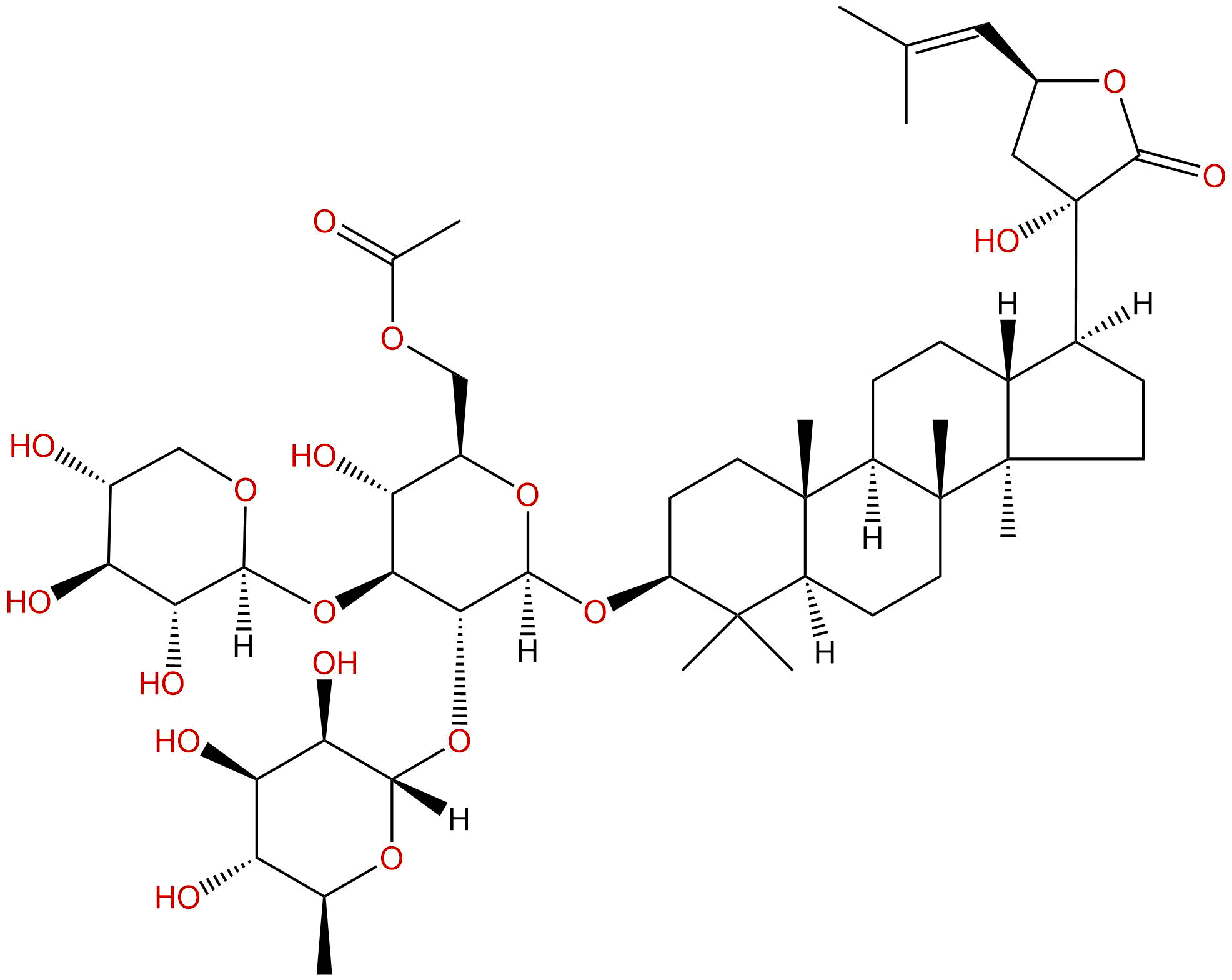


Product name: Gypenoside BP2213
Synonym name: (3β,20S,23S)-3,20,23-trihydroxydammar-24-en-21-oic acid-21,23-lactone 3-O-[α-L-rhamnopyranosyl-(1-2)]-[β-D-xylopyranosyl-(1-3)]-β-D-6-O-acetylglucopyranoside
Catalogue No.: BP2213
Cas No.: 862286-45-1
Formula: C49H78O18
Mol Weight: 955.145
Botanical Source:
Type of Compound: Triterpenoids
Purity: 95%~99%
Analysis Method: HPLC-DAD or/and HPLC-ELSD
Identification Method: Mass, NMR
Packing: Brown vial or HDPE plastic bottle
Storage: Store in a well closed container, protected from air and light. Put into refrigerate or freeze for long term storage.
Whenever possible, you should prepare and use solutions on the same day. However, if you need to make up stock solutions in advance, we recommend that you store the solution as aliquots in tightly sealed vials at -20℃. Generally, these will be useable for up to two weeks.
The product could be supplied from milligrams to grams
Inquire for bulk scale.
For Reference Standard and R&D, Not for Human Use Directly.
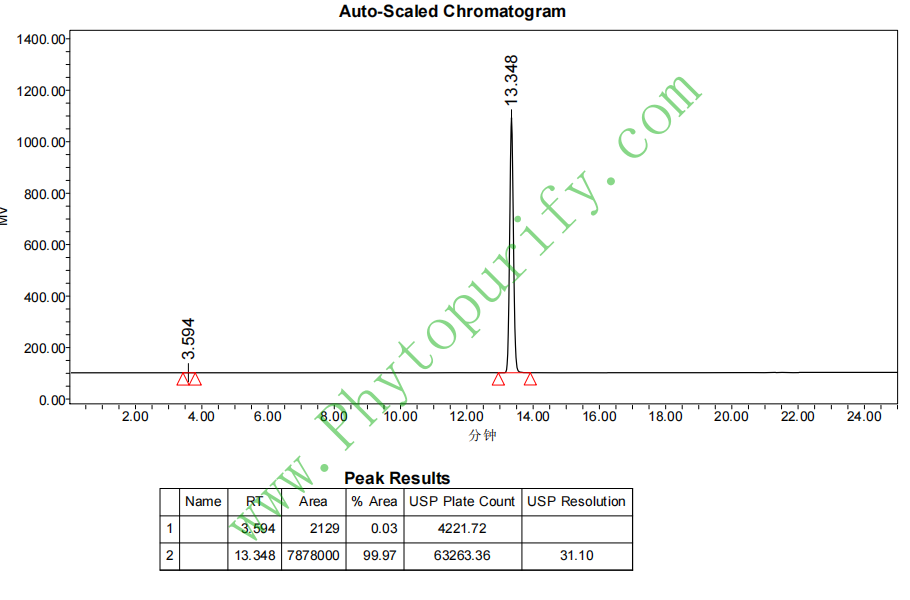
HPLC of Gypenoside BP2213
Storage conditions:Short-term storage at 2~8℃, long-term storage at -20 ~ -80℃
Gypenoside BP2213 (CAS number 862286-45-1), as an important triterpenoid saponin in Gynostemma pentaphyllum, has attracted much attention in recent years due to its multi-target and multi pathway pharmacological activities. Gynostemma pentaphyllum saponins are widely used in traditional Chinese medicine for anti-inflammatory, antioxidant, immune regulation, and anti-tumor purposes. BP2213, as a representative compound, exhibits significant anti lung cancer potential. Lung cancer is one of the malignant tumors with the highest incidence rate and mortality in the world, and its treatment still faces great challenges, especially the poor prognosis of advanced patients. BP2213 intervenes in the proliferation, apoptosis, and signaling pathways of tumor cells by regulating multiple key molecular targets, demonstrating good anti-cancer activity and safety, and has the potential to become a novel anti lung cancer drug.
This article aims to systematically review the chemical structure and physicochemical properties, plant sources and extraction methods, pharmacological activity and mechanism of action, pharmacological evaluation and pharmacokinetic characteristics of Gynostemma pentaphyllum saponin BP2213, and comprehensively analyze the research progress and future development directions of this compound in combination with its application prospects in the treatment of lung cancer.
Gynostemma pentaphyllum saponin BP2213 belongs to the pentacyclic triterpenoid saponin class, with a complex molecular formula and a molecular weight of 955.1450, indicating that it is a natural product with a relatively high molecular weight. Its structural core is a typical pentacyclic triterpenoid skeleton, connecting multiple glycosidic groups, endowing it with high polarity and multifunctional activity. The LogP value of BP2213 is 3.0023, indicating its moderate lipophilicity, which facilitates membrane penetration. However, its extremely high topological polar surface area (TPSA) of 269.82 Å ² reflects strong polarity characteristics, which may limit its oral absorption and bioavailability.
The low water solubility (0.0378 mg/mL) suggests limited solubility in aqueous media, but this can be improved to some extent through formulation processes. The low permeability of the blood-brain barrier means that BP2213 is less likely to enter the central nervous system, reducing the risk of neurological side effects. The hERG channel inhibition experiment showed a negative result, indicating a low risk of cardiac toxicity. The Ames test showed 0.0, indicating no significant mutagenicity and good safety.
In summary, Gynostemma pentaphyllum saponin BP2213 has a complex chemical structure and physicochemical properties. Although it has certain solubility and absorption limitations, its safety indicators are excellent, laying the foundation for subsequent drug development.
Gynostemma pentaphyllum saponins BP2213 mainly come from the gourd family plant Gynostemma pentaphyllum, which is widely distributed in southern China and Southeast Asia. It is traditionally used as a health supplement and traditional Chinese medicine. Gynostemma pentaphyllum contains abundant triterpenoid saponins, and BP2213, as one of the specific saponins, has a relatively low content, making extraction and purification difficult.
Common extraction methods include:
Solvent extraction Reflux extraction of dried powder of Gynostemma pentaphyllum using methanol, ethanol, or their aqueous solutions, and dissolution of saponin components using polar solvents.
Liquid liquid distribution Separate lipophilic impurities and enrich polar saponin components using organic solvents such as n-hexane and ethyl acetate.
Column chromatography separation: Silica gel, C18 reverse phase column and gel filtration column were used for fractionation and purification, and high purity BP2213 was obtained by monitoring with high performance liquid chromatography (HPLC).
Optimization of preparation process In recent years, new technologies such as ultrasound assisted extraction and microwave-assisted extraction have been introduced to improve extraction efficiency and purity, and reduce solvent consumption.
Through the above methods, researchers were able to obtain a purity of over 95% of Gynostemma pentaphyllum saponins BP2213, providing a reliable material basis for its pharmacological research.
The pharmacological activity of Gynostemma pentaphyllum saponins BP2213 mainly focuses on anti-tumor effects, especially the inhibitory effect on lung cancer. In vitro cell experiments have shown that BP2213 can significantly inhibit the proliferation of various lung cancer cell lines, induce cell cycle arrest and apoptosis. Its anti-cancer effect is closely related to regulating multiple signaling pathways.
In addition, BP2213 exhibits anti-inflammatory, antioxidant, and immunomodulatory activities, which help improve the tumor microenvironment and enhance the body's immune surveillance and clearance capabilities against tumors. Animal model studies further confirm that BP2213, when administered orally or by injection, can effectively inhibit the growth of lung cancer tumor volume, prolong the survival of experimental animals, and has no significant toxic side effects.
The specific pharmacological activities are summarized as follows:
These multiple pharmacological effects make BP2213 a powerful candidate molecule for comprehensive treatment of lung cancer.
The mechanism of action of Gynostemma pentaphyllum saponin BP2213 in lung cancer involves the synergistic regulation of multiple targets and signaling pathways. Through molecular docking, gene expression analysis, and proteomic studies, BP2213 has been confirmed to act on the following key targets:
BP2213 exhibits a complex and effective anti-cancer mechanism by inhibiting the proliferation, migration, and survival of tumor cells through the synergistic action of multiple targets mentioned above, while promoting apoptosis and immune clearance.
The pharmacological evaluation of Gynostemma pentaphyllum saponins BP2213 shows that it has certain advantages and challenges:
Pharmacokinetic studies have shown that BP2213 is slowly absorbed after oral administration, with limited bioavailability, mainly metabolized through the liver, and excreted primarily through bile. Its half-life is moderate and suitable for daily administration. In the future, new formulation technologies such as nanocarriers and liposomes are expected to significantly improve their solubility and absorption performance.
Gynostemma pentaphyllum saponin BP2213, as a natural triterpenoid saponin, has the potential to become a novel anti-tumor drug due to its significant anti lung cancer activity and good safety. At present, the research on BP2213 is still in the preclinical stage and urgently needs systematic pharmacokinetic, toxicological, and clinical trial data support.
Future research directions include:
In addition, given the multi-target nature of BP2213, its potential for application in other tumor types and chronic inflammatory diseases is also worth exploring.
Gynostemma pentaphyllum saponin BP2213, as an important triterpenoid saponin active ingredient in Gynostemma pentaphyllum, exhibits good anti lung cancer activity and safety. Its complex chemical structure, multi-target mechanism of action, and multiple pharmacological effects make it a powerful candidate for the development of natural anti-cancer drugs. Despite the challenges of drug formation such as bioavailability, with the development of modern drug formulation technology, BP2213 is expected to overcome these bottlenecks and become an important new drug in the field of lung cancer treatment.
In the future, systematic pharmacokinetic studies, mechanism exploration, and clinical validation will be key to promoting the clinical translation of BP2213. Through interdisciplinary collaboration, Gynostemma pentaphyllum saponin BP2213 is expected to bring new treatment options for lung cancer patients and promote the innovative development of natural product drugs.
