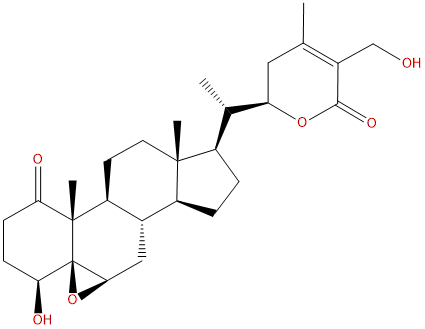


Storage conditions:Short-term storage at 2~8℃, long-term storage at -20 ~ -80℃
96.3600
3.2346
3.2349
.0214
2.7680
8.6686
High
83.0938
5.7189
No
No
No
No
Yes
No
0.0
No
No
No
No
Dihydrowithaferin A (CAS number: 5589-41-3) is a natural lactone product isolated from the traditional medicinal plant Withania somnifera. As an important medicinal herb in the Ayurvedic system of traditional Indian medicine, sleeping eggplant has been widely studied due to its various bioactive components. Dihydroquercetin A, as one of the key active ingredients, has attracted high attention in the field of pharmacology in recent years due to its significant acetylcholinesterase inhibitory activity and multi-target anti-inflammatory effects. Its unique chemical structure and good pharmacological parameters make it potentially valuable for therapeutic research in neurodegenerative diseases, chronic inflammation, and related pathological states.
This article will provide a systematic review of the chemical structure and physicochemical properties, plant sources and extraction methods, pharmacological activities, and mechanisms of action of dihydrosolanine A. The focus will be on exploring its molecular targets and signaling pathway regulation in the anti-inflammatory field. Combined with drug evaluation and pharmacokinetic characteristics, the clinical translation prospects of dihydrosolanine A will be explored, providing theoretical support for subsequent basic and applied research.
Dihydroquercetin A belongs to the typical class of sleeping eggplant lactones, with a chemical formula of C28H38O6 and a molecular weight of 472.6220. Its structural basis is the steroid skeleton, which contains a characteristic lactone ring and undergoes hydrogenation modification at positions 2 and 3, hence it is called 2,3-dihydroquinine A. This structure endows it with high lipid solubility (LogP of approximately 3.23), which facilitates penetration of cell membranes and the blood-brain barrier.
In terms of physicochemical properties, the polar surface area (TPSA) of dihydrosolanine A is 96.36 Å ², indicating its moderate polarity and facilitating binding to protein targets. Low water solubility (0.0214 mg/mL) suggests that its bioavailability may need to be improved in vivo through liposomes or other carrier systems. Importantly, dihydroquercetin A does not exhibit hERG channel inhibitory activity, reducing the risk of cardiac toxicity; The Ames test result is 0, indicating that it has no significant mutagenicity and good safety.
The steroid skeleton and lactone ring in its structure play a decisive role in its biological activity, and by modifying different sites of the structure, its pharmacological and pharmacokinetic characteristics may be further optimized.
Dihydroquercetin A is mainly isolated from the Indian medicinal plant Withania somnifera, also known as Cordyceps sinensis. Sleeping eggplant belongs to the Solanaceae family and is widely distributed in the Indian subcontinent and some parts of Asia. Its roots, leaves, and fruits all contain various bioactive steroid esters, among which dihydrosolanine A is more abundant.
Traditional extraction methods often use organic solvent extraction combined with column chromatography separation. The general process is:
1. Collect dry eggplant roots or leaves and crush them into powder.
2. Use solvents with moderate polarity such as methanol, ethanol, or ethyl acetate for reflux extraction.
3. After concentration, the extract is separated and purified using silica gel column chromatography or high-performance liquid chromatography (HPLC).
4. The structure of the pure product was identified by nuclear magnetic resonance (NMR), mass spectrometry (MS) and other methods.
In recent years, in order to improve extraction efficiency and purity, green technologies such as ultrasound assisted extraction and supercritical fluid extraction have gradually been applied to the extraction of dihydrosolanine A, balancing environmental protection and economy.
The pharmacological activities of dihydroquercetin A mainly focus on neuroprotection, anti-inflammatory, and acetylcholinesterase (AChE) inhibition. Its inhibitory effect on AChE lays the foundation for its potential application in the treatment of neurodegenerative diseases such as Alzheimer's disease (AD). Related in vitro enzymatic experiments have shown that dihydrosolanine A can effectively reduce AChE activity, delay the breakdown of acetylcholine, and improve neural transmission function.
Anti inflammatory activity is another important pharmacological characteristic of dihydrosolanine A. Multiple cell and animal model studies have confirmed that it can significantly inhibit the expression of inflammatory factors such as tumor necrosis factor alpha (TNF - α) and interleukin-6 (IL-6), and alleviate inflammatory responses. Its efficacy in chronic inflammatory diseases, neuroinflammation, and pain models is gradually being recognized.
In addition, dihydrosolanine A has shown multiple effects in regulating oxidative stress, inhibiting cell apoptosis, and neuroprotection, indicating its broad pharmacological potential.
The pharmacological mechanism of dihydroquercetin A involves multiple molecular targets and signaling pathways, especially in the field of anti-inflammatory effects. Its main targets include:
In summary, dihydrosolanine A inhibits the production and signaling of inflammatory factors, alleviates inflammatory reactions, and related pathological processes through multi-target synergistic regulation. In addition, its inhibitory effect on acetylcholinesterase provides a mechanistic basis for neuroprotection.
The development of medicinal properties is a crucial step in the clinical translation of natural products. Dihydroquercetin A exhibits excellent performance in medicinal parameters:
In terms of pharmacokinetics, although there is currently limited research on the in vivo metabolism of dihydroquercetin A, preliminary data suggests that it has good stability and half-life in vivo. Its lipophilicity and blood-brain barrier permeability support its potential as a central nervous system drug. Further research on in vivo absorption, distribution, metabolism, and excretion (ADME) is needed in the future to clarify its pharmacokinetic characteristics and metabolic pathways.
Based on the multi-target anti-inflammatory effect and acetylcholinesterase inhibitory activity of dihydroquercetin A, it has broad application prospects in the treatment of various diseases:
Future research should focus on:
-Optimize its pharmaceutical formulation to improve bioavailability and targeting.
-Thoroughly analyze its molecular mechanism of action and signal network.
-Conduct in vivo pharmacokinetic and toxicological evaluations of the system.
-Design preclinical and clinical trials to verify their safety and efficacy.
In addition, structural modification and derivative development will also provide possibilities for enhancing its efficacy and reducing potential side effects.
Dihydroquercetin A, as an important natural product of steroidal lactones in sleeping eggplant, exhibits significant acetylcholinesterase inhibition and anti-inflammatory potential due to its unique chemical structure and multi-target biological activity. Its good pharmacological parameters and safety evaluation have laid a solid foundation for clinical translation. With the in-depth analysis of its mechanism of action and the advancement of pharmacokinetic research, dihydroquercetin A is expected to become a new candidate drug for the treatment of neurodegenerative and chronic inflammatory diseases. In the future, interdisciplinary collaborative research will further promote its transition from the laboratory to clinical applications, benefiting a wide range of patients.
