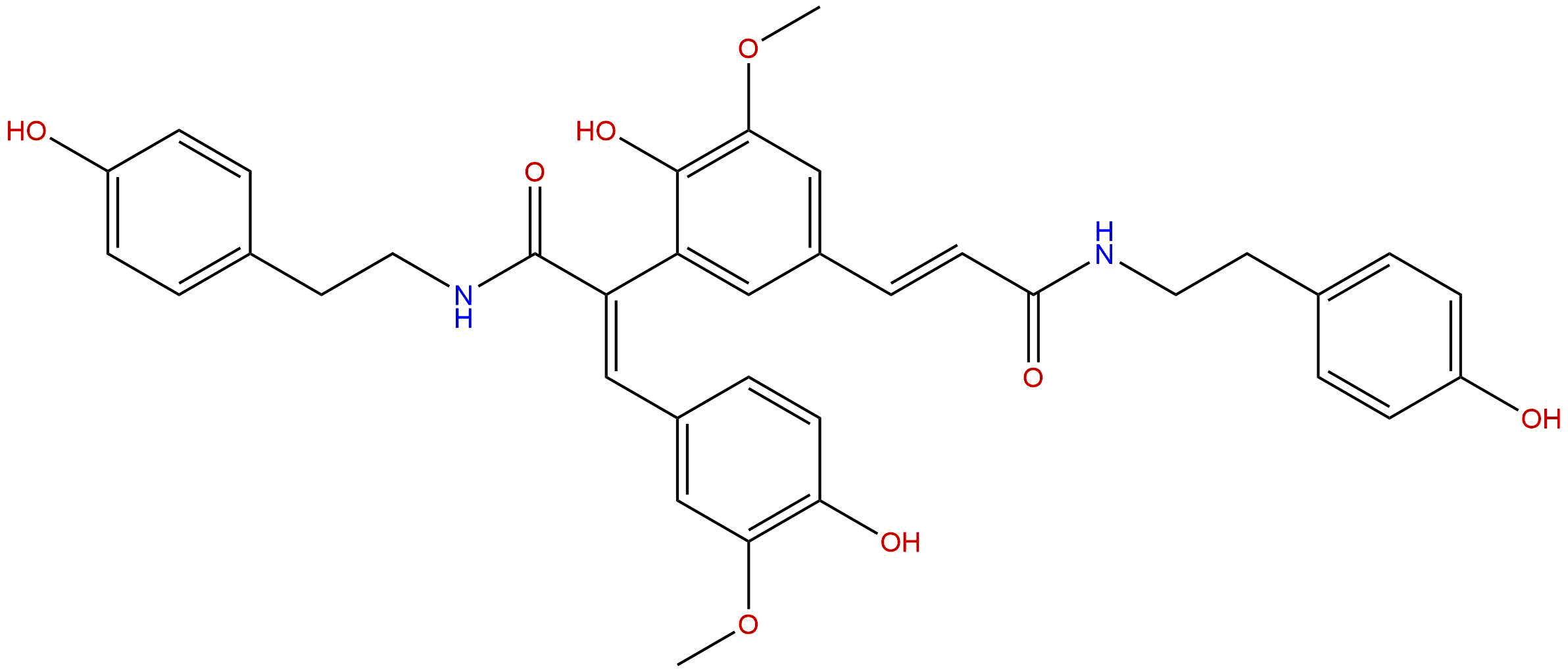


Product name: Isocannabisin F
Synonym name: (E,E)-n,n-dityramin-4,4'-dihydroxy-3,5'-dimethoxy-β,3'-bicinnamamide
Catalogue No.: BP2458
Cas No.: 879223-63-9
Formula: C36H36N2O8
Mol Weight: 624.69
Botanical Source: Ashwagandha
Type of Compound: Phenols
Purity: 95%~99%
Analysis Method: HPLC-DAD or/and HPLC-ELSD
Identification Method: Mass, NMR
Packing: Brown vial or HDPE plastic bottle
Storage: Store in a well closed container, protected from air and light. Put into refrigerate or freeze for long term storage.
Whenever possible, you should prepare and use solutions on the same day. However, if you need to make up stock solutions in advance, we recommend that you store the solution as aliquots in tightly sealed vials at -20℃. Generally, these will be useable for up to two weeks.
The product could be supplied from milligrams to grams
Inquire for bulk scale.
For Reference Standard and R&D, Not for Human Use Directly.
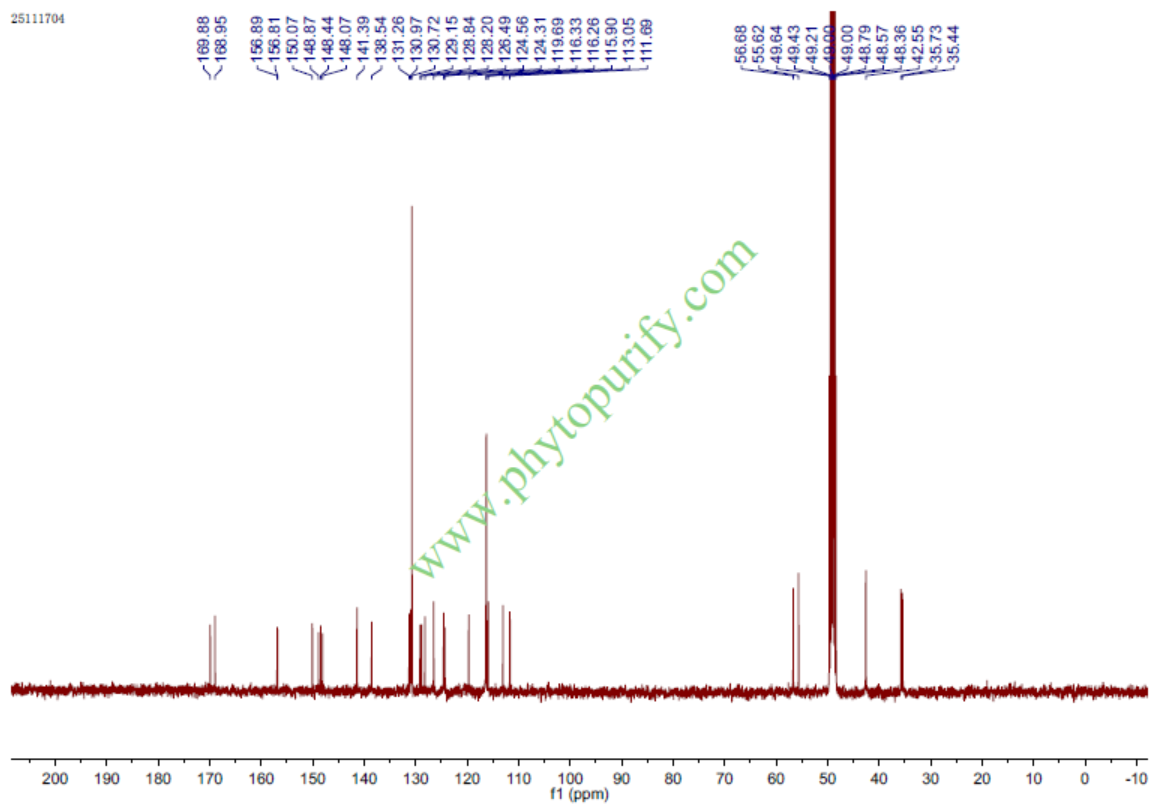
NMR of Isocannabisin F
Storage conditions:Short-term storage at 2~8℃, long-term storage at -20 ~ -80℃
Natural products, as an important source of drug discovery, play an irreplaceable role in the long history of human fight against diseases. Especially secondary metabolites derived from the plant kingdom, due to their structural diversity and unique biological activity, have always been valuable resources for innovative drug development. Among the numerous natural product families with pharmacological activities, lignan amide compounds have attracted much attention due to their significant neuroprotective, anti-inflammatory, antioxidant, and anti-tumor biological activities. Isocannabinabisin F, as a structurally unique lignan amide dimer, has gradually entered the field of researchers in recent years. This compound was initially isolated from Moraceae plants, and its chemical structure consists of two phenylpropanoid units connected by amide bonds, presenting a typical dibenzofuran type lignin skeleton. The CAS registration number for Isocannabinoid F is 879223-63-9, with a molecular weight of 596.6800 Da. This molecular weight is considered moderate to high among natural small molecule drugs, suggesting that it may have complex pharmacokinetic characteristics. Although there are relatively limited research reports on isocannabinoid F compared to other members of the same family such as the Cannabis in series compounds, existing research results indicate that this compound exhibits promising prospects in anti-inflammatory, neuroprotective, and potential anti-tumor activities. This article aims to systematically review the chemical structure, plant sources, extraction and isolation methods, pharmacological activity, mechanism of action, pharmacological evaluation, and clinical application prospects of isocannabinoid F, in order to provide comprehensive scientific basis for the in-depth research and development of this natural product.
Isocannabinabisin F belongs to the lignan amide class of compounds, and its chemical structure core is a dibenzofuran type lignan skeleton. From the perspective of structural analysis, the compound is formed by oxidative coupling of two phenylpropanoid units (C6-C3) to form a dimer, which further binds with an amide group. Specifically, its molecular skeleton contains a dihydrobenzofuran ring system, which is a common feature of many bioactive lignans. There are usually substituents such as hydroxyl and methoxy attached to two aromatic rings, and the type and position of these substituents have a significant impact on the biological activity of the compound. The molecular formula of isocannabinoid F is C ∝₄ H ∝₂ N ₂ O ₉, with an accurate molecular weight of 596.6800 Da. This molecular weight falls in the "gray zone" between small molecule drugs and biomacromolecules, typically indicating that the compound may have good target binding ability, but may also face challenges in solubility and permeability.
In terms of physicochemical properties, isocannabinoid F, as a polyphenolic compound, contains multiple phenolic hydroxyl groups in its molecule, thus exhibiting a certain degree of polarity and acidity. This compound usually exists in the form of white or light yellow amorphous powder, soluble in polar organic solvents such as methanol, ethanol, dimethyl sulfoxide, and has relatively low solubility in water. This solubility characteristic is related to the distribution of multiple aromatic rings and polar groups in its molecule. From a stability perspective, isocannabinoid F is relatively stable under acidic conditions, but may degrade in strongly alkaline environments. In addition, due to the presence of phenolic hydroxyl groups, this compound is sensitive to light and heat, and long-term exposure to ultraviolet light or high temperature environments may lead to structural changes. Therefore, in experimental research and storage processes, it is usually recommended to avoid light and store at low temperatures. It is worth noting that there are multiple chiral centers in the structure of isocannabinoid F, and its stereochemical configuration is crucial for its biological activity. The current research is mainly based on specific configurations isolated from natural sources, and the differences in activity between different configurations still need to be systematically studied. These physicochemical properties provide important foundational data for subsequent extraction, separation, activity evaluation, and drug formulation development.
Isocannabinoid F was initially isolated and identified from plants in the Moraceae family. Mulberry plants are a large plant family consisting of about 40 genera and over 1000 species, widely distributed in tropical and subtropical regions. Among them, the mulberry genus(Morus)Plants, especially mulberry trees(Morus alba L.), It is the main source of discovered isocannabinoid F. Mulberry trees are not only important economic crops, but their leaves, root bark, branches, and fruits are widely used in traditional Chinese medicine, with various effects such as clearing heat, improving vision, and lowering blood sugar. In addition, the genus Goushu(Broussonetia)Plants, such as oak trees(Broussonetia papyrifera)It has also been reported to contain isocannabinoid F. These plants have synthesized a series of defensive compounds, including lignans, through secondary metabolic pathways over a long period of evolution to cope with environmental stress and pathogen invasion.
The extraction of isocannabinoid F from plant materials usually follows the classic natural product chemical process. Firstly, grind the dried plant materials (such as mulberry bark or mulberry branches and leaves) to an appropriate particle size, and then extract them using organic solvents. Common extraction solvents include methanol, ethanol, or their aqueous solutions, which use the principle of "similar solubility" to dissolve the target compound from the plant matrix. In order to improve extraction efficiency, modern extraction techniques such as ultrasound assisted extraction, microwave-assisted extraction, or heating reflux can be used. Ultrasound assisted extraction destroys cell walls through cavitation effect, accelerates solvent permeation, and can usually be completed within 30-60 minutes, greatly reducing the time compared to traditional cold soaking methods (24-72 hours). The crude extract is obtained by filtering and concentrating the extract under reduced pressure.
Due to the generally low content of isocannabinoid F in crude extracts and the presence of a large number of other lignin amides and polyphenolic compounds with similar structures, multi-step chromatographic separation techniques are required for purification. The classic separation process includes: first, the crude extract is preliminarily classified by liquid-liquid extraction (using different polar solvents such as petroleum ether, ethyl acetate, n-butanol, etc.), and the component rich in isocannabinoid F usually appears in the medium polarity (such as ethyl acetate) extraction site. Subsequently, preliminary separation was performed using silica gel column chromatography, followed by gradient elution using mixed solvent systems such as chloroform methanol or petroleum ether acetone. For further purification, Sephadex LH-20 gel column chromatography is often used. The packing is separated according to the molecular size, which can effectively remove impurities with large differences in pigment and molecular weight. Finally, high-purity isocannabinoid F monomer was obtained by preparative high-performance liquid chromatography (Pre HPLC). The entire separation process typically requires real-time monitoring using thin-layer chromatography (TLC) and high-performance liquid chromatography (HPLC) to ensure accurate tracking of the target compound. In recent years, liquid-liquid distribution chromatography techniques such as high-speed countercurrent chromatography (HSCCC) have also been applied to the separation of lignin amide compounds, which have the advantages of high sample recovery and less irreversible adsorption. The continuous optimization of these extraction and separation methods has laid the material foundation for the large-scale preparation and subsequent in-depth research of isocannabinoid F.
Isocannabinoid F, as a structurally unique lignan amide dimer, although its pharmacological activity research is still in its infancy, existing studies have revealed its potential therapeutic value in multiple disease models. The existing evidence mainly focuses on anti-inflammatory, neuroprotective, antioxidant, and anti-tumor aspects.
In terms of anti-inflammatory activity, isocannabinoid F exhibits significant ability to inhibit the production of inflammatory mediators. In vitro cell experiments have shown that the compound can effectively inhibit the production of nitric oxide (NO) and prostaglandin E ₂ (PGE ₂) in macrophages (such as RAW264.7 cells) stimulated by lipopolysaccharide (LPS). NO and PGE ₂ are key mediators in the inflammatory response, catalyzed by inducible nitric oxide synthase (iNOS) and cyclooxygenase-2 (COX-2), respectively. Isocannabinoid F blocks the excessive production of these pro-inflammatory factors by downregulating the protein expression levels of iNOS and COX-2. In addition, the compound can also inhibit the release of classic pro-inflammatory cytokines such as tumor necrosis factor - α (TNF - α), interleukin-6 (IL-6), and interleukin-1 β (IL-1 β). These anti-inflammatory effects are concentration dependent and operate within a non-toxic concentration range, suggesting that they may achieve anti-inflammatory effects by regulating upstream signaling pathways rather than direct cytotoxicity.
The neuroprotective effect is another highly anticipated area of activity for isocannabinoid F. Oxidative stress and neuroinflammation are the core pathological mechanisms of neurodegenerative diseases such as Alzheimer's disease (AD) and Parkinson's disease (PD). Research has shown that isocannabinoid F can protect neuronal cells, such as PC12 cells or primary cortical neurons, from toxic damage induced by β - amyloid protein (A β). The abnormal aggregation and deposition of A β are characteristic pathological features of AD, and the oxidative stress and mitochondrial dysfunction caused by it are important causes of neuronal death. Isocannabinoid F alleviates oxidative damage caused by A β by clearing reactive oxygen species (ROS), increasing the activity of intracellular superoxide dismutase (SOD) and glutathione peroxidase (GSH Px). Meanwhile, the compound can also inhibit A β - induced caspase-3 activation and reduce cell apoptosis. In addition, in the glutamate induced excitotoxicity model, isocannabinoid F also exhibits a protective effect, which may be related to its regulation of calcium ion homeostasis and inhibition of glutamate receptor overactivation.
The antioxidant activity is the basis for the various pharmacological effects of isocannabinoid F. The multiple phenolic hydroxyl groups in its molecular structure are excellent hydrogen atom donors, which can directly neutralize free radicals and block lipid peroxidation chain reactions. In chemical models such as DPPH and ABTS free radical scavenging experiments, isocannabinoid F exhibits strong free radical scavenging ability. In cell models, this compound can reduce intracellular ROS levels induced by hydrogen peroxide (H ₂ O ₂) or tert butyl hydroperoxide (t-BHP), protecting cells from oxidative stress damage. This direct antioxidant activity is complementary to its indirect induction of antioxidant enzyme expression through activation of the nuclear factor E2 related factor 2 (Nrf2) signaling pathway.
In terms of anti-tumor activity, preliminary studies have shown that isocannabinoid F has a proliferative inhibitory effect on certain tumor cell lines. For example, it has certain inhibitory activity on the proliferation of human breast cancer cells (MCF-7), human liver cancer cells (HepG2) and human colon cancer cells (HT-29). Its mechanism of action may involve inducing cell cycle arrest and apoptosis. However, current research data on its anti-tumor activity is still limited and lacks validation through in vivo experiments. Compared with similar compounds that have entered clinical research, such as certain derivatives of podophyllotoxin, the anti-tumor activity of isocannabinoid F is relatively weak, but its low toxicity may make it more suitable as an adjuvant therapy or chemopreventive agent. It is worth noting that the antibacterial activity of isocannabinoid F has also been occasionally reported, but the activity spectrum is relatively narrow and mainly targets certain Gram positive bacteria. Its clinical significance still needs further evaluation.
A deep understanding of the mechanism of action and molecular targets of isoniazid F is crucial for transforming it from a natural product into a candidate drug. Based on existing pharmacological research, the mechanism of action of this compound exhibits multi-target and multi pathway characteristics, which is consistent with the mode of action of many natural polyphenolic compounds.
In terms of anti-inflammatory mechanisms, one of the core targets of isocannabinoid F is the nuclear factor kappa B (NF - κ B) signaling pathway. NF - κ B is a key transcription factor that regulates inflammatory responses and exists in the cytoplasm by binding to the inhibitory protein I κ B at rest. When stimulated by pro-inflammatory factors such as LPS and TNF - α, I κ B kinase (IKK) is activated, leading to phosphorylation and degradation of I κ B. The released NF - κ B is then translocated into the nucleus, initiating the transcription of downstream pro-inflammatory genes such as iNOS, COX-2, TNF - α, IL-6, etc. Research has shown that isocannabinoid F can effectively inhibit LPS induced phosphorylation and degradation of I κ B α, thereby blocking the nuclear translocation of NF - κ B and ultimately downregulating the expression of inflammatory mediators. In addition, the compound may also synergistically regulate inflammatory responses by inhibiting the mitogen activated protein kinase (MAPK) pathway, including phosphorylation of p38 MAPK, c-Jun N-terminal kinase (JNK), and extracellular signal regulated kinase (ERK). The activation of the MAPK pathway also participates in the production of pro-inflammatory cytokines, and the inhibitory effect of isocannabinoid F on MAPK further enhances its anti-inflammatory effect.
In terms of neuroprotective mechanisms, the targets of isoniazid F involve oxidative stress and apoptosis signaling pathways. Firstly, this compound is an effective activator of nuclear factor E2 related factor 2 (Nrf2). Nrf2 is the "main switch" of the cellular antioxidant defense system, which binds to Kelch like ECH related protein 1 (Keap1) under normal physiological conditions and is in an inhibited state. When stimulated by oxidative stress or electrophilic agents, Nrf2 dissociates from Keap1 and translocates into the nucleus, binding to antioxidant response elements (ARE) and initiating the transcription of a series of antioxidant enzyme genes (such as HO-1, NQO1, SOD, GSH Px, etc.). Isocannabinoid F enhances the antioxidant capacity of cells by promoting nuclear translocation of Nrf2, thereby protecting neurons from oxidative damage induced by A β or glutamate. Secondly, the compound can regulate mitochondrial function and apoptosis pathway. In neurons treated with A β, isocannabinoid F can inhibit the decrease of mitochondrial membrane potential, reduce the release of cytochrome c from mitochondria to the cytoplasm, and thereby inhibit the cascade activation of caspase-9 and caspase-3, blocking the mitochondrial pathway of cell apoptosis. In addition, the compound may also maintain mitochondrial homeostasis by regulating the expression of Bcl-2 family proteins (upregulating anti apoptotic protein Bcl-2 and downregulating pro apoptotic protein Bax).
In terms of anti-tumor mechanisms, although research is not yet in-depth, preliminary evidence suggests that isocannabinoid F may act by inducing cell cycle arrest and apoptosis. Specifically, this compound may block tumor cells in the G0/G1 or G2/M phase by upregulating the expression of cell cycle dependent kinase inhibitors such as p21 and p27. Meanwhile, the induced apoptosis may be related to the activation of endogenous (mitochondrial) apoptotic pathways, manifested as the activation of caspase-3 and the cleavage of PARP. It is worth noting that isocannabinoid F has low toxicity to normal cells, and this selective toxicity may be related to its regulation of abnormally activated signaling pathways (such as the PI3K/Akt/mTOR pathway) in tumor cells, but this hypothesis still needs experimental verification.
From the perspective of molecular targets, isocannabinoid F does not act on a single target, but exerts its pharmacological effects through a "multi-target" mode. Its phenolic hydroxyl structure enables it to directly react with free radicals and exert antioxidant effects; At the same time, it can interact with intracellular signaling proteins such as IKK, Nrf2/Keap1 complex, MAPK kinase, etc., to regulate gene expression. This multi-target characteristic is not only an advantage of natural products (which may produce synergistic effects and reduce drug resistance), but also a challenge for their development as drugs (difficult to identify the main target of action and increase the risk of off target effects). In the future, using techniques such as chemical proteomics, surface plasmon resonance (SPR), and cellular thermal transition analysis (CETSA), it is expected to more accurately identify the direct protein targets of isoniazid F, providing a basis for structure based drug design and optimization.
Advancing natural products from laboratory research to clinical applications, drug evaluation is an essential and critical step. The molecular weight of isocannabinoid F is 596.68 Da, which exceeds the traditional Lipinski's Rule of Five limit of molecular weight less than 500 Da. According to this rule, excessive molecular weight is usually associated with poor permeability and oral bioavailability. However, in recent years, many successfully marketed drugs, such as certain macrolides and natural product derivatives, have overcome this limitation, indicating that molecular weight is not the only factor determining drug efficacy. The molecule of isocannabinoid F contains multiple hydrogen bond donors (phenolic hydroxyl groups) and hydrogen bond acceptors (carbonyl, ether bonds), and its number of hydrogen bond donors (usually exceeding 5) and hydrogen bond acceptors (usually exceeding 10) also exceeds the recommended range of the "Five Rules", which may lead to an increase in its water solubility but a decrease in membrane permeability. The calculation of its lipid water partition coefficient (logP) is about 2.5-3.5, indicating that the compound has moderate lipophilicity, which theoretically facilitates transmembrane transport. However, the actual permeability still needs to be determined through experiments.
In terms of pharmacokinetics, there is currently very limited research on the in vivo processes of isocannabinoid F, which constitutes the main bottleneck for its pharmacological evaluation. Based on the metabolic characteristics of similar lignan amide compounds, their pharmacokinetic behavior can be preliminarily speculated. In terms of absorption, due to its large molecular weight and strong polarity, the oral absorption of isocannabinoid F may be poor, and its bioavailability may be low. The phenolic hydroxyl groups in its molecules may undergo first pass metabolism in the gastrointestinal tract, including glucuronidation and sulfation binding reactions, further reducing the amount of prototype drugs entering the systemic circulation. In terms of distribution, this compound may have a high binding rate with plasma proteins (especially albumin), which can affect its distribution volume and free drug concentration. In terms of metabolism, the liver is its main metabolic organ, which may undergo phase I metabolism (such as oxidation, reduction, hydrolysis) and phase II metabolism (such as glucuronic acid binding, sulfate binding, methylation). Especially its phenolic hydroxyl group is a common site in phase II metabolism, and the activity of metabolites is usually lower than that of the prototype drug. In terms of excretion, metabolites are mainly excreted from the body through bile and urine.
Pharmaceutical chemical modification is an important strategy to improve the pharmacokinetic properties of isoniazid F. For example, through prodrug design, acetylation or phosphorylation modification of phenolic hydroxyl groups can improve their lipid solubility and oral absorption. Alternatively, encapsulating the compound using nanoformulation technologies such as liposomes, polymer nanoparticles, and solid lipid nanoparticles can increase its solubility, protect it from metabolic degradation, prolong in vivo circulation time, and achieve targeted delivery. In addition, structural simplification is also a direction worth exploring. By retaining key pharmacophores such as dihydrobenzofuran rings and amide bonds while reducing unnecessary hydroxyl and methoxy groups, it is possible to obtain derivatives with smaller molecular weight and better permeability. It is worth noting that the toxicity data of isoniazid F is currently very lacking. Preliminary cytotoxicity experiments have shown that it has low toxicity to normal cells such as human umbilical vein endothelial cells (HUVEC) or fibroblasts, but the systematic in vivo toxicity evaluation (including acute toxicity, subchronic toxicity, and genetic toxicity) is still blank. The development of any drug candidate must be based on sufficient safety evaluation.
Overall, the main challenges facing the pharmacological properties of Isocannabinoid F include permeability issues caused by high molecular weight, first pass metabolism and low oral bioavailability caused by phenolic hydroxyl groups, and a severe lack of pharmacokinetic and toxicological data. However, its multi-target pharmacological activity, low cytotoxicity, and the safety advantage of natural product sources still have the potential for further development. Future research should focus on establishing sensitive biological sample analysis methods (such as LC-MS/MS) to determine drug concentrations in vivo; Conduct systematic pharmacokinetic and toxicological studies; Overcoming its pharmacokinetic deficiencies through structural modifications or novel formulation technologies.
Isocannabinoid F, as a natural lignan amide with multiple pharmacological activities, has clinical application prospects mainly in the fields of neurodegenerative diseases, chronic inflammatory diseases, and tumor adjuvant therapy. However, from laboratory discoveries to clinical applications, there are still many challenges and scientific issues that need to be overcome.
In the field of neurodegenerative diseases, there is currently a lack of effective disease modifying therapies for diseases such as Alzheimer's disease and Parkinson's disease. Isocannabinoid F protects neurons through multiple mechanisms of antioxidant, anti-inflammatory, and anti apoptotic effects, making it a potential candidate molecule for developing neuroprotective agents. Especially, it can activate the Nrf2 pathway and enhance the endogenous antioxidant defense system, which is highly consistent with the current hot research direction of neuroprotective drugs. If its blood-brain barrier penetration ability can be improved through formulation technology or structural modification, isocannabinoid F or its derivatives are expected to become candidate drugs for the treatment of AD or PD. In addition, in acute neurological injury models such as cerebral ischemia-reperfusion injury, the anti-inflammatory and antioxidant properties of this compound may also play a protective role.
In terms of chronic inflammatory diseases, the anti-inflammatory activity of isocannabinoid F makes it potentially applicable in diseases such as rheumatoid arthritis, inflammatory bowel disease, asthma, etc. It downregulates the mode of action of various pro-inflammatory cytokines and mediators by inhibiting the NF - κ B and MAPK pathways, which is similar to the mechanism of action of many nonsteroidal anti-inflammatory drugs (NSAIDs) and biologics, but may have lower gastrointestinal and cardiovascular side effects. However, current research is limited to in vitro cell models and lacks validation data in animal inflammation models such as collagen induced arthritis mouse models and dextran sulfate induced colitis models. Future research needs to systematically evaluate the efficacy and safety of these in vivo models.
In the field of oncology, although the direct anti-tumor activity of isocannabinoid F is relatively weak, its potential as a chemopreventive or adjuvant therapeutic drug is worth exploring. For example, in the early stages of tumor development, long-term low-dose administration may utilize its antioxidant and anti-inflammatory properties to inhibit the carcinogenic process induced by carcinogens. Alternatively, when used in combination with chemotherapy drugs, it may improve patient tolerance and quality of life by reducing oxidative stress and inflammatory reactions caused by chemotherapy (such as nephrotoxicity caused by cisplatin and cardiotoxicity caused by doxorubicin). The positioning of this' adjuvant therapy 'may be more feasible than developing it as a first-line anti-tumor drug.
Looking ahead to the future, research on isocannabinoid F should focus on the following aspects: firstly, conducting in-depth structure-activity relationship (SAR) studies. By synthesizing a series of structurally similar compounds through the system, the contribution of key structural units such as dihydrobenzofuran skeleton, amide bond, phenolic hydroxyl group, and methoxy group to activity is clarified, providing guidance for pharmaceutical chemistry optimization. Secondly, modern drug discovery technologies such as fragment based drug design (FBDD) and computer-aided drug design (CADD) are utilized to search for lead compounds with smaller molecular weights and better pharmacokinetic properties. Thirdly, establish reliable in vivo pharmacological models, especially to validate their efficacy in animal models of neurodegenerative and chronic inflammatory diseases. Fourthly, conducting systematic pharmacokinetic and toxicological studies is crucial in determining whether it can enter the preclinical development stage. Fifth, explore new drug delivery systems, such as nasal brain direct delivery systems (for neurological diseases), oral colon targeted delivery systems (for inflammatory bowel disease), etc., to overcome their pharmacokinetic barriers.
Isocannabin F, as a unique lignan amide dimer in the mulberry family, has shown unique research value in the fields of natural product chemistry and pharmacology due to its structural characteristics of a dibenzofuran skeleton and amide bond connection. This article systematically reviews the chemical structure, plant origin, extraction and isolation methods, pharmacological activity, mechanism of action, evaluation of drug properties, and clinical application prospects of the compound. Existing studies have shown that isocannabinoid F exerts pharmacological effects such as anti-inflammatory, neuroprotective, and antioxidant effects by regulating multiple signaling pathways including NF - κ B, MAPK, and Nrf2, and has shown preliminary potential in anti-tumor treatment. However, the research on this compound is still in its early stages and there are many urgent problems to be solved: its pharmacokinetic characteristics are not yet clear, there is a lack of in vivo pharmacological data, the structure-activity relationship research is not systematic enough, and the safety evaluation is almost blank. These shortcomings seriously constrain its transformation process into clinical candidate drugs. However, the multi-target and low toxicity characteristics of isocannabinoid F give it unique advantages in the treatment of neurodegenerative and chronic inflammatory diseases. In the future, through drug chemical modification, formulation technology innovation, and in-depth biological mechanism research, it is expected to overcome its drug resistance barriers and explore its true therapeutic potential. As a microcosm of the field of natural product drug development, the research process of isocannabinoid F once again confirms the classic path of discovering lead compounds from traditional medicinal plants and optimizing them into innovative drugs through modern medicinal chemistry and pharmacology methods. With the continuous advancement of analytical techniques, chemical biology, and drug design methods, it is believed that isocannabinoid F and its derivatives will eventually play their due role in human health.
