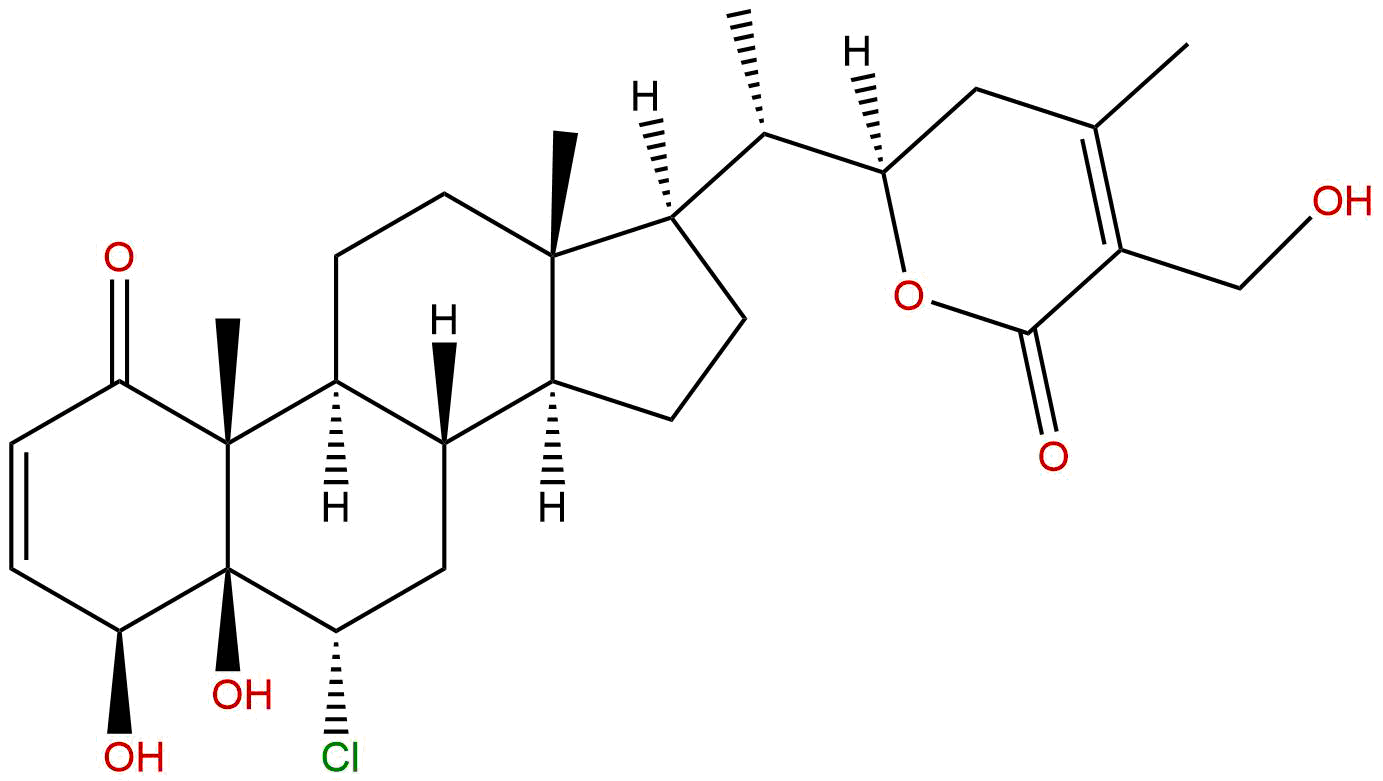


Product name: 6α-chloro-5β-hydroxywithaferin A
Synonym name:
Catalogue No.: BP5318
Cas No.: 52329-20-1
Formula: C28H39ClO6
Mol Weight: 507.064
Botanical Source: Solanum torvum Sw.
Type of Compound: Terpenoids
Purity: 95%~99%
Analysis Method: HPLC-DAD or/and HPLC-ELSD
Identification Method: Mass, NMR
Packing: Brown vial or HDPE plastic bottle
Storage: Store in a well closed container, protected from air and light. Put into refrigerate or freeze for long term storage.
Whenever possible, you should prepare and use solutions on the same day. However, if you need to make up stock solutions in advance, we recommend that you store the solution as aliquots in tightly sealed vials at -20℃. Generally, these will be useable for up to two weeks.
The product could be supplied from milligrams to grams
Inquire for bulk scale.
For Reference Standard and R&D, Not for Human Use Directly.
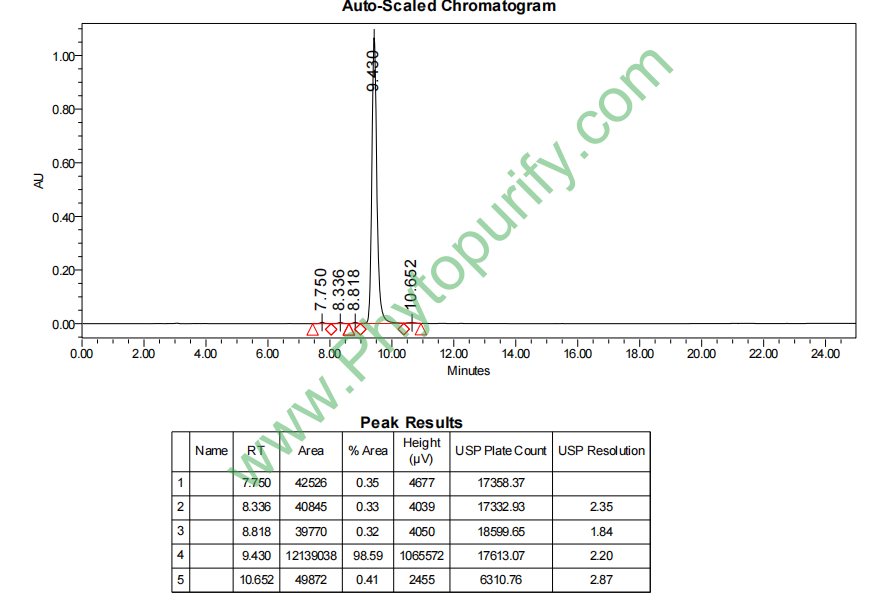
HPLC of 6α-chloro-5β-hydroxywithaferin A
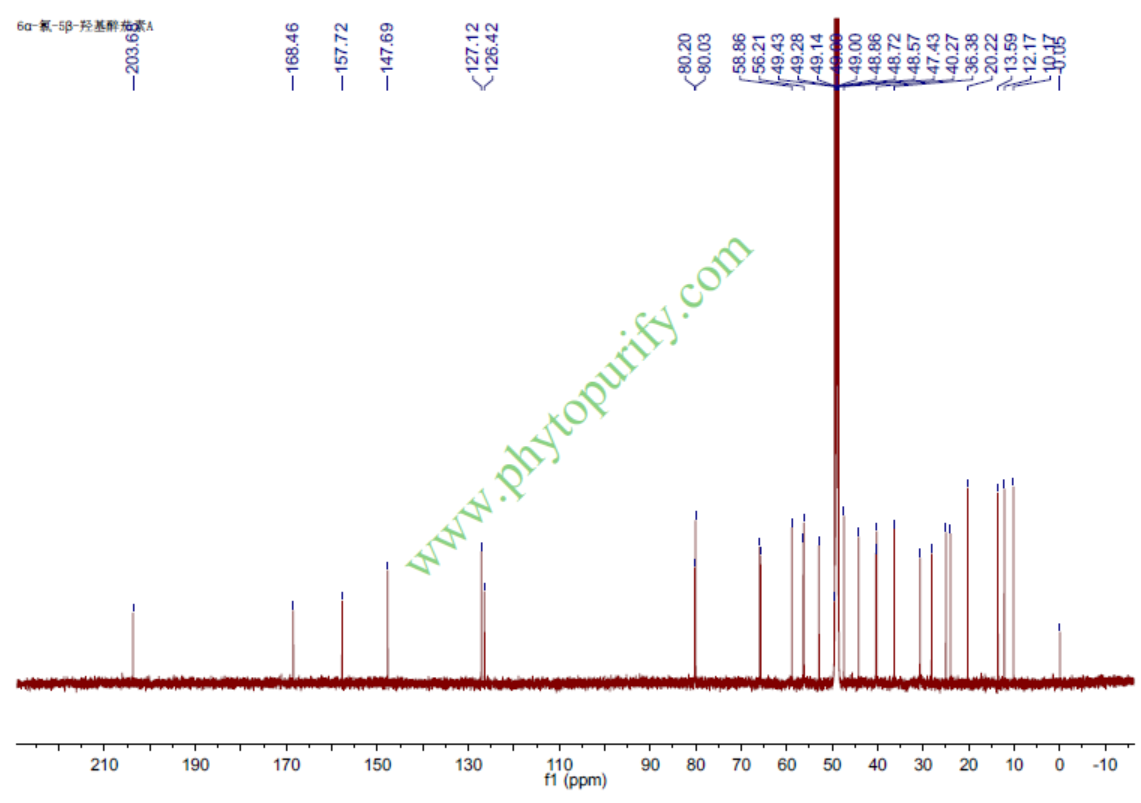
NMR of 6α-chloro-5β-hydroxywithaferin A
Storage conditions:Short-term storage at 2~8℃, long-term storage at -20 ~ -80℃
104.0600
3.4654
3.4654
.0111
2.2641
10.2278
High
88.6653
5.4199
No
No
No
No
Yes
No
0.3
Yes
No
No
Yes
Natural products, as an important source of drug discovery, play an irreplaceable role in the long struggle between humans and diseases. Among the numerous biologically active natural product families, the lactone compounds represented by Withaferin A have attracted much attention due to their novel structure and diverse activities. Drunken eggplant A is from South Africa Drunken eggplant(Withania somnifera The core active ingredient isolated from Indian ginseng, also known as winter cherry blossom, belongs to a class of C28 steroid lactones with ergosterol skeleton. Its extensive pharmacological activities, including anti-inflammatory, anti-tumor, immunomodulatory, neuroprotective, and adaptive effects, have made it a hot topic in natural product chemistry and pharmacology research.
Among the numerous derivatives of astaxanthin A, 6 α - chlorophoro-5 β - hydroxywithaferin A is a structurally unique and highly active member. This compound introduces chlorine atoms and hydroxyl functional groups into the parent nucleus of alcohol extract A, which not only changes its physicochemical properties, but also potentially endows it with a unique biological activity spectrum. Although its natural abundance is relatively low, in recent years, with the advancement of separation technology and the application of activity oriented separation strategies, 6 α - chloro-5 β - hydroxycoumarin A has gradually transformed from a "minor component" to a candidate molecule with potential development value.
Of particular note is that existing research has shown promising prospects for 6 α - chloro-5 β - hydroxyquercetin A in the field of neurological and psychiatric disorders, particularly in the area of anti anxiety. Anxiety disorder, as one of the most common mental disorders worldwide, has a complex pathogenesis involving multiple neurotransmitter systems and signaling pathways. At present, first-line clinical drugs such as benzodiazepines and selective serotonin reuptake inhibitors (SSRIs) have certain therapeutic effects, but they generally have dependence, drug resistance, and multiple side effects. Therefore, searching for anti anxiety candidate compounds with novel structures, unique mechanisms of action, and minimal side effects from natural products has become an important direction for drug development. The emergence of 6 α - chlorine-5 β - hydroxycoumarin A provides new ideas for this field. This article aims to systematically review the chemical structure, physicochemical properties, plant origin, pharmacological activity, mechanism of action, and pharmacological characteristics of the compound, in order to provide comprehensive references for subsequent basic research and drug development.
The chemical structure of 6 α - chlorine-5 β - hydroxycoumarin A belongs to the typical coumarin skeleton, with its core being ergostane type steroids and containing a δ - lactone ring (i.e. coumarin ring) on the C-17 side chain. Compared with the parent compound Zuojiaosu A, this derivative undergoes key functional group modifications on the A ring: a hydroxyl group (- OH) with a β configuration at the C-5 position and a chlorine atom (- Cl) with an α configuration at the C-6 position. This structural feature makes it unique in the family of lactones.
From the molecular formula, the precise molecular weight of 6 α - chloro-5 β - hydroxycoumarin A is 507.0670 Da, which belongs to a medium-sized steroid molecule. The multiple functional groups in its molecular structure determine its physicochemical properties. Firstly, the LogP value of 3.4654 indicates that the compound has moderate lipid solubility, which facilitates its transmembrane transport and interaction with targets in the lipid bilayer. Secondly, the topological polar surface area (TPSA) is 104.0600 Å ², which is at a moderate level, indicating that the molecule has a certain polarity and can form hydrogen bonds with biomolecules in aqueous environments, without being difficult to penetrate biofilms due to its strong polarity.
Water solubility is one of the key parameters for evaluating the pharmacological properties of compounds. The water solubility of 6 α - chlorine-5 β - hydroxycoumarin A is 0.0111 mg/mL, making it a poorly soluble compound. This characteristic is related to the hydrophobicity and limited polar groups of its steroid skeleton. Low water solubility may affect its oral bioavailability and in vivo distribution, which is a key concern in the development of subsequent formulations. However, its high lipid solubility (moderate LogP) provides favorable conditions for its passage through the blood-brain barrier (BBB). The evaluation shows that the compound has high blood-brain barrier penetration ability, which is crucial for its potential anti anxiety effect, as central nervous system (CNS) drugs must be able to effectively enter brain tissue to exert therapeutic effects.
In addition, regarding its chemical stability, the introduction of chlorine atoms usually increases the chemical inertness of the molecule, but the hydroxyl group at the C-5 position may undergo dehydration or oxidation reactions under acidic or alkaline conditions. Therefore, in the process of extraction, separation, storage, and formulation, it is necessary to control the pH value and temperature to maintain its structural integrity. Overall, the chemical structure of 6 α - chlorine-5 β - hydroxycoumarin A determines its dual lipophilicity and certain polarity. Its high BBB penetration is an important advantage as a candidate molecule for CNS drugs, while its low water solubility is the main challenge for drug development.
6 α - Chloro-5 β - Hydroxysolanine A is mainly derived from the Solanaceae family and the Solanaceae genus(Physalis)Plants, the most typical source of which is mucilage(Physalis pubescens L. ) and acid slurry(Physalis alkekengi L. var. franchetii). In addition, in the genus Solanum(Withania)Plants such as South African drunken eggplant(Withania somnifera)There are also trace discoveries in it. These plants are often used in traditional medicine to treat conditions such as inflammation, pain, anxiety, and insomnia, and 6 α - chloro-5 β - hydroxyquercetin A is considered one of the material bases for its neuropsychiatric activity.
The content of this compound in plants is usually low and belongs to the category of secondary active ingredients. Therefore, its extraction and separation require efficient and selective methods. The classic extraction process usually includes the following steps:
Raw material pretreatment Collect aboveground parts (stems, leaves) or whole plants, dry and crush them, and extract them using organic solvents. Common solvents include methanol, ethanol, or their mixed solvents, which utilize their good permeability to dissolve target compounds from plant cells.
Rough extraction and allocation Concentrate the solvent extract to obtain the total extract. Subsequently, preliminary separation was carried out using liquid-liquid distribution extraction method. Usually, solvents of different polarities such as petroleum ether, ethyl acetate, and n-butanol are used for sequential extraction to remove a large amount of lipid soluble impurities (such as chlorophyll and wax) and water-soluble impurities (such as sugars and tannins). Due to its equipolarity, 6 α - chloro-5 β - hydroxycoumarin A is mainly enriched in the ethyl acetate extraction site.
chromatographic separation This is a crucial step in obtaining pure compounds. Common chromatographic techniques include:
Structural Identification Through techniques such as nuclear magnetic resonance spectroscopy (NMR, including 1H-NMR, 13C-NMR, DEPT, HSQC, HMBC, etc.), high-resolution mass spectrometry (HR-ESI-MS), and circular dichroism (CD), combined with literature data comparison, the chemical structure, including the substitution positions and stereoconfigurations of chlorine atoms and hydroxyl groups, was finally confirmed.
It is worth noting that due to the low content of this compound in plants and its potential sensitivity to heat and light, the entire extraction and separation process should be carried out under light avoidance and low temperature conditions, and the number of operating steps should be minimized as much as possible to improve the recovery rate. In recent years, green and efficient new technologies such as supercritical fluid extraction (SFE) and high-speed countercurrent chromatography (HSCCC) have also been applied to the separation of such compounds, showing promising application prospects.
The pharmacological activity research of 6 α - chloro-5 β - hydroxycoumarin A is still in the early exploration stage, but existing evidence, especially in the study of its anti anxiety effect, reveals its enormous potential as a CNS active molecule.
The core characteristics of anxiety disorder are excessive expectations and fear of future threats, and its neurobiological basis involves multiple brain regions (such as amygdala, prefrontal cortex, hippocampus) and multiple neurotransmitter systems. Existing research has shown that 6 α - chloro-5 β - hydroxycoumarin A exhibits significant anti anxiety like effects in various classic animal anxiety models.
It is worth noting that compared with traditional benzodiazepine drugs such as diazepam, 6 α - chloro-5 β - hydroxybenzodiazepine A did not cause significant side effects such as sedation, muscle relaxation, or ataxia while producing anti anxiety effects. This suggests that its mechanism of action may differ from classical GABAA receptor positive allosteric regulation, thus having better safety.
In addition to its anti anxiety effect, based on the extensive activity of its parent nucleus, 6 α - chloro-5 β - hydroxycatechins A may also have other pharmacological effects, although relevant research is not yet sufficient.
A deep understanding of the mechanism of action of 6 α - chlorine-5 β - hydroxycoumarin A is key to its clinical application. Based on existing research, especially regarding its anti anxiety effect, this compound may exert its effects through multiple targets and pathways, which is in line with the characteristics of natural product "multi-directional pharmacology".
According to existing data, the anti anxiety effect of 6 α - chloro-5 β - hydroxycoumarin A may be closely related to the following key targets:
Monoamine oxidase A (MAOA)MAOA is a key enzyme that degrades monoamine neurotransmitters such as serotonin, norepinephrine, and dopamine. Inhibiting MAOA activity can increase the concentration of these neurotransmitters in the synaptic cleft, thereby producing antidepressant and anti anxiety effects. 6 α - Chloro-5 β - Hydroxycatechin A may act as a MAOA inhibitor to improve anxiety symptoms by increasing the availability of serotonin and norepinephrine. This is similar to the mechanism of action of SSRIs and SNRIs, but with different targets of action.
5-hydroxytryptamine transporter (SLC6A4)SLC6A4 is responsible for reuptake of serotonin released into the synaptic cleft and retrieving it from presynaptic neurons, thereby terminating their signal transduction. Inhibition of SLC6A4 is the core mechanism of SSRIs drugs. 6 α - Chloro-5 β - Hydroxyquercetin A may enhance serotonin neurotransmission by binding to SLC6A4, blocking the reuptake of serotonin. This may be another important pathway for its anti anxiety effect.
5-hydroxytryptamine receptor (HTR2A, HTR1A)Serotonin functions by acting on multiple receptor subtypes. The HTR2A receptor is closely related to anxiety, fear, and cognitive function, and its overactivation is associated with anxiety states. The activation of HTR1A receptors (especially presynaptic self receptors) can negatively feedback regulate serotonin release. 6 α - Chloro-5 β - Hydroxyquercetin A may act as an antagonist of HTR2A or an agonist/partial agonist of HTR1A, thereby finely regulating the balance of the 5-hydroxytryptamine system and producing anti anxiety effects.
Dopamine receptor D2 (DRD2)The dopamine system plays a central role in reward, motivation, and motor control, and is also associated with the regulation of anxiety. The activation or blockade of DRD2 receptors in specific brain regions can affect anxiety levels. This compound may indirectly affect anxiety states by regulating the DRD2 signaling pathway.
GABAA receptor complex (GABRA1, GABRB2, GABRG2)GABAA receptors are the main inhibitory neurotransmitter receptors in the central nervous system and are classic targets of benzodiazepines and barbiturates. Although 6 α - chlorine-5 β - hydroxycoumarin A does not produce typical benzodiazepine like side effects, it may enhance the inhibitory effect of GABA by conformational modulation of GABAA receptors (especially receptors containing α 1, β 2, and γ 2 subunits). This regulatory approach may be milder and more specific, thus avoiding excessive sedation and dependence.
CAMP response element binding protein (CREB1) and brain-derived neurotrophic factor (BDNF)CREB is a key transcription factor involved in neuronal survival, differentiation, and synaptic plasticity. BDNF is an important member of the neurotrophic factor family and is crucial for the growth, maturation, and maintenance of neurons. Under chronic stress and anxiety, BDNF expression in the hippocampus and prefrontal cortex is usually downregulated. 6 α - Chloro-5 β - Hydroxyquercetin A may promote neurogenesis and synaptic remodeling by activating CREB, upregulating BDNF expression, and repairing nerve damage caused by anxiety. This may be the molecular basis for its long-lasting anti anxiety effect.
Overall, the anti anxiety effect of 6 α - chlorine-5 β - hydroxycoumarin A does not rely on a single target, but is achieved through a "network regulation" mode. It may act on both the monoaminergic system (MAOA, SLC6A4, 5-HT receptors, DRD2) and the amino acid system (GABAA receptors) simultaneously, and consolidate its long-term effects by upregulating neurotrophic factor (BDNF). This multi-target mode of action can explain its high efficiency and may also reduce the risk of side effects caused by excessive inhibition of a single target. For example, by simultaneously inhibiting MAOA and SLC6A4, serotonin levels can be more effectively increased; By regulating GABAA receptors, excitatory neurotransmission can be balanced, avoiding anxiety or agitation that may be caused by monoamine enhancement.
To advance 6 α - chloro-5 β - hydroxycoumarin A from an active compound to a clinical candidate drug, a systematic evaluation of its drug affinity is necessary. This includes an evaluation of its pharmacokinetic (ADME) properties, safety, and physicochemical properties.
Overall, 6 α - chloro-5 β - hydroxycoumarin A has a good foundation as a candidate molecule for CNS drugs: high BBB penetration, multi-target anti anxiety mechanism, no hERG inhibition, and genotoxicity. The main pharmaceutical challenge lies in the oral absorption problem caused by low water solubility. The future directions for optimizing drug properties include:
1. Prodrug design Esterify or phosphorylate the hydroxyl group at position C-5 or the hydroxyl group on the lactone ring to improve water solubility, and release the original drug after enzymatic hydrolysis in vivo.
2. Formulation development Adopting modern formulation technologies such as nanocrystals, liposomes, and self microemulsion delivery systems to improve their solubility and bioavailability.
3. structural optimization On the basis of maintaining the core pharmacophore, water-soluble groups (such as amino, carboxyl, phosphate) are introduced to synthesize a series of derivatives, and candidate compounds with better activity and pharmacokinetic properties are screened.
As a structurally novel natural product, the clinical application prospects of 6 α - chlorine-5 β - hydroxycoumarin A mainly focus on the treatment of neurological and psychiatric disorders, especially anxiety disorders.
Despite its promising future, this compound still has a long way to go before it can be clinically applied.
6 α - Chloro-5 β - Hydroxysolanine A, a natural product derived from traditional medicinal plants, provides valuable lead compounds for modern drug discovery due to its unique chemical structure and remarkable anti anxiety activity. It cleverly regulates the excitatory inhibitory balance of the central nervous system through a multi-target and multi pathway mode of action, and demonstrates the advantages of high efficiency and low side effects in animal models. Its high blood-brain barrier penetration, good cardiac safety (without hERG inhibition), and genotoxicity negative results further highlight its potential as a candidate molecule for CNS drugs.
However, the road from laboratory to clinical translation is not smooth. The oral absorption challenge brought by low water solubility, as well as the unknown precise mechanism of action and long-term safety, are all urgent difficulties that need to be overcome. Future research requires collaborative efforts from multiple disciplines such as chemistry, pharmacology, pharmacy, and toxicology to fully unleash the potential of this natural product through structural optimization, formulation innovation, and in-depth mechanism research.
In today's increasingly severe global health problem of anxiety disorders, the emergence of 6 α - chloro-5 β - hydroxycoumarin A undoubtedly brings new hope for the development of a new generation of safer and more effective anti anxiety drugs. It is not only a pearl in the treasure trove of natural product chemistry, but also a bridge connecting traditional medical wisdom with modern precision medicine. We have reason to believe that with further research, this compound or its derivatives will eventually occupy a place in the treatment of neurological and psychiatric disorders in the future.
