


Synonym name: Soyasapogenol M2
Catalogue No.: BP1329
Cas No.: 595-15-3
Formula: C30H50O3
Mol Weight: 458.727
Botanical Source: soya bean saponin, Medicago, Astragalus, Trifolium spp. and Streptomyces sp.
Purity: 95%~99%
Analysis Method: HPLC-DAD or/and HPLC-ELSD
Identification Method: Mass, NMR
Packing: Brown vial or HDPE plastic bottle
Can be supplied from milligrams to grams.
For Reference Standard and R&D, Not for Human Use Directly.
Inquire for bulk scale.
Description:
Soyasapogenol B has anti-cancer, hypocholesterolemic, anticomplementary, hepatoprotective effects, it inhibits proliferation of cultured Hep-G2.
References:
Biol Pharm Bull. 2003 Sep;26(9):1357-60.
Hepatoprotective constituents in plants. 14. Effects of soyasapogenol B, sophoradiol, and their glucuronides on the cytotoxicity of tert-butyl hydroperoxide to HepG2 cells.
The effects of Soyasapogenol B, sophoradiol, their glucuronides, and glycyrrhizin on the hepatotoxicity of tert-butyl hydroperoxide (t-BuOOH) in a human-liver-derived cell line (HepG2 cells) were investigated.
METHODS AND RESULTS:
Glycyrrhizin showed significant dose-dependent protective effects against the cytotoxicity of t-BuOOH. Among Soyasapogenol B and its glucuronides, the monoglucuronide showed the most potent hepatoprotective activity, followed by Soyasapogenol B itself. Soyasaponin III was weakly protective, while soyasaponin I increased the toxicity of t-BuOOH. Among sophoradiol and its glucuronides, sophoradiol itself showed the most potent hepatoprotective activity, which was equal to glycyrrhizin, while the monoglucuronide and kaikasaponin III showed an increase in cytotoxicity. These results were considerably different from those reported previously on the protective effects of these compounds using primary cultures of immunologically injured rat liver cells.
CONCLUSIONS:
Consequently, the hepatoprotective action of the triterpene derivatives investigated would be different in HepG2 cells and in rat primary hepatocyte cultures.
J Agric Food Chem. 2008 Apr 23;56(8):2603-8.
Effect of soyasapogenol A and soyasapogenol B concentrated extracts on HEP-G2 cell proliferation and apoptosis.
The growth inhibition and the induction of apoptosis brought about by soyasaponins extracted from soy flour ( Glycine max (L.)) and concentrated for soyasapogenols A and B formed by hydrolysis were tested for cytoactivity in the human hepatocellular carcinoma cell line Hep-G2.
METHODS AND RESULTS:
Concentrated soyasapogenol A (SG-A) and Soyasapogenol B (SG-B) extracts contained approximately 69.3% and 46.2% of their respective aglycones (soyasapogenols) assessed by HPLC and ESI-MS, while the soyasaponin extract (TS), derived from crude methanol extraction, did not contain any detectable amounts of SG-A or SG-B. An MTT viability assay showed that all three extracts had an effect on Hep-G2 proliferation in a dose-response manner with 72 h LC50 values of 0.594+/-0.021 mg/mL for TS, 0.052+/-0.011 mg/mL for SG-A, and 0.128+/-0.005 mg/mL for SG-B. Apoptotic cells were determined by flow cytometry cell cycle analysis and confocal laser scanning microscopy (CLSM). Cell cycle analysis indicated a significant ( P< 0.05) greater sub-G1 buildup of apoptotic cells at 24 h (25.63+/-2.1%) and 72 h (47.1+/-3.5%) for the SG-A extract compared to SG-B, whereas the TS extract produced only a minor buildup of sub-G1 cells. CLSM confirmed a morphological change of all treatments after 24 h, at the respective LC50 concentrations.
CONCLUSIONS:
These results show that the samples that contained mainly soyasapogenols A and B showed a greater ability to inhibit proliferation of cultured Hep-G2 when compared to a total soyasaponin extract that did not contain any soyasapogenols.
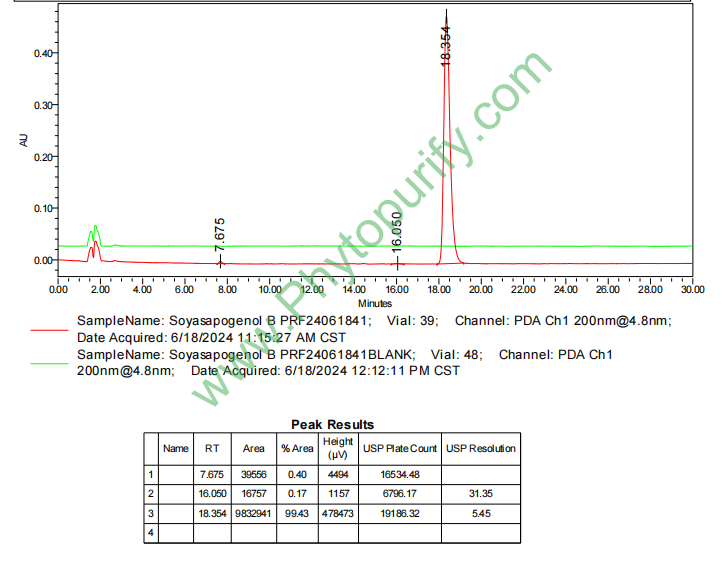
HPLC of Soyasapogenol B
Storage conditions:Short-term storage at 2~8℃, long-term storage at -20 ~ -80℃
60.6900
5.8659
5.8659
.0005
5.7949
6.9362
High
89.5716
4.8767
No
No
No
No
No
No
0.0
Yes
No
Yes
No
Cardiovascular disease (CVD) is the leading cause of death worldwide, and dyslipidemia, especially hypercholesterolemia, is one of its core risk factors. Although lipid-lowering drugs such as statins have been widely used, some patients still suffer from intolerance, inadequate response, or residual cardiovascular risks. Therefore, the development of new, safe, and effective lipid-lowering drugs or functional food ingredients remains a current research hotspot. In this context, natural products derived from traditional foods have attracted much attention due to their multi-target, multi pathway effects and good safety. Soyasapogenol B (SS-B), as an important bioactive substance in soybeans - the glycoside of soybean saponins, has gradually become a research focus in the field of natural product pharmacology in recent years due to its extensive pharmacological activity, especially its outstanding potential in regulating lipid metabolism. This article aims to systematically review the chemical properties, plant sources, pharmacological activities, especially the molecular mechanism and pharmacological evaluation of the lipid-lowering effect of soybean saponin B, and prospects its clinical application prospects, in order to provide comprehensive scientific references for the in-depth research and development of this compound.
Soybean sapogenin B (CAS number: 595-15-3) is a pentacyclic triterpenoid compound with the chemical names Qideng-12-en-3 β, 21 β, 22 β, 24 tetraol. Its molecular formula is C30H50O4 and its molecular weight is 458.7270. Its core structure is an oleanane type pentacyclic triterpenoid skeleton, with one hydroxyl group substituted at positions C-3, C-21, C-22, and C-24. The hydroxyl groups at positions C-21 and C-22 are in the cis configuration, which is the key distinguishing feature from other sapogenins (such as soybean saponin A).
From the analysis of parameters related to drug properties, the lipid water partition coefficient (LogP) of soybean saponin B is 5.8659, indicating its high lipophilicity. Its topological polar surface area (TPSA) is 60.6900 Å ², which is relatively small. The water solubility is extremely low, about 0.0005 mg/mL, mainly due to its hydrophobic triterpenoid skeleton. The characteristics of high lipophilicity and low water solubility determine its poor solubility in conventional aqueous media, which may affect its oral bioavailability. Therefore, formulation techniques such as nanoemulsions, liposomes, cyclodextrin inclusion complexes, etc. are usually needed to improve it. It is worth noting that its blood-brain barrier permeability is predicted to be "high", indicating its potential for central nervous system effects, but specific central effects need to be experimentally verified. On early safety indicators, hERG inhibition was predicted as' no ', indicating a low potential risk of cardiac toxicity; The Ames test predicted a value of 0.0, indicating that it may not be mutagenic and preliminarily demonstrating good safety characteristics.
Soybean saponin B is mainly derived from leguminous plants, especially soybeans(Glycine max (L.) Merr. and its processed products. In soybeans, it does not exist in large quantities in the form of free aglycones, but rather as the aglycone part of saponins (such as soybean saponins Bb, Bc, Bd, etc.), which are connected to glycosides such as glucuronic acid, galactose, arabinose through sugar chains. These saponins are mainly enriched in the cotyledons and hypocotyls of soybeans.
Its extraction and preparation usually involve two steps: first, extracting soybean saponins from soybean raw materials, and then hydrolyzing the saponins into aglycones. Extraction methods include traditional solvent extraction methods (commonly methanol, ethanol, or aqueous ethanol), as well as modern technologies such as ultrasound assisted extraction, microwave-assisted extraction, and supercritical fluid extraction, which can improve extraction efficiency and purity. After obtaining the crude extract of soybean saponins, the glycosidic bond is cleaved by acid hydrolysis (usually hydrochloric acid or sulfuric acid) or enzymatic hydrolysis (such as β - glucosidase) to release soybean saponin B. The hydrolyzed product is purified by organic solvent extraction (such as ethyl acetate, chloroform), column chromatography (silica gel, reverse phase C18, etc.) separation, and recrystallization to obtain high-purity compounds. In recent years, microbial transformation and synthetic biology methods have also provided new ideas for large-scale preparation.
A large number of in vitro and in vivo studies have shown that daidzein B has diverse pharmacological activities, making it potential for the prevention and treatment of various diseases.
Hypolipidemic activity This is one of the most highly regarded activities of daidzein B. Multiple animal experiments have confirmed that administering soybean saponin B to high-fat diet induced hyperlipidemia model rats or mice can significantly reduce serum total cholesterol (TC), triglycerides (TG), and low-density lipoprotein cholesterol (LDL-C) levels, while increasing high-density lipoprotein cholesterol (HDL-C) levels. Its effect is comparable to or has a synergistic effect with positive drugs such as simvastatin.
Antitumor activity: Research shows that daidzein B has proliferation inhibition and apoptosis promoting effects on many cancer cell lines (such as liver cancer, breast cancer, colon cancer, lung cancer, etc.). The mechanism involves inducing cell cycle arrest, activating the mitochondrial apoptosis pathway, and as mentioned in the description Promote cellular autophagy Autophagy is a double-edged sword, as it may inhibit tumors in the early stages of development, while in specific contexts, excessive autophagy may co induce apoptosis and lead to cell death.
Anti inflammatory and antioxidant activity Soy saponin B can inhibit the production of nitric oxide (NO), prostaglandin E2 (PGE2), and pro-inflammatory cytokines (such as TNF - α, IL-6, IL-1 β) in macrophages stimulated by lipopolysaccharides (LPS) and other factors. Its antioxidant effect is reflected in clearing free radicals, increasing the activity of endogenous antioxidant enzymes such as superoxide dismutase (SOD) and glutathione peroxidase (GSH Px), and reducing oxidative stress damage.
Other activities In addition, research suggests that it has potential benefits such as liver protection (against liver damage caused by alcohol or chemicals), anti osteoporosis, and improvement of insulin resistance.
The lipid-lowering effect of soybean saponin B is the core of its pharmacological research, and its mechanism is complex, involving the regulation of multiple key lipid metabolism targets, showing the characteristic of multi pathway synergy:
Inhibit cholesterol synthesis Hydroxymethylglutaryl-CoA reductase (HMGCR) is the rate limiting enzyme for cholesterol synthesis in the body and a classic target for statins. Research has shown that soybean saponin B can downregulate the gene expression or activity of HMGCR, thereby reducing the synthesis of endogenous cholesterol.
Promote the expression and function of low-density lipoprotein receptor (LDLR)LDLR is the main pathway for clearing LDL-C from the loop. Soy saponin B can upregulate the expression of LDLR in liver cells, accelerating the uptake and clearance of LDL-C. It is worth noting that the pre protein converting enzyme subtilisin 9 (PCSK9) is a key negative regulatory factor for the degradation of LDLR. There is evidence to suggest that daidzein B may indirectly stabilize and increase LDLR protein levels by inhibiting the expression or activity of PCSK9, which is an important lipid-lowering pathway beyond statins.
Regulating apolipoprotein metabolism Apolipoprotein B (APOB) is the main structural protein of LDL and very low density lipoprotein (VLDL), and its level is positively related to the risk of atherosclerosis. Soy saponin B may reduce the synthesis of APOB or promote its clearance. Meanwhile, it may affect the expression of apolipoprotein E (APOE), which plays a crucial role in the clearance of chylomicrons and VLDL residues.
Activate nuclear receptor PPAR αPeroxisome proliferator activated receptor alpha (PPARA) is a core transcription factor that regulates fatty acid oxidation and lipoprotein metabolism. Soy saponin B may act as an agonist of PPAR α, upregulating fatty acid β - oxidation related genes upon activation, reducing plasma TG levels, and potentially increasing HDL-C.
Affects cholesterol ester transfer protein (CETP)CETP promotes the transfer of cholesterol esters from HDL to LDL/VLDL, while inhibiting CETP activity helps to increase HDL-C and decrease LDL-C. Some studies suggest that soybean saponin B may have the potential to inhibit CETP activity.
Cross regulation of autophagy and apoptosis In terms of anti-tumor effects, there is a cross-talk between autophagy and apoptosis induced by it. It may lead to tumor cell death by regulating signaling pathways such as PI3K/Akt/mTOR and MAPK, while activating autophagosomes and apoptosis related proteins (such as LC3-II, Beclin-1, caspase-3, Bax/Bcl-2, etc.).
Although the pharmacological activity of soybean saponin B is clear, its pharmacological development still faces challenges, mainly due to its poor solubility and potentially unsatisfactory pharmacokinetic properties.
Absorption, distribution, metabolism, excretion (ADME)Current pharmacokinetic studies are relatively limited. Due to its high lipophilicity, it may be absorbed through passive diffusion in the intestine after oral administration, but its extremely low water solubility severely limits its dissolution in gastrointestinal fluids, becoming the rate limiting step of absorption, and it is expected to have low oral bioavailability. After absorption, due to its high LogP value and high blood-brain barrier permeability prediction, it may accumulate in adipose tissue and enter the central nervous system. As a triterpenoid compound, its metabolism may mainly occur in the liver, undergoing phase I (such as hydroxylation and oxidation of cytochrome P450 enzymes) and phase II (such as glucuronidation and sulfation) metabolic reactions, generating more polar metabolites that are excreted through bile or urine. The specific half-life and tissue distribution characteristics of its prototype drug and metabolites need to be further elucidated through in vivo pharmacokinetic studies.
Formulation strategy To overcome the problem of poor water solubility and improve bioavailability, researchers are exploring various advanced drug delivery systems. For example: ① Nanoformulations: such as preparing soy saponin B nanocrystals, solid lipid nanoparticles, and polymer nanoparticles, improving dissolution and absorption by reducing particle size and increasing specific surface area. ② Lipid systems, such as self microemulsions and liposomes, utilize lipid carriers to promote their absorption in the lymphatic system and avoid first pass effects. ③ Cyclodextrin inclusion technology: utilizing the cavity structure of cyclodextrin to encapsulate drug molecules, significantly improving their water solubility and stability.
Preliminary evaluation of safety Based on the provided predictive data (no hERG inhibition, no Ames mutagenicity) and the long-term consumption history of traditional soy foods, soybean saponin B may have a good safety basis at conventional doses. However, comprehensive preclinical safety evaluation, including acute toxicity, chronic toxicity, reproductive toxicity, etc., is still an indispensable link in its conversion to drugs.
The clinical application prospects of soybean saponin B are broad, but the pathway is clear and needs to be gradual.
As a dietary supplement/functional food ingredient This is the closest conversion path to implementation. Based on its clear lipid-lowering, antioxidant activity, and safety awareness derived from food, specific functional foods or dietary supplements can be developed for the maintenance of blood lipid abnormalities and cardiovascular health. It is necessary to optimize its formula and dosage form to ensure stability and bioavailability.
As a prescription drug development This is a more challenging but also more valuable path. Future research should focus on: ① Deep exploration of mechanisms Using omics techniques (transcriptome, proteome, metabolome) to comprehensively reveal its network mechanism of lipid-lowering and anti-tumor effects, and confirm its direct molecular targets. ② structural optimization Under the premise of retaining core pharmacological activity, improve its water solubility and pharmacokinetic properties through chemical modification, such as introducing hydrophilic groups or preparing prodrugs. ③ Systematic evaluation of drug properties Complete standardized preclinical pharmacological, pharmacokinetic, and toxicological studies to provide solid data for its clinical trial application. ④ Explore combination therapy Given its multi-target nature, it is possible to explore the combination application with existing lipid-lowering drugs such as statins and ezetimibe, which may produce synergistic effects and reduce their respective dosages and side effects.
Potential applications in disease prevention and control In addition to the cardiovascular field, its applications in tumor adjuvant therapy (especially for digestive system tumors), non-alcoholic fatty liver disease (NAFLD), neurodegenerative diseases (due to its high BBB permeability and antioxidant anti-inflammatory activity) are also worth exploring.
In summary, soybean saponin B, as a natural product of pentacyclic triterpenoids derived from soybeans, has become an important candidate molecule in the research and development of natural products due to its significant pharmacological activities such as lipid-lowering, anti-tumor, anti-inflammatory, and antioxidant effects. Its lipid-lowering effect demonstrates the advantages of multi pathway and multi link synergy by regulating multiple key targets such as CETP, HMGCR, LDLR, PCSK9, APOB, APOE, PPARA, etc. Although its poor solubility poses a challenge to drug development, modern pharmaceutical technology provides effective means to overcome this bottleneck. In the future, through in-depth research on the mechanism of action, rational structural modification, systematic preclinical evaluation, and innovative formulation development, soybean saponin B is expected to be successfully transformed from a potential food active ingredient into an innovative drug or highly effective functional product for the prevention and treatment of dyslipidemia, related metabolic diseases, and even tumors, contributing significant value to human health.
