


Product name: Ophiopogonin D
Synonym name: 441753-55-3; Deacetylophiopogonin C,OJV-V
Catalogue No.: BP1036
Cas No.: 945619-74-9
Formula: C44H70O16
Mol Weight: 855.028
Botanical Source: Ophiopogonis Radix
Physical Description:
Type of Compound: Steroids
Purity: 95%~99%
Analysis Method: HPLC-DAD or/and HPLC-ELSD
Identification Method: Mass, NMR
Packing: Brown vial or HDPE plastic bottle
Storage: Store in a well closed container, protected from air and light. Put into refrigerate or freeze for long term storage.
Whenever possible, you should prepare and use solutions on the same day. However, if you need to make up stock solutions in advance, we recommend that you store the solution as aliquots in tightly sealed vials at -20℃. Generally, these will be useable for up to two weeks.
The product could be supplied from milligrams to grams
Inquire for bulk scale.
Chengdu Biopurify Phytochemicals Ltd. is a leading company in the research, development, manufacture and marketing of High Quality Phytochemicals and Extracts(especially Active Ingredients from Traditional Chinese Medicine,TCM), Natural Active Pharmaceutical Ingredients worldwide.
The main services:
A. Supply active ingredients and reference standards of TCM, from mgs to kgs scale
B. Custom extraction and purification, target Herb Active Ingredients
C. Custom synthesis and semi-synthesis for Natural Active Ingredients
D. CR(contract research), CM(contract manufacture) and PD(process development) services from lab scale, pilot scale to commercial scale(GMP is also available)
E. TCM compounds library for drug screen,more than 3000 compounds available, many of them are rare and unique.
HPLC of Ophiopogonin D
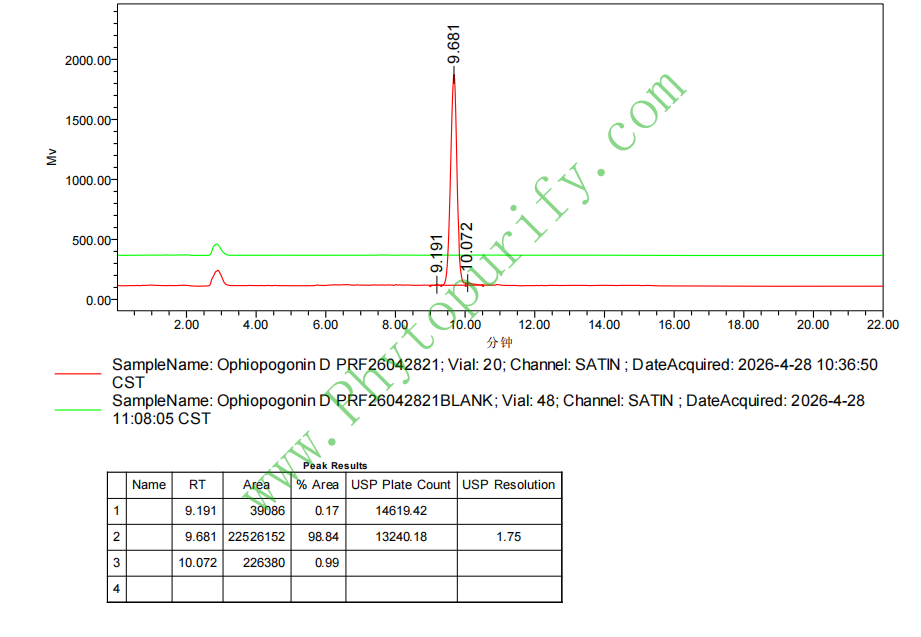
Storage conditions:Short-term storage at 2~8℃, long-term storage at -20 ~ -80℃
235.6800
2.1681
2.1683
.0400
.5631
.7424
Low
63.9402
6.7750
No
No
No
No
No
No
0.0
Yes
No
Yes
Yes
Natural products, as an important source of drug discovery, play an irreplaceable role in the long struggle between humans and diseases. Among the numerous natural compounds with biological activity, it originates from the traditional medicinal plant Ophiopogon japonicus(Ophiopogon japonicus)Ophiopogonin D, with its unique chemical structure and extensive pharmacological activity, has attracted widespread attention in the field of pharmaceutical research in recent years. Ophiopogon japonicus, as a traditional Chinese medicine, has the effects of nourishing yin and generating fluids, moistening the lungs and clearing the heart. It is commonly used to treat symptoms such as lung dryness and dry cough, yin deficiency, tuberculosis and cough, throat obstruction and sore throat, fluid damage and thirst, internal heat and thirst, restlessness and insomnia, intestinal dryness and constipation. Modern pharmacological research has revealed that many biological activities of Ophiopogon japonicus are closely related to the steroidal saponins it contains, and Ophiopogon japonicus saponin D is one of the most representative active monomers.
Ophiopogon saponin D is a rare natural C29 steroid glycoside with a complex and unique chemical structure, endowing it with diverse biological functions. From a molecular mechanism perspective, Ophiopogon japonicus saponin D has been identified as an inducer of the cytochrome P450 enzyme subtype CYP2J3. This discovery has significant pharmacological implications, as CYP2J2 (human homolog) and its metabolite epoxyeicosaenoic acid (EETs) play critical roles in cardiovascular protection, anti-inflammatory, and metabolic regulation. By upregulating the CYP2J2/ETs system, Ophiopogon japonicus saponin D can significantly inhibit a series of pathophysiological processes induced by angiotensin II (Ang II), including nuclear translocation of nuclear factor kappa B (NF - κ B), downregulation of I κ B α, intracellular calcium overload, and activation of pro-inflammatory cytokines, thereby exhibiting a protective effect in cardiovascular disease models.
In addition to its cardiovascular protective effects, Ophiopogon japonicus saponin D also exhibits significant activities in multiple fields such as anti-inflammatory, antioxidant, anti-tumor, and metabolic regulation. It can inhibit the differentiation of RAW264.7 macrophages into osteoclasts, indicating its potential application in bone metabolism diseases; As an antioxidant, it can effectively combat endothelial cell damage induced by hydrogen peroxide (H ₂ O ₂); In oncology, it exhibits anti-tumor potential by blocking the ERK signaling cascade and regulating multiple key targets such as MCL1, BCL2, STAT3, MMP2, and HIF1A. In addition, the latest research has found that Ophiopogon japonicus saponin D can alleviate high-fat diet induced metabolic syndrome and significantly alter the structure of mouse gut microbiota, providing a new perspective for its application in the treatment of metabolic diseases.
Given the enormous potential of Ophiopogon japonicus saponin D in the fields of inflammation, metabolism, and cardiovascular disease, a systematic and in-depth review of it not only helps to comprehensively understand its pharmacological mechanisms, but also provides important theoretical basis and scientific clues for the development of new drugs based on this natural product. This article will comprehensively review and prospect the research progress of Ophiopogon japonicus saponin D from multiple dimensions, including chemical structure, plant origin, pharmacological activity, molecular mechanism, pharmacological evaluation, and clinical application prospects.
The chemical structure of Ophiopogonin D belongs to the typical steroid saponin class, but its skeleton is a rare C29 steroid, which is different from the common C27 steroid saponins. Its chemical structure consists of two parts: aglycones (ligands) and sugar chains. The glycoside moiety is a derivative based on the spirostane skeleton, while the sugar chain is usually composed of multiple monosaccharide units connected by glycosidic bonds and attached to specific hydroxyl groups of the glycoside moiety. This unique C29 skeleton structure endows Ophiopogon japonicus saponin D with stereochemical characteristics and biological activity that distinguish it from other steroidal saponins.
From the perspective of physicochemical properties, the molecular formula of Ophiopogon japonicus saponin D is C ₄₄ H ₇₀ O ₁₆, with a molecular weight of 855.0280 g/mol. Its lipophilic water partition coefficient (LogP) is 2.1681, indicating that the compound has a certain degree of lipophilicity, but at the same time, due to the presence of multiple hydroxyl and sugar groups in the molecule, its polarity is also high. The topological polar surface area (TPSA) is 235.6800 Å ², which is a relatively high value and usually indicates that the molecule may be limited in terms of cell membrane penetration, especially in crossing the blood-brain barrier (BBB). In fact, its blood-brain barrier penetration ability was evaluated as "low", indicating that the application of Ophiopogon japonicus saponin D in the treatment of central nervous system diseases may be limited, but it may also mean that its peripheral effects are more prominent, reducing central related side effects.
The water solubility of Ophiopogon japonicus saponin D is 0.0400 mg/mL, making it a poorly soluble compound. This lower solubility is a common characteristic of many natural saponin compounds, which may pose challenges to their oral bioavailability and formulation development. In the early assessment of drug safety, the inhibitory risk of Ophiopogon japonicus saponin D on hERG potassium channels was "no", and the Ames test result was 0.0, indicating that its risk in genetic toxicity and cardiac toxicity is low, which provides a positive safety signal for its subsequent preclinical studies. Overall, the chemical structure of Ophiopogon japonicus saponin D is complex, and its physicochemical properties exhibit a combination of lipophilicity and hydrophilicity, poor solubility, and low central permeability. These properties have important impacts on its pharmacological performance, pharmacokinetic behavior, and formulation design.
Ophiopogon saponins D are mainly derived from the Liliaceae family, the genus Ranunculus(Ophiopogon)Plant Ophiopogon(Ophiopogon japonicus Dried tubers of (L. f.) Ker Gawl. Ophiopogon japonicus is native to China, Japan, and Southeast Asia, and is widely cultivated in Zhejiang, Sichuan, Hubei, and other regions of China. It is one of the famous "Zhejiang Eight Flavors". Besides Ophiopogon japonicus, other plants of the same genus include Hubei Ophiopogon japonicus(Liriope spicata var. prolifera)It is also commonly used as a local medicinal product, but the composition and content of its saponin components differ from those of genuine Ophiopogon japonicus. The content of Ophiopogon japonicus saponin D in Ophiopogon japonicus tubers is usually low and belongs to trace active ingredients, which to some extent increases the difficulty and cost of its separation and purification.
The traditional method for extracting saponins from Ophiopogon japonicus is mainly based on solvent extraction. Due to the high polarity of compound D in Ophiopogon japonicus, commonly used extraction solvents include methanol, ethanol, or their aqueous solutions. Usually, reflux extraction or percolation method is used to crush Ophiopogon japonicus medicinal materials, and then extract them multiple times with a certain concentration of ethanol (such as 70% -95%). The extracted liquids are combined, and the solvent is recovered under reduced pressure to obtain the crude extract of total saponins. In order to improve extraction efficiency and selectivity, modern extraction techniques such as ultrasound assisted extraction, microwave-assisted extraction, and enzyme assisted extraction have also been applied in the extraction process of Ophiopogon japonicus saponins. These techniques can significantly shorten extraction time and improve the extraction rate of target compounds by disrupting cell wall structure or enhancing solvent permeation.
The separation and purification of Ophiopogon japonicus saponin D monomer from crude total saponin extract usually requires the combination of multiple chromatographic techniques. The commonly used methods include: first, using macroporous adsorption resins (such as D101, AB-8 type) to preliminarily enrich and decolorize total saponins, and obtaining fractions rich in target saponins through gradient elution with different concentrations of ethanol. Subsequently, further separation was performed using silica gel column chromatography and ODS (octadecylsilane bonded silica gel) reverse phase column chromatography, with gradient elution using solvent systems such as chloroform methanol water or acetonitrile water. For saponin isomers with extremely similar structures, high-performance liquid chromatography (HPLC) or preparative high-performance liquid chromatography (Pre HPLC) is a key step in obtaining high-purity Ophiopogon japonicus saponin D. Finally, the isolated compound was structurally identified as Ophiopogon japonicus saponin D using spectroscopic techniques such as nuclear magnetic resonance (NMR) and mass spectrometry (MS). The entire extraction and separation process is complex, involves multiple steps, and has a low yield, which limits the large-scale production and widespread application of Ophiopogon japonicus saponin D.
The pharmacological activity spectrum of Ophiopogon japonicus saponin D is very broad, covering multiple aspects such as cardiovascular protection, anti-inflammatory, antioxidant, anti-tumor, bone metabolism regulation, and metabolic syndrome improvement, reflecting its potential as a natural multi-target active molecule.
1. Cardiovascular protective effect
Cardiovascular protection is one of the most in-depth directions in the research of Ophiopogon japonicus saponins D. Research has shown that Ophiopogon japonicus saponin D can significantly inhibit Ang II induced damage to human umbilical vein endothelial cells (HUVECs). The mechanism is related to inducing CYP2J2 expression and increasing EETs generation. EETs are a class of endogenous lipid mediators with potent vasodilatory, anti-inflammatory, and antiplatelet aggregation effects. By activating the CYP2J2/EETs pathway, Ophiopogon japonicus saponin D can inhibit Ang II triggered NF - κ B activation, reduce the expression of downstream pro-inflammatory factors such as TNF - α, IL-6, MCP-1, and inhibit intracellular calcium overload, thereby protecting endothelial cell function and maintaining vascular homeostasis. In addition, in the myocardial ischemia-reperfusion injury model, Ophiopogon japonicus saponin D also showed the effect of reducing myocardial infarction area and improving heart function.
2. Anti inflammatory and antioxidant activity
Ophiopogon saponins D have significant anti-inflammatory activity. In a macrophage model stimulated by lipopolysaccharide (LPS), it can inhibit the expression of cyclooxygenase-2 (COX-2) and inducible nitric oxide synthase (iNOS), reduce the release of prostaglandin E2 (PGE2) and nitric oxide (NO). Its antioxidant activity is mainly reflected in its protective effect against oxidative stress damage induced by H ₂ O ₂. In HUVECs, pretreatment with Ophiopogon japonicus saponin D can reduce intracellular reactive oxygen species (ROS) levels and increase the activity of antioxidant enzymes such as superoxide dismutase (SOD) and glutathione peroxidase (GSH Px), thereby alleviating endothelial cell apoptosis and functional impairment caused by oxidative stress. This dual effect of antioxidant and anti-inflammatory is an important foundation for its cardiovascular and tissue protective effects.
3. Antitumor activity
Ophiopogon japonicus saponin D exhibits inhibitory activity on proliferation and induces apoptosis in various tumor cell lines. Research has shown that it can inhibit the growth of tumor cells by blocking the ERK signaling pathway. The network pharmacology analysis of its anti-tumor mechanism revealed multiple potential targets, including MCL1, BCL2, STAT3, MMP2, HIF1A, TOP1, TOP2A, MAPK1, ESR1, and CYP19A1. This suggests that Ophiopogon japonicus saponins D may exert anti-tumor effects by regulating multiple pathways, including cell apoptosis (MCL1, BCL2), signal transduction (STAT3, MAPK1), tumor invasion and metastasis (MMP2), hypoxia adaptation (HIF1A), and hormone metabolism (ESR1, CYP19A1). For example, by downregulating the expression of anti apoptotic proteins BCL2 and MCL1, and upregulating the pro apoptotic protein Bax, the mitochondrial apoptosis pathway can be activated. In addition, it can also inhibit the activity of matrix metalloproteinase MMP2, which may help suppress the migration and invasion of tumor cells.
4. Regulation of bone metabolism
Ophiopogon saponins D also exhibit unique activity in the field of bone metabolism. Research has found that it can effectively inhibit the differentiation of RAW264.7 macrophages into osteoclasts. Osteoclasts are the main cells responsible for bone resorption, and their excessive activation is a key factor leading to bone loss diseases such as osteoporosis. Ophiopogon japonicus saponin D inhibits the RANKL (nuclear factor kappa B receptor activator ligand) - induced NF - κ B and MAPK signaling pathways, downregulates the expression of key transcription factors NFATc1 and c-Fos for osteoclast differentiation, thereby reducing osteoclast formation and bone resorption activity. This suggests that Ophiopogon japonicus saponin D may become a potential candidate drug for the treatment of bone metabolism diseases such as osteoporosis.
5. Improvement effect on metabolic syndrome
The latest research reveals a new role of Ophiopogon japonicus saponin D in metabolic regulation. In a high-fat diet induced metabolic syndrome mouse model, intervention with Ophiopogon japonicus saponin D can significantly alleviate weight gain, improve insulin resistance, lower blood lipid levels (such as total cholesterol and triglycerides), and alleviate liver steatosis. More interestingly, Ophiopogon japonicus saponin D can significantly alter the structure of the gut microbiota in mice, increasing the relative abundance of beneficial bacteria such as Akkermansia and Lactobacillus, and reducing the proportion of harmful bacteria such as Desulfovibrio. This regulatory effect on gut microbiota is considered one of the important mechanisms for improving metabolic syndrome, providing a new perspective for understanding the systemic efficacy of Ophiopogon japonicus saponin D.
The pharmacological activity of Ophiopogon japonicus saponin D originates from its precise regulation of multiple signaling pathways and molecular targets. Its mechanism of action exhibits networked and multi-target characteristics, and the core mechanism can be summarized into the following aspects.
1. Activation of CYP2J2/EETs/PPAR α pathway
This is the core mechanism of the cardiovascular protective effect of Ophiopogon japonicus saponin D. Ophiopogon saponin D, as an inducer of CYP2J3 (human CYP2J2), can upregulate the expression of CYP2J2 in endothelial cells, thereby promoting the metabolism of arachidonic acid into biologically active EETs. EETs are not only potent vasodilators, but also activate peroxisome proliferator activated receptor alpha (PPAR alpha). The activation of PPAR α further inhibits the Ang II induced NF - κ B signaling pathway, specifically by suppressing the phosphorylation and degradation of I κ B α, preventing the translocation of NF - κ B p65 subunit to the nucleus, and thereby reducing the transcription of downstream pro-inflammatory genes such as ICAM-1, VCAM-1, MCP-1. Meanwhile, EETs can directly regulate intracellular calcium homeostasis, inhibit Ang II induced calcium influx, and alleviate endothelial damage caused by calcium overload. Therefore, the CYP2J2/EETs/PPAR α axis is a key signaling hub for the anti-inflammatory and endothelial function protective effects of Ophiopogon japonicus saponins D.
2. Inhibition of ERK signaling pathway
ERK (extracellular signal regulated kinase) is an important member of the MAPK (mitogen activated protein kinase) family, involved in regulating cell proliferation, differentiation, and survival. Ophiopogon japonicus saponin D can effectively block the ERK signaling cascade and inhibit the phosphorylation of ERK1/2. This mechanism is particularly prominent in its anti-tumor activity. In many tumor cells, the ERK pathway is continuously activated, driving infinite cell proliferation. Ophiopogon japonicus saponin D can inhibit ERK phosphorylation, block the cell cycle in G0/G1 phase, and induce cell apoptosis. In addition, the inhibition of the ERK pathway may also be related to its inhibition of osteoclast differentiation and anti-inflammatory effects, as ERK signaling also plays an important role in RANKL induced osteoclastogenesis and inflammatory cytokine expression.
3. Regulation of apoptosis and survival related targets
Ophiopogon japonicus saponin D regulates multiple key proteins related to cell apoptosis and survival through direct or indirect means. It can downregulate the expression of anti apoptotic proteins BCL2 and MCL1, while upregulating pro apoptotic protein Bax, leading to a decrease in mitochondrial membrane potential, release of cytochrome c, and activation of caspase-9 and caspase-3, initiating mitochondrial pathway apoptosis. In addition, it can also inhibit the phosphorylation of STAT3. STAT3 is an important transcription factor that is continuously activated in various tumors, promoting cell survival and proliferation. The inhibition of STAT3 by Ophiopogon japonicus saponin D can further weaken the survival signal of tumor cells. Meanwhile, the downregulation of HIF1A may disrupt the tumor microenvironment by inhibiting tumor angiogenesis and glycolysis.
4. Inhibition of inflammation and oxidative stress signals
The anti-inflammatory mechanism of Ophiopogon japonicus saponin D lies in its inhibition of the NF - κ B signaling pathway. In addition to indirectly inhibiting NF - κ B through the CYP2J2/ETs/PPAR α pathway mentioned above, it may also directly act on upstream activating molecules of NF - κ B, such as I κ B kinase (IKK). In terms of oxidative stress, Ophiopogon japonicus saponin D activates the Nrf2/ARE (nuclear factor E2 related factor 2/antioxidant response element) pathway, upregulates the expression of a series of antioxidant enzyme genes, such as SOD, HO-1, NQO1, etc., thereby enhancing the cell's ability to clear ROS and reducing oxidative damage.
In summary, the mechanism of action of Ophiopogon japonicus saponin D is not singular, but rather achieves comprehensive regulation of cardiovascular, inflammatory, tumor, and metabolic diseases through the synergistic effect of activating protective pathways (CYP2J2/ETs/PPAR α, Nrf2) and inhibiting pathogenic pathways (NF - κ B, ERK, STAT3). Its multi-target nature gives it unique advantages in treating complex diseases.
To promote the clinical application of Ophiopogon japonicus saponin D from laboratory research, a systematic evaluation of its drug like and pharmacokinetic (ADME) properties is necessary. According to existing data, the pharmacological properties of Ophiopogon japonicus saponins D present both opportunities and challenges.
From the Lipinski's Rule of Five, the molecular weight of Ophiopogon japonicus saponin D (855.03 Da) far exceeds 500 Da, and the LogP value (2.17) meets the requirement of less than 5. However, the number of hydrogen bond donors (- OH groups) and hydrogen bond acceptors (O atoms) also far exceeds the upper limit of the rule. This indicates that Ophiopogon japonicus saponin D is a typical "rule breaking" compound, and its oral bioavailability may be low. Its high TPSA value (235.68 Å ²) also indicates poor membrane permeability, which is consistent with its "low" blood-brain barrier penetration ability. However, this does not mean that it has no medicinal value. Many successful natural medicines, such as cyclosporine and paclitaxel, also do not comply with the "five rules", but can still exert strong therapeutic effects through appropriate dosage form design (such as liposomes, nanoparticles) or administration routes (such as injection).
In terms of safety, Ophiopogon japonicus saponin D exhibits good preliminary characteristics. The risk assessment of hERG inhibition is' no ', reducing its risk of causing prolonged QT interval and fatal arrhythmia in the heart. The Ames test result is 0.0, indicating that it has no mutagenicity in the bacterial recovery mutation test and has a low risk of genetic toxicity. These positive security data provide important guarantees for its further development.
Regarding pharmacokinetics, there is currently insufficient research on the in vivo process of Ophiopogon japonicus saponin D. Given its high molecular weight and poor water solubility (0.04 mg/mL), it can be inferred that its oral absorption is poor and its absolute bioavailability may be very low. After oral administration, most drugs may enter the intestine directly in their original form or be metabolized by the gut microbiota. In fact, its role in improving metabolic syndrome is closely related to regulating gut microbiota, suggesting that after oral administration, the interaction between the drug and gut microbiota may be one of the important pathways for its pharmacological effects. Intravenous injection may be a more effective way of administration to ensure sufficient blood drug concentration. Its distribution, metabolism, and excretion pathways still require further research. Due to the presence of multiple sugar groups in the molecule, it may be hydrolyzed by glycosidases in the body to produce secondary glycosides or aglycones, which may also have biological activity. Therefore, the systematic pharmacokinetic study of Ophiopogon japonicus saponin D and its metabolites is a key issue that urgently needs to be addressed in future drug development.
Based on the unique pharmacological activity and preliminary safety characteristics of Ophiopogon japonicus saponin D, its clinical application prospects in multiple disease fields are promising, but it also faces many challenges.
1. Cardiovascular diseases
Ophiopogon japonicus saponin D plays an anti-inflammatory, antioxidant and endothelial protective role by activating CYP2J2/EETs pathway, making it have great potential in treating cardiovascular diseases such as hypertension, atherosclerosis, myocardial ischemia reperfusion injury, etc. Especially its unique mechanism as a CYP2J2 inducer provides new ideas for the development of novel cardiovascular protective drugs. In the future, more in vivo pharmacological studies are needed, especially to validate its efficacy in large animal models and clinical trials.
2. Inflammatory diseases
Its strong anti-inflammatory activity, especially its inhibition of the NF - κ B pathway, makes it promising for application in various chronic inflammatory diseases, such as rheumatoid arthritis and inflammatory bowel disease. Its inhibitory effect on osteoclast differentiation also provides a basis for its application in bone inflammatory diseases such as osteoporosis.
3. Tumor treatment
The multi-target anti-tumor activity of Ophiopogon japonicus saponin D, especially its regulation of key targets such as ERK, STAT3, BCL2, endows it with broad-spectrum anti-tumor potential. It can be used as a chemotherapy sensitizer in combination with existing chemotherapy drugs or targeted drugs to overcome drug resistance and enhance efficacy. However, its application in tumor treatment needs to address two major issues: firstly, how to improve its bioavailability and achieve effective concentration in tumor tissue; Secondly, it is necessary to comprehensively evaluate its potential off target effects and long-term toxicity.
4. Metabolic disorders
Ophiopogon japonicus saponin D can improve metabolic syndrome and regulate intestinal flora, which opens a new direction for its application in the treatment of obesity, type 2 diabetes and non-alcoholic fatty liver disease (NAFLD). Especially its mechanism of action through the "gut liver axis" or "gut metabolic axis" is in line with the forefront trend of current metabolic disease research. In the future, it can be explored to develop it into an oral natural medicine that improves metabolism by regulating gut microbiota.
Outlook and Challenges:
Despite its broad prospects, the clinical translation of Ophiopogon japonicus saponin D still faces severe challenges. The primary issue is its extremely low oral bioavailability. How to improve its solubility and oral absorption through modern pharmaceutical technologies such as nanoliposomes, phospholipid complexes, self microemulsifying drug delivery systems, etc., is the key to breaking through its application bottleneck. Secondly, its complex chemical structure makes synthesis difficult and natural extraction costly, limiting its large-scale supply. Developing efficient and green biosynthetic or semi synthetic methods is the fundamental way to solve the problem of raw material sources. Finally, in-depth research on its metabolic pathways, pharmacological substance basis (whether it is a prototype or a metabolite), and the safety of long-term use are essential prerequisites for promoting its entry into clinical trials.
Ophiopogon saponin D, as a rare C29 steroid glycoside derived from traditional Chinese medicine Ophiopogon japonicus, has become a shining pearl in the field of natural product research due to its unique chemical structure and diverse pharmacological activities. From cardiovascular protection, anti-inflammatory and antioxidant effects to anti-tumor and metabolic regulation, its mechanism of action involves multiple aspects such as CYP2J2/ETs/PPAR α pathway activation, ERK signaling blockade, and multi-target regulation, demonstrating the unique advantages of natural products in the treatment of complex diseases. Although its low solubility and low oral bioavailability pose major challenges in drug development, its good preliminary safety characteristics and unique pharmacological mechanisms provide a solid foundation for its subsequent development. In the future, with the advancement of modern pharmacy, medicinal chemistry, and systems biology technologies, we have reason to believe that through reasonable structural modification, dosage form optimization, and in-depth mechanism research, Ophiopogon japonicus saponin D and its derivatives are expected to be developed into new drugs for the treatment of inflammation, cardiovascular, and metabolic diseases, contributing to human health. The in-depth study of Ophiopogon japonicus saponin D is not only a modern interpretation of the treasure trove of traditional Chinese medicine, but also an important bridge connecting traditional wisdom with modern drug discovery.
