Methyl Ophiopogon Flavonoids A: Natural Anti inflammatory and Anti tumor Candidate Molecules Derived from Ophiopogon japonicus
1. Overview
Methylophopogone A (CAS number: 74805-90-6) is a traditional medicinal plant derived from the plant lilyturf(Ophiopogon japonicus)Separated from the roots High isoflavones Natural products. Its molecular formula is C19H16O6 and its molecular weight is 340.3310 g/mol. As a plant secondary metabolite, it not only reflects the complexity of plant chemical defense, but also becomes one of the hotspots in modern natural medicine chemistry and pharmacology research due to its unique chemical structure and significant biological activity.
As a classic Chinese medicinal herb, Ophiopogon japonicus has a history of over a thousand years of application in traditional Chinese medicine. It is commonly used to nourish yin, moisten the lungs, clear the heart, and relieve annoyance. Modern research has revealed that its pharmacological activity is closely related to the various saponins, polysaccharides, and flavonoids it contains. Methyl Ophiopogon flavanone A is one of the representative active ingredients. Early research has confirmed that it has anti-inflammatory activity With the development of molecular target screening technology, its deeper pharmacological effects, especially in relation to Lung cancer The interactions between multiple key targets, such as PIK3CA, EGFR, TP53, etc., have been gradually revealed, transforming it from a traditional plant metabolite to a lead compound with potential anti-tumor applications.
This article will systematically elaborate on the scientific connotation and research value of methyl Ophiopogon japonicus high flavonoid A from its chemical structure, plant origin, pharmacological mechanism, pharmacological evaluation, and research prospects.
2. Chemical structure and physicochemical properties
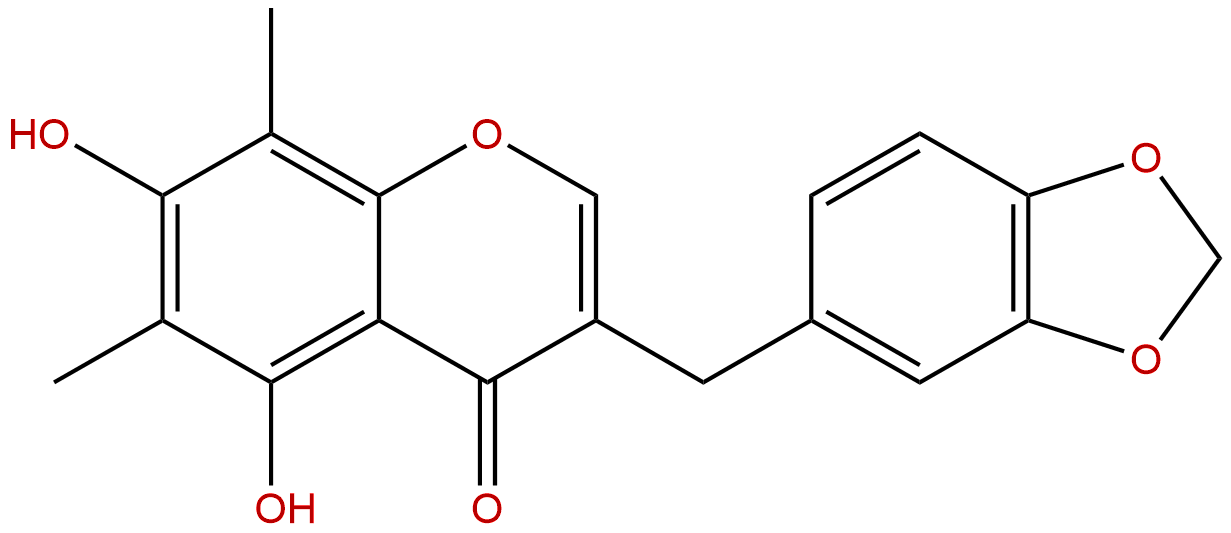
Methyl Ophiopogon flavonoids A belong to High isoflavones The structural skeleton of the class compound is different from the classical flavonoid (2-phenylchromenone). According to its SMILES representation (Cc1c (O) c (C) c2occ (Cc3ccc4c (c3) OCO4) c (=O) c2c1O) and existing descriptions, its core structure is 4H-1-benzopyran-4-one(i.e. chromogen ketone). Its structural features are:
- 5 and 7 digits Replaced by hydroxyl (- OH), which is a common site for many flavonoids to possess antioxidant and coordination abilities.
- 6-digit and 8-bit Replaced by methyl (- CH3), this alkylation modification may affect the lipid solubility and spatial conformation of the molecule.
-The most crucial thing is that 3 people Connected one(2H-1,3-Benzodioxolan-5-yl) methyl Functional groups. This group contains a methylene group (- CH2-) connected to a benzodioxolane (i.e. pepper ring) structure. This unique structural unit classifies it as a "high isoflavone" (i.e. the 3rd position of the C ring is replaced by a phenylpropyl or similar group, rather than the classical phenyl group), and is also the key structural basis for its biological activity.
Analyzing its physicochemical properties from the parameters of drug properties:
- Molecular weight (MW):340.33 g/mol, Far less than 500, it meets the requirements of Lipinski's five rules (RO5) for the molecular weight of oral drugs.
- Lipid water partition coefficient (LogP)The calculated value is 2.55, and the LogD (at pH 7.4) is 2.37. This indicates that the compound has Moderate lipophilicity It is neither too hydrophilic (difficult to penetrate cell membranes) nor too lipophilic (difficult to dissolve in body fluids), which is beneficial for its transmembrane absorption and distribution.
- Topological Polarity Surface Area (TPSA): 89.13 Å ². This value reflects the surface area of polar atoms (such as oxygen atoms) in the molecule, and typically TPSA<140 Å ² is favorable for cell membrane permeation. This value is moderate, indicating that it has good membrane permeation potential.
- Water solubility The low value (0.0294, usually measured in mg/mL or mol/L) is consistent with its moderate LogP value, indicating that it is a poorly soluble compound in water and may require consideration of solubilization strategies during formulation development.
- Caco-2 permeability The value is 21.16 (usually on the order of apparent permeability coefficient Papp × 10 ⁻⁶ cm/s), which is relatively high and indicates its Good intestinal absorption potential。
In summary, methyl Ophiopogon japonicus high flavonoid A has a unique modified high isoflavone skeleton, and its physicochemical properties show good basis as an oral lead compound in terms of molecular weight, lipophilicity, and membrane permeability.
3. Plant sources and traditional applications
The plant source of high flavonoid A from methyl Ophiopogon japonicus is single and clear, that is The plant Ophiopogon japonicus in the Liliaceae family (now belonging to the Asparagaceae family)(Ophiopogon japonicus (L. f.) Ker-Gawl.)。 The dried root of Ophiopogon japonicus is a famous traditional Chinese medicinal herb, also known as "Yan Jie Cao" or "Mai Men Dong". Its medicinal history dates back to ancient times, first recorded in the "Shennong Bencao Jing" and classified as a top-grade herb. It is said to "cause stagnation of qi in the heart and abdomen, damage and injury, fullness, loss of gastric meridians, and weakness and shortness of qi".
In traditional Chinese medicine theory, Ophiopogon japonicus has a sweet, slightly bitter, and slightly cold nature, and belongs to the heart, lungs, and stomach meridians. It has Nourishing Yin and generating fluids, moistening the lungs and clearing the heart The efficacy. Widely used clinically for:
1. Insufficient lung yin Causing dry cough with less phlegm, coughing and hemoptysis.
2. Deficiency of gastric yin Causing dry mouth and tongue, internal heat to quench thirst, intestinal dryness, and constipation.
3. Heart Yin deficiency The resulting restlessness, insomnia, palpitations, and palpitations.
In traditional prescriptions, Ophiopogon japonicus is often combined with sand ginseng, jade bamboo, and heavenly pollen (such as sand ginseng and Ophiopogon japonicus decoction), or used in the same way as Pinellia ternata, ginseng, and licorice (such as Ophiopogon japonicus decoction), reflecting its core therapeutic idea of "nourishing yin and moistening dryness".
Modern plant chemistry research has isolated and identified various components such as steroidal saponins, isoflavones, polysaccharides, amino acids, etc. from Ophiopogon japonicus. Among them, high isoflavones are one of the characteristic active ingredients of Ophiopogon japonicus, and methyl Ophiopogon japonicus high flavonoid A is one of them. The discovery of these ingredients provides a modern scientific basis for explaining the traditional effects of Ophiopogon japonicus in "moistening the lungs" and "clearing heat" - its anti-inflammatory, antioxidant, immune regulatory and other activities may be the molecular basis for its treatment of lung dryness cough, internal heat injury and other diseases. Therefore, in-depth research on the high flavonoid A of methyl Ophiopogon japonicus is also necessary Modernization of Traditional Chinese Medicine and Natural product new drug discovery An important pathway.
4. Pharmacological activity and mechanism of action
Methyl Ophiopogon High Flavonoids A was initially reported to have anti-inflammatory activity Inflammation is a common pathological basis for various chronic diseases, including cancer, and its anti-inflammatory effect may be achieved by inhibiting classic inflammatory pathways such as NF - κ B and COX-2. However, what is even more remarkable is its association with Lung cancer Related multi-target potential. According to database information, it is associated with five key cancer-related targets: PIK3CA, EGFR, TP53, CDKN2A, and KRAS. These targets play a central role in the occurrence, development, proliferation, survival, and metastasis of lung cancer.
Based on the pathology of lung cancer, analyze the possible mechanism of action of methyl Ophiopogon japonicus high flavonoid A:
1. Targeting the EGFR signaling pathway:
- EGFR (epidermal growth factor receptor) It is a tyrosine kinase receptor that is often overexpressed or mutated in non-small cell lung cancer (NSCLC), leading to sustained activation of downstream signaling pathways and promoting cell proliferation and survival. EGFR inhibitors, such as gefitinib and erlotinib, have become important drugs for targeted therapy of lung cancer.
-If methyl Ophiopogon flavanone A can bind to EGFR and inhibit its kinase activity, it can block downstream survival promoting signals such as MAPK and PI3K/AKT, thereby inhibiting the growth of lung cancer cells.
2. Intervention in the PI3K/AKT/mTOR pathway:
- PIK3CA It is the catalytic subunit of phosphatidylinositol 3-kinase (PI3K), and mutations or amplifications of this gene can lead to overactivation of the PI3K/AKT/mTOR signaling pathway, which is a key mechanism for lung cancer cells to evade apoptosis, promote proliferation, and reprogram metabolism.
-As a small molecule derived from plants, methyl Ophiopogon flavonoids A may induce apoptosis and inhibit proliferation of lung cancer cells by directly or indirectly inhibiting the activity of PIK3CA, downregulating the phosphorylation levels of AKT and mTOR.
3. Impact on tumor suppressor genes and cell cycle:
- TP53 It is a well-known tumor suppressor gene, whose mutations or functional inactivation occur in over 50% of lung cancers, leading to uncontrolled cell cycle and genomic instability.
- CDKN2A The p16INK4a protein encodes for cyclin dependent kinase (CDK) inhibitors, and its absence or inactivation can lead to dysfunction of the G1/S checkpoint in the cell cycle and abnormal cell proliferation.
-Methyl Ophiopogon flavanone A may inhibit cancer cell division by upregulating or stabilizing the function of p53 protein or restoring the expression of cell cycle inhibitory proteins such as p16, thereby blocking cancer cells at specific cell cycle stages (such as G1 phase).
4. Apply to RAS signal nodes:
- KRAS It is a member of the RAS family, and its mutations (commonly found in lung adenocarcinoma) can lead to the loss of GTPase activity, causing it to remain in a continuously activated state, which in turn activates multiple downstream pathways such as RAF-MEK-ERK, driving tumor growth.
-Directly targeting KRAS mutants was once a challenge in drug development, but breakthroughs have been made in recent years. Methyl Ophiopogon flavanone A may interfere with the interaction between KRAS and downstream effector proteins, or affect its membrane localization, thereby weakening its carcinogenic signal.
Hypothesis of mechanism of action integration:
Methyl Ophiopogon High Flavonoids A may serve as a potential Multi target modulators Make an impact. Its unique benzodioxolane structure may provide a chemical basis for the interaction with ATP binding pockets or conformational sites of these target proteins. By simultaneously or synergistically affecting kinase activities such as EGFR and PIK3CA, and regulating tumor suppressor pathways such as TP53 and CDKN2A, it may inhibit the survival signaling network of lung cancer cells at multiple levels, induce cell cycle arrest and programmed cell death. This multi-target characteristic may help overcome the resistance problem of single target drugs, but it also puts higher demands on the study of their mechanisms of action, requiring more in-depth cell and animal experiments, as well as structure based molecular docking and target validation studies to confirm.
5. Evaluation of drug properties
Based on the provided pharmacological parameters, we can conduct a preliminary evaluation of the potential of methyl Ophiopogon flavonoids A as a drug lead compound, and refer to the famous Lipinski's Five Rules (RO5) Compare and contrast.
Lipinski's Five Rules Compliance Status:
1. Molecular weight (MW)<500 Da:340.33,Comply with。
2. Lipid water partition coefficient (LogP)<5:2.55,Comply with。
3. The number of hydrogen bond donors (HBDs) is less than 5 According to the structure, there are two phenolic hydroxyl groups (- OH) with a HBD number of 2,Comply with。
4. The number of hydrogen bond acceptors (HBAs) is less than 10 There are 6 oxygen atoms in the molecule (2 hydroxyl oxygen, 1 carbonyl oxygen, 3 ether oxygen in benzodioxolane), and the HBA number is 6,Comply with。
5. Number of rotatable keys It is usually recommended to be less than 10. The molecular structure is relatively rigid and has a moderate number of rotatable bonds.
Conclusion Methyl Ophiopogon flavonoids A fully comply with Lipinski's five rules, indicating that it has good properties Oral absorption potential。
Analysis of other key pharmacological parameters:
- Absorption and penetration:
- Caco-2 permeability (21.16) The values of effective permeability (Peff: 3.67) are both high, strongly indicating its good passive diffusion and absorption ability in the intestine.
- Blood-brain barrier (BBB) penetrability Annotated as' low '. This is not a disadvantage for treating diseases outside the central nervous system such as lung cancer, but may actually reduce potential central nervous system side effects. But it may be disadvantageous for preventing or treating brain metastases.
- Distribution and Metabolism:
- Plasma protein binding rate (PPB)Up to 90.78%, indicating that most of it binds to plasma proteins (mainly albumin) in the blood. High PPB can affect the free concentration, tissue distribution, and clearance rate of drugs, and may require higher dosages to achieve effective free drug concentrations, but it may also prolong the half-life.
- Toxicity risk:
- Mutagenicity (Ames test)A value of 0.9 (usually<1.0 is considered negative or weakly positive) indicates its Low risk of mutagenicity This is a positive signal.
- chromosome aberration Marked as' Yes', this is a Signals that require high vigilance This indicates that the compound may have the potential to cause genetic damage in vitro, and further genetic toxicity assessment is necessary in subsequent development.
- HERG inhibition Annotated as' no ', it means that its potential to cause prolonged QT interval in the heart (a serious risk of arrhythmia) is low.
- Phototoxicity Annotated as' present '. This may be related to its conjugated aromatic structure, and special attention should be paid when developing topical formulations.
- Respiratory sensitization Annotated as' Yes', indicating a possible risk of inhalation exposure.
- Serum biochemical indicators Only serum alkaline phosphatase (Ser_LK) may be elevated, while key liver enzyme indicators such as alanine/aspartate aminotransferase (ALT/AST) did not show abnormalities, indicating preliminary indications of its Direct liver toxicity may not be significant。
Comprehensive evaluation:
Methyl Ophiopogon High Flavonoids A Oral absorption and molecular properties It exhibits excellent lead compound characteristics. However, it High plasma protein binding rate, potential chromosomal aberration, and phototoxicity risk This is its main weakness. Especially the risk of genetic toxicity, which is a "fatal flaw" that needs to be addressed in the early stages of drug development. Therefore, although its pharmacological targets are attractive, its safety must be clarified through higher-level in vitro and in vivo genetic toxicity tests (such as micronucleus assay, comet assay, etc.). If the genetic toxicity risk can be confirmed as false positive or eliminated through structural modification, it will be a very valuable candidate molecule for subsequent optimization of anti lung cancer.
6. Research Status and Application Prospects
At present, research on high flavonoid A in methyl Ophiopogon japonicus is still ongoing Preclinical stage Mainly focused on plant chemistry (isolation, identification), preliminary pharmacological activity screening, and database based target prediction. Its clear anti-inflammatory activity and association with multiple key targets of lung cancer have pointed the way for its subsequent research.
Current research focus and challenges:
1. Mechanism verification The urgent task is to use molecular docking, surface plasmon resonance (SPR), kinase activity inhibition experiments and other methods to verify its direct interaction with predicted targets such as EGFR and PIK3CA at the molecular level. Subsequently, in lung cancer cell lines such as A549 and H1299, the specific effects on downstream signaling pathways (PI3K/AKT, RAS/RAF/MEK/ERK), cell cycle, and apoptosis were elucidated through techniques such as Western blot, flow cytometry, and gene knockdown/overexpression.
2. Pharmacodynamic evaluation in vivo Establishing a mouse model of lung cancer xenograft, evaluating the in vivo anti-tumor effect, optimal dosage and route of administration of methyl Ophiopogon flavonoids A, and observing its toxicity on mouse body weight and major organs, is an indispensable step in promoting its drug conversion.
3. Optimization of drug properties To address its shortcomings such as poor water solubility, potential genetic toxicity, and phototoxicity Structural modification For example, by preparing water-soluble prodrugs (such as phosphate esters, amino acid esters) or appropriately derivatizing benzene rings and hydroxyl groups, while retaining the core pharmacophore, their solubility can be improved and toxicity reduced. This belongs to Synthesis of natural product derivatives The scope of research.
4. Research on the synergistic effect of multiple components As a single component in Ophiopogon japonicus, its effect may not be as effective as that of Ophiopogon japonicus extract or its synergistic effect with other components such as Ophiopogon saponins and polysaccharides. Studying its compatibility with other ingredients can help to gain a more comprehensive understanding of the traditional efficacy of Ophiopogon japonicus and potentially discover better compound combinations.
Application prospects:
- As a lead compound for anti lung cancer treatment If its multi-target anti-tumor mechanism is confirmed and its safety can be optimized, it is expected to be developed into a new type of small molecule drug or adjuvant therapy for lung cancer with traditional Chinese medicine characteristics.
- As a candidate for anti-inflammatory drugs Its basic anti-inflammatory activity is also worth further exploration and can be used to treat lung diseases related to chronic inflammation, such as chronic obstructive pulmonary disease (COPD), pulmonary fibrosis, etc.
- Quality markers of traditional Chinese medicine As a characteristic high flavonoid component of Ophiopogon japonicus, the content of methyl Ophiopogon japonicus high flavonoid A can be used as one of the chemical markers to evaluate the quality of Ophiopogon japonicus medicinal materials and related preparations (such as Shengmai Yin).
- Chemical and Biological Research Tools Its unique structure can be used as a probe to study the structure-activity relationship of high isoflavones and explore the mechanism of multi signaling pathway cross-talk in diseases such as lung cancer.
In summary, Methyl Ophiopogon High Flavonoids A is a potential bridge connecting the wisdom of traditional Chinese medicine with modern precision medicine. Although the challenges in drug development still need to be overcome, its unique chemical structure and initial multi-target pharmacological activity make it occupy a position worthy of continuous attention and in-depth exploration in the field of natural product drug development for anti-tumor, especially anti lung cancer. Future research requires close collaboration among multiple disciplines such as chemistry, pharmacology, and toxicology to transform active molecules from the laboratory into therapeutic drugs that benefit patients.