


Synonym name: 8-Methylophiopogonanone B
Catalogue No.: BP0942
Cas No.: 74805-91-7
Formula: C19H20O5
Mol Weight: 328.364
Botanical Source: Ophiopogon japonicus and Polygonum odoratum
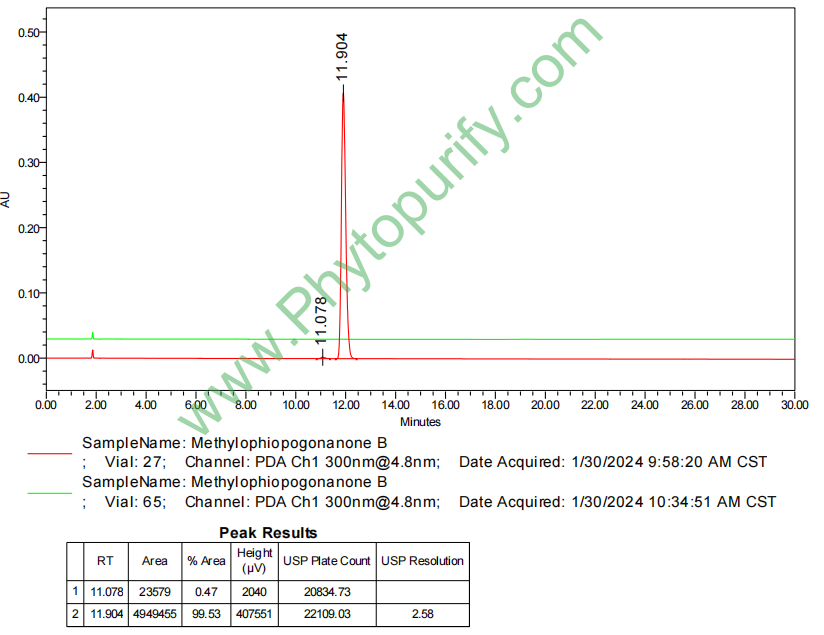
Purity: 95%~99%
Analysis Method: HPLC-DAD or/and HPLC-ELSD
Identification Method: Mass, NMR
Packing: Brown vial or HDPE plastic bottle
Can be supplied from milligrams to grams.
For Reference Standard and R&D, Not for Human Use Directly.
Inquire for bulk scale.
HPLC of Methylophiopogonanone B
Storage conditions:Short-term storage at 2~8℃, long-term storage at -20 ~ -80℃
Methylophopogonone B (CAS number: 74805-91-7) is a natural high isodihydroflavonoid extracted from the roots of traditional Chinese medicine Ophiopogon japonicus. In recent years, with the in-depth development of natural product pharmacology, methyl ophiopogon flavanone B has become a hot spot in the research of metabolic diseases such as diabetes because of its significant antioxidant capacity and multi-target regulation. Its unique molecular structure endows it with multiple biological functions in cell signaling, cytoskeleton reorganization, and metabolic regulation, especially in regulating the Rho signaling pathway and AMPK related metabolic pathways, showing potential therapeutic value. This article will systematically review the chemical characteristics, plant origin, pharmacological activity, mechanism of action and drug evaluation of methyl sparganone B, and explore its application prospects in diabetes and related diseases.
Methyl Ophiopogon flavanone B belongs to the class of isoflavones, with a molecular formula of C19H20O6 and a molecular weight of 328.3640. Its structural features include a typical flavanone skeleton with methyl substituents, giving it high lipid solubility (LogP=3.6820), which facilitates penetration of the cell membrane and binding to intracellular targets. Its polar surface area (TPSA) is 75.99 Å ², indicating that it has moderate polarity, which is beneficial for the balance between the aqueous and lipid phases. Low water solubility (0.1304 mg/mL) suggests that there may be solubility limitations in vivo, but moderate lipid solubility facilitates cellular absorption.
The physicochemical properties of methyl Ophiopogon flavanone B indicate its low blood-brain barrier penetration ability, which may limit its direct effects in the central nervous system, but also reduce the risk of central side effects. The negative result of hERG channel inhibition experiment indicates a low risk of cardiac toxicity. The Ames mutagenicity test result is 0.6, indicating a low risk of genotoxicity and meeting safety requirements.
Methyl Ophiopogon flavanone B is mainly extracted from the roots of Ophiopogon japonicus. Ophiopogon japonicus is a perennial herbaceous plant in the Liliaceae family, widely distributed in southern China and East Asia. It is commonly used in traditional Chinese medicine to nourish yin, moisten the lungs, clear the heart, and calm the mind. Its rhizome is rich in various active ingredients, including saponins, polysaccharides, and flavonoids.
The common methods for extracting methyl Ophiopogon flavanone B include:
In recent years, the application of supercritical CO2 extraction and molecular imprinting technology has further improved the extraction purity and yield of methyl Ophiopogon flavanone B, providing technical support for its large-scale production.
The pharmacological activities of methyl Ophiopogon flavanone B are mainly reflected in antioxidant, cytoskeletal reorganization regulation, and metabolic regulation.
As a highly isodihydroflavonoid, methyl Ophiopogon flavanone B exhibits significant free radical scavenging ability and can effectively inhibit the generation of reactive oxygen species (ROS), reducing oxidative stress damage to cells. In vitro experiments have shown that it has good scavenging effects on DPPH radicals, superoxide anions, and hydroxyl radicals, protecting cells from oxidative induced apoptosis and inflammatory reactions.
Methyl Ophiopogon flavanone B can significantly increase GTP Rho levels by activating the Rho signaling pathway, inducing actin cytoskeleton reorganization, manifested as dendritic contraction and stress fiber formation. This change in cell morphology is of great significance for cell migration, morphology maintenance, and signal transduction, indicating its potential role in tissue repair and cellular function regulation.
The potential of methyl sparganone B in the treatment of diabetes has attracted increasing attention. Its target involves key metabolic enzymes and transporters such as AMPK (PRKAA1), SGLT2, GCK, etc., which can regulate glucose metabolism and energy homeostasis. By activating the AMPK signaling pathway, methyl Ophiopogon flavanone B promotes glucose and lipid metabolism balance, improves insulin resistance, and lowers blood glucose levels. In addition, its regulatory effect on PTPN1 (protein tyrosine phosphatase 1B) helps to enhance insulin signal transduction and further exert its anti diabetes effect.
The biological function of methyl Ophiopogon flavanone B depends on its regulation of multiple signaling pathways, including dynamic regulation of the cytoskeleton, metabolic signaling, and neuroprotection.
By increasing GTP Rho activity, methyl Ophiopogon flavanone B regulates the activation status of Rho family small GTPases, promotes the polymerization of actin fibers and stress fiber formation, thereby affecting cell morphology and migration. This mechanism is of great significance in processes such as cell repair, immune regulation, and tumor metastasis.
As a key regulator of cellular energy metabolism, AMPK promotes glucose uptake and fatty acid oxidation by activating AMPK (PRKAA1), thereby improving metabolic disorders. This mechanism is particularly critical in the treatment of diabetes and metabolic syndrome.
Methyl Ophiopogon flavanone B is also involved in the regulation of multiple targets such as SGLT2 (sodium glucose co transporter 2), GCK (glucokinase), PTPN1, MAOA (monoamine oxidase A), and ESR2 (estrogen receptor β), demonstrating its multi-target and multi pathway synergistic effects. This multi-target mode of action helps to improve the broad-spectrum and comprehensive efficacy of treatment.
The pharmacological evaluation of methyl Ophiopogon flavanone B shows that it has good potential for drug development:
In terms of pharmacokinetics, existing studies have shown that methyl Ophiopogon flavanone B is absorbed quickly after oral administration, but its bioavailability is limited by solubility and first pass effects. Its metabolism is mainly carried out through the liver enzyme system, and its excretion pathway is mainly through bile excretion. In the future, further systematic research is needed on its metabolic kinetic parameters and in vivo distribution characteristics.
As a multifunctional natural product, methyl ophiopogon flavanone B has broad clinical application potential, especially in the prevention and treatment of diabetes and its complications. It can regulate metabolic pathways through multiple targets, improve insulin sensitivity and energy metabolism, and has antioxidant and cytoprotective effects. It is suitable for development as a new type of anti diabetes drug or adjuvant therapy.
In addition, the regulatory effect of methyl Ophiopogon flavanone B on the cytoskeleton suggests its potential application value in tissue repair, anti-inflammatory, and neuroprotective fields. In the future, technologies such as nanocarriers and drug modification can be combined to optimize its pharmacokinetic properties, improve targeting and therapeutic efficacy.
However, the clinical research on methyl Ophiopogon flavanone B is still in its preliminary stage and lacks systematic clinical trial data. In the future, clinical evaluations of its pharmacodynamics, safety, and pharmacokinetics should be strengthened to clarify the optimal dosing regimen and indications. Meanwhile, in-depth analysis of its mechanism of action and molecular targets will help guide its clinical application and new drug development.
Methyl Ophiopogon flavanone B, as an important active ingredient in Ophiopogon japonicus, exhibits excellent antioxidant, metabolic regulation, and cytoskeletal reorganization abilities due to its unique chemical structure and multi-target pharmacological effects. Its therapeutic potential in diabetes and related metabolic diseases has become increasingly prominent, and it has a good pharmaceutical and safety basis. In the future, through in-depth mechanism research and clinical verification, methyl asparaginone B is expected to become an important candidate molecule in the development of natural product drugs, providing new strategies and ideas for the treatment of diabetes and metabolic diseases.
