Introduction/Overview
Inflammatory Bowel Disease (IBD), especially colitis, is a chronic and recurrent gastrointestinal inflammatory disease. Its global incidence rate is on the rise, posing a serious threat to the quality of life of patients. The current clinical treatment mainly relies on aminosalicylic acid preparations, glucocorticoids, immunosuppressants, and biologics, but these therapies are often accompanied by adverse reactions, drug resistance, and high costs. Therefore, exploring efficient and low toxicity new therapeutic drugs from natural products has always been an important direction for drug development. Aldehydoisophopogonone A (6-), an isoflavonoid compound isolated from traditional medicinal plants, has attracted much attention due to its significant pharmacological activity in inflammatory disease models such as colitis. Its CAS number is 116291-82-8. In recent years, with the deepening of molecular pharmacology and network pharmacology research, the multi-target and multi pathway characteristics of this compound have gradually become clear, involving multiple key targets such as CES1, TLR4, NFE2L2, CASP1, etc., laying a solid scientific foundation for its development as a candidate drug for anti colitis. This article aims to provide a systematic review of the chemical properties, plant sources, pharmacological activities, mechanisms of action, and pharmacological properties of 6-aldehyde isophorone A, and to explore its clinical application prospects.
Chemical structure and physicochemical properties
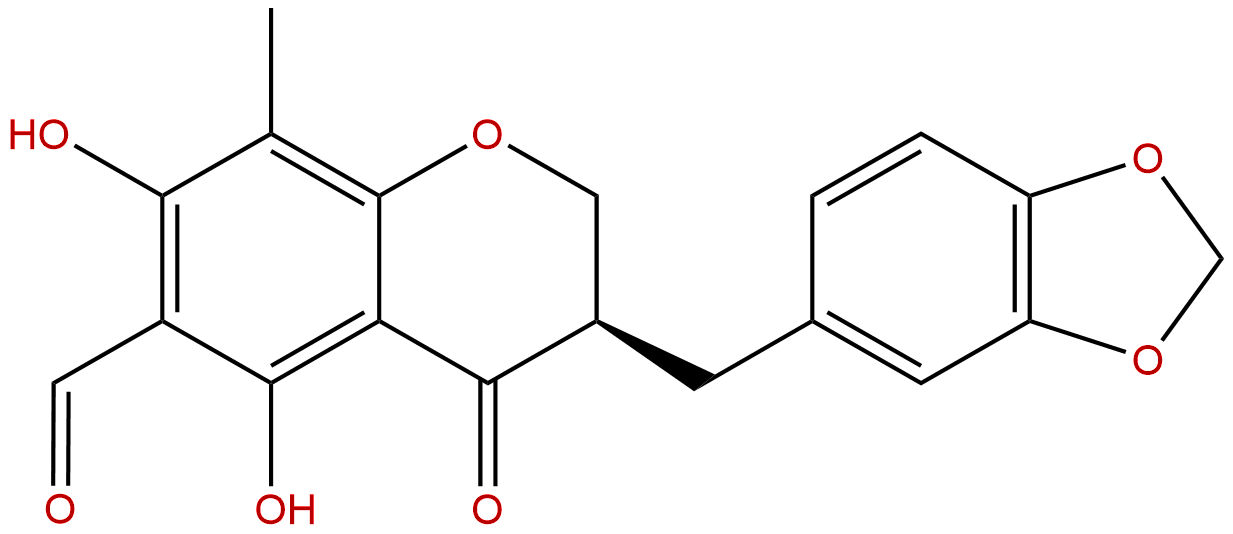
6-Aldehyde-Isoflavonone A belongs to the class of isoflavones and is a characteristic high isoflavone derivative in Ophiopogon medicinal materials. Its molecular formula is C20H20O6 and its molecular weight is 356.3300. Its core structure is a dihydrochromenone skeleton (isoxanthone), with specific substituents on its A and B rings. The "6-aldehyde group" in its name indicates that there is an aldehyde group (- CHO) attached to the 6th position of the isoflavanone skeleton, which is one of its important active functional groups and may affect its biological activity by participating in the formation of Schiff bases or interacting with the amino groups of proteins. Isoflavones from Ophiopogon indicate their origin from plants of the Ophiopogon genus and their basic skeletal types.
From the analysis of physical and chemical properties, the calculated lipid water partition coefficient (LogP) of this compound is 2.3641, indicating that it has moderate lipophilicity, which is conducive to its penetration of cell membranes, but not causing distribution or metabolic problems due to excessive lipid solubility. Its topological polar surface area (TPSA) is 102.2900 Å ², reflecting the presence of multiple polar atoms (such as aldehyde, ketone carbonyl, and ether oxygen atoms) in the molecule, which are crucial for its solubility and hydrogen bonding interactions with target proteins. The predicted water solubility value is 0.1379 (usually measured in mg/mL or log mol/L scale, indicating low solubility), which is consistent with the properties of most flavonoids and suggests that solubilization strategies may need to be considered in formulation development. Taking into account its molecular weight (<500), LogP (<5), number of rotatable bonds (moderate), and number of hydrogen bond donors and acceptors, this compound basically conforms to Lipinski's "Five Rules" and has a good drug like basis.
Plant sources and extraction methods
6-Aldehyde-Iso Ophiopogon flavanone A is mainly derived from the Liliaceae family and the Ranunculaceae genus(Ophiopogon)Heshan Ophiopogon genus(Liriope)Various plants, including Ophiopogon japonicus(Ophiopogon japonicus)Heshan Maidong(Liriope spicata)The most common. These plants have the effects of nourishing yin, generating fluids, moistening the lungs, and clearing the heart in traditional Chinese medicine theory. They are commonly used to treat diseases such as dry cough, restlessness, insomnia, and constipation. Modern pharmacological research has also revealed significant anti-inflammatory, antioxidant, and cardiovascular protective effects. 6-Aldehyde-isoquercetin A is one of the important secondary metabolites that exert pharmacological activity in these medicinal plants.
Its extraction and separation usually follow the conventional process of natural product chemistry. Firstly, the dried roots of Ophiopogon japonicus or Ophiopogon japonicus are crushed and subjected to reflux extraction or ultrasound assisted extraction using polar solvents such as methanol, ethanol, or aqueous ethanol. The crude extract obtained was concentrated under reduced pressure and subjected to gradient extraction using solvents such as petroleum ether, ethyl acetate, and n-butanol. The target compounds were mostly enriched in the ethyl acetate extraction site. Further purification relies on various chromatographic techniques, including silica gel column chromatography (gradient elution with chloroform methanol or petroleum ether ethyl acetate system), reverse phase C18 column chromatography (elution with methanol water or acetonitrile water system), and high performance liquid chromatography (HPLC) or preparative thin layer chromatography (PTLC) for final refinement. Structural identification involves the comprehensive use of spectroscopic methods such as ultraviolet spectroscopy (UV), infrared spectroscopy (IR), mass spectrometry (MS, especially high-resolution mass spectrometry HR-MS), and nuclear magnetic resonance spectroscopy (NMR, including 1H NMR, 13C NMR, and 2D NMR such as HSQC, HMBC, etc.) to ultimately determine its planar and relative configurations.
Pharmacological activity research
A large number of in vitro and in vivo pharmacological studies have shown that 6-aldehyde isophorone A has a wide range of biological activities, with its core pharmacological effects focused on anti-inflammatory, antioxidant, and immune regulation, especially demonstrating excellent therapeutic potential in colitis models.
-
Anti colitis activity In experimental colitis models induced by dextran sulfate sodium (DSS) or 2,4,6-trinitrobenzenesulfonic acid (TNBS) in mice or rats, administration of 6-aldehyde isophorone A significantly improved disease activity index (DAI), reduced colonic shortening, and lowered colonic histopathological scores (reducing inflammatory cell infiltration, crypt destruction, and ulcer formation). Its effect is comparable or better than positive drugs (such as sulfasalazine), and no significant toxic reactions have been observed.
-
Anti inflammatory and immune regulatory effects In lipopolysaccharide (LPS) - stimulated macrophages (such as RAW264.7 cells) or intestinal epithelial cell models, this compound can dose dependently inhibit the production of nitric oxide (NO), prostaglandin E2 (PGE2), and key pro-inflammatory cytokines (such as tumor necrosis factor - α (TNF - α), interleukin-1 β (IL-1 β), interleukin-6 (IL-6)). It can also regulate the balance of T lymphocyte subsets, inhibit overactivated Th1 and Th17 cell responses, and may promote the function of regulatory T cells (Tregs), thereby restoring immune homeostasis.
-
Antioxidant and Cellular Protective Effects 6-Aldehyde-isoquercetin A has strong free radical scavenging ability, which can enhance the activity of intracellular antioxidant enzymes such as superoxide dismutase (SOD) and glutathione peroxidase (GPx), and reduce the levels of reactive oxygen species (ROS) and malondialdehyde (MDA). In the oxidative stress-induced intestinal epithelial cell injury model, it exhibits significant cell protective effects, maintaining the integrity of the intestinal mucosal barrier (such as upregulating the expression of tight junction proteins ZO-1 and Occludin).
-
Other potential activities Preliminary studies also suggest that the compound may have certain benefits for the cardiovascular system (such as protecting myocardial cells) and the nervous system (such as potential neuroprotection), but these activities require further systematic research.
Mechanism of action and molecular targets
Based on network pharmacology prediction, molecular docking, and experimental verification, the mechanism of action of 6-aldehyde isophoroflavanone A against colitis exhibits multi-target and multi pathway synergistic characteristics, mainly involving the following key targets and pathways:
-
Regulating the TLR4/NF - κ B signaling pathway This is one of the core mechanisms of its anti-inflammatory effect. This compound can directly or indirectly inhibit the activation of Toll like receptor 4 (TLR4), thereby suppressing downstream key signaling molecules such as protein kinase C alpha (PRKCA) and nuclear factor kappa B p65 subunit (RELA). This leads to the obstruction of nuclear translocation of NF - κ B, ultimately inhibiting gene transcription of a series of pro-inflammatory factors (TNF - α, IL-1 β, IL-6) and inflammatory mediators (iNOS, COX-2).
-
Activate Nrf2/ARE antioxidant pathway This compound is an effective activator of nuclear factor E2 related factor 2 (NFE2L2/Nrf2). It can promote the dissociation and translocation of Nrf2 from the cytoplasm to the nucleus, where it binds to antioxidant response elements (ARE), thereby upregulating the expression of phase II detoxifying enzymes such as heme oxygenase-1 (HO-1), NAD (P) H quinone oxidoreductase 1 (NQO1), and antioxidant proteins, enhancing the cell's antioxidant defense ability, and reducing oxidative stress damage to the intestinal mucosa.
-
Inhibition of Pyroptosis Cellular pyroptosis is an important mode of cell death in the pathogenesis of colitis. 6-Aldehyde-isoquercetin A has been shown to inhibit the activation of caspase-1 (CASP1). CASP1 is a key executor of the inflammasome signaling pathway, and its activation cleaves Gasdermin D protein and promotes the mature release of IL-1 β and IL-18. Inhibiting CASP1 can effectively alleviate pyroptosis of intestinal epithelial cells and alleviate inflammation.
-
Regulating lipid metabolism and signaling This compound may participate in regulating bile acid metabolism and lipid mediated inflammatory signaling by acting on the farnesol X receptor (NR1H4/FXR) and the lysophosphatidic acid receptor 2 (LPAR2). Activating FXR helps maintain intestinal barrier function and immune balance. Meanwhile, it can also inhibit sphingosine kinase 1 (SPHK1) and reduce the production of pro-inflammatory lipid mediator sphingosine-1-phosphate (S1P).
-
Affects the endogenous cannabinoid system and esterase The regulatory effects of fatty acid amide hydrolase (FAAH) and carboxylesterase 1 (CES1) suggest that they may indirectly exert anti-inflammatory and analgesic effects by affecting the hydrolysis metabolism of endogenous cannabinoids (such as peanut tetraethylenediamine) and other lipid signaling molecules.
In summary, 6-Aldehyde-Iso Ophiopogon flavanone A forms a complex and effective networked mechanism for treating colitis by synergistically acting on key biological processes such as inflammation, oxidative stress, cell death, and lipid metabolism.
Evaluation of drug properties and pharmacokinetics
Although 6-Aldehyde-Iso Ophiopogon flavanone A exhibits good pharmacological activity, its potential as a drug still requires systematic pharmacological evaluation.
-
Physicochemical and Preliminary ADMET Properties As mentioned earlier, its molecular weight, LogP, TPSA and other parameters meet the basic requirements of drug likeness. Predicting a 'low' blood-brain barrier (BBB) penetration may be advantageous for anti colitis drugs primarily targeting peripheral intestinal diseases, as it may reduce central nervous system side effects. The key toxicity warning indicators show that it does not significantly inhibit hERG potassium channels ("no"), indicating a low risk of causing QT interval prolongation in the heart. The Ames test predicts a value of 0.6 (usually represented by a mutation index, which may indicate a lower risk of mutagenicity if it is less than 1.5), but this is a calculated prediction value that must be confirmed through experiments (such as bacterial recovery mutation test).
-
Pharmacokinetic (PK) Challenge Flavonoids generally face the problem of low oral bioavailability, and 6-aldehyde isophorone A may be no exception. Its moderate LogP and lower predicted water solubility may lead to limited dissolution and absorption in the gastrointestinal tract. In addition, as a compound containing phenolic hydroxyl and aldehyde groups, it is highly prone to undergo phase II metabolic binding reactions (such as glucuronidation and sulfation) in vivo, as well as possible aldehyde reduction or oxidation, resulting in significant first pass effects, low blood drug concentrations, and fast elimination. The enterohepatic circulation may contribute to the maintenance of its local concentration in the intestine.
-
Formulation strategy Future pharmaceutical research is crucial to improve its pharmacological properties. Possible strategies include:① Prodrug design Modify its phenolic hydroxyl or aldehyde groups to prepare prodrugs that release the original drug in a specific intestinal environment, in order to improve oral absorption and targeting.② New drug delivery system Develop drug delivery systems based on nanocrystals, liposomes, solid dispersions, or self microemulsions to significantly improve their solubility and dissolution rate.③ Targeted delivery Using colon targeted materials (such as pH dependent, time-dependent, or enzyme triggered coatings) to prepare microspheres or capsules for specific drug release in the colon, increasing local drug concentration while reducing systemic exposure and side effects.
At present, there is still a relative lack of in vivo pharmacokinetic studies on the compound system, such as the full process parameters of absorption, distribution, metabolism, and excretion, which is a key data gap that must be filled to advance its preclinical development.
Clinical application prospects and prospects
6-Aldehyde-Iso Ophiopogon flavanone A, as an active natural product derived from traditional Chinese medicine, has shown great potential for development in the treatment of inflammatory bowel diseases, especially ulcerative colitis.
-
Treatment positioning It is expected to be developed into a novel oral or topical anti colitis drug for inducing remission and maintenance therapy in patients with mild to moderate activity. Its multi-target mechanism of action may provide an alternative option for patients with poor efficacy or drug resistance to existing drugs such as anti TNF - α monoclonal antibodies. In addition, its antioxidant and mucosal protective effects may help promote mucosal healing, which is an important goal of IBD treatment.
-
Potential for combination therapy Given its unique mechanism of action (such as activating Nrf2 and inhibiting pyroptosis), when used in combination with existing standard therapeutic drugs (such as 5-ASA and immunosuppressants), it may produce a synergistic effect, reduce their respective dosages, thereby reducing adverse reactions and improving efficacy.
-
Expand indications Its core anti-inflammatory and antioxidant mechanisms also suggest that it may have application value in other chronic inflammatory diseases, such as non-alcoholic steatohepatitis (NASH), arthritis, atherosclerosis and some neurodegenerative diseases, which is worth further exploration.
-
Future research directions:
- In depth mechanism research Using techniques such as gene knockout/knock in animals and CRISPR-Cas9 to validate its key targets at a more precise level and elucidate the specific details of its network pharmacology.
- Systematic pharmacokinetics and toxicological evaluation Complete comprehensive preclinical pharmacokinetic studies and conduct safety evaluations for acute, chronic, and reproductive toxicity to clarify their treatment window.
- Structural optimization and derivative development Using it as the parent nucleus, systematic structure-activity relationship studies and structural modifications are conducted with the aim of improving its activity, metabolic stability, oral bioavailability or targeting, and obtaining better candidate compounds.
- Clinical translational research After completing sufficient preclinical research, promote its entry into clinical trials to verify its safety and efficacy in humans.
Conclusion
6-Aldehyde-Isoflavonone A is a type of isoflavone compound with significant anti colitis activity isolated from traditional Chinese medicine Ophiopogon japonicus. It exerts a good therapeutic effect in experimental colitis models through multi-target and multi pathway synergistic effects, including inhibiting TLR4/NF - κ B mediated inflammatory response, activating Nrf2 driven antioxidant defense, inhibiting CASP1 dependent cell apoptosis, and regulating lipid metabolism related receptors. Although it exhibits certain pharmacological properties and preliminary ADMET predictions, pharmacokinetic issues such as oral bioavailability remain the main challenges for its drug conversion. In the future, through in-depth mechanism elucidation, systematic optimization of drug properties, and innovative formulation strategies, 6-aldehyde isophorone A is expected to be developed as a novel candidate drug for the treatment of colitis, providing not only new treatment options for IBD patients but also valuable examples for the development of innovative drugs based on natural products.