


Synonym name: Populnin
Catalogue No.: BP0825
Cas No.: 16290-07-6
Formula: C21H20O11
Mol Weight: 448.38
Botanical Source: Thespesia populnea and many other plant spp.
Purity: 95%~99%
Analysis Method: HPLC-DAD or/and HPLC-ELSD
Identification Method: Mass, NMR
Packing: Brown vial or HDPE plastic bottle
Can be supplied from milligrams to grams.
For Reference Standard and R&D, Not for Human Use Directly.
Inquire for bulk scale.
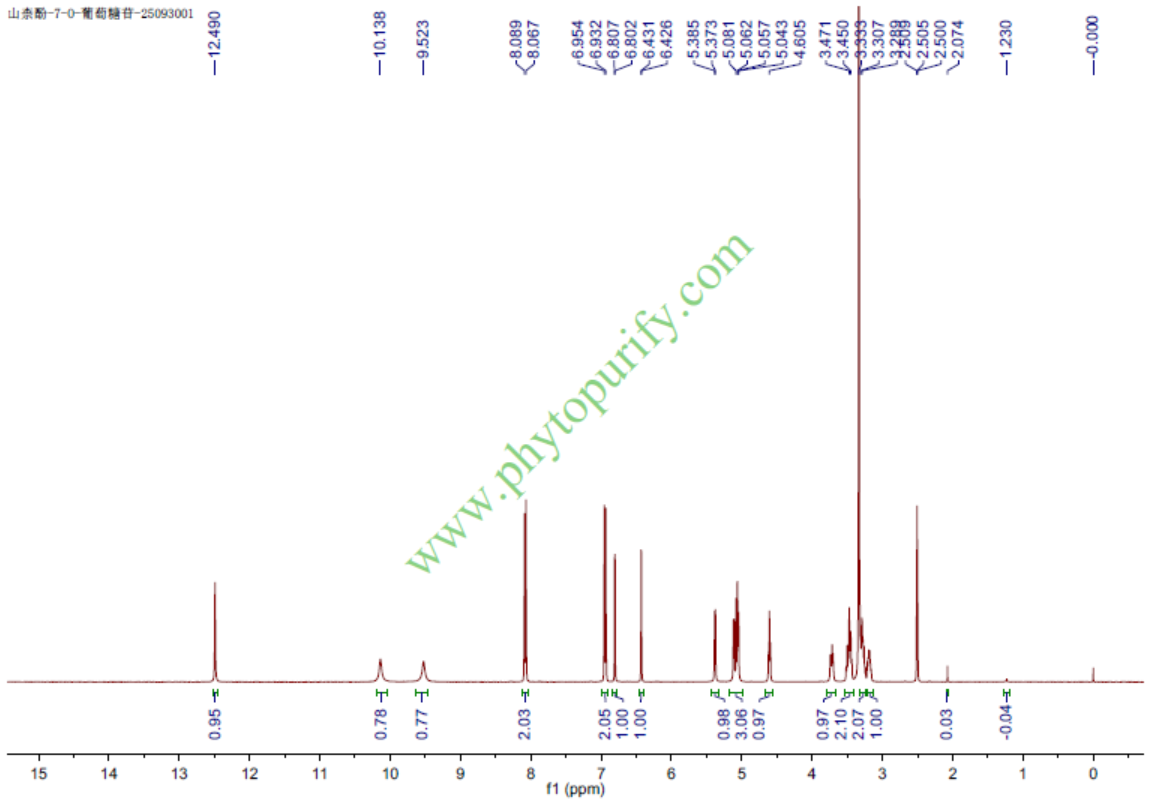
HNMR-山奈酚-7-O-葡萄糖苷-Kaempferol-7-O-β-D-glucopyranoside
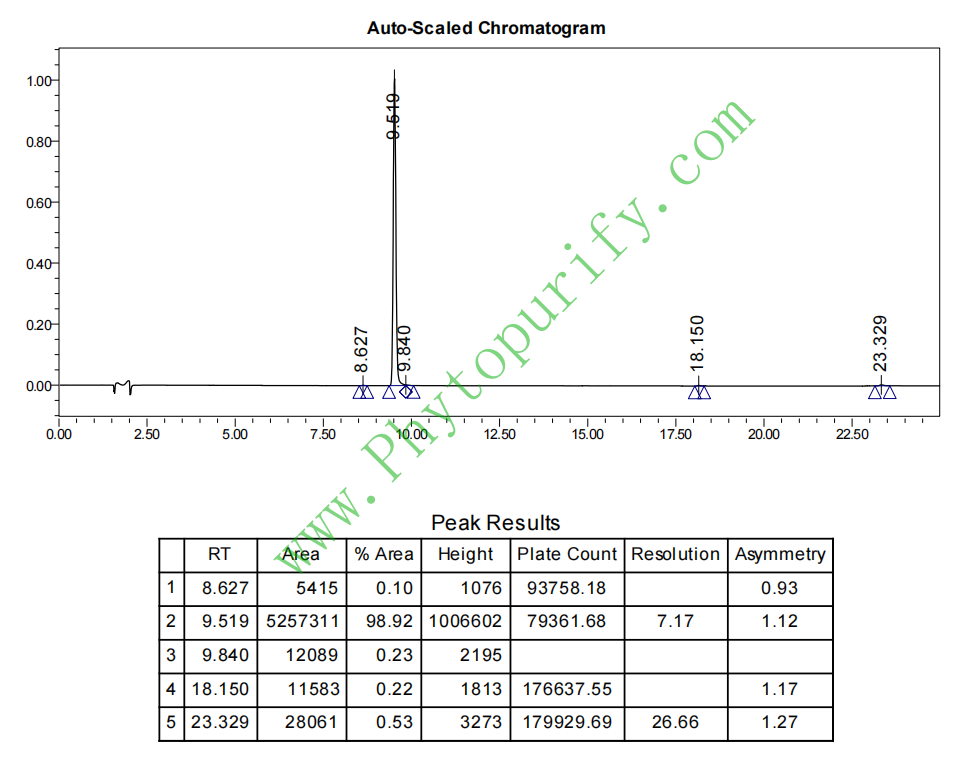
HPLC of Kaempferol-7-O-beta-D-glucopyranoside
Storage conditions:Short-term storage at 2~8℃, long-term storage at -20 ~ -80℃
Kaempferol-7-O-beta-D-glucopyranoside (CAS number 16290-07-6) is a typical flavonoid compound mainly isolated from the flowers of Malus pumila Mill. As an important member of flavonoid natural products, kaempferol-7-O-glucoside has attracted widespread attention in the fields of pharmacology and natural product chemistry in recent years due to its unique chemical structure and diverse biological activities. It mainly exhibits significant antioxidant, anti-inflammatory, and procoagulant activities, demonstrating potential application value in the prevention and treatment of various diseases.
Antioxidant damage is an important pathological basis for the occurrence and development of various chronic diseases, such as neurodegenerative diseases, cardiovascular diseases, and inflammatory diseases. Kaempferol-7-O-glucoside effectively alleviates oxidative stress and protects cells from free radical damage by regulating various antioxidant related targets such as NFE2L2 (NRF2), SOD1, CAT, GPX1, HMOX1, and SOD2. In addition, its anti-inflammatory effect is closely related to regulating the expression of pro-inflammatory factors, further expanding its potential application in inflammatory diseases. This article will provide a systematic review of the chemical structure and physicochemical properties, plant sources and extraction methods, pharmacological activity and mechanism of action, pharmacological evaluation and pharmacokinetic characteristics of kaempferol-7-O-glucoside, and explore its clinical application prospects and future research directions.
Kaempferol-7-O-glucoside belongs to the flavonoid glycoside class of flavonoids, with a molecular formula of C21H20O11 and a molecular weight of 448.38. Its structural core is Kaempferol, which is connected to a β - D-glucoside bond through a 7-hydroxyl group to form 7-O-glucoside. This structure endows it with high polarity and water solubility, with a TPSA (topological polar surface area) of 190.28 Å ², indicating its strong polar groups, especially multiple hydroxyl and glycoside moieties.
In terms of physical and chemical properties, the LogP value of kaempferol-7-O-glucoside is 0.0879, indicating its strong hydrophilicity and water solubility of 1.1903, making it suitable for biological activity in aqueous systems. Its molecular structure contains multiple hydroxyl groups, which can form hydrogen bonds with biomolecules, enhancing its biological activity and targeted binding ability. The low permeability of the blood-brain barrier suggests that its direct effect on the central nervous system may be limited, but this also reduces the potential toxicity risk to the central nervous system. The negative result of hERG channel inhibition experiment indicates a low risk of cardiac toxicity. The Ames mutagenicity test score is 0.6, indicating a low risk of genotoxicity and a good safety foundation.
Kaempferol-7-O-glucoside mainly comes from the flowers of Malus pumila Mill., a plant in the apple genus. This plant is widely distributed in temperate regions, and its flowers are rich in various flavonoids and polyphenolic compounds, making it an important resource in traditional medicine and the food industry. After flower collection, it is usually dried and crushed for easy extraction.
The extraction method often uses solvent extraction combined with column chromatography for separation and purification. Common solvents include ethanol, water, methanol, and their mixed solvent systems. The typical process is to repeatedly reflux extract the dried powder with 70% ethanol, filter and concentrate it, and then separate and purify it by silica gel column chromatography or reverse phase high performance liquid chromatography (RP-HPLC). Purity testing is often confirmed using HPLC-UV and mass spectrometry techniques. In recent years, green extraction techniques such as ultrasound assisted extraction (UAE) and microwave-assisted extraction (MAE) have also been applied to improve extraction efficiency and purity.
The antioxidant activity of kaempferol-7-O-glucoside is one of its most significant pharmacological properties. In vitro studies have shown that the compound can effectively scavenge free radicals such as DPPH and ABTS, inhibit lipid peroxidation, and protect cells from oxidative stress damage. In cell models, kaempferol-7-O-glucoside can significantly increase the activity of intracellular superoxide dismutase (SOD), catalase (CAT), and glutathione peroxidase (GPX1), reduce reactive oxygen species (ROS) levels, and alleviate oxidative damage.
In animal experiments, kaempferol-7-O-glucoside activates the NFE2L2 (NRF2) signaling pathway, induces downstream antioxidant enzymes such as HMOX1 expression, enhances the body's antioxidant defense ability, reduces myocardial ischemia-reperfusion injury and neuronal oxidative damage, and demonstrates good protective effects.
Inflammatory response is a common pathological process in various diseases. Kaempferol-7-O-glucoside exhibits significant anti-inflammatory effects by inhibiting the expression of pro-inflammatory factors such as TNF - α, IL-1 β, and IL-6, reducing the release of inflammatory mediators. Its mechanism of action is partially attributed to inhibiting the activation of the NF - κ B signaling pathway and reducing the transcription of inflammatory genes. In addition, the compound can also regulate the MAPK pathway, further inhibiting inflammatory responses.
There is limited research on the procoagulant activity of kaempferol-7-O-glucoside, but existing data suggests that it can promote platelet aggregation and shorten clotting time, possibly by regulating coagulation factor activity and platelet function. This characteristic suggests its potential application value in hemostasis and wound repair, but caution should also be exercised about its possible thrombotic risk.
The main mechanism of action of kaempferol-7-O-glucoside is focused on the regulation of antioxidant and anti-inflammatory signaling pathways. Its core target is NFE2L2 (NRF2), a transcription factor that is a key regulatory factor for cellular antioxidant defense. Kaempferol-7-O-glucoside promotes NRF2 nuclear translocation, enhances its binding to antioxidant response elements (ARE), induces the expression of downstream antioxidant enzymes such as SOD1, SOD2, CAT, GPX1, and HMOX1, and enhances the cell's ability to clear ROS.
In addition, the compound has an inhibitory effect on the NF - κ B signaling pathway, reducing the expression of pro-inflammatory cytokines and alleviating inflammatory responses. Its regulation of the MAPK pathway further enhances the anti-inflammatory mechanism.
The procoagulant activity may involve the regulation of platelet membrane receptor and coagulation factor activity, but the specific molecular targets are not yet clear and require further research.
The pharmacological evaluation of kaempferol-7-O-glucoside shows that it has good safety and pharmacological potential. The molecular weight of 448.38 is moderate, and the LogP is close to zero, indicating its strong hydrophilicity, which is conducive to oral absorption and in vivo distribution. A higher TPSA value indicates greater polarity, which may limit cell membrane permeability, especially the lower permeability of the blood-brain barrier, which may limit the role of the central nervous system.
The hERG channel inhibition experiment results were negative, reducing the risk of cardiac toxicity. The Ames test score is 0.6, indicating a low risk of genotoxicity and good safety.
In terms of pharmacokinetics, current research on in vivo metabolism and excretion is relatively limited. Considering its glycoside structure, it may be hydrolyzed by gut microbiota and liver enzymes to form kaempferol, which has high biological activity and good pharmacokinetic properties. In the future, it is necessary to systematically study its absorption, distribution, metabolism, and excretion (ADME) characteristics to guide clinical applications and dosage form design.
Kaempferol-7-O-glucoside has shown broad application prospects in various oxidative stress-related diseases due to its significant antioxidant and anti-inflammatory activities. It has potential preventive and therapeutic value in the fields of cardiovascular disease, neurodegenerative diseases, chronic inflammatory diseases, and metabolic syndrome.
In addition, its procoagulant activity provides new ideas for hemostasis and wound repair, but the risk of thrombosis should be carefully evaluated. In the future, its pharmacokinetic performance can be optimized through structural modification and drug carrier technology to improve bioavailability and targeting.
In terms of clinical translation, systematic toxicological evaluation and preclinical efficacy verification are still needed to clarify the effective dosage and safety range. Combining modern drug development technologies such as nanocarriers, sustained-release formulations, and combination therapy strategies is expected to accelerate its clinical application process.
As an important natural flavonoid product, kaempferol-7-O-glucoside has shown great pharmacological potential and potential as a drug due to its unique chemical structure and diverse biological activities. It exerts significant antioxidant and anti-inflammatory effects by regulating key antioxidant signaling pathways such as NFE2L2/NRF2, providing new molecular basis and drug candidates for the prevention and treatment of related diseases.
Future research should focus on further elucidating its molecular mechanism of action, optimizing extraction and synthesis processes, improving pharmacokinetics and safety evaluation, and promoting its translation into clinical applications. With the continuous advancement of natural product pharmacology and drug development technology, kaempferol-7-O-glucoside is expected to become an important representative of natural flavonoid drug development, contributing new strength to human health.
