


Product name: Cardanol C13:0
Synonym name: 3-Tridecylphenol;m-Tridecylphenol
Catalogue No.: BP2431
Cas No.: 72424-02-3
Formula: C19H32O
Mol Weight: 276.464
Botanical Source: Ginkgo biloba L.
Type of Compound: Phenols
Purity: 95%~99%
Analysis Method: HPLC-DAD or/and HPLC-ELSD
Identification Method: Mass, NMR
Packing: Brown vial or HDPE plastic bottle
Storage: Store in a well closed container, protected from air and light. Put into refrigerate or freeze for long term storage.
Whenever possible, you should prepare and use solutions on the same day. However, if you need to make up stock solutions in advance, we recommend that you store the solution as aliquots in tightly sealed vials at -20℃. Generally, these will be useable for up to two weeks.
The product could be supplied from milligrams to grams
Inquire for bulk scale.
For Reference Standard and R&D, Not for Human Use Directly.
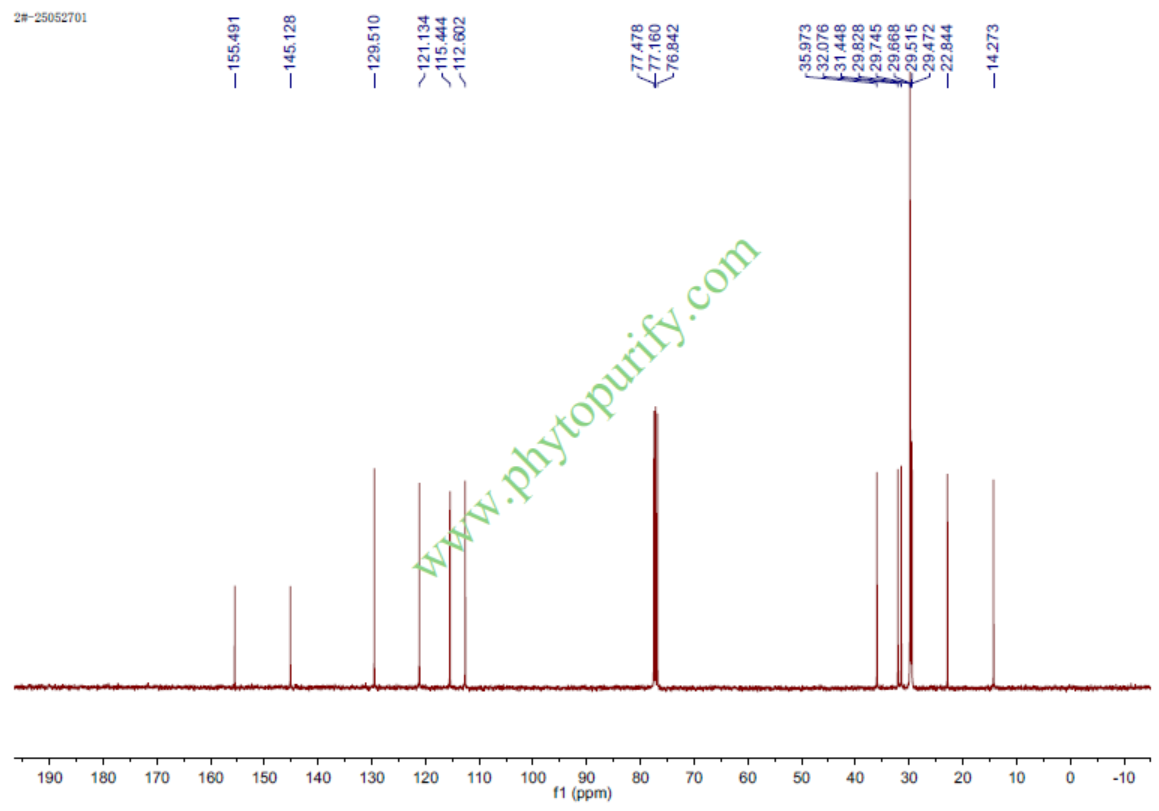
NMR of Cardanol C13:0
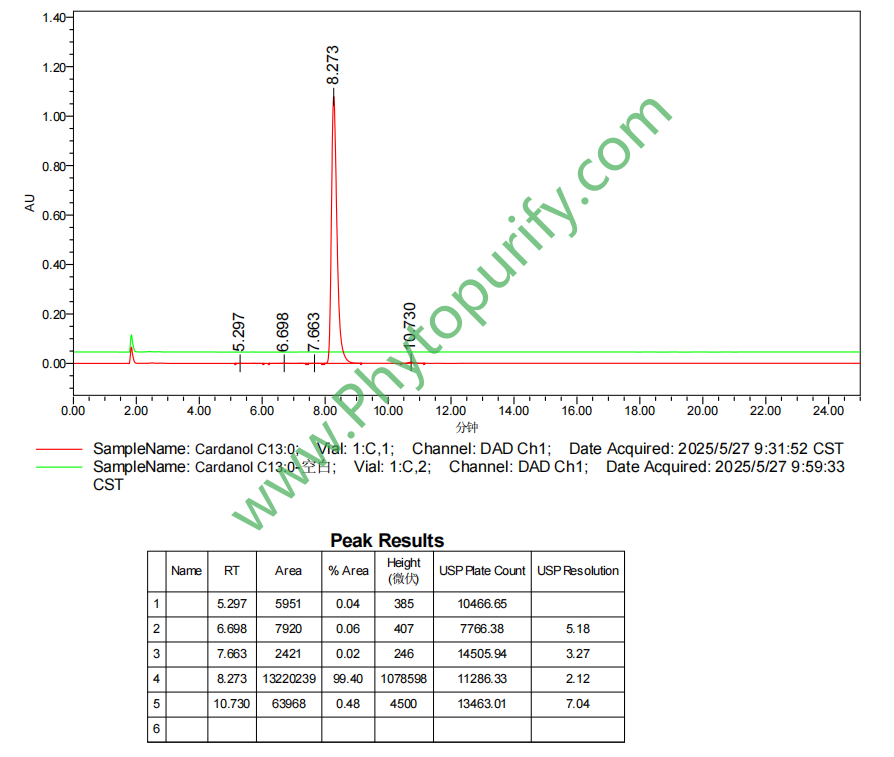
HPLC of Cardanol C13:0
Storage conditions:Short-term storage at 2~8℃, long-term storage at -20 ~ -80℃
20.2300
6.5000
Unknown
null
Yes
Unknown
Unknown
Unknown
Unknown
Unknown
null
Natural products, as important sources of drug lead compounds, play an indispensable role in the long history of human struggle against diseases. Among the diverse family of natural phenolic compounds, Cardanol, as one of the main components of Cashew Nut Shell Liquid (CNSL), has received increasing attention in recent years due to its unique chemical structure and extensive biological activity. Cashew phenols are not a single compound, but a mixture of phenolic compounds with different degrees of saturation and chain length (usually C15) alkyl side chains between the benzene rings. Among them, fully saturated 3-tetradecylphenol, also known as Cardanol C13:0 (CAS number: 72424-02-3), is the simplest and most representative saturated homolog in this family.
The molecular structure of cashew phenols C13:0 consists of a phenolic hydroxyl group and a long-chain alkyl group (C13H27) located in the meta position. This unique amphiphilic structure of "polar head (phenolic hydroxyl) - non-polar tail (long alkyl chain)" endows it with unique physicochemical properties and biological characteristics that differ from simple phenols or long-chain fatty acids. From a plant chemistry perspective, cashew phenols mainly come from cashews(Anacardium occidentale L. The by-product during the processing - cashew shell liquid. As a renewable and low-cost agricultural waste resource, the development and utilization of cashew shell liquid and its components have important economic and ecological value.
Early research mainly focused on the application of cashew phenols in the industrial field, such as as as raw materials for surfactants, coatings, resins, and friction materials. However, with the deepening of modern pharmacological research, the biological activity potential of cashew phenols C13:0 and its analogues has gradually been revealed. Research has shown that cashew phenols C13:0 exhibit various pharmacological activities, including antibacterial, anti-inflammatory, antioxidant, anti-tumor, and enzyme inhibition. These discoveries have transformed it from an industrial raw material to a research hotspot in the fields of medicinal chemistry and natural product pharmacology.
Although cashew phenols C13:0 exhibit remarkable biological activity potential, their drug like evaluation, particularly their high lipid solubility (LogP=6.5) and limited polar surface area (TPSA=20.23), presents both opportunities and challenges for their subsequent drug development. High lipophilicity is beneficial for its penetration through biological membranes, but it may also lead to poor water solubility, metabolic instability, and potential toxicity issues. At present, key pharmacological parameters such as blood-brain barrier permeability, hepatotoxicity, cardiotoxicity, and genetic toxicity are still unknown, which constitutes the main bottleneck for the transformation from active compounds to clinical candidate drugs.
This article aims to provide a systematic professional review of cashew phenols C13:0. The article will first elaborate on its chemical structure and physicochemical properties, then trace its plant origin and extraction process, focus on reviewing its pharmacological activity research progress in antibacterial, anti-inflammatory, anti-tumor and other aspects, and deeply explore its potential mechanisms of action and molecular targets. On this basis, combined with its pharmacological parameters, a preliminary evaluation of its pharmacokinetic characteristics and safety is conducted, and finally, the clinical application prospects and future research directions in the pharmaceutical field are discussed. Through this review, it is expected to provide comprehensive and systematic scientific basis for the in-depth research and rational development of cashew phenols C13:0.
Cashew nut phenol C13:0, also known as 3-Tridecylphenol, has a core structure consisting of a benzene ring. The 1st position of the benzene ring is connected to a phenolic hydroxyl group (- OH), and the 3rd position (i.e. the meta position) is connected to a fully saturated linear tridecyl group (- C13H27). This structural feature distinguishes it from other homologues in the cashew phenol family that contain unsaturated bonds (such as C15:1, C15:2, C15:3). The molecular formula is C19H32O, with a molecular weight of 276.46 g/mol.
From the perspective of physicochemical properties, cashew phenols C13:0 exhibit typical "amphiphilic" molecular characteristics. The phenolic hydroxyl group endows the molecule with a certain polarity and hydrogen bond donor/acceptor ability, while the long-chain alkyl group endows it with extremely strong hydrophobicity. This structure directly determines its key physicochemical parameters:
1. Fat solubility (LogP)The calculated LogP value is 6.5. This is a very high value, indicating that the compound has strong lipophilicity and is highly soluble in organic solvents such as ethanol, ether, chloroform, n-hexane, etc., while its solubility in water is extremely low. A high LogP value means that the compound can easily penetrate the lipid bilayer of the cell membrane, which is closely related to its subsequent observed multiple biological activities (such as antibacterial and anti-tumor), but also poses challenges for its in vivo delivery and pharmacokinetic properties.
2. Polarized surface area (TPSA)Its TPSA is only 20.23 Å ². TPSA is an important indicator for measuring the ability of compound molecules to penetrate cell membranes, especially the blood-brain barrier. It is generally believed that molecules with TPSA less than 60-70 Å ² have good cell membrane penetration. The extremely low TPSA value of cashew phenol C13:0 further confirms its excellent membrane permeability, suggesting that it may have high oral bioavailability and broad tissue distribution ability, including potential brain distribution.
3. Hydrogen bond acceptor and donor The molecule has only one hydrogen bond acceptor (oxygen atom of phenolic hydroxyl group) and one hydrogen bond donor (hydrogen atom of phenolic hydroxyl group). This limited ability to form hydrogen bonds is also one of the reasons for its high lipid solubility and low water solubility.
4. chemical stability As a phenolic compound with a saturated alkyl chain, cashew phenols C13:0 have higher chemical stability compared to their unsaturated counterparts (such as cashew phenols C15:1) and are less prone to oxidation or polymerization reactions. This gives it an advantage in storage and formulation processes.
Overall, the chemical structure of cashew phenols C13:0 determines its core physicochemical characteristics of high lipid solubility, low water solubility, and easy membrane permeability. These properties are not only the structural basis for its various pharmacological activities, but also the key factors that need to be considered in the evaluation of its pharmacological properties. Its high LogP value suggests that it may follow the "hydrophobicity" restriction in the Lipinski Five Rules (LogP<5), indicating potential absorption and metabolic challenges in oral drug development.
Cashew phenol C13:0 is not a rare compound that exists independently in nature, but a key component in the complex natural product mixture of cashew shell liquid (CNSL). The cashew shell is a cashew nut(Anacardium occidentale L. The main by-products during the processing account for about 67% of the total weight of the fruit. Waist fruit shell consists of three layers: outer skin (smooth, thin), middle skin (honeycomb like, rich in oily liquid), and inner skin (hard, dense). CNSL is a dark brown, viscous oily liquid that exists in the honeycomb structure of the mesocarp, accounting for approximately 20-25% of the shell weight.
The chemical composition of CNSL is complex, mainly consisting of four phenolic compounds: Anacardial Acid, Cardanol, Cardol, and 2-methyl Cardol. Among them, cashew phenols are the main products of CNSL in industrial thermal processing. In natural CNSL (usually obtained by cold pressing), the content of malic acid is the highest (about 60-70%), while the content of cashew phenols is relatively low (about 10%). However, in commercial industrial grade CNSL, high temperature extraction (such as baking, steam, or solvent extraction) is commonly used, during which cashew acid undergoes thermal decarboxylation reaction and is converted into the corresponding cashew phenols. Therefore, the content of cashew phenols in industrial grade CNSL can reach as high as 60-70%, becoming its main component.
Cashew phenols themselves are also a mixture, with alkyl side chains mainly consisting of 15 carbon atoms (C15), but with varying degrees of saturation, including:
-Triene (C15:3): Approximately 41-43%
-Monoene (C15:1): about 34-36%
-Diene (C15:2): about 16-19%
-Saturation (C15:0): about 2-5%
The cashew phenol C13:0, also known as 3-tetradecylphenol, which has an alkyl chain of 13 carbon atoms, is the focus of this article. Its content is extremely low in natural cashew phenol mixtures and is usually not the main component. It may be a product of specific biosynthesis or degradation processes of C15 cashew phenols, or obtained through chemical synthesis.
Extraction and purification methods:
Obtaining high-purity cashew phenols C13:0 usually requires the following steps:
1. Extraction of CNSL The most commonly used method is solvent extraction. Dry and crushed cashew shells are subjected to Soxhlet extraction or soaking extraction using non-polar or moderately polar solvents such as n-hexane, petroleum ether, ether, or ethanol. The extraction solution was subjected to vacuum distillation to recover the solvent, resulting in crude CNSL.
2. Enrichment of cashew phenols The most classic methods for separating cashew phenols from CNSL are urea encapsulation or column chromatography. The urea inclusion method utilizes the characteristic of urea forming inclusion complexes with straight chain fatty acids/alcohols to preferentially remove saturated or monounsaturated components in CNSL, thereby enriching cashew phenols. The more commonly used method is silica gel column chromatography, which uses different ratios of petroleum ether/ethyl acetate or n-hexane/ether as eluents to elute and separate components such as malic acid, cashew phenols, and cardiac catechins according to polarity differences.
3. Separation and Purification of Cashew Phenol C13:0 Due to the extremely low content of cashew phenols C13:0 in natural mixtures, direct separation and purification from natural sources is costly and inefficient. Therefore, the main way to obtain high-purity cashew phenols C13:0 is chemical synthesis Usually, starting from resorcinol or 3-methoxyphenol, the target product is obtained by introducing a tridecyl chain through Friedel Crafts alkylation reaction, followed by demethylation and other steps. The synthesized product needs to be purified by high-performance liquid chromatography (HPLC) or preparative thin layer chromatography (PTLC), and its structure confirmed by nuclear magnetic resonance (NMR) and mass spectrometry (MS).
In summary, although the plant source of cashew phenols C13:0 is cashew shell liquid, the research samples mainly rely on chemical synthesis due to its extremely low content in natural mixtures. The study of its extraction and purification methods not only helps to understand the chemical complexity of CNSL, but also provides a technical basis for the large-scale preparation of this compound.
In recent years, significant progress has been made in the pharmacological activity research of cashew phenol C13:0, revealing its potential application value in the treatment of multiple diseases. Its activity is mainly attributed to the synergistic effect of its phenolic hydroxyl group and long alkyl chain.
Cashew phenols C13:0 exhibit broad-spectrum antibacterial activity and have inhibitory effects on various Gram positive bacteria, Gram negative bacteria, and fungi.
* antibacterial Research has shown that cashew nut phenol C13:0 has an effect on Staphylococcus aureus(Staphylococcus aureus)Bacillus subtilis(Bacillus subtilis)Gram positive bacteria have strong inhibitory effects, and their minimum inhibitory concentration (MIC) is usually in the micromolar range. Regarding Escherichia coli(Escherichia coli)Pseudomonas aeruginosa(Pseudomonas aeruginosa)The activity of Gram negative bacteria is relatively weak, which may be related to the structural barrier of the outer membrane of Gram negative bacteria. Its antibacterial mechanism is believed to be related to the destruction of the integrity of bacterial cell membranes. Long alkyl chains can insert into the lipid bilayer of bacteria, increasing membrane permeability, leading to leakage of cellular contents and bacterial death.
* antifungal Cashew phenols C13:0 are effective against various pathogenic fungi, such as Candida albicans(Candida albicans)Cryptococcus neoformans(Cryptococcus neoformans)It also exhibits inhibitory activity against various types of dermatophytes, such as Trichophyton rubrum. Its mechanism of action may involve interference with the ergosterol synthesis pathway of fungal cell membranes or direct disruption of membrane structure.
Inflammation is the common pathological basis of various chronic diseases. Cashew phenols C13:0 have shown significant anti-inflammatory effects in both in vitro and in vivo models.
* Inhibit inflammatory mediators Research has shown that cashew phenols C13:0 can effectively inhibit the production of nitric oxide (NO) and prostaglandin E2 (PGE2) in macrophages stimulated by lipopolysaccharide (LPS). This is mainly achieved by inhibiting the expression of inducible nitric oxide synthase (iNOS) and cyclooxygenase-2 (COX-2).
* Inhibit pro-inflammatory cytokines It can also significantly reduce the levels of key pro-inflammatory cytokines such as tumor necrosis factor - α (TNF - α), interleukin-6 (IL-6), and interleukin-1 β (IL-1 β).
* Signaling pathway Its anti-inflammatory effect is closely related to the inhibition of the activation of nuclear factor kappa B (NF - κ B) and mitogen activated protein kinase (MAPK) signaling pathways. By blocking these upstream signaling pathways, cashew nut phenol C13:0 can downregulate the expression of various inflammation related genes at the transcriptional level.
The phenolic hydroxyl structure of cashew phenols C13:0 endows them with certain free radical scavenging ability.
* Directly eliminate free radicals In chemical systems, it can effectively scavenge 1,1-diphenyl-2-trinitrophenylhydrazine (DPPH) free radicals, 2,2 '- diazo-bis-3-ethylbenzothiazoline-6-sulfonic acid (ABTS) cationic free radicals, and has reducing power.
* Cellular protective effect In cell models, cashew phenols C13:0 can alleviate oxidative stress damage induced by oxidants such as hydrogen peroxide (H ₂ O ₂), reduce intracellular reactive oxygen species (ROS) levels, and protect cells from oxidative damage. Its antioxidant activity may have a synergistic relationship with its anti-inflammatory and anti-tumor effects.
Cashew phenols C13:0 exhibit cytotoxic effects on various cancer cell lines, which has sparked interest in the field of anti-tumor drug research.
* cytotoxicity: It has been reported that cashew phenol C13:0 can inhibit the proliferation and induce apoptosis of breast cancer (MCF-7, MDA-MB-231), lung cancer (A549), liver cancer (HepG2), colon cancer (HCT-116), melanoma (B16) and other cancer cell lines. Its IC50 value is usually in the range of 10-50 μ M.
* selectivity It is worth noting that some studies have shown that cashew nut phenol C13:0 has relatively low toxicity to certain normal cells (such as human peripheral blood monocytes), demonstrating a certain degree of selectivity, which provides favorable conditions for its use as an anti-tumor candidate drug.
* mechanism of action Its anti-tumor mechanism involves multiple aspects, including inducing cell cycle arrest (such as G0/G1 phase or G2/M phase arrest), activating mitochondrial apoptosis pathways (such as upregulating Bax/Bcl-2 ratio, releasing cytochrome c, activating Caspase-3/9), inhibiting angiogenesis, and inducing autophagic cell death.
Cashew phenols C13:0 have been found to be inhibitors of various important enzymes associated with diseases.
* Acetylcholinesterase (AChE) inhibition Research has shown that cashew phenols C13:0 have moderate acetylcholinesterase inhibitory activity. AChE inhibitors are first-line drugs for treating neurodegenerative diseases such as Alzheimer's disease. This discovery suggests that cashew phenols C13:0 may have the potential to improve cognitive function.
* Tyrosinase inhibition Cashew phenols C13:0 can inhibit the activity of tyrosinase. Tyrosinase is a key rate limiting enzyme in melanin synthesis, and its inhibitors have application value in whitening cosmetics and the treatment of pigmentary skin diseases.
* Lipase and alpha glucosidase inhibition: Preliminary research also shows that cashew phenol C13:0 may inhibit pancreatic lipase and α - glucosidase, suggesting its potential application in the management of obesity and diabetes.
In addition, cashew phenols C13:0 have been reported to have anti parasitic (such as Leishmania parasites), antiviral (such as herpes simplex virus), and insect repellent activities.
The pharmacological activity of cashew phenols C13:0 does not originate from a single target, but rather acts through multiple targets and pathways. Its core mechanism of action is closely related to its amphiphilic molecular structure, mainly reflected in the following aspects:
This is the most fundamental and direct mechanism of action of cashew phenols C13:0. Its long alkyl chain can be inserted into the lipid bilayer of the cell membrane, while the phenolic hydroxyl group may be located at the membrane water interface. This insertion behavior will:
* Change membrane fluidity Increase the fluidity and permeability of the membrane, and disrupt its integrity.
* Affects membrane protein function Interference with the conformation and function of receptors, ion channels, and enzymes embedded in the membrane.
* Causing content leakage In bacteria and fungi, this membrane disturbance can directly cause leakage of cellular contents (such as ions, ATP, proteins), leading to cell death. This explains the basis of its broad-spectrum antibacterial activity.
Cashew phenols C13:0 can regulate multiple key intracellular signaling pathways, which is the core of their anti-inflammatory and anti-tumor activities.
* NF - κ B pathway NF - κ B is a core transcription factor in inflammation and cancer. Cashew phenols C13:0 can inhibit the phosphorylation and degradation of I κ B α, thereby preventing the translocation of NF - κ B from the cytoplasm to the nucleus and inhibiting the transcription of downstream target genes such as iNOS, COX-2, TNF - α, IL-6, Bcl-2, etc.
* MAPK pathway The MAPK family (including ERK, JNK, p38) plays a crucial role in cell proliferation, differentiation, and apoptosis. Cashew phenols C13:0 can inhibit LPS or growth factor induced MAPK phosphorylation, thereby blocking its pro-inflammatory and pro proliferative signals.
* PI3K/Akt/mTOR pathway This pathway is a key regulator of cell growth and survival. Cashew phenols C13:0 have been found to inhibit Akt phosphorylation, thereby inducing apoptosis and autophagy in cancer cells.
* Nrf2/ARE pathway Nrf2 is a key transcription factor in the cellular antioxidant defense system. Cashew phenols C13:0 may exert cell protective effects by activating the Nrf2 pathway and upregulating the expression of a series of antioxidant enzymes such as HO-1 and NQO1.
Cashew phenols C13:0 can directly bind to the active sites of certain enzymes, inhibiting their catalytic activity.
* Acetylcholinesterase (AChE)Molecular docking studies have shown that the phenolic hydroxyl group of cashew phenols C13:0 can form hydrogen bonds and π - π stacking interactions with key amino acid residues at the active site of AChE (such as Trp84, Phe330), while the long alkyl chain occupies the hydrophobic channel of the enzyme, thereby inhibiting its ability to hydrolyze acetylcholine.
* tyrosinase Cashew phenols C13:0 inhibit their catalytic activity for the oxidation of L-tyrosine and L-dopa by chelating with copper ions in the active center of tyrosinase or competing with substrates.
* COX-2 and 5-LOX Its anti-inflammatory activity is partially derived from direct inhibition of key enzymes COX-2 and 5-lipoxygenase (5-LOX) involved in arachidonic acid metabolism, thereby reducing the production of inflammatory mediators PGE2 and leukotrienes.
In cancer cells, cashew phenols C13:0 mainly induce apoptosis through the mitochondrial pathway (endogenous pathway).
* Mitochondrial membrane potential loss After processing cancer cells, the mitochondrial membrane potential (Δ PSI m) decreases.
* Bcl-2 family protein imbalance Upregulation of pro apoptotic protein Bax and downregulation of anti apoptotic protein Bcl-2 lead to an increase in Bax/Bcl-2 ratio.
* cytochrome c release Increased mitochondrial outer membrane permeability leads to the release of cytochrome c into the cytoplasm.
* Caspase cascade activation Cytochrome c binds to Apaf-1, activating Caspase-9 and subsequently activating downstream execution of Caspase-3/7, ultimately leading to DNA fragmentation and cell apoptosis.
In addition, cashew phenols C13:0 can induce autophagic cell death in cancer cells, manifested by an increase in LC3-II/I ratio and p62 protein degradation, which may be a potential mechanism for overcoming tumor drug resistance.
To advance cashew phenol C13:0 from an active compound to a clinical candidate drug, a systematic evaluation of its drug like and pharmacokinetic (ADME) properties is necessary. Based on its structural features and existing data, we conduct the following analysis:
According to Lipinski's "Rule of Five", the molecular weight (276.46<500) and hydrogen bond donor/acceptor number (1<5/10) of cashew phenols C13:0 meet the requirements. However, it The LogP value is 6.5, far above the threshold of 5 This constitutes a significant violation. A high LogP value indicates:
* Poor water solubility Extremely low water solubility can seriously affect its oral absorption and in vivo delivery.
* High metabolic clearance rate Highly lipophilic compounds are usually easily metabolized rapidly by the cytochrome P450 enzyme system (CYP450) in the liver, resulting in a short half-life and low bioavailability.
* High plasma protein binding rate Easy to bind with plasma proteins (such as albumin), thereby reducing the concentration of free drugs and affecting their efficacy.
* Potential toxicity risks Highly lipophilic compounds are prone to accumulate in adipose tissue and may cause phosphatidylosis or interact with other hydrophobic drugs.
In addition, although its TPSA (20.23 Å ²) is beneficial for membrane penetration, it also suggests that it may lack the ability to form specific hydrogen bonds with the target, resulting in poor selectivity and an increased risk of off target effects.
At present, there is a severe lack of in vivo pharmacokinetic data on cashew phenols C13:0, with most information based on theoretical predictions and structure-activity relationship (SAR) inferences.
* Absorption Due to its high lipophilicity, oral absorption may be poor and irregular. It may be absorbed through passive diffusion, but is highly susceptible to first pass metabolism by the intestine and liver. Developing suitable formulations (such as liposomes, nanoemulsions, cyclodextrin inclusion complexes) is key to improving their oral bioavailability.
* Distribution Once it enters the bloodstream, cashew phenols C13:0 are widely distributed and tend to accumulate in fat rich tissues such as the brain, liver, and adipose tissue. Its extremely low TPSA value suggests that May have the ability to penetrate the blood-brain barrier This is an advantage for developing central nervous system drugs (such as Alzheimer's disease treatment), but it may also bring risks of central neurotoxicity.
* Metabolism The liver is its main metabolic site. Phenolic hydroxyl groups are targets of phase II metabolism (glucuronidation, sulfation). Long alkyl chains are easily hydroxylated at the ω - and ω -1 positions by CYP450 enzyme systems (such as CYP3A4, CYP2C9), followed by further oxidation to carboxylic acids. These metabolites usually have increased polarity and are more easily excreted from the body, but they may also produce intermediates with biological activity or toxicity.
* Excretion Metabolites are mainly excreted through bile and urine. The renal excretion of the prototype drug may be extremely low as it is easily reabsorbed in the renal tubules.
At present, cashew phenols C13:0 Key toxicological data such as hepatotoxicity, cardiotoxicity (such as hERG inhibition), and genotoxicity (Ames test) are all "unknown"This is the biggest uncertainty in its pharmacological evaluation.
* Potential toxicity Based on structural warnings, phenolic compounds may pose risks of oxidative stress and liver toxicity. Highly lipophilic compounds may also interfere with cardiac ion channels (such as hERG), leading to prolonged QT interval. Therefore, conducting systematic toxicology research is a necessary prerequisite for future development.
* selectivity Although some studies have shown low toxicity to normal cells, there is a lack of comprehensive in vivo toxicity data. It is necessary to evaluate its potential toxicity to major organs (liver, kidney, heart, brain).
Although cashew phenols C13:0 face challenges in developing medicinal properties, their unique chemical structure and multifaceted pharmacological activities make them promising for clinical applications in multiple therapeutic fields.
Given its broad-spectrum antibacterial activity, particularly its potential effect on drug-resistant strains such as methicillin-resistant Staphylococcus aureus (MRSA), cashew phenol C13:0 or its derivatives are expected to be developed as novel antibacterial drugs. One of its major advantages is that its mechanism of action (membrane disruption) does not easily lead to drug resistance. Structural modification, such as introducing hydrophilic groups to enhance water solubility, or combining with other antibiotics to exert synergistic effects, is a feasible development strategy. In terms of antifungal activity, its activity against dermatophyton suggests its potential application in topical preparations for the treatment of superficial fungal infections such as tinea pedis and tinea corporis.
Its strong anti-inflammatory activity, especially its inhibitory effect on NF - κ B and COX-2, makes it a potential candidate drug for treating chronic inflammatory diseases such as rheumatoid arthritis, inflammatory bowel disease, and asthma. Developed into oral or topical formulations for controlling inflammatory responses, may have lower gastrointestinal side effects than traditional nonsteroidal anti-inflammatory drugs (NSAIDs).
The toxicity of cashew nut phenol C13:0 to various cancer cells and its ability to induce apoptosis and autophagy make it a chemotherapy sensitizer or adjuvant therapy drug. Combined with conventional chemotherapy drugs, it may reduce the dosage and toxicity of chemotherapy drugs and overcome tumor resistance. Its anti angiogenic activity also provides a basis for its application in tumor treatment.
Its acetylcholinesterase inhibitory activity, combined with its potential ability to penetrate the blood-brain barrier, makes it a potential lead compound for treating Alzheimer's disease. By optimizing its structure, improving its selectivity and efficacy towards AChE while reducing toxicity, it is expected to develop novel acetylcholinesterase inhibitors.
Its tyrosinase inhibitory activity and antioxidant activity make it an ideal active ingredient for whitening and anti-aging cosmetics. Its antibacterial and anti-inflammatory properties are also suitable for treating skin problems such as acne and seborrheic dermatitis.
Cashew phenols C13:0, as representative saturated phenolic compounds in the rich renewable resource of cashew shell liquid, have shown remarkable potential in the field of natural product pharmacology due to their unique amphiphilic structure of "polar head non-polar tail". This article systematically reviews its chemical structure, physicochemical properties, plant origin, extraction methods, and pharmacological activities covering multiple aspects such as antibacterial, anti-inflammatory, antioxidant, anti-tumor, and enzyme inhibition. Its mechanism of action involves cell membrane disturbance, regulation of multiple signaling pathways (such as NF - κ B, MAPK), and direct enzyme inhibition, reflecting the characteristics of multi-target and multi pathway action.
However, the path from active compounds to clinical drugs is not smooth. The extremely high lipid solubility (LogP 6.5) and unknown toxicological characteristics of cashew phenols C13:0 constitute the main bottlenecks in their pharmacological evaluation. A high LogP value indicates poor water solubility, metabolic instability, and potential toxicity risks, while the lack of key safety data such as liver toxicity and cardiac toxicity makes its development prospects full of uncertainty.
Nevertheless, the unique chemical framework and rich pharmacological activity of cashew phenols C13:0 make it an extremely attractive lead compound. Future research should focus on optimizing the structure through systematic structure-activity relationship studies to improve its water solubility and metabolic stability; Develop advanced drug delivery systems to overcome their pharmacokinetic deficiencies; And conduct a comprehensive toxicological evaluation to clarify its safety. Only in this way can this active molecule derived from nature be truly transformed into drugs or functional products that can benefit human health. The study of cashew phenols C13:0 is not only an exploration of a single natural product, but also a vivid practice of the important scientific proposition of how to excavate and rationally develop drug lead compounds from renewable resources.
