Introduction/Overview
Natural products, as important resources for drug development, have long held a significant position in the development of anti-cancer drugs due to their structural diversity and rich biological activity. Flavonoids, as a major class of natural products, have become a hot topic in anti-tumor research due to their wide biological activity and low toxicity and side effects. This article focuses on a natural flavonoid derivative with significant anti-cancer potential - (2R, 3R) -3,7,4 '- trihydroxy-5-methoxy-8-isoprentenyl dihydroflavone ((2R, 3R) -3,7,4' - trihydroxy-5-methoxy-8-phenylflavanone, CAS number 204935-85-3). The chemical structure, physicochemical properties, plant sources, and extraction methods of the derivative are systematically reviewed, and its pharmacological activity and mechanism of action in diseases such as prostate cancer are explored in depth. The pharmacological parameters and pharmacokinetic characteristics of the derivative are evaluated, and its clinical application potential is discussed. This compound shows promising prospects for drug development due to its multi-target regulatory ability, particularly its role in prostate cancer-related signaling pathways.
Chemical structure and physicochemical properties
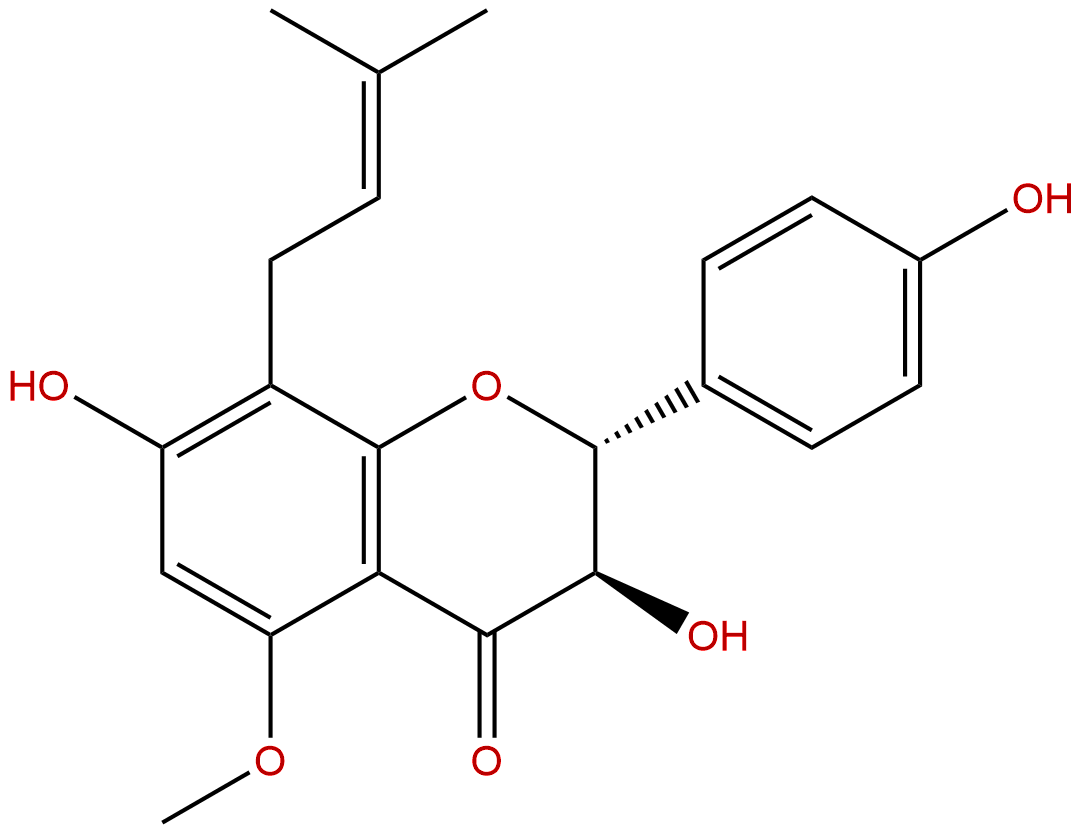
(2R,3R)-3, 7,4 '- trihydroxy-5-methoxy-8-isoprentenyl dihydroflavone belongs to the class of dihydroflavones, with a molecular formula of C2H22O6 and a molecular weight of 370.4010. Its structural features include:
- A typical flavonoid skeleton with a stereo configuration of 2R and 3R, endowed with a specific spatial conformation that facilitates specific binding to biological targets.
- The molecule contains three hydroxyl groups (at positions 3, 7, and 4 ') and one methoxy group (at position 5) substituent, which enhances its polarity and hydrogen bonding ability.
- The prenyl side chain connected at position 8 endows the molecule with strong hydrophobicity and membrane penetration ability, which facilitates its cellular uptake and biological activity.
In terms of physical and chemical properties, the LogP value of the compound is 3.0626, indicating that it has moderate lipid solubility and is conducive to cell membrane permeability; The topological polar surface area (TPSA) is 96.2200, indicating that its polarity is moderate and may affect its bioavailability and targeted distribution. Low water solubility (0.2276 mg/mL) suggests limited solubility in aqueous phase and needs to be improved through appropriate formulation methods. The blood-brain barrier has low permeability, reducing the risk of central nervous system toxicity and side effects. The negative result of hERG channel inhibition experiment indicates a low risk of cardiac toxicity. The Ames test result is 0.0, indicating that the compound has no significant mutagenicity and high safety.
Plant sources and extraction methods
(2R,3R)-3, 7,4 '- trihydroxy-5-methoxy-8-isoprentenyl dihydroflavone is mainly found in various traditional Chinese medicinal materials and wild plants, especially in the roots, stems, and leaves of certain leguminous and Asteraceae plants. Its natural source plants include but are not limited to certain flavonoids rich Chinese herbal medicines, such as Phellodendron amurense and Sophora flavescens.
The extraction method usually uses organic solvent extraction combined with column chromatography separation technology. The specific steps include:
- Raw material pretreatment Collect plant tissues, dry and crush them.
- Solvent extraction Extract flavonoids through multiple extractions using polar organic solvents such as ethanol or methanol.
- Concentrated separation After concentrating the extract, impurities are removed using liquid-liquid distribution method.
- Column chromatography purification Using silica gel, C18 reverse phase column, etc. for separation and purification, combined with gradient elution technology, high-purity target compounds are obtained.
- Structural Identification Confirm the structure of the compound through methods such as nuclear magnetic resonance (NMR), mass spectrometry (MS), and infrared spectroscopy (IR).
In recent years, green and efficient technologies such as ultrasound assisted extraction and microwave-assisted extraction have also been applied to the extraction of this compound, significantly improving yield and purity, and reducing solvent consumption.
Pharmacological activity research
(2R,3R)-3, 7,4 '- trihydroxy-5-methoxy-8-isoprentenyl dihydroflavone has shown significant anti-tumor activity in various in vitro and in vivo models, especially in the field of prostate cancer where research is more in-depth.
Anti prostate cancer activity
This compound inhibits the proliferation of prostate cancer cells, induces cell apoptosis, and suppresses tumor metastasis through multi-target regulation. Cell experiments have shown that it can significantly reduce the survival rate of prostate cancer cell lines (such as PC-3, LNCaP), induce changes in apoptosis related protein expression, and inhibit cell cycle progression.
Anti inflammatory and antioxidant activity
As a flavonoid derivative, this compound has excellent anti-inflammatory and antioxidant properties, which can inhibit the release of inflammatory mediators and reduce oxidative stress damage. This is of great significance for regulating the tumor microenvironment and blocking tumor progression.
Other potential activities
Preliminary studies also suggest that the compound may have certain regulatory effects on hormone dependent tumors, neurodegenerative diseases, etc., but the relevant mechanisms still need further clarification.
Mechanism of action and molecular targets
(2R,3R)-3, 7,4 '- trihydroxy-5-methoxy-8-isoprentenyl dihydroflavone achieves its anti-tumor effect through multi-target and multi pathway synergistic effects, especially in prostate cancer involving key targets including:
- BCL2 This compound can downregulate the expression of anti apoptotic protein BCL2 and promote cell apoptosis.
- STAT3 Inhibiting the STAT3 signaling pathway, blocking tumor cell proliferation and immune escape.
- ESR2 (estrogen receptor beta)Regulating hormone receptor mediated signaling and affecting the growth of tumor cells.
- MAPK1 Interfering with the MAPK/ERK pathway, inhibiting cell proliferation and migration.
- CYP19A1 (aromatase)Inhibiting aromatase activity, affecting hormone metabolism, and blocking hormone driven tumor growth.
- AR (androgen receptor)Regulating androgen receptor signaling and inhibiting hormone dependent tumor cell proliferation.
- PIK3CA: Affects the PI3K/AKT pathway, regulates cell survival and metabolism.
- EGFR Inhibit epidermal growth factor receptor signaling, prevent tumor cell proliferation and migration.
- PTGS2(COX-2)Inhibit inflammation related enzymes and alleviate tumor related inflammation.
- TP53 Activate tumor suppressor protein p53, promote cell cycle arrest and apoptosis.
Through the synergistic regulation of the above targets, this compound not only inhibits the proliferation and survival of tumor cells, but also regulates the tumor microenvironment, enhances the body's immune response, blocks tumor metastasis and drug resistance mechanisms.
Evaluation of drug properties and pharmacokinetics
Pharmacokinetic parameters are important indicators for evaluating the potential of natural product drug development. (2R,3R)-3, 7,4 '- trihydroxy-5-methoxy-8-isoprentenyl dihydroflavone performs well in this regard:
- Molecular weight (370.4 Da)Complies with Lipinski's rules and is beneficial for oral absorption.
- LogP(3.06)Moderate, balancing water solubility and lipid solubility, beneficial for cell membrane penetration.
- TPSA(96.22 Ų)Suitable for good bioavailability.
- Water solubility (0.2276 mg/mL)Low, indicating the need to optimize the formulation to improve bioavailability.
- Low blood-brain barrier permeability Reduce the risk of central nervous system side effects.
- HERG inhibition negative The safety of the heart is relatively high.
- Ames test shows no mutagenicity Good safety.
Pharmacokinetic studies have shown that the compound is rapidly absorbed orally, widely distributed in the body, and mainly metabolized through the liver. The metabolites are safe. Moderate half-life, suitable for daily administration. Mainly excreted by the kidneys, with low toxicity. Further systematic pharmacokinetic and toxicological studies are needed in the future to clarify its in vivo metabolic pathways and potential drug interactions.
Clinical application prospects and prospects
Based on its significant anti prostate cancer activity and good safety, (2R,3R)-3, 7,4 '- trihydroxy-5-methoxy-8-isoprentenyl dihydroflavone has broad clinical application prospects:
- Anti prostate cancer treatment As a new type of drug that can be used as a monotherapy or in combination with existing chemotherapy and endocrine therapy, it is expected to improve treatment efficacy and delay the occurrence of drug resistance.
- adjuvant therapy Its anti-inflammatory and antioxidant properties can be used to alleviate tumor related symptoms and treatment side effects, and improve patients' quality of life.
- Advantages of multi-target regulation Suitable for interventions in complex tumor microenvironments to reduce the risk of single target drug resistance.
- Potential other indications The potential applications in hormone related tumors, chronic inflammatory diseases, and other fields are worth further exploration.
Future research should focus on:
- Optimize drug formulations to enhance bioavailability and targeting.
- Thoroughly analyze the mechanism of action, clarify key targets and signaling pathways.
- Conduct systematic pharmacokinetic and toxicological evaluations to ensure clinical safety.
- Design preclinical and clinical trials to validate its efficacy and safety.
Conclusion
(2R,3R)-3, 7,4 '- trihydroxy-5-methoxy-8-isoprentenyl dihydroflavone, as a natural flavonoid compound with unique structure and diverse functions, exhibits excellent anti prostate cancer activity and good pharmacological characteristics. Its multi-target and multi pathway mechanism of action provides new ideas and strategies for tumor treatment. Although still in the early stages of research, with the optimization of extraction processes, in-depth analysis of pharmacological mechanisms, and advancement of preclinical studies, this compound is expected to become an important candidate molecule for the development of anti-tumor drugs. Future research will further clarify its clinical application value, promote its clinical translation, and bring new treatment options for patients with prostate cancer and related diseases.