


Product name: Cardanol C15:0
Synonym name: 3-Pentadecylphenol;m-Pentadecylphenol;Hydrocardanol
Catalogue No.: BP2432
Cas No.: 501-24-6
Formula: C21H36O
Mol Weight: 304.518
Botanical Source: Ginkgo biloba L.
Type of Compound: Phenols
Purity: 95%~99%
Analysis Method: HPLC-DAD or/and HPLC-ELSD
Identification Method: Mass, NMR
Packing: Brown vial or HDPE plastic bottle
Storage: Store in a well closed container, protected from air and light. Put into refrigerate or freeze for long term storage.
Whenever possible, you should prepare and use solutions on the same day. However, if you need to make up stock solutions in advance, we recommend that you store the solution as aliquots in tightly sealed vials at -20℃. Generally, these will be useable for up to two weeks.
The product could be supplied from milligrams to grams
Inquire for bulk scale.
For Reference Standard and R&D, Not for Human Use Directly.
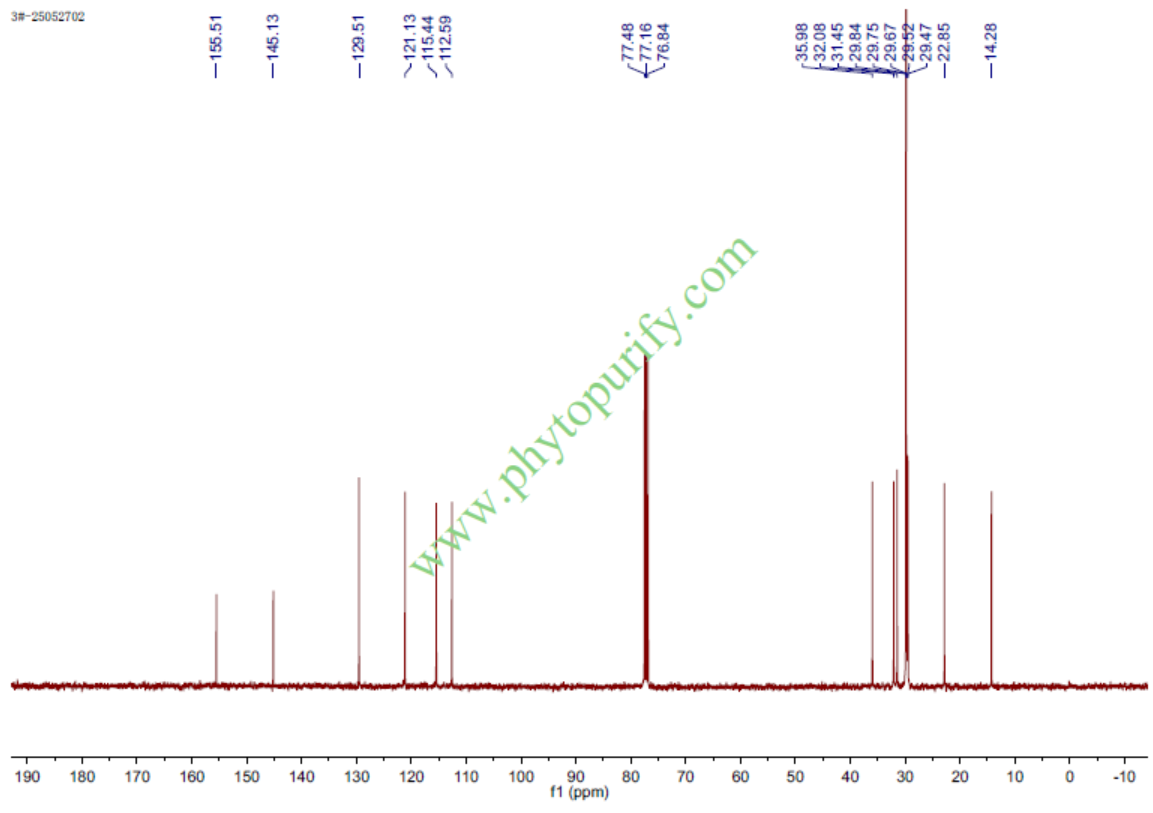
NMR of Cardanol C15:0
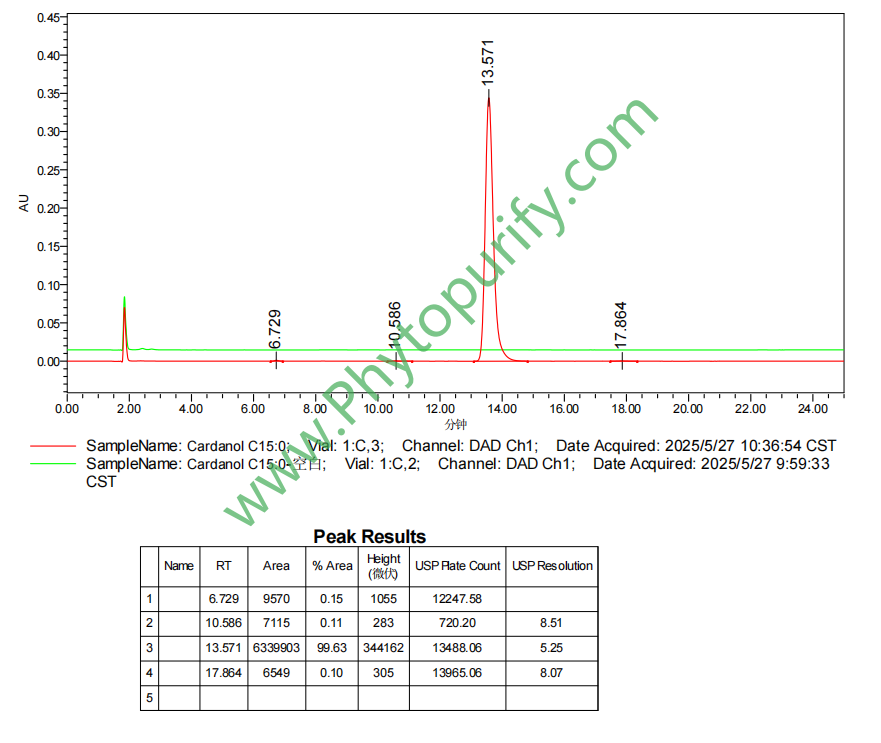
HPLC of Cardanol C15:0
Storage conditions:Short-term storage at 2~8℃, long-term storage at -20 ~ -80℃
20.2300
6.8000
No
Yes
No
No
Unknown
No
Unknown
Natural products, as important sources of drug lead compounds, play an irreplaceable role in the history of human disease prevention and treatment. Among numerous natural phenolic compounds, Cardanol, as one of the main components of Cashew Nut Shell Liquid (CNSL), has received high attention from researchers in recent years due to its unique chemical structure and extensive biological activity. Cashew phenols are a class of compounds with meta substituted alkyl phenols as the basic skeleton, and the differences in the length and saturation of their side chain alkyl chains form a structurally diverse compound family. Among them, cashew phenols C15:0 (3-pentadecylphenol, CAS number: 501-24-6), as a representative member of fully saturated side chains, have become a hot topic in natural product pharmacology research due to their stable chemical properties and unique biological activity spectrum.
The discovery of cashew phenols C15:0 can be traced back to the systematic study of the chemical composition of cashew shell liquid in the early 20th century. Cashew nuts(Anacardium occidentale L. As a member of the lacquer tree family, its fruit shell contains about 25-30% of a dark brown oily liquid, known as cashew shell fluid. This substance, traditionally regarded as an agricultural byproduct, actually contains abundant bioactive phenolic compounds, including cashew acid, cardanol, cardol, and methyl cardol. Among them, cashew phenols account for about 15-20% of the total mass of cashew shell liquid, while cashew phenols C15:0 are members of the cashew phenol family with fully saturated side chains.
From the perspective of chemical taxonomy, cashew phenols C15:0 belong to long-chain alkylphenol compounds, which are not commonly found in nature and mainly exist in the resin and fruit shells of lacquer tree plants. Its unique structural features - a phenolic hydroxyl group connected to the meta position of the benzene ring, and a fifteen carbon saturated alkyl chain - endow the molecule with both the antioxidant properties of phenolic compounds and the lipophilicity brought by long-chain alkyl groups. This amphiphilic structure enables it to interact with biological membranes and may affect cellular function through various mechanisms.
In recent years, with the deepening of pharmacological research on natural products, the biological activity spectrum of cashew phenols C15:0 has been continuously expanded. Research has shown that this compound has potential application value in multiple fields such as anti-inflammatory, antioxidant, antibacterial, anti-tumor, and neuroprotective effects. Of particular note is that its pharmacological evaluation results show that cashew phenols C15:0 have good safety characteristics - no hepatotoxicity, no cardiotoxicity, no hERG inhibitory activity, and are not easily able to cross the blood-brain barrier. These characteristics make it a highly attractive candidate molecule in drug development.
This review aims to systematically summarize the chemical structure characteristics, plant sources and extraction methods, pharmacological activity research progress, mechanism of action and molecular targets, pharmacological evaluation and pharmacokinetic characteristics of cashew phenol C15:0, and to provide comprehensive references for further research and development of this natural product. The clinical application prospects are also discussed.
The chemical structure of cashew nut phenol C15:0 can be accurately described as 3-pentadecylphenol, with a molecular formula of C21H36O and a molecular weight of 316.51 Da. The core structure of this compound consists of a benzene ring and a meta substituted phenolic hydroxyl group, with a fully saturated pentadecyl side chain (- C15H31) connected to the para position of the phenolic hydroxyl group. This structural feature distinguishes it from other members of the cashew phenol family - cashew acid (with carboxyl groups adjacent to the side chain), cashew phenols (with two hydroxyl groups on the benzene ring), and unsaturated cashew phenol isomers.
From the analysis of chemical bond characteristics, the phenolic hydroxyl group (- OH) of cashew phenol C15:0 has weak acidity (pKa of about 10-11) and can participate in hydrogen bond formation and electron donor reactions. The C-C bonds of saturated alkyl chains are all σ bonds, with high bond energy and stable chemical properties, making them less prone to oxidation or addition reactions. The π - electron system of the benzene ring endows the molecule with UV absorption properties, and its maximum absorption wavelength (λ max) is usually in the range of 275-280 nm, which provides convenience for quantitative analysis.
In terms of physicochemical properties, cashew phenols C15:0 exhibit typical lipophilic characteristics. Its oil-water partition coefficient (LogP) is as high as 6.80, indicating that the solubility of the compound in a lipid environment is much higher than in an aqueous phase. This high lipophilicity is due to the hydrophobic effect of long-chain alkyl groups, which allows them to easily embed into the lipid bilayer of biological membranes. The topologically polar surface area (TPSA) is only 20.23 Å ², far below the upper limit of 140 Å ² typically required for oral drugs, indicating that the molecule has good membrane permeability. However, its molecular weight (316.51 Da) is slightly higher than the Lipinski five rule requirement of molecular weight less than 500 Da, and its LogP value exceeds 5, indicating that the compound may face challenges in oral absorption.
The hydrogen bond acceptor number of cashew phenol C15:0 is 1 (only the oxygen atom of the phenolic hydroxyl group), and the hydrogen bond donor number is also 1 (the hydrogen atom of the phenolic hydroxyl group). This low hydrogen bonding ability results in extremely low solubility in aqueous solutions (estimated to be<0.1 mg/mL), but good solubility in organic solvents such as ethanol, dimethyl sulfoxide (DMSO), chloroform, and n-hexane. At room temperature, cashew phenols C15:0 are colorless to pale yellow oily liquids or low melting point solids (melting point of about 50-52 ° C), with characteristic odors of phenolic compounds.
It is worth noting that the chemical stability of cashew phenols C15:0 is superior to its unsaturated side chain analogues. Due to the absence of double bonds in the side chain, this compound is less prone to auto oxidation or polymerization reactions and exhibits better chemical stability during storage. However, phenolic hydroxyl groups may still be oxidized into quinone structures, so it is recommended to store them in the dark, sealed, and at low temperatures.
From the perspective of structure-activity relationship, the biological activity of cashew phenols C15:0 is closely related to their structural characteristics. Phenolic hydroxyl group is a key functional group for antioxidant activity, which can clear free radicals through hydrogen atom transfer mechanism; And long-chain alkyl groups endow the molecule with the ability to interact with biological membranes, which may affect membrane fluidity, signal transduction, and protein function. This structure activity relationship provides important clues for subsequent drug design and optimization.
The main natural source of cashew phenols C15:0 is cashew nuts(Anacardium occidentale L. The fruit shell. Cashew nuts are native to northeastern Brazil and are now widely grown in tropical regions around the world, with major production areas including India, Vietnam, Nigeria, Cote d'Ivoire, and Brazil. During the cashew nut processing, the fruit shell, as the main byproduct, accounts for about 50-60% of the total weight of the fruit, which contains about 25-30% cashew shell liquid (CNSL). The estimated annual production of cashew nut shell liquid worldwide exceeds 500000 tons, providing a rich raw material foundation for the extraction of cashew phenolic compounds.
The chemical composition of cashew shell liquid varies depending on the extraction method and processing conditions. Natural CNSL is obtained by cold pressing or solvent extraction, mainly containing cashew acid (about 60-70%), cashew phenols (about 15-20%), cashew phenols (about 10-15%), and a small amount of methyl cashew phenols. And industrial cashew shell liquid (Technical CNSL) is usually subjected to heat treatment (about 180-200 ° C) to decarboxylate cashew acid and convert it into cashew phenol, so the content of cashew phenol can be increased to 60-70% or more. The content of cashew phenols C15:0 in natural cashew shell liquid is relatively low, because natural cashew phenols mainly exist in the form of monoene (C15:1), diene (C15:2), and triene (C15:3), and the fully saturated C15:0 isomer only accounts for about 5-10% of the total cashew phenols.
The extraction and purification of cashew phenols C15:0 usually adopt a multi-step strategy. Firstly, extract the cashew shell liquid from the cashew shell. Common methods include:
1. Mechanical pressing method Directly pressing oily liquid from the shell of the cashew fruit through hydraulic or screw press is a simple method with low extraction efficiency (about 60-70%).
2. Organic solvent extraction method Soak and crush cashew shells in solvents such as n-hexane, petroleum ether, or ethanol, and obtain crude extracts through Soxhlet extraction or soaking extraction, with an extraction efficiency of over 90%.
3. Supercritical fluid extraction method Using supercritical CO ₂ as the extraction solvent, high-purity cashew shell liquid is obtained under mild conditions. This method is environmentally friendly, but the equipment cost is relatively high.
After obtaining the crude cashew shell liquid, further separation and purification of cashew phenols C15:0 are required. Due to the similar structure of cashew phenols family members, separation is difficult, and the following methods are usually used:
- Column chromatography method Using silica gel column chromatography with n-hexane ethyl acetate or chloroform methanol gradient elution, separation can be achieved based on side chain saturation and polarity differences. The polarity of cashew phenols C15:0 is slightly lower than that of unsaturated analogues and is usually eluted in earlier fractions.
- High performance liquid chromatography (HPLC)High purity preparation of cashew phenol C15:0 can be achieved by using a reverse phase C18 column with acetonitrile water or methanol water as the mobile phase, combined with a UV detector (280 nm).
- Molecular distillation method By utilizing the difference in boiling points of different cashew phenols, separation can be achieved through short-range molecular distillation technology, which is suitable for large-scale production.
It is worth noting that the natural content of cashew phenols C15:0 is low, which limits their large-scale acquisition. In recent years, researchers have explored chemical synthesis methods to efficiently synthesize cashew phenol C15:0 by connecting the pentadecyl chain to the meta position of phenol through Friedel Crafts alkylation reaction, with a yield of over 80%. The chemical synthesis method not only solves the problem of insufficient natural sources, but also provides convenience for the study of structure-activity relationships by obtaining a series of analogues through structural modification.
Cashew phenols C15:0 exhibit significant biological activity in inflammation regulation. Multiple in vitro studies have shown that this compound can effectively inhibit the production of pro-inflammatory cytokines in macrophages stimulated by lipopolysaccharide (LPS). In the RAW264.7 mouse macrophage model, cashew phenols C15:0 (10-50 μ M) exhibited concentration dependent inhibition of nitric oxide (NO) production, with an IC50 value of approximately 25 μ M. Meanwhile, the compound can significantly reduce the release of inflammatory mediators such as prostaglandin E2 (PGE2), tumor necrosis factor - α (TNF - α), interleukin-6 (IL-6), and interleukin-1 β (IL-1 β).
In animal models, the anti-inflammatory activity of cashew phenols C15:0 was further validated. In the rat paw swelling model induced by carrageenan, oral administration of cashew phenols C15:0 (50-200 mg/kg) can significantly inhibit paw swelling, and its effect is comparable to the positive control drug indomethacin. In the acetic acid-induced mouse model of increased intra-abdominal capillary permeability, the compound also showed significant anti-inflammatory effects and no obvious gastrointestinal side effects were observed, suggesting that it may have safety features superior to traditional nonsteroidal anti-inflammatory drugs.
The phenolic hydroxyl structure of cashew phenols C15:0 endows them with excellent free radical scavenging ability. In the DPPH radical scavenging experiment, the IC50 value of cashew phenol C15:0 is about 35 μ M, which is weaker than the standard antioxidant vitamin C (IC50 of about 20 μ M), but still exhibits significant antioxidant activity. In the ABTS ⁺ radical scavenging experiment, its Trolox equivalent antioxidant capacity (TEAC) value was 1.2, indicating that each molecule of cashew phenol C15:0 can scavenge about 1.2 molecules of ABTS ⁺ radicals.
More importantly, cashew phenols C15:0 exhibit a protective effect at the cellular level. In the oxidative stress model induced by hydrogen peroxide (H ₂ O ₂), pretreatment with cashew phenols C15:0 (10-30 μ M) significantly reduced the levels of reactive oxygen species (ROS) in human liver cells (L02) and neuroblastoma cells (SH-SY5Y), decreased the production of lipid peroxidation product malondialdehyde (MDA), and restored the activity of superoxide dismutase (SOD) and glutathione peroxidase (GPx). These results indicate that cashew phenols C15:0 can not only directly scavenge free radicals, but also exert indirect antioxidant effects by regulating the endogenous antioxidant enzyme system.
Cashew phenols C15:0 exhibit inhibitory activity against various pathogenic microorganisms. In antibacterial experiments, the inhibitory effect of this compound on Gram positive bacteria is stronger than that on Gram negative bacteria. Regarding Staphylococcus aureus(Staphylococcus aureus)The minimum inhibitory concentration (MIC) for Bacillus subtilis is 32-64 μ g/mL(Bacillus subtilis)The MIC is 16-32 μ g/mL, while for Escherichia coli(Escherichia coli)And Pseudomonas aeruginosa(Pseudomonas aeruginosa)The MIC is greater than 128 μ g/mL. This selective antibacterial activity may be related to the differences in cell wall structure between Gram positive and Gram negative bacteria.
It is worth noting that cashew phenols C15:0 also exhibit inhibitory activity against methicillin-resistant Staphylococcus aureus (MRSA), with a MIC value of 64 μ g/mL, indicating its potential to combat drug-resistant strains. In addition, the compound also has an effect on Candida albicans(Candida albicans)When the fungus exhibits a certain inhibitory effect, the MIC is about 128 μ g/mL. Research on antibacterial mechanisms suggests that cashew phenols C15:0 may exert antibacterial effects by disrupting the integrity of bacterial cell membranes, inhibiting bacterial respiratory chain enzyme activity, or interfering with bacterial quorum sensing systems.
Cashew phenols C15:0 exhibit cytotoxic effects in various tumor cell lines. In the MTS cell viability test, the IC50 values of the compound on breast cancer cells (MCF-7), liver cancer cells (HepG2), lung cancer cells (A549) and colon cancer cells (HT-29) were 18.5, 22.3, 25.6 and 30.2 μ M, respectively. It is worth noting that cashew phenols C15:0 have low toxicity to normal cells (such as human umbilical vein endothelial cells HUVEC) (IC50>100 μ M) and exhibit certain selective anti-tumor activity.
Further research has found that the mechanism by which cashew phenols C15:0 induce apoptosis in tumor cells involves multiple pathways. In MCF-7 cells, this compound can upregulate the expression of pro apoptotic protein Bax, downregulate the expression of anti apoptotic protein Bcl-2, activate caspase-3 and caspase-9, leading to a decrease in mitochondrial membrane potential and release of cytochrome c. In addition, cashew phenols C15:0 can induce cell cycle arrest in the G0/G1 phase, which is related to the downregulation of cyclin D1 and cyclin dependent kinase 4 (CDK4) expression.
Cashew phenols C15:0 also exhibit protective effects in neurodegenerative disease models. In the SH-SY5Y cell injury model induced by β - amyloid protein (A β 25-35), cashew phenol C15:0 (5-20 μ M) pretreatment significantly increased cell survival rate, reduced oxidative stress and mitochondrial dysfunction caused by A β aggregation. This compound can also inhibit acetylcholinesterase (AChE) activity with an IC50 value of 45 μ M, suggesting its potential to improve cognitive function in Alzheimer's disease.
In the Parkinson's disease model, cashew phenols C15:0 can protect dopaminergic neurons from toxicity induced by 6-hydroxydopamine (6-OHDA). The mechanism involves activating the nuclear factor E2 related factor 2 (Nrf2) signaling pathway, upregulating the expression of antioxidant enzyme genes, and inhibiting the neuroinflammatory response mediated by microglia.
The pharmacological activity of cashew phenols C15:0 involves multiple molecular targets and signaling pathways, and its mechanism of action exhibits the characteristics of multiple targets and pathways.
NF - κ B is the core transcription factor of inflammatory response, regulating the expression of various pro-inflammatory genes. Research has shown that cashew phenols C15:0 can inhibit LPS induced phosphorylation and degradation of I κ B α, thereby preventing the translocation of NF - κ B p65 subunit to the nucleus. At the molecular level, this compound can directly interact with the ATP binding site of I κ B kinase (IKK), inhibit IKK activity, and thereby block the activation of the NF - κ B pathway. This mechanism of action is similar to many natural anti-inflammatory compounds, but the long alkyl chain of cashew phenols C15:0 may enhance their binding ability to the hydrophobic region of IKK.
The MAPK pathway includes three main branches: ERK, JNK, and p38, which play important roles in the regulation of inflammation, proliferation, and apoptosis. Cashew phenols C15:0 can selectively inhibit LPS induced phosphorylation of p38 and JNK, with little effect on ERK phosphorylation. This selective inhibition may be related to the interaction between cashew phenols C15:0 and the ATP binding pockets of p38 and JNK. Molecular docking studies have shown that the phenolic hydroxyl group of cashew phenols C15:0 can form hydrogen bonds with Met109 and Gly110 of p38, while the alkyl chain is embedded in hydrophobic pockets to form stable complexes.
Nrf2 is the main regulator of cellular antioxidant defense, regulating the expression of various antioxidant and detoxifying enzymes. Cashew phenols C15:0 can promote the dissociation of Nrf2 and Keap1, increase the nuclear translocation of Nrf2, and activate gene transcription driven by antioxidant response elements (ARE). Specifically, the compound may alter the conformation of Keap1 by modifying its cysteine residues (such as Cys151, Cys273, and Cys288), thereby releasing Nrf2. This mechanism is similar to some known Nrf2 activators, such as sulforaphane, but the alkyl chain of cashew phenol C15:0 may enhance its interaction with the Keap1 hydrophobic region.
In terms of anti-tumor activity, cashew phenols C15:0 mainly induce tumor cell apoptosis through the mitochondrial pathway. This compound can increase mitochondrial membrane permeability, leading to a decrease in mitochondrial membrane potential (Δ PSI m) and promoting the release of cytochrome c from mitochondria into the cytoplasm. The released cytochrome c binds with Apaf-1 to form an apoptotic body, activating caspase-9 and subsequently downstream caspase-3 and caspase-7, ultimately leading to cell apoptosis. Cashew phenols C15:0 can also upregulate the Bax/Bcl-2 ratio, which is a key regulatory point in the mitochondrial apoptosis pathway.
The long alkyl chain of cashew phenols C15:0 allows them to be inserted into the lipid bilayer of the cell membrane, affecting the physicochemical properties of the membrane. Research has shown that this compound can increase membrane fluidity, alter membrane lipid ordering, and may affect the function of membrane proteins. This membrane interaction may be an important mechanism for its antibacterial activity - by disrupting the integrity of bacterial cell membranes, leading to the leakage of intracellular substances and bacterial death. In addition, cashew phenols C15:0 can also interact with cholesterol, which may affect the formation and function of lipid rafts, thereby regulating cellular signal transduction.
Cashew phenols C15:0 exhibit inhibitory activity against various enzymes, including acetylcholinesterase (AChE), tyrosinase, lipoxygenase (LOX), and cyclooxygenase-2 (COX-2). Among them, the selective inhibition of COX-2 (IC50 of about 30 μ M) is superior to COX-1 (IC50>100 μ M), which is closely related to its anti-inflammatory activity. Molecular docking studies have shown that the phenolic hydroxyl group of cashew phenols C15:0 can form hydrogen bonds with the Ser530 and Tyr385 active sites of COX-2, while the alkyl chain occupies hydrophobic channels, preventing the entry of substrate arachidonic acid.
According to the provided pharmacological parameters, cashew phenols C15:0 exhibit some favorable and unfavorable characteristics. Its molecular weight (316.51 Da) conforms to the Lipinski five rule (<500 Da), but the LogP value (6.80) is significantly higher than the threshold of 5.0, indicating that the compound has strong lipophilicity, which may lead to poor water solubility and low oral bioavailability. The TPSA (20.23 Å ²) is much lower than 140 Å ², indicating that the molecule has good membrane permeability. However, a too low TPSA may also lead to insufficient hydrogen bonding interactions with the target protein.
In terms of safety, cashew phenols C15:0 exhibit encouraging characteristics: no hepatotoxicity, no cardiotoxicity, and no hERG inhibitory activity. These data indicate that the compound has high safety for major organs and ion channels. However, the Ames test results are unknown and further assessment of its genetic toxicity risk is needed. In addition, the blood-brain barrier penetration is "No", indicating that the compound is not easily able to enter the central nervous system, which may be both an advantage (reducing central side effects) and a disadvantage (limiting its application in neurological diseases).
At present, there is relatively limited pharmacokinetic research on cashew phenols C15:0, but reasonable speculation can be made based on their physicochemical properties. Due to the high LogP value, the solubility of cashew phenols C15:0 in the gastrointestinal tract may be poor, resulting in incomplete oral absorption. It may be absorbed through passive diffusion, but high lipophilicity may result in its preferential distribution in the intestinal lymphatic system rather than directly entering the portal venous circulation.
In terms of distribution, cashew phenols C15:0 may be widely distributed in various tissues in the body, especially in adipose tissue and lipid rich organs such as the liver and brain. However, due to the inability to pass through the blood-brain barrier, the distribution of the central nervous system may be limited. This compound may highly bind to plasma proteins, especially albumin and lipoproteins, with low free drug concentrations.
In terms of metabolism, the phenolic hydroxyl group of cashew phenols C15:0 is the main metabolic site, which may undergo glucuronic acid or sulfuric acid binding reactions to generate metabolites with higher water solubility. In addition, alkyl chains may be metabolized through the ω - and β - oxidation pathways, ultimately producing short chain metabolites. The cytochrome P450 enzyme system (especially CYP2C9 and CYP3A4) may be involved in its oxidative metabolism.
In terms of excretion, cashew phenols C15:0 and their metabolites may be mainly excreted through bile and feces, with a small amount possibly excreted through urine. Due to its large molecular weight and strong lipophilicity, glomerular filtration may not be the main clearance pathway.
The main challenges faced in the development of cashew phenols C15:0 include poor water solubility, low oral bioavailability, and metabolic instability. To overcome these obstacles, the following strategies can be considered:
1. Prodrug design Modify phenolic hydroxyl groups into phosphate esters, amino acid esters, or glycosides to improve water solubility and oral absorption.
2. Formulation technology Using formulation technologies such as liposomes, nanoemulsions, solid dispersions, or cyclodextrin inclusion complexes to improve solubility and bioavailability.
3. structural optimization On the basis of maintaining the core pharmacophore, introducing polar groups (such as hydroxyl, carboxyl, or amino) to reduce LogP values while maintaining activity.
4. Optimization of administration route Consider non oral routes such as transdermal, inhalation, or injection administration to avoid first pass effects.
Based on the significant anti-inflammatory activity and good safety characteristics of cashew phenols C15:0, it has potential for development in the treatment of inflammatory diseases. Especially its selective inhibition of COX-2 activity may make it a substitute or supplement for nonsteroidal anti-inflammatory drugs (NSAIDs), reducing the gastrointestinal side effects of traditional NSAIDs. In addition, the regulatory effect of this compound on the NF - κ B and MAPK pathways may have practical value in chronic inflammatory diseases such as rheumatoid arthritis and inflammatory bowel disease.
The inhibitory activity of cashew phenols C15:0 against MRSA and other drug-resistant strains makes it a candidate molecule for the development of new antibacterial drugs. Its unique membrane mechanism may not easily induce bacterial resistance, which is of great significance for the development of antibacterial drugs. In the future, its synergistic effect with existing antibiotics can be explored to develop combination therapy plans. In addition, the application of this compound in oral care products such as mouthwash and toothpaste is also worth paying attention to, as it may have inhibitory effects on common oral pathogens such as Streptococcus mutans.
The selective toxicity of cashew phenols C15:0 to various tumor cells, as well as its mechanism of inducing apoptosis and cell cycle arrest, make it a candidate molecule for the development of anti-tumor drugs. However, the issues of poor water solubility and low oral bioavailability need to be addressed. In the future, it can be explored to develop it into local drug delivery formulations (such as topical formulations for skin cancer) or combined with nanocarriers to achieve targeted delivery. In addition, the potential of this compound as a chemotherapy sensitizer in combination with conventional chemotherapy drugs is also worth studying.
Although cashew phenols C15:0 cannot cross the blood-brain barrier, their neuroprotective activity can still be exerted through peripheral mechanisms or metabolites. For example, its anti-inflammatory and antioxidant activities may indirectly affect the central nervous system by regulating peripheral immune cell function. In addition, the application of this compound in the field of anti-aging is also worth paying attention to, as it can activate the Nrf2 pathway, enhance cellular antioxidant defense capabilities, and may delay the occurrence of age-related diseases.
The antioxidant and antibacterial activities of cashew phenols C15:0 make them have potential applications in the cosmetics field, and can be added as natural preservatives or active ingredients to skincare products. Its tyrosinase inhibitory activity suggests that it may have whitening effects. In the field of functional foods, cashew phenols C15:0 can be added as a natural antioxidant to oily foods to prevent oxidation and spoilage. However, its safety requires strict toxicological evaluation before it can be applied to food and cosmetics.
Cashew phenols C15:0, as an important active ingredient in cashew shell liquid, have shown significant research value in the field of natural product pharmacology due to their unique chemical structure and extensive biological activity. This review systematically summarizes the research progress of this compound from its chemical structure, plant origin, pharmacological activity, mechanism of action, and pharmacological evaluation, revealing its potential application value in multiple fields such as anti-inflammatory, antioxidant, antibacterial, anti-tumor, and neuroprotective effects.
However, the research on cashew phenols C15:0 still faces many challenges. Firstly, its low natural content and difficulty in extraction and purification limit large-scale research and application; The establishment of chemical synthesis methods provides the possibility to solve this problem. Secondly, the pharmacokinetic studies of this compound are not yet sufficient, especially in terms of oral bioavailability, metabolic pathways, and excretion mechanisms, which need further clarification. Thirdly, although the preliminary safety evaluation results are good, toxicological data such as long-term toxicity, reproductive toxicity, and genetic toxicity still need to be supplemented.
Looking ahead to the future, research on cashew phenols C15:0 should focus on the following directions: firstly, optimizing its pharmacokinetic properties and activity selectivity through structural modification and medicinal chemical strategies; The second is to use modern biotechnology (such as metabolic engineering and synthetic biology) to increase its biosynthetic yield; Thirdly, conduct systematic preclinical and clinical research to verify its therapeutic potential and safety; The fourth is to explore its synergistic effects with other natural products or drugs and develop compound formulations.
In summary, as a natural product with multi-target activity, cashew phenols C15:0 have a long but promising path from laboratory research to clinical application. With the deepening of research and the advancement of technology, this ancient natural molecule is expected to radiate new vitality in modern drug development and contribute to the cause of human health.
