


Product name: Ginkgetin
Synonym name:
Catalogue No.: BP0642
Cas No.: 481-46-9
Formula: C32H22O10
Mol Weight: 566.518
Botanical Source: Ginkgo biloba L.
Physical Description:
Type of Compound: Flavonoids
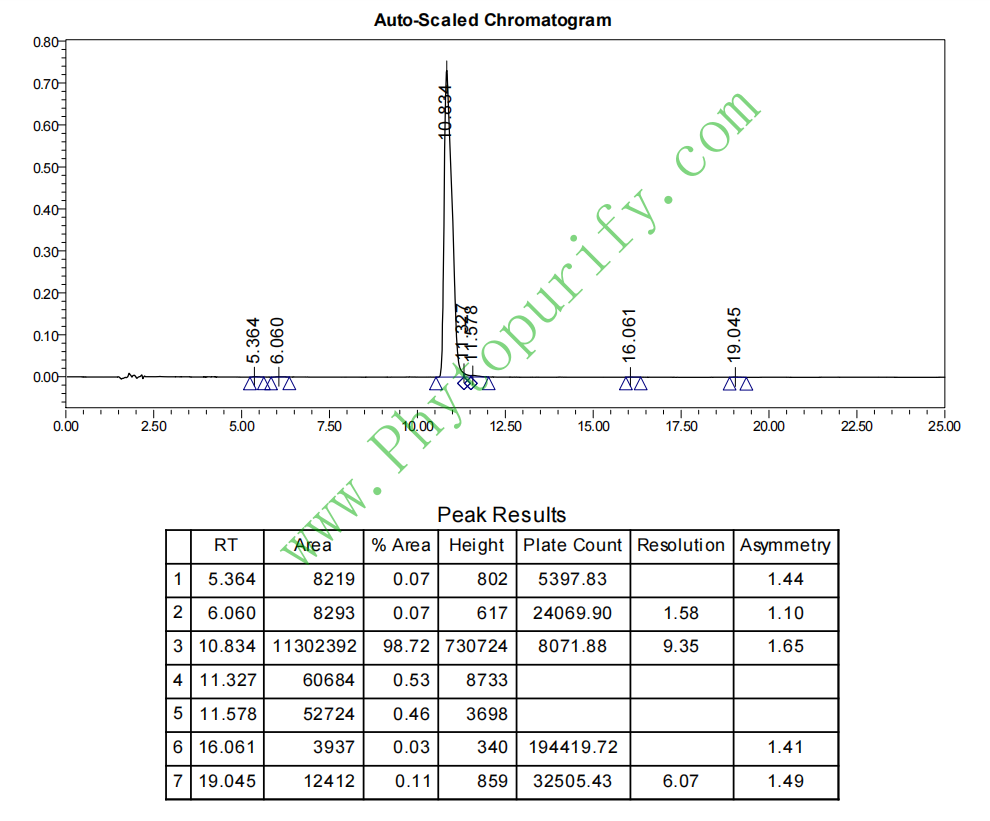
Purity: 95%~99%
Analysis Method: HPLC-DAD or/and HPLC-ELSD
Identification Method: Mass, NMR
Packing: Brown vial or HDPE plastic bottle
Storage: Store in a well closed container, protected from air and light. Put into refrigerate or freeze for long term storage.
The product could be supplied from milligrams to grams
Inquire for bulk scale.
Description:
Ginkgetin is a good STAT3 inhibitor , which has anti-inflammatory, neuroprotective, anti-influenza virus and anti-fungal activities. Ginkgetin induces apoptosis in PC-3 cells via activation of caspase 3 and inhibition of survival genes as a potent chemotherapeutic agent for prostate cancer treatment.
References:
Bioorg Med Chem Lett. 2013 May 1;23(9):2692-5.
Ginkgetin induces apoptosis via activation of caspase and inhibition of survival genes in PC-3 prostate cancer cells.
Ginkgetin is a natural biflavonoid isolated from leaves of Ginkgo biloba L. Though it was known to have anti-inflammatory, anti-influenza virus, anti-fungal activity, osteoblast differentiation stimulating activity and neuro-protective effects, the underlying antitumor mechanism of Ginkgetin still remains unclear. Thus, in the present study, anti-cancer mechanism of Ginkgetin was elucidated in human prostate cancer PC-3 cells.
METHODS AND RESULTS:
Ginkgetin suppressed the viability of PC-3 cells in a concentration-dependent manner and also significantly increased the sub-G1 DNA contents of cell cycle in PC-3 cells. Ginkgetin activated caspase-3 and attenuated the expression of survival genes such as Bcl-2, Bcl-xL, survivin and Cyclin D1 at protein and mRNA levels. Consistently, pan-caspase inhibitor Z-DEVD-fmk blocked sub G1 accumulation and cleavages of PRAP and caspase 3 induced by Ginkgetin in PC-3 cells.
CONCLUSIONS:
Overall, these findings suggest that Ginkgetin induces apoptosis in PC-3 cells via activation of caspase 3 and inhibition of survival genes as a potent chemotherapeutic agent for prostate cancer treatment.
Free Radic Res. 2015 May 12:1-39.
Neuroprotective effects of ginkgetin against neuro-injury in Parkinson's disease model induced by MPTP via chelating iron.
Disruption of neuronal iron homeostasis and oxidative stress are closely related to the pathogenesis of Parkinson's disease (PD). Ginkgetin, a natural biflavonoid isolated from leaves of Ginkgo biloba L, has many known effects, including anti-inflammatory, anti-influenza virus, and anti-fungal activities, but its underlying mechanism of the neuroprotective effects in PD remains unclear.
METHODS AND RESULTS:
The present study utilized PD models induced by 1-methyl-4-phenylpyridinium (MPP(+)) and 1-methyl-4-phenyl-1, 2, 3, 6-tetrahydropyridine (MPTP) to explore the neuroprotective ability of Ginkgetin in vivo and in vitro. Our results showed that Ginkgetin could provide significant protection from MPP(+)-induced cell damage in vitro by decreasing the levels of intracellular reactive oxygen species and maintaining mitochondrial membrane potential. Meanwhile, Ginkgetin dramatically inhibited cell apoptosis induced by MPP+ through the caspase-3 and Bcl2/Bax pathway. Moreover, Ginkgetin significantly improved sensorimotor coordination in a mouse PD model induced by MPTP by dramatically inhibiting the decrease of tyrosine hydroxylase expression in the substantia nigra and superoxide dismutase activity in the striatum. Interestingly, Ginkgetin could strongly chelate ferrous ion and thereby inhibit the increase of the intracellular labile iron pool through downregulating L-ferritin and upregulating transferrin receptor 1.
CONCLUSIONS:
These results indicate that the neuroprotective mechanism of Ginkgetin against neurological injury induced by MPTP occurs via regulating iron homeostasis. Therefore, Ginkgetin may provide neuroprotective therapy for PD and iron metabolism disorder related diseases.
HPLC of Ginkgetin
Storage conditions:Short-term storage at 2~8℃, long-term storage at -20 ~ -80℃
159.8000
4.0999
3.6230
.0019
2.2237
14.6701
Low
92.8772
2.9841
Yes
No
No
No
Yes
No
0.6
Yes
Yes
Yes
No
Natural products, as an important treasure trove for drug discovery and development, play an irreplaceable role in the long history of human fight against diseases. Among them, flavonoids have attracted much attention due to their wide range of biological activities and low toxicity. Ginkgo flavonoids (CAS number: 481-46-9), as a unique flavonoid compound, are mainly derived from Ginkgo biloba(Ginkgo biloba L. Separated from the leaves. Ginkgo biloba, as a "living fossil" plant, has a long history of using its extracts to improve cognitive function and promote blood circulation. Ginkgo biloba flavonoids are one of the key active ingredients that exert various pharmacological effects.
In recent years, with the rapid development of modern pharmacology and molecular biology techniques, the research on Ginkgo biloba flavonoids has deepened from traditional activity screening to systematic molecular mechanism exploration. Research has shown that Ginkgo biloba flavonoids exhibit multiple biological activities, including anti-tumor, anti-inflammatory, neuroprotective, and antifungal effects. What is particularly noteworthy is that it has been identified as an effective inhibitor of the Wnt/β - catenin signaling pathway, providing a solid theoretical basis for its application in the treatment of cancer, especially tumors that rely on abnormal activation of Wnt signaling. Meanwhile, its neuroprotective potential demonstrated in neurodegenerative disease models such as Alzheimer's disease and Parkinson's disease has also made it a hot topic in neuropharmacological research.
This article aims to systematically review the chemical properties, plant sources, pharmacological activities, molecular mechanisms of action, pharmacological evaluation, and clinical application prospects of Ginkgo biloba flavonoids, in order to provide comprehensive scientific references for the deep development and transformation research of this natural product.
The chemical name of Ginkgo biloba flavonoids is 5,5 ″, 8,8 ″ - tetrahydroxy-7,7 ″ - dimethoxy-4 ′, 4 ‴ - flavonoids, with a molecular formula of C32H22O10 and a molecular weight of 566.5180. Its structure belongs to the class of flavonoids, consisting of two flavonoid monomers (apigenin derivatives) connected by C-C bonds (3 ′ -8 ″ positions), forming a rigid coplanar structure. This unique bimolecular structure is the chemical basis that distinguishes it from flavonoids and endows it with special biological activity.
In terms of physicochemical properties, the lipid water partition coefficient (LogP) of Ginkgo biloba flavonoids is 4.0999, indicating its good lipophilicity. Its topological polar surface area (TPSA) is 159.8000 Å ², reflecting the presence of multiple polar groups (such as hydroxyl and methoxy) in the molecule. However, its water solubility is extremely low, only 0.0019 mg/mL, mainly due to its large conjugated planar structure and strong intermolecular forces, which make it difficult to dissolve in water. This characteristic is a key physicochemical parameter that affects its oral bioavailability and formulation development. In the solid state, ginkgo flavonoids usually appear as yellow crystalline powder.
Ginkgo biloba flavonoids mainly come from Ginkgo biloba, a plant in the Ginkgo genus of the Ginkgo family(Ginkgo biloba L. The leaves. The flavonoids in Ginkgo biloba leaves are complex and diverse. In addition to Ginkgo biloba flavonoids, they also contain single flavonoids such as quercetin, kaempferol, isorhamnetin, and their glycosides. The content of Ginkgo biloba flavonoids in leaves is relatively low and belongs to the characteristic flavonoid components.
The extraction and separation method follows the conventional process of natural product chemistry and is continuously optimized to improve efficiency and purity:
1. Extract Organic solvent extraction method is usually used. After crushing the dried ginkgo leaves, reflux extraction or ultrasound assisted extraction is performed using methanol, ethanol, or acetone water mixed solvents. In recent years, green extraction techniques such as supercritical CO2 fluid extraction have also been applied, which can reduce the use of organic solvents and improve selectivity.
2. Enrichment and Separation After vacuum concentration, the crude extract is preliminarily enriched using the characteristics of flavonoids, such as polyamide column chromatography or macroporous adsorption resin (such as AB-8, D101) column chromatography, with a water ethanol gradient elution to remove impurities such as polysaccharides and proteins, and obtain the flavonoid enrichment site.
3. purification: Ginkgo biloba biflavones are further separated and purified from the enrichment site, usually using silica gel column chromatography, Sephadex LH-20 column chromatography, preparative high performance liquid chromatography (HPLC) and other technologies. By comparing the spectral data (UV, IR, MS, NMR) of the compound with the reported values in the literature, its structure can be confirmed.
Numerous in vitro and in vivo studies have confirmed that Ginkgo biloba flavonoids have broad and significant pharmacological activities.
Antitumor activity: Ginkgo biloba biflavone has growth inhibition and apoptosis promoting effects on a variety of human cancer cell lines, including lung cancer, breast cancer, liver cancer, colon cancer, prostate cancer and glioma. Its function is not limited to inducing cell cycle arrest (such as G2/M phase arrest), but can also activate the Caspase cascade reaction through the mitochondrial pathway and endoplasmic reticulum stress pathway, leading to cancer cell apoptosis. In addition, studies have shown that it can inhibit the migration, invasion, and angiogenesis of tumor cells, indicating its potential for anti metastasis.
Neuroprotective activity This is one of the most promising pharmacological directions for Ginkgo biloba flavonoids. In various neurotoxic models such as β - amyloid protein induction, MPP+induction, glutamate excitotoxicity, oxidative stress, etc., Ginkgo biloba flavonoids can significantly improve the survival rate of neuronal cells and reduce apoptosis. In Alzheimer's disease model animals, it can improve learning and memory impairment, reduce amyloid plaque deposition and Tau protein hyperphosphorylation in the brain. In Parkinson's disease models, it can protect dopaminergic neurons from damage.
anti-inflammatory activity Ginkgo biloba flavonoids exert strong anti-inflammatory effects by inhibiting the production of pro-inflammatory mediators such as TNF - α, IL-1 β, IL-6, NO, PGE2. The mechanism involves the regulation of key inflammatory signaling pathways such as nuclear factor kappa B (NF - κ B) and mitogen activated protein kinases (MAPKs). It has shown good therapeutic effects in animal inflammation models such as acute lung injury, arthritis, and colitis.
Antifungal and antiviral activity Research has shown that Ginkgo biloba flavonoids have inhibitory effects on various plant pathogenic fungi and human pathogenic fungi, such as Candida albicans. Its antiviral activity has also been reported, such as having a certain inhibitory effect on influenza virus, herpes simplex virus, etc.
Other activities It also includes antioxidant, antiplatelet aggregation, and cardiomyocyte protection effects.
The multiple pharmacological activities of Ginkgo biloba flavonoids stem from their multi-target regulatory effects on cellular signaling networks. The key mechanism of action and molecular targets are as follows:
Inhibition of Wnt/β - catenin signaling pathway Ginkgo biloba flavonoids have been identified as a Wnt signaling inhibitor (IC50=5.92 μ M). It can downregulate the protein level of β - catenin, inhibit its nuclear translocation, and thus block the transcription of Wnt target genes (such as c-Myc, Cyclin D1). This mechanism is the core of its anti-tumor activity, especially in colorectal cancer, and also provides ideas for the treatment of other diseases related to Wnt signaling abnormalities.
Neural protection related target network:
Common pathway of anti-inflammatory and anti-tumor effects In addition to specific inhibition of the Wnt pathway, its regulation of MAPK (such as MAPK1/ERK, p38, JNK) and PI3K/Akt pathways, as well as inhibition of NF - κ B transcriptional activity, are the common molecular basis for its simultaneous anti-inflammatory and induction of tumor cell apoptosis.
In summary, Ginkgo biloba flavonoids synergistically exert their multifaceted biological effects by acting on a target network that includes BCL2, APP, BACE1, MAPT, NFE2L2, SIRT1, MAPK1, CASP9, GSK3B, and others.
Despite the significant pharmacological activity of Ginkgo biloba flavonoids, their drug likeness still faces challenges, mainly based on their physicochemical properties and preliminary ADMET (absorption, distribution, metabolism, excretion, toxicity) evaluation.
Current status of pharmacokinetic research Currently, there are relatively few reports on the pharmacokinetic studies of Ginkgo biloba flavonoids system. Limited animal experiments suggest that the plasma concentration is lower and the peak time is later after oral administration. Developing appropriate drug delivery systems (such as nano formulations, phospholipid complexes, cyclodextrin inclusion complexes, etc.) to improve their solubility and bioavailability is a key step in promoting their clinical application.
The multi-target and multifunctional properties of Ginkgo biloba flavonoids have depicted broad prospects for their application in multiple disease fields, but at the same time, it also means that more precise development strategies are needed.
The challenges faced mainly include: lack of systematic pharmacokinetic data, complex mechanism of action network requiring clarification of primary and secondary targets, and urgent breakthroughs in formulation technology to solve delivery difficulties. Future research requires close collaboration among multiple disciplines such as pharmacy, pharmacology, chemistry, and clinical medicine.
Ginkgo biloba flavonoids are a bioactive flavonoid molecule discovered from the ancient plant Ginkgo biloba. From anti-tumor to neuroprotection, from anti-inflammatory to antifungal, its extensive pharmacological effects are backed by a precise molecular regulatory network involving multiple pathways such as Wnt, apoptosis, oxidative stress, and inflammation. Although it currently faces pharmaceutical bottlenecks such as poor water solubility and low bioavailability, modern medicinal chemistry and pharmaceutical technology provide possible solutions to these challenges. With a deeper understanding of its molecular mechanism and the successful development of new delivery systems, Ginkgo biloba flavonoids are expected to gradually move from a potential natural active molecule to clinical practice, providing new options for the treatment of major human health problems such as tumors and neurodegenerative diseases. Continuous and in-depth research on it is not only an exploration of this specific compound, but also a vivid interpretation of the eternal proposition of natural products as a source of drug discovery.
