


Synonym name: Ginkgolic Acid C17:1
Catalogue No.: BP0645
Cas No.: 111047-30-4
Formula: C24H38O3
Mol Weight: 374.565
Botanical Source: Knema elegans and Ginkgo biloba (ginkgo)
Purity: 95%~99%
Analysis Method: HPLC-DAD or/and HPLC-ELSD
Identification Method: Mass, NMR
Packing: Brown vial or HDPE plastic bottle
Can be supplied from milligrams to grams.
For Reference Standard and R&D, Not for Human Use Directly.
Inquire for bulk scale.
HPLC of Ginkgolic Acid C17:1
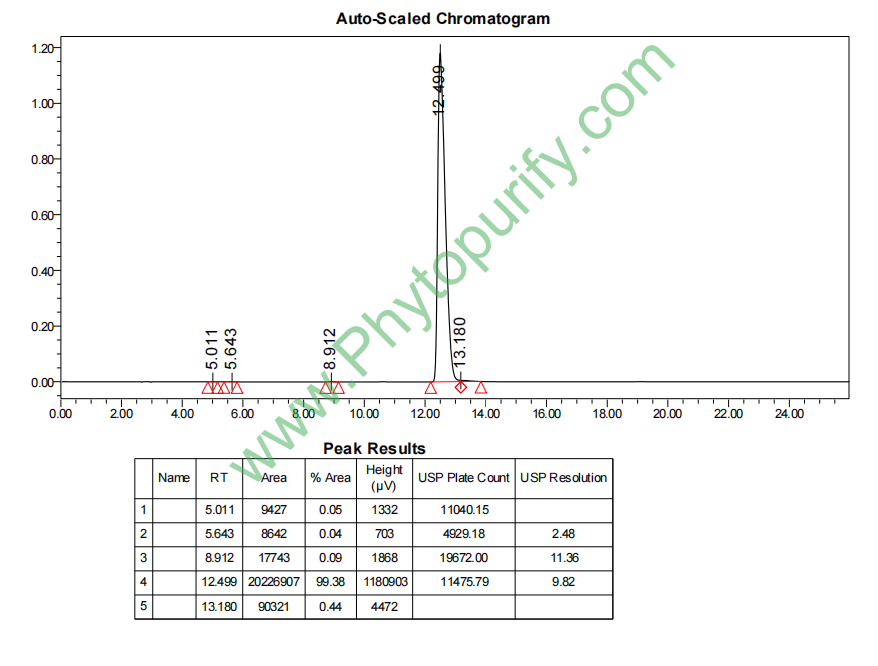
Storage conditions:Short-term storage at 2~8℃, long-term storage at -20 ~ -80℃
Ginkgolic Acid C17:1 is a natural hydroxybenzoic acid derivative derived from Ginkgo biloba leaves and seeds. Due to its unique chemical structure and diverse biological activities, it has attracted widespread attention in the field of natural product pharmacology in recent years. As an important member of the ginkgolic acid family, ginkgolic acid C17:1 not only plays a role in plant defense mechanisms, but its potential pharmacological activity also provides the possibility for developing new therapeutic drugs. The structure of ginkgolic acid C17:1 has a certain functional correlation with salicylic acid, which provides a theoretical basis for the study of its multiple biological effects such as anti-inflammatory, antibacterial, and anti-tumor effects.
This article will provide a systematic review of the chemical structure and physicochemical properties, plant sources, and extraction methods of ginkgolic acid C17:1, with a focus on its pharmacological activity and mechanism of action. Combining the pharmacological parameters and pharmacokinetic characteristics, it will explore its clinical application prospects and future research directions, aiming to provide scientific basis and theoretical support for the drug development of this natural product.
The chemical name of ginkgolic acid C17:1 is hydroxybenzoic acid derivative, with a molecular formula of C24H38O3 and a molecular weight of 374.5650. Its structural features include a hydroxyl substituted benzene ring and a fatty acid side chain containing 17 carbon atoms and an unsaturated double bond. This structure gives it both lipophilicity and a certain degree of polarity, with a LogP value of 8.6969, indicating its high hydrophobicity. The high hydrophobicity has a significant impact on its cell membrane penetration ability and biological distribution.
The topological polar surface area (TPSA) of ginkgolic acid C17:1 is 57.53 Å ², reflecting its moderate molecular polarity, which may affect its binding ability with biomolecules. The extremely low water solubility (0.0123 mg/mL) limits its solubility and bioavailability in the aqueous phase. The low penetration ability of the blood-brain barrier suggests that its role in the central nervous system is limited. The negative result of hERG channel inhibition experiment indicates a low risk of cardiac toxicity. The Ames test result is 0.0, indicating no significant genotoxicity.
In summary, the physicochemical properties of ginkgolic acid C17:1 suggest that its solubility and bioavailability need to be optimized in drug design, but its safety indicators have shown good performance and have potential for further development.
Ginkgolic acid C17:1 is mainly present in Ginkgo biloba leaves, seeds, and fruits, especially in Ginkgo biloba leaf extracts where it is abundant. Ginkgo biloba, as an ancient gymnosperm, contains various bioactive components in its leaves, including flavonoids, terpenes, and ginkgolic acid compounds.
The common methods for extracting ginkgolic acid C17:1 include solvent extraction, ultrasound assisted extraction, and liquid chromatography separation. Traditional solvent extraction often uses organic solvents such as ethanol, methanol, or ethyl acetate, combined with heating reflux or ultrasound assistance to improve extraction efficiency. The extraction solution is purified by liquid-liquid distribution, silica gel column chromatography, or high-performance liquid chromatography (HPLC) to obtain high-purity ginkgolic acid C17:1.
In recent years, green extraction techniques such as supercritical CO2 extraction and microwave-assisted extraction have gradually been applied to the separation of ginkgolic acid compounds, which have the advantages of high extraction efficiency, environmental friendliness, and low solvent residue. The optimization of extraction process is of great significance for ensuring the yield and activity of ginkgolic acid C17:1.
Ginkgolic acid C17:1 exhibits various pharmacological activities, mainly including anti-inflammatory, antibacterial, anti-tumor, and neuroprotective effects.
Ginkgolic acid C17:1 exhibits significant anti-inflammatory effects by inhibiting the production and release of inflammatory mediators. In vitro studies have shown that it can downregulate the expression of pro-inflammatory factors such as tumor necrosis factor - α (TNF - α), interleukin-6 (IL-6), and cyclooxygenase-2 (COX-2), reducing inflammatory response. In animal models, ginkgolic acid C17:1 significantly alleviates edema and cell infiltration in inflammatory tissues, indicating its potential application value in inflammatory diseases.
Ginkgolic acid C17:1 exhibits inhibitory effects on various Gram positive and negative bacteria, especially on drug-resistant strains such as Staphylococcus aureus and Escherichia coli. Its antibacterial mechanism may involve cell membrane disruption, inhibition of protein synthesis, and interference with energy metabolism. The antibacterial activity of ginkgolic acid C17:1 provides a theoretical basis for its use as a natural antibiotic substitute.
In recent years, the anti proliferative and pro apoptotic effects of ginkgolic acid C17:1 in tumor cells have gradually been revealed. In vitro experiments show that ginkgolic acid C17:1 can induce cell cycle arrest and apoptosis in many tumor cell lines (such as breast cancer, lung cancer and colon cancer cells). Its mechanism of action involves activation of mitochondrial pathways, generation of reactive oxygen species (ROS), and regulation of apoptosis related protein expression. In addition, ginkgolic acid C17:1 can also inhibit tumor cell migration and invasion, demonstrating its anti metastatic potential.
Although the blood-brain barrier penetration ability of ginkgolic acid C17:1 is low, some studies have shown that it has a certain protective effect in neuroinflammation and oxidative stress models. By regulating the activity of neuroinflammatory factors and antioxidant enzymes, ginkgolic acid C17:1 may play an adjuvant therapeutic role in neurodegenerative diseases such as Alzheimer's disease and Parkinson's disease.
The multiple pharmacological effects of ginkgolic acid C17:1 are attributed to its regulation of multiple signaling pathways and molecular targets.
Ginkgolic acid C17:1 inhibits the nuclear factor kappa B (NF - κ B) signaling pathway, reduces the transcriptional activity of pro-inflammatory genes, and decreases the production of inflammatory mediators. In addition, it also affects the MAPK (mitogen activated protein kinase) pathway, regulating cellular stress response and inflammatory response.
Ginkgolic acid C17:1 disrupts the integrity of bacterial cell membranes, leading to leakage of cellular contents and metabolic disorders. At the same time, it also has inhibitory effects on bacterial protein synthesis and DNA replication processes, enhancing antibacterial efficacy.
Ginkgolic acid C17:1 activates the mitochondrial dependent apoptosis pathway, promotes cytochrome c release, activates the caspases family, and triggers cell apoptosis. It also promotes apoptosis signaling by regulating the expression of Bcl-2 family proteins. In addition, ginkgolic acid C17:1 induces ROS generation, leading to increased oxidative stress and further promoting tumor cell death.
Ginkgolic acid C17:1 reduces neuronal damage by inhibiting the expression of neuroinflammatory factors and enhancing the antioxidant defense system. It has an inhibitory effect on the activation of microglia and reduces neuroinflammatory reactions.
The pharmacological parameters of ginkgolic acid C17:1 indicate that it faces certain challenges in drug development. A high LogP value (8.6969) indicates its extremely high hydrophobicity, resulting in extremely low water solubility (0.0123 mg/mL), which limits oral absorption and bioavailability. Its TPSA value is 57.53, indicating that the molecular polarity is moderate and conducive to membrane penetration, but the overall hydrophobicity may lead to limited distribution in vivo.
The low permeability of the blood-brain barrier limits its direct application in central nervous system diseases. The hERG channel inhibition test was negative, indicating a low risk of cardiac toxicity and good safety. The Ames test showed no mutagenicity, further supporting its safety.
Pharmacokinetic studies are relatively limited, and preliminary data shows that ginkgolic acid C17:1 is metabolized rapidly in vivo, mainly through the liver metabolic enzyme system. The activity and toxicity of metabolites still need further research. To enhance its drug efficacy, future research may consider strategies such as structural modification, nanocarrier encapsulation, or liposome delivery to improve its solubility and bioavailability.
Ginkgolic acid C17:1 has broad clinical application potential due to its multiple pharmacological activities. Its anti-inflammatory and antibacterial effects make it valuable in the treatment of infectious diseases and inflammatory diseases. Especially in the context of increasingly serious antibiotic resistance, the development of natural antibacterial agents is particularly important.
The anti-tumor activity of ginkgolic acid C17:1 provides the possibility of using it as an adjuvant anti-cancer drug, especially in combination chemotherapy or targeted therapy, which may exert a synergistic effect. Although the neuroprotective effect is limited by blood-brain barrier penetration, optimizing drug delivery systems has the potential to expand its application in neurodegenerative diseases.
Future research should focus on the pharmacokinetic optimization of ginkgolic acid C17:1, precise identification of target proteins, and preclinical safety evaluation. In addition, the design and synthesis of derivatives based on their structural characteristics will help enhance their efficacy and drug properties, and promote their clinical translation.
Ginkgolic acid C17:1, as a natural hydroxybenzoic acid compound with rich biological activity, has shown extensive pharmacological potential in anti-inflammatory, antibacterial, anti-tumor, and neuroprotective aspects. Its unique chemical structure endows it with multi-target regulatory ability and good safety, providing a solid foundation for drug development. However, its high hydrophobicity and low water solubility limit its wide clinical application and urgently need to be overcome through drug design and delivery technology.
Based on existing research, ginkgolic acid C17:1 has the potential to become a new natural drug candidate molecule. In the future, it is necessary to strengthen its pharmacokinetics and mechanism research to promote its clinical application. With the development of natural product pharmacology and medicinal chemistry, ginkgolic acid C17:1 is expected to play an important role in the treatment of various diseases and become one of the important directions for the development of natural medicines.
