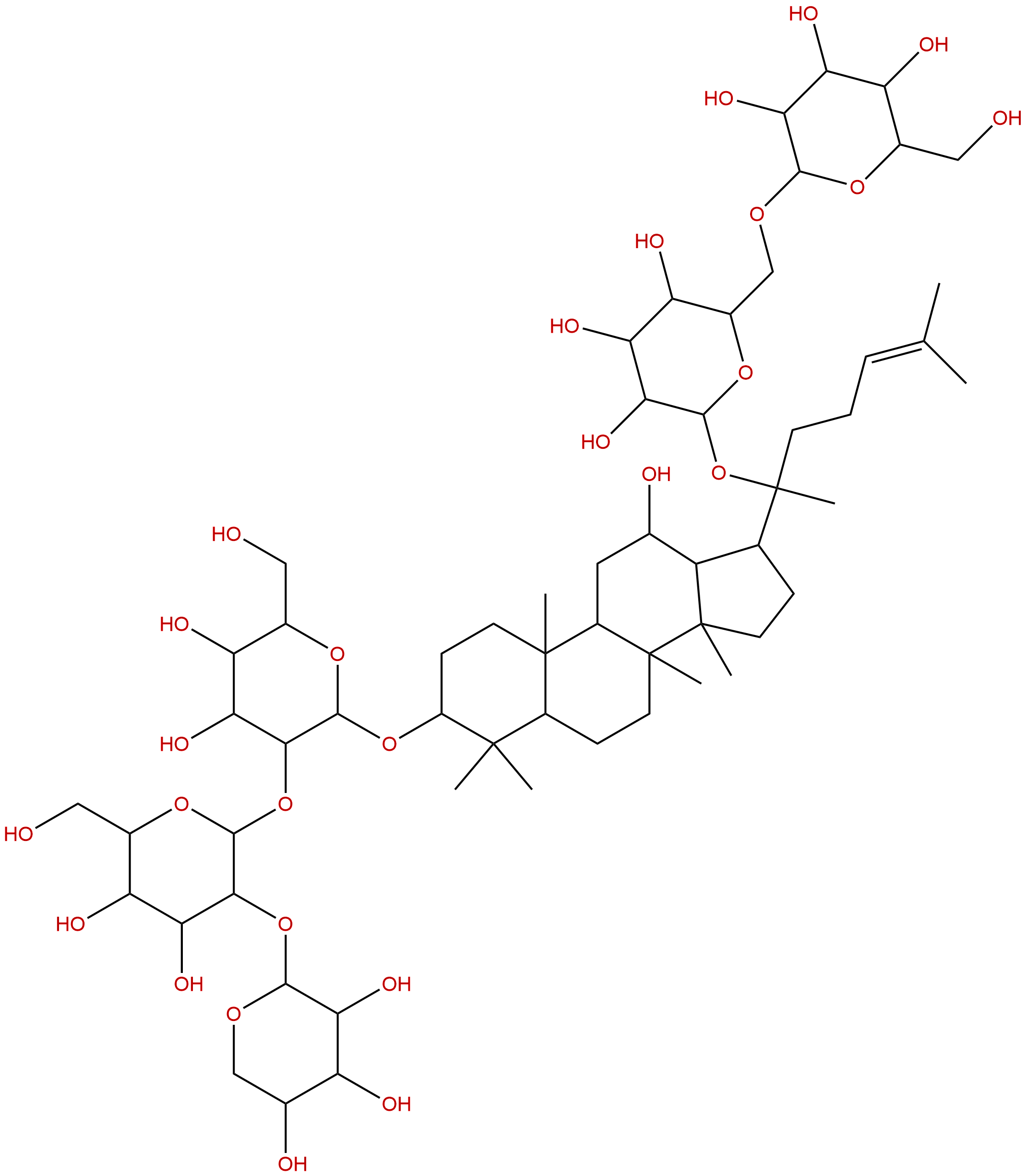


Product name: Notoginsenoside Fa
Synonym name:
Catalogue No.: BP1703
Cas No.: 88100-04-3
Formula: C59H100O27
Mol Weight: 1241.42
Botanical Source: Constit. of leaves of Panax notoginseng
Physical Description:
Type of Compound: Terpenoids
Purity: 95%~99%
Analysis Method: HPLC-DAD or/and HPLC-ELSD
Identification Method: Mass, NMR
Packing: Brown vial or HDPE plastic bottle
The product could be supplied from milligrams to grams. Inquire for bulk scale.
We provide solution to improve the water-solubility of compounds, thereby facilitating the variety of activity tests and clinic uses.
For Reference Standard and R&D, Not for Human Use Directly.
Description:
Notoginsenosides Fa and R4 show significant neurite outgrowth enhancing activities in human neuroblastoma SK-N-SH cells.
References:
J. Nat. Prod., 2002, 65(9):1288-92.
Dammarane-type Saponins from Panax japonicus and their neurite outgrowth activity in SK-N-SH cells.
METHODS AND RESULTS:
Four new dammarane-type saponins (1-4), named yesanchinosides G-J, together with nine ginsenosides (5-13) were isolated from Ye-Sanchi, the underground part of Panax japonicus collected in the south of Yunnan Province, China. Their structures were elucidated on the basis of spectroscopic and chemical methods.
CONCLUSIONS:
Ginsenosides Rb(1) and Rb(3) and notoginsenosides R(4) (6) and Notoginsenoside Fa (7) showed significant neurite outgrowth enhancing activities in human neuroblastoma SK-N-SH cells.
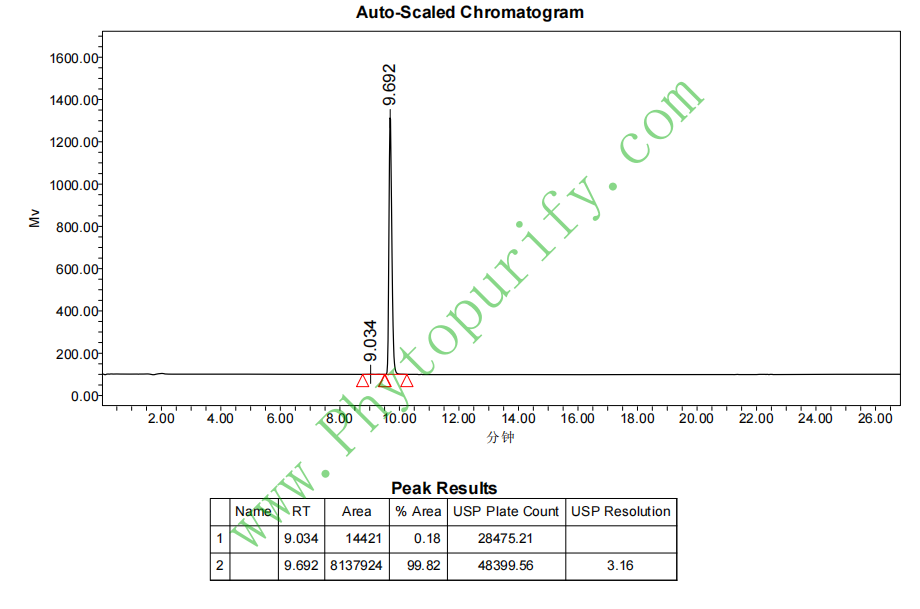
HPLC of Notoginsenoside Fa
Storage conditions:Short-term storage at 2~8℃, long-term storage at -20 ~ -80℃
436.2100
1.4352
1.4349
.3997
.3942
.1085
Low
65.5163
7.3102
Yes
No
No
No
No
No
0.0
Yes
No
No
No
Cardiovascular disease, especially myocardial ischemia, is one of the leading causes of death and disability worldwide. Myocardial ischemia is a complex pathological process caused by reduced coronary artery blood flow, resulting in insufficient oxygen supply to the myocardium, leading to energy metabolism disorders, oxidative stress, inflammatory reactions, and even cell apoptosis or necrosis in myocardial cells. Although reperfusion therapy is an effective means of restoring blood flow, the accompanying reperfusion injury can also cause serious myocardial damage. Therefore, the search for drugs that can effectively protect the myocardium and alleviate ischemia/reperfusion injury is currently a hot topic in pharmacological research. Natural products have become an important treasure trove for discovering new cardiac protective agents due to their structural diversity and multi-target effects.
Sanqi(Panax notoginseng Burk. F. H. Chen, as a traditional precious Chinese medicinal herb, has the characteristics of "stopping bleeding without leaving blood stasis, and removing blood stasis without damaging the body", and has a long history of application in the prevention and treatment of cardiovascular and cerebrovascular diseases. Modern pharmacological research has shown that the main active ingredient of Panax notoginseng is the dammarane type triterpenoid saponin, among which ginsenosides Rg1, Rb1, and Panax notoginseng saponin R1 have been widely studied. In recent years, with the advancement of separation and identification techniques, a series of rare saponins with novel structures and unique activities have been discovered one after another. Notoginsenoside Fa (CAS: 88100-04-3) is one of the original ginsenosides with significant research value. Preliminary studies have revealed that this compound not only has the potential to activate and restore degenerated brain function, but also exhibits significant protective effects in the field of myocardial ischemia. Its effects involve multiple pathways such as anti apoptosis, anti-inflammatory, antioxidant, and regulation of energy metabolism, which has attracted widespread attention from researchers. This article aims to systematically review the chemical structure, plant origin, pharmacological activity, mechanism of action, pharmacological evaluation, and clinical application prospects of Panax notoginseng saponins Fa, in order to provide comprehensive scientific references for the in-depth research and development of this compound.
Sanqi saponin Fa is a type of protopanaxadiol type dammarane triterpenoid saponin. Its parent nucleus is Protopanaxadiol (PPD), which belongs to the tetracyclic triterpenoid structure. Compared with the common ginsenoside Rb1, the sugar chain structure of Sanqi saponin Fa is more complex. Its molecular formula is C ₆₀ H ₁₀₂ O ₂₇, with a molecular weight of 1241.4220 Da. Oligosaccharides are connected to both the C-3 and C-20 positions of its aglycone. Typical glycosylation combinations may include glucose, xylose, arabinose, etc. This unique glycosylation pattern is the structural basis of its biological activity and may also affect its solubility and membrane permeability.
From the analysis of the parameters related to drug properties, the logarithm of the lipid water partition coefficient (LogP) of Sanqi saponin Fa is 1.4352, indicating that it has a certain degree of lipophilicity, but not high lipid solubility. Its topological polar surface area (TPSA) is as high as 436.2100 Å ², which is mainly attributed to the abundant hydroxyl and glycosidic bonds in the molecule, resulting in strong molecular polarity. The water solubility parameter is 0.3997, indicating that its solubility in water is limited and it belongs to insoluble compounds. The combination of high TPSA and limited solubility determines its poor membrane permeability. Of particular note is that its blood-brain barrier (BBB) permeability is predicted to be "low", which means that under conventional administration, it may be difficult to effectively enter the central nervous system, posing a challenge to its potential activity of "restoring degraded brain function" in terms of administration pathways or formulations. However, in peripheral disease models such as myocardial ischemia, this characteristic may not constitute a major obstacle. In addition, the compound showed no risk of hERG potassium channel inhibition in preliminary toxicity predictions (hERG inhibition: No), and the Ames test predicted a value of 0.0, suggesting that it may not be mutagenic and has a relatively good safety starting point.
Sanqi saponin Fa mainly comes from the Panax ginseng plant in the Araliaceae family(Panax notoginseng)Dry roots and rhizomes. Among the total saponins of Panax notoginseng, Panax notoginseng saponins Fa belong to rare saponins with low content, which increases the difficulty and cost of their separation and purification. The traditional method for extracting saponins from Panax notoginseng often uses alcohol extraction, with commonly used solvents being methanol, ethanol, or ethanol water solutions of different concentrations. After extraction, enrichment and preliminary purification were carried out using macroporous adsorption resins (such as D101, AB-8) to remove impurities such as polysaccharides and proteins, resulting in crude total saponins.
In order to further isolate and obtain high-purity Sanqi saponins Fa from total saponins, efficient chromatographic separation techniques are required. Conventional column chromatography techniques, such as silica gel column chromatography and reverse phase silica gel column chromatography (such as ODS), are commonly used to perform gradient elution using solvent systems of different polarities. Modern preparative high-performance liquid chromatography (Prep HPLC) has become a key technology for separating such rare saponins due to its high resolution and efficiency. Usually, a reverse phase C18 chromatography column is used, with acetonitrile water or methanol water as the mobile phase for elution, and monitored by a UV detector (usually with end absorption around 203 nm) or an evaporative light scattering detector. In addition, liquid-liquid distribution chromatography techniques such as high-speed countercurrent chromatography have also been applied for the separation and purification of Panax notoginseng saponins due to their advantages of irreversible adsorption and high recovery rate. With the development of synthetic biology, the heterologous synthesis of rare saponins using microbial cell factories has become a potential production pathway, but it is still in the research stage.
A large number of preclinical studies, especially experiments based on cell and animal models, have confirmed the outstanding pharmacological activity of Sanqi saponin Fa in myocardial ischemia protection.
1. Anti cardiomyocyte apoptosis effect: One of the core processes of myocardial ischemia/reperfusion injury is excessive apoptosis of myocardial cells. Research has shown that Sanqi saponin Fa can significantly alleviate myocardial cell damage induced by hypoxia/reoxygenation. In model cells, pretreatment with Sanqi saponin Fa can reduce cell apoptosis rate, decrease lactate dehydrogenase leakage, and maintain cell membrane integrity. Its function is closely related to upregulating the expression of anti apoptotic protein Bcl-2 and downregulating the expression of pro apoptotic protein Bax, thereby stabilizing mitochondrial membrane potential, inhibiting the release of cytochrome C and activation of caspase-3, and blocking endogenous apoptotic pathways.
2. Anti oxidative stress damage: The large amount of reactive oxygen species generated during ischemia and reperfusion is a key factor leading to myocardial lipid peroxidation, protein and DNA damage. Sanqi saponin Fa exhibits strong antioxidant capacity. It can increase the activity of endogenous antioxidant enzymes such as superoxide dismutase, catalase, and glutathione peroxidase in myocardial cells, while reducing the content of lipid peroxidation end products such as malondialdehyde. This antioxidant effect helps to eliminate oxygen free radicals and alleviate direct damage to myocardial cells caused by oxidative stress.
3. Anti inflammatory effect: Inflammatory response runs through the entire process of myocardial ischemic injury. Sanqi saponin Fa can effectively inhibit the overexpression and release of pro-inflammatory cytokines such as tumor necrosis factor - α and interleukin-6 in ischemic myocardial tissue. It can also inhibit the activity of inducible nitric oxide synthase, reduce excessive production of nitric oxide, thereby alleviating cardiomyocyte toxicity and microvascular dysfunction mediated by inflammatory mediators and nitric oxide.
4. Improve energy metabolism and promote angiogenesis: Myocardial ischemia is essentially an energy crisis. Research has shown that Sanqi saponin Fa may improve mitochondrial function and promote ATP production by regulating signaling pathways such as AMPK/PGC-1 α. In addition, it can upregulate the expression of hypoxia inducible factor-1 α and vascular endothelial growth factor, promote the formation of new blood vessels in the ischemic margin, establish collateral circulation, and improve the blood supply to the myocardium.
5. Other potential activities: In addition to its direct protective effect on the myocardium, Sanqi saponin Fa may also have a positive impact on the risk factors of myocardial ischemia by regulating blood pressure (affecting ACE activity), improving insulin resistance (activating PPAR γ), and other pathways, exerting a multi-level cardiovascular protective effect.
The cardioprotective effect of Sanqi saponin Fa is not achieved through a single target, but through a complex multi-target signaling network that works synergistically. Existing research has preliminarily revealed its interactions with multiple key targets.
Core signaling pathway and target network:
1. Regulating cell apoptosis and survival (BCL2, SIRT1, MAPK1): Sanqi saponin Fa activates SIRT1 deacetylase, which then deacetylates and activates transcription factor FOXO1/3, promoting the expression of downstream antioxidant and anti apoptotic genes. Meanwhile, SIRT1 can also positively regulate the expression of BCL2. In addition, it may regulate the MAPK/ERK signaling pathway (such as MAPK1) to transmit cell survival signals and inhibit the initiation of apoptosis programs.
Activate the endogenous antioxidant defense system (NFE2L2/Nrf2): Nrf2 is a central regulatory factor of cellular antioxidant response. Research has shown that Sanqi saponin Fa can promote the translocation of Nrf2 from the cytoplasm to the nucleus, bind to antioxidant response elements, and initiate the transcription of a series of phase II detoxifying enzymes and antioxidant proteins such as heme oxygenase-1 and NAD (P) H quinone oxidoreductase-1, thereby systematically enhancing the antioxidant capacity of cells.
Response to hypoxia and regulation of inflammation (HIF1A, TNF, IL-6, NOS2): Under conditions of ischemia and hypoxia, Sanqi saponin Fa can stabilize HIF1A protein and promote its accumulation within cells. HIF1A not only induces VEGF expression to promote angiogenesis, but also regulates inflammatory response through complex cross talk. Meanwhile, Sanqi saponin Fa can effectively inhibit the activation of pro-inflammatory signaling pathways such as NF - κ B, thereby suppressing the expression of pro-inflammatory factors such as TNF and IL-6, as well as iNOS (NOS2 encoded) at the transcriptional level, and suppressing excessive inflammatory response.
Regulating metabolism and renin-angiotensin system (PPARG, ACE): Sanqi saponin Fa may act as a partial agonist of PPAR γ, improving insulin sensitivity, regulating lipid metabolism, and protecting the cardiovascular system from a metabolic perspective. In addition, its potential inhibitory effect on angiotensin-converting enzyme may help reduce the production of angiotensin II, alleviate vascular constriction, and alleviate cardiac afterload.
In summary, the mechanism of action of Sanqi saponin Fa exhibits a typical "multi-component multi-target multi-path" characteristic. It simultaneously acts on multiple targets such as BCL2, SIRT1, NFE2L2, HIF1A, TNF, etc., interweaving into a protective network to jointly combat myocardial ischemic injury from multiple dimensions, including inhibiting apoptosis, resisting oxidation, reducing inflammation, improving metabolism, and promoting repair.
Although Sanqi saponin Fa exhibits excellent pharmacological activity, there are some challenges in its drug like properties, which directly affect its successful development from candidate compounds into clinical drugs.
Pharmaceutical Characteristics Challenge:
1. Solubility and permeability: As mentioned earlier, Sanqi saponin Fa has a large molecular weight, high polar surface area, and poor water solubility, and belongs to Class IV (low solubility, low permeability) compounds in the biopharmaceutical classification system. This may result in extremely low oral bioavailability, making it difficult for the drug to be effectively absorbed and reach the site of action.
2. Metabolism and stability: As a glycoside compound, Sanqi saponin Fa is easily hydrolyzed by gut microbiota or digestive enzymes in the gastrointestinal tract, removing some glycosides and converting them into secondary glycosides (such as Compound K). This metabolic transformation may alter its original pharmacological activity and target of action, making the in vivo processes more complex and posing difficulties for quality control.
3. Blood-brain barrier permeability: The prediction shows that its BBB permeability is low, which is a major obstacle for developing indications for the central nervous system, such as brain function recovery.
Current status of pharmacokinetic research: At present, there are relatively few research reports on the pharmacokinetics of Sanqi saponin Fa system. Limited animal experiments (mostly administered intravenously) suggest that the exposure level of the prototype drug in the blood may not be high and the elimination may be rapid. Its main distribution organs may be liver, kidney, etc., but the specific tissue distribution characteristics are not yet clear. Its excretion pathway may be mainly through bile excretion and renal excretion. Due to poor oral absorption, it is particularly important to explore non oral routes of administration (such as injection) or adopt advanced drug delivery systems.
Prospects for Pharmaceutical Strategy: To overcome the bottleneck of drug development, future research can focus on the following formulation strategies:
- New drug delivery system: Develop nano drug delivery systems such as liposomes, nanoparticles, and polymer micelles to encapsulate Panax notoginseng saponins Fa, improve its solubility, protect it from gastrointestinal degradation, and target ischemic tissues through enhanced permeation and retention effects.
- Predrug modification: By modifying its sugar or glycoside groups through chemical methods, derivatives or prodrugs with higher lipid solubility or stronger targeting can be prepared to improve their absorption and distribution characteristics.
- Combination therapy and compound therapy: Explore the combination with other cardiovascular protective drugs or natural ingredients that promote their absorption, such as piperine, in order to produce synergistic effects while reducing their respective doses.
Sanqi saponin Fa, as an active monomer discovered from traditional Chinese medicine, has broad clinical application prospects, but the road is long and full of challenges.
Potential application directions:
1. Adjuvant treatment for acute myocardial infarction: As an intravenous injection, it is administered simultaneously or before and after reperfusion therapy (such as PCI surgery) with the aim of reducing reperfusion injury, shrinking myocardial infarction area, and protecting heart function.
2. Chronic myocardial ischemia and angina pectoris: Develop long-acting sustained-release formulations for improving myocardial blood supply in patients with chronic coronary heart disease, reducing the frequency of angina attacks, and enhancing exercise tolerance.
3. Prevention and treatment of heart failure: Based on its potential role in anti myocardial fibrosis and improving myocardial remodeling, it may be used to prevent the occurrence and development of heart failure after myocardial infarction.
4. Other ischemic diseases: Its mechanism of action is universal and may be extended to protect against ischemic injury in other organs such as cerebral ischemia and renal ischemia.
Challenges faced:
1. Insufficient depth of basic research: At present, the research on the mechanism of action still mostly remains at the level of phenotype and known pathway validation, lacking in-depth analysis of its direct interaction with specific targets (such as whether it is a direct ligand for SIRT1 or PPAR γ) and precise structure-activity relationship.
2. The bottleneck of drug development is prominent: Low bioavailability is the core issue that constrains its development, requiring significant resources to be invested in formulation and structural optimization research.
3. Preclinical and clinical research gaps: Lack of systematic toxicological evaluation (acute toxicity, long-term toxicity, reproductive toxicity, etc.) and standardized pharmacokinetic studies. There is a huge gap in the transition from cellular animal experiments to human clinical trials.
4. Intellectual Property and Industrialization: It is necessary to establish a complete intellectual property protection system around its formulation process, derivatives, medical applications, etc., and solve the cost problem of large-scale extraction, purification or synthesis from plants.
Future prospects: Future research should follow the "translational medicine" approach, utilizing techniques such as chemical biology, structural biology, and computational simulation to deeply elucidate their molecular mechanisms of action; On the other hand, we actively engage with pharmacy and materials science to address their delivery challenges. Exploring its use as a lead compound for structural optimization, while maintaining activity and improving pharmacokinetic properties, is an important research and development direction. Ultimately, rigorous randomized controlled clinical trials are needed to confirm its effectiveness and safety in the human body, in order to truly serve clinical practice and become a new weapon in the fight against myocardial ischemic diseases.
Sanqi saponin Fa is a rare protopanaxadiol type saponin isolated from traditional Chinese medicine Sanqi. A large number of preclinical studies have shown that it integrates multiple pharmacological effects such as anti apoptosis, antioxidant, anti-inflammatory, and pro angiogenesis by acting on multiple molecular targets such as BCL2, SIRT1, NFE2L2, HIF1A, TNF, etc., demonstrating excellent cardioprotective potential in myocardial ischemic injury models. This fully demonstrates the therapeutic advantages of natural products with multi-target and multi pathway synergistic effects. However, its inherent drug defects such as high molecular weight, poor water solubility, and low oral bioavailability pose significant challenges for its subsequent development. The current research is at a critical stage of transitioning from activity discovery to drug development. The future focus of work should be on deepening the understanding of mechanisms, vigorously innovating drug delivery strategies or making reasonable structural modifications to break through their in vivo delivery barriers. Only through close interdisciplinary cooperation and systematic research and development investment can we hope to transform the star molecule of Sanqi saponin Fa in the laboratory into a clinical new drug that can benefit a large number of cardiovascular disease patients, continuing the modern scientific chapter of Sanqi, an ancient medicinal herb.
