Introduction/Overview
Natural products are an important source of new drug discovery and development, among which polyphenolic compounds have attracted much attention due to their wide range of biological activities. Resveratrol, as a star molecule of stilbene compounds, has been widely studied for its antioxidant, anti-inflammatory, cardiovascular protective, and potential anti-cancer activities. However, the low bioavailability and rapid metabolism of resveratrol limit its clinical applications, prompting researchers to focus on its structural analogues in order to discover more promising candidate molecules. Rhapontigenin-3 '- O-glucoside (CAS number: 94356-22-6) is an important natural flavonoid compound that has entered the research field in this context. As a methoxylated derivative of resveratrol and linked to a glucose group at the 3 'position, this compound not only retains some of the core activity of resveratrol, but also exhibits unique pharmacological properties, especially its outstanding ability as a potent and highly selective cytochrome P450 1A1 (CYP1A1) inhibitor. CYP1A1 is a key enzyme involved in the metabolic activation of a variety of pre carcinogens (such as polycyclic aromatic hydrocarbons), and its overexpression is closely related to the occurrence and development of lung cancer, breast cancer and other cancers. Therefore, selective inhibition of CYP1A1 is considered a highly promising cancer chemoprevention strategy. This article aims to provide a systematic review of the chemical structure, plant origin, pharmacological activity, mechanism of action, pharmacological characteristics, and clinical application prospects of Dan Ye Da Huang -3 '- O-glucoside, in order to provide comprehensive academic references for the in-depth research and development of this compound.
Chemical structure and physicochemical properties
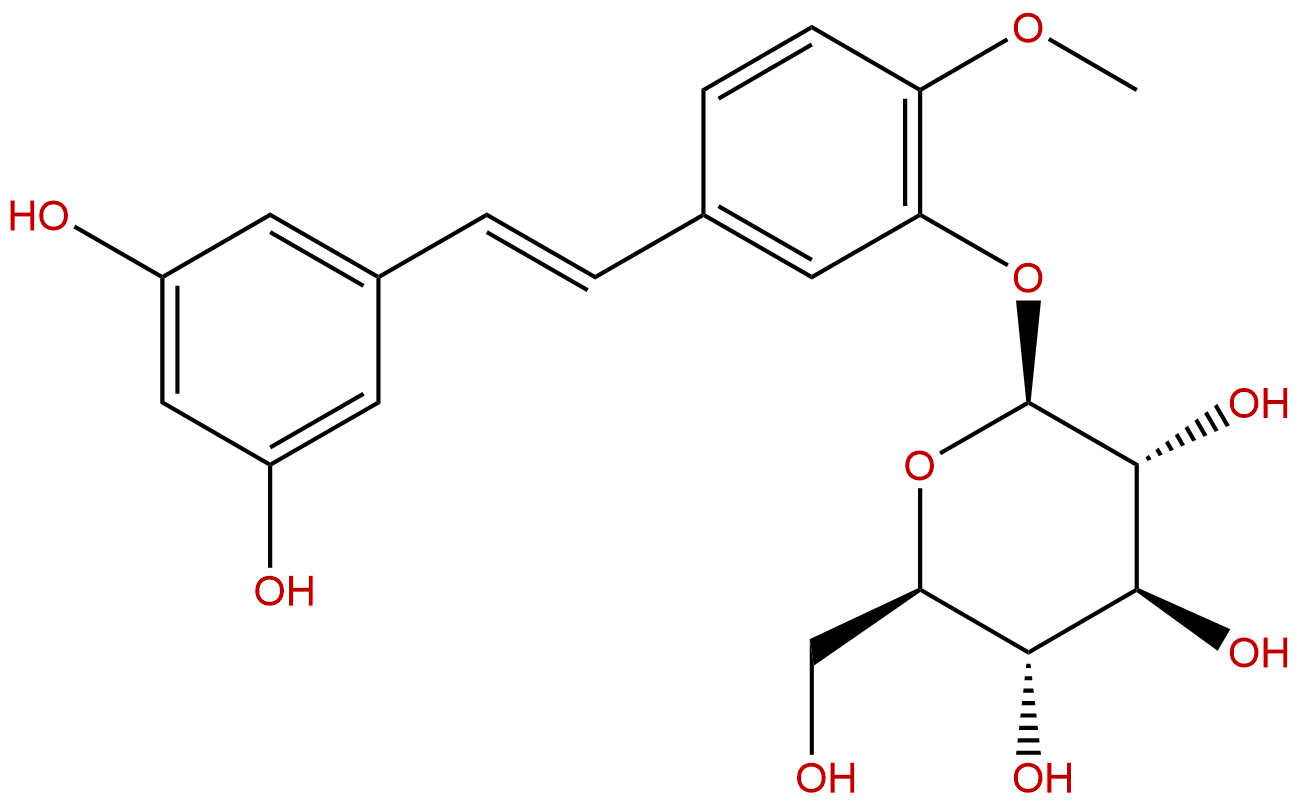
The chemical name of Dan Ye Da Huang -3 '- O-glucoside is 3,5,3' - trihydroxy-4 '- methoxyqin-3' - O - β - D-glucoside. Its molecular formula is C21H24O9 and its molecular weight is 420.4140. Structurally, this compound belongs to the stilbene class (stilbene class), and its parent nucleus structure is similar to resveratrol (3,5,4 '- trihydroxy stilbene), with the core difference being the substituent on its benzene ring: methoxy (- OCH3) instead of hydroxyl (- OH) at the 4' position, and a β - D-glucosyl group is connected to the hydroxyl group at the 3 'position through a glycosidic bond. This structural modification significantly altered its physicochemical properties and biological activity.
The introduction of glucoside greatly enhances the hydrophilicity of the molecule. The calculated lipid water partition coefficient (LogP) is 0.6444, indicating that the compound has good hydrophilicity, which is consistent with its glycoside structure. The topologically polar surface area (TPSA) is as high as 149.0700 Å ², further confirming its high molecular polarity. The predicted water solubility value is 3.4339 (LogS), which belongs to the solubility range, which is beneficial for its dissolution and distribution in organisms. These physical and chemical parameters suggest that compared to resveratrol, which has stronger lipid solubility, Dan Ye Emodin -3 '- O-Glucoside may have different pharmacokinetic behaviors.
Plant sources and extraction methods
Dan Ye Da Huang -3 '- O-glucoside is not widely distributed in the plant kingdom, and its main sources are concentrated in a few medicinal plants. The most famous source is the Polygonaceae plant rhubarb(Rheum spp.), especially Eating rhubarb(Rheum rhaponticum L. The root and stem of the compound, with the added word 'rhaponticum', are also the origin of the compound's name 'Rhapontigenin'. In addition, in some grape genera(Vitis)Plants, Tiger Cane(Polygonum cuspidatum)And a small amount has also been found in some Liliaceae plants.
The extraction of daidzein-3 '- O-glucoside from plant materials usually involves conventional extraction techniques for polyphenolic compounds.Solvent extraction method It is the most basic method, commonly used for extraction or reflux extraction using methanol, ethanol, or acetone water mixed solvents. In order to improve extraction efficiency and selectivity, modern extraction techniques have been widely applied:
1. Ultrasonic assisted extraction Utilizing the cavitation effect of ultrasound to destroy plant cell walls, accelerate solvent penetration and target component dissolution, has the advantages of short time, high efficiency, and low temperature.
2. Microwave assisted extraction Microwaves can directly act on plant tissues and solvent molecules, generating instantaneous internal heating and rapidly and efficiently extracting target components.
3. Supercritical fluid extraction Supercritical CO2 is usually used to change its solubility by adjusting temperature and pressure. This method is environmentally friendly, but requires the addition of entrainers (such as ethanol) to improve the extraction rate of polar glycosides.
After filtration and concentration, the crude extract needs to be separated and purified through a series of chromatographic techniques, such as silica gel column chromatography, reverse phase C18 column chromatography, Sephadex gel (LH-20) chromatography, and high-performance liquid chromatography (HPLC) or preparative HPLC. The structural identification of compounds relies on spectroscopic techniques such as nuclear magnetic resonance (NMR, including 1H-NMR and 13C-NMR), mass spectrometry (MS), and ultraviolet (UV) spectroscopy.
Pharmacological activity research
Dan Ye Da Huang -3 '- O-glucoside exhibits diverse biological activities, and its research mainly focuses on the following aspects:
-
Anti cancer and chemopreventive activity This compound is currently the core focus of research. Its anti-cancer effect is not only reflected in the inhibition of proliferation of many cancer cell lines (such as breast cancer MCF-7, lung cancer A549, colon cancer HT-29, etc.), but also in its role as Chemical preventive agent The potential. By efficiently and selectively inhibiting CYP1A1 enzyme, it can block the metabolic activation of environmental carcinogens such as benzo [a] pyrene in the body, thereby reducing the generation of terminal carcinogens with DNA damage ability from the source and preventing the occurrence of cancer.
-
antioxidant activity As a polyphenolic compound, Dan Ye Da Huang -3 '- O-glucoside has the ability to scavenge free radicals (such as DPPH free radicals, ABTS free radical cations) and reduce metal ions. Its phenolic hydroxyl group is the main functional group that exerts antioxidant effects. Although its direct antioxidant capacity may differ from its aglycone (emodin) or resveratrol due to methoxy substitution and glycosylation, its protective effect against oxidative stress damage in cell models has been confirmed.
-
Antibacterial and antifungal activity Research has shown that this compound has certain inhibitory activity against certain Gram positive bacteria (such as Staphylococcus aureus) and fungi (such as Candida albicans). The mechanism may be related to the destruction of microbial cell membrane integrity, interference with energy metabolism, or inhibition of biofilm formation. This activity provides the possibility for the development of new plant-based antibacterial agents.
-
anti-inflammatory activity Preliminary studies have shown that Dan Ye Da Huang -3 '- O-glucoside can inhibit the excessive production of inflammatory mediators such as nitric oxide (NO) and prostaglandin E2 (PGE2) in macrophages induced by lipopolysaccharide (LPS). Its effect may be related to the inhibition of inflammatory signaling pathways such as nuclear factor kappa B (NF - κ B) and mitogen activated protein kinase (MAPK).
Mechanism of action and molecular targets
The most significant and characteristic mechanism of action of Dan Ye Da Huang -3 '- O-glucoside is its potent selective inhibition of the cytochrome P450 enzyme system, particularly CYP1A1.
-
Highly selective inhibition of CYP1A1 This compound has been discovered so far One of the most selective CYP1A1 natural inhibitors Experimental data shows that its half maximal inhibitory concentration (IC50) for CYP1A1 is as low as 400 nM. Its selectivity for CYP1A1 is 400 times and 23 times higher than that of CYP1A2 and CYP1B1, respectively. This extremely high selectivity is crucial because CYP1A2 is an important drug metabolizing enzyme in the liver, involved in approximately 10% of clinical drug metabolism, and non selective inhibition may lead to severe drug drug interactions. CYP1B1 is often overexpressed in tumor tissues and is associated with anti-cancer drug resistance, but it is also distributed in normal tissues. Selective inhibition of CYP1A1 can maximize its chemopreventive effect while reducing interference with normal physiological metabolism. Its inhibition mechanism belongs to competitive or mixed inhibition, that is, its structure is similar to the substrate of CYP1A1 (polycyclic aromatic hydrocarbons), and it can competitively bind to the active pocket of the enzyme.
-
Regulation of the Aromatic Hydrocarbon Receptor (AhR) Signaling Pathway The expression of CYP1A1 is mainly regulated by the aromatic hydrocarbon receptor (AhR) signaling pathway. After environmental toxins (such as dioxins) bind and activate AhR, AhR translocates to the nucleus, forms heterodimers with ARNT protein, binds to the upstream xenobiotic response element (XRE) of CYP1A1 gene, and initiates its transcription. Research has shown that Dan Ye Da Huang -3 '- O-glucoside and its aglycones may achieve dual inhibition by antagonizing the activation of AhR, downregulating the transcriptional expression of CYP1A1, and inhibiting both enzyme activity and expression.
-
Inducing cell cycle arrest and apoptosis In anti-cancer research, this compound can induce cancer cell cycle arrest in G0/G1 or G2/M phase, and activate mitochondrial dependent apoptosis pathway, manifested as activation of caspase-3/9, increased Bax/Bcl-2 ratio, and cleavage of poly (ADP ribose polymerase) (PARP).
-
Inhibit cell invasion and metastasis There is evidence to suggest that it can downregulate the expression of matrix metalloproteinases (MMP-2, MMP-9) and upregulate tissue metalloproteinase inhibitors (TIMP-1, TIMP-2), thereby inhibiting the invasion and migration ability of cancer cells.
Evaluation of drug properties and pharmacokinetics
Based on calculations and preliminary experimental data, the pharmacological characteristics of Dan Ye Da Huang -3 '- O-glucoside have both advantages and challenges.
Advantage aspects:
- Good potential for safety The calculation prediction shows that there is no risk of hERG potassium channel inhibition (low arrhythmogenic potential), and the Ames test prediction result is negative (no mutagenicity), which provides an important safety basis for its long-term use in chemoprevention.
- Good water solubility Compared to many hydrophobic natural products, its glycoside structure brings better water solubility, which is beneficial for formulation development and oral absorption.
- Extremely high selectivity The ultra-high selectivity towards CYP1A1 is its core advantage as a chemopreventive agent, which can minimize drug interactions caused by inhibition of other CYP enzymes (such as CYP1A2, CYP2C9, CYP2D6, CYP3A4).
Challenges and research questions:
1. Oral bioavailability As a glycoside compound, it may be hydrolyzed by β - glucosidase in the gut microbiota or epithelial cell brush edges in the gastrointestinal tract to produce the aglycone daidzein. The lipid solubility of glycosides is enhanced, which may make them more easily absorbed, but their pharmacological activity and target selectivity may differ from those of the original glycosides. The absorption of the original glycoside may involve intestinal oligopeptide transporters (such as PEPT1), but its absorption efficiency and degree still need to be confirmed by clear in vivo pharmacokinetic studies.
2. Blood-brain barrier permeability Predict that its blood-brain barrier (BBB) permeability is low, mainly due to its high polarity and molecular weight. This is unfavorable for the treatment of central nervous system diseases, but for chemoprevention or treatment primarily targeting peripheral organs such as the lungs, breasts, and colon, it may actually reduce the risk of central side effects.
3. Metabolism and excretion The prototype drug or aglycone entering the body is expected to undergo II binding reactions (such as glucuronidation and sulfation), and the metabolic products are excreted through urine or bile. Its inhibitory properties on CYP enzymes, especially CYP1A1, may affect the pharmacokinetics of itself or other drugs metabolized through this pathway, which needs to be carefully evaluated in subsequent studies.
4. Lack of pharmacokinetic parameters Currently, there is a significant lack of publicly available systematic pharmacokinetic studies on this compound, such as absolute bioavailability, half-life, distribution volume, clearance rate, etc. This is a key data gap that must be filled to advance its preclinical development.
Clinical application prospects and prospects
The clinical application prospects of Dan Ye Da Huang -3 '- O-glucoside mainly focus on Cancer chemoprevention The field may expand to include adjuvant therapy.
- Cancer chemopreventive agents: To develop functional food, dietary supplements or drugs with this compound as the core for long-term and low-dose use to prevent the occurrence of lung cancer, head and neck cancer, breast cancer, etc. for smokers, high-risk groups exposed to polycyclic aromatic hydrocarbons or individuals with specific genetic susceptibility to cancer. Its high selectivity and good predictive security are the biggest highlights of its application in this field.
- Anticancer adjuvant therapy drugs Combined with conventional chemotherapy drugs or radiotherapy. On the one hand, its antioxidant and anti-inflammatory properties may alleviate normal tissue damage caused by radiotherapy and chemotherapy; On the other hand, by inhibiting CYP1A1 in tumor tissue, it may reverse resistance to certain chemotherapy drugs mediated by this enzyme, such as etoposide, or prevent pre carcinogens from promoting secondary cancer during treatment.
- External skin preparation Given its antioxidant, anti-inflammatory, and potential anti-aging effects, it may be considered for use in high-end functional cosmetics or dermatological topical preparations to protect the skin from UV induced oxidative damage and cancer.
Future research prospects should focus on:
- In depth mechanism research Using techniques such as gene knockout and proteomics, comprehensively elucidate the upstream and downstream signaling networks of its chemopreventive effect.
- Systematic pharmacokinetic study Conduct research on ADME (absorption, distribution, metabolism, excretion) in animals to clarify the pharmacokinetic characteristics, absolute bioavailability, and tissue distribution of their original form and major metabolites.
- Pharmaceutical research Develop novel drug delivery systems, such as nanoparticles, liposomes, phospholipid complexes, or structural modifications based on prodrug strategies, to address potential oral absorption barriers and improve their stability and bioavailability.
- Preclinical safety evaluation Complete standardized GLP toxicology studies, including acute toxicity, long-term toxicity, reproductive toxicity, etc., and comprehensively evaluate their safety.
- Searching for better analogues Using it as the parent nucleus, conduct structural optimization and structure-activity relationship research to search for derivatives with stronger activity, higher selectivity, and better pharmacokinetic properties.
Conclusion
Dan Ye Da Huang -3 '- O-glucoside, as a natural flavonoid glycoside derived from traditional medicinal plants, has shown great potential in the field of cancer chemoprevention due to its unique pharmacological properties as a highly efficient and selective CYP1A1 inhibitor. It cleverly circumvents certain defects of the star molecule resveratrol and opens up a new path for cancer prevention by intervening in the early stages of carcinogen metabolism activation. Although it still faces many unknowns and challenges in terms of drug development, especially in terms of oral bioavailability and systemic pharmacokinetics, its excellent target selectivity and good preliminary safety prediction have laid a solid foundation for its subsequent development. With the in-depth analysis of its mechanism of action, systematic elucidation of its pharmacokinetic properties, and innovative application of formulation technology, Dan Ye Da Huang -3 '- O-glucoside is expected to develop from a potential natural active ingredient into a chemical preventive or adjuvant therapy drug with practical application value, providing new weapons for human cancer prevention and treatment.