


Product name: Chrysophanol
Synonym name: Chrysophanic acid; 1,8-Dihydroxy-3-methylanthraquinone
Catalogue No.: BP0348
Cas No.: 481-74-3
Formula: C15H10O4
Mol Weight: 254.241
Botanical Source: Cassia, Rumex, Rheum, sphodelus, Muehlenbeckia spp., Monilinia fructicola and others. V. widely distributed in plants and also found in the marine annelid Urechis unicinctus
Physical Description: Yellow powder
Type of Compound: Anthraquinones
Purity: 95%~99%
Analysis Method: HPLC-DAD or/and HPLC-ELSD
Identification Method: Mass, NMR
Packing: Brown vial or HDPE plastic bottle
Storage: Store in a well closed container, protected from air and light. Put into refrigerate or freeze for long term storage.
Whenever possible, you should prepare and use solutions on the same day. However, if you need to make up stock solutions in advance, we recommend that you store the solution as aliquots in tightly sealed vials at -20℃. Generally, these will be useable for up to two weeks.
The product could be supplied from milligrams to grams, up to kilograms
Inquire for bulk scale.
Descriptions:
Chrysophanol has anti-inflammatory activity through the suppression of NF-κB/caspase-1 activation in vitro and in vivo.[1]
Chrysophanol induces necrosis through the production of ROS and alteration of ATP levels in J5 human liver cancer cells.[2]
Chrysophanol has mild cytotoxicity and anti-diabetic properties, it up to 100 microM exerts mild glucose transport activity and elevates the tyrosine phosphorylation of IR via tyrosine phosphatase 1B inhibition (IC50=79.86+/-0.12 microM), thus it could play metabolic roles in the insulin-stimulated glucose transport pathway.[3]
Chrysophanol and physcion, are main active compounds of the plant Baill, has is active against plant powdery mildew, and physcion is much more bioactive than chrysophanol against these powdery mildews.[4]
Chrysophanol can inhibit NALP3 inflammasome activation and ameliorate cerebral ischemia/reperfusion in mice.[5]
References:
[1] Sujin K, Mincheol K, Byongjoo L, et al. Molecules, 2010, 15(9):6436-51.
[2] Lu C C, Yang J S, Huang A C, et al. Mol Nutr Food Res, 2010, 54(7):967–76.
[3] Lee M S, Sohn C B. Biol Pharm Bull, 2008, 31(11):2154-7.
[4] Yang X, Yang L, Wang S, et al. Pest Manag Sci, 2007, 63(5):511-5.
[5] Zhang N, Zhang X, Liu X, et al. Mediat Inflamm, 2014, 2014(1):289-339.
[6] Tang W F, Yu Q, Wan M H, et al. Biomed Chromatogr, 2007, 21(7):701-7.
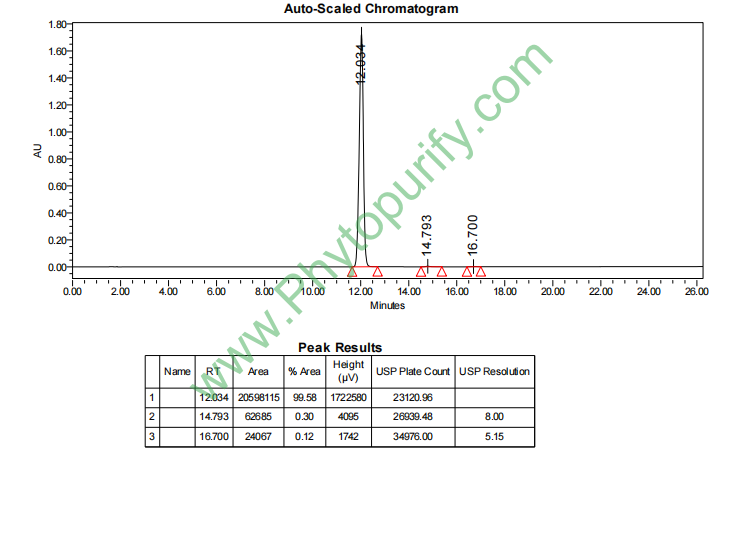
HPLC of Chrysophanol
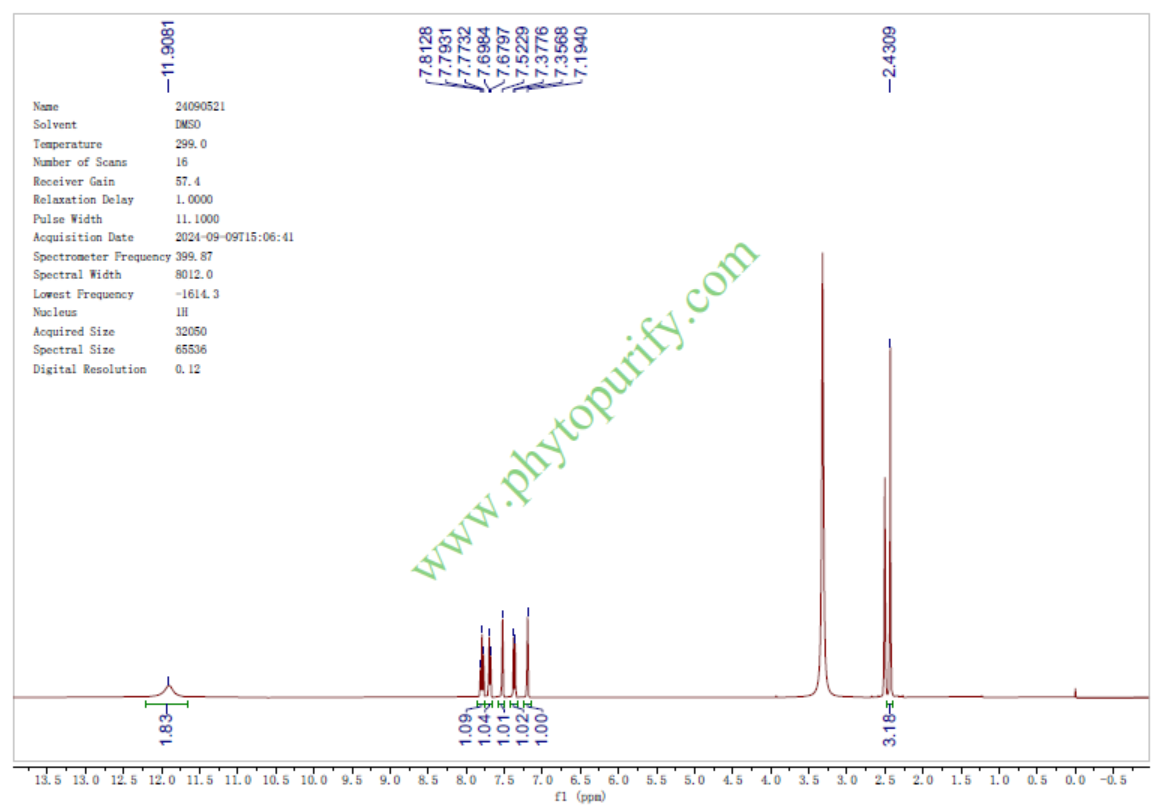
HNMR of Chrysophanol
Storage conditions:Short-term storage at 2~8℃, long-term storage at -20 ~ -80℃
Chrysophanol, also known as anthraquinone acid, is a naturally occurring anthraquinone compound widely distributed in various traditional Chinese medicinal materials, especially in Rheum palmatum L., which is abundant in content. As an important natural product, emodin has attracted widespread attention in the fields of pharmacology and medicinal chemistry due to its diverse biological activities. In recent years, with the in-depth study of tumor molecular mechanisms, the potential value of emodin in the treatment of malignant tumors such as liver cancer has gradually emerged, especially in inhibiting the epidermal growth factor receptor (EGFR) signaling pathway and its downstream key molecular activities, showing significant pharmacological activity.
This article aims to provide a systematic review of the chemical structure and physicochemical properties, plant sources, and extraction methods of emodin. It elaborates on its pharmacological activity and mechanism of action, with a focus on analyzing its regulatory effects on molecular targets related to liver cancer. At the same time, it evaluates its pharmacological properties and pharmacokinetic characteristics, explores its clinical application prospects and development directions, and provides theoretical basis and practical guidance for natural product pharmacology research and new drug development.
The chemical name of emodin is 1,8-Dihydroxy-3-methylanthraquinone, with a molecular formula of C15H10O4 and a molecular weight of 254.24. Its structural core is the anthraquinone skeleton, which has two hydroxyl substituents and one methyl substituent, endowing it with unique chemical properties and biological activity. The CAS number for emodin is 481-74-3.
In terms of physical and chemical properties, the LogP value of emodin is about 3.37, indicating that it has moderate lipid solubility, which is beneficial for cell membrane penetration and in vivo distribution. Its topological polar surface area (TPSA) is 74.6 Å ² and the number of hydrogen bond acceptors is 4, indicating its hydrophilicity and binding ability in intermolecular interactions. The blood-brain barrier permeability of emodin is relatively low, and there are no significant negative effects on liver toxicity, cardiac toxicity, or hERG channel inhibition. Moreover, the Ames mutagenicity test result is negative, indicating its high safety.
Rhubarb phenols are mainly found in plants of the Rheum genus, such as Rheum palmatum L. and Rheum officinale Baill. Rhubarb is widely used in traditional Chinese medicine for the treatment of diarrhea, clearing heat and detoxifying, and its pharmacological effects are closely related to anthraquinone components.
The common methods for extracting emodin include solvent extraction, ultrasound assisted extraction, microwave-assisted extraction, etc. Generally, ethanol or methanol is used as the extraction solvent. By optimizing parameters such as extraction temperature, time, and solvent concentration, the extraction rate of emodin can be effectively improved. Subsequently, high-purity emodin was obtained through liquid-liquid distribution, column chromatography, and other separation and purification techniques. In recent years, green extraction techniques such as supercritical CO2 extraction have also been applied to the extraction of emodin, further improving extraction efficiency and environmental friendliness.
Rhubarb phenol exhibits various biological activities, including anti-inflammatory, antioxidant, antibacterial, and anti-tumor effects. Especially in the field of tumor suppression, emodin exhibits significant anti-cancer potential through multi-target and multi pathway regulation.
In liver cancer models, emodin can effectively inhibit the proliferation, migration, and invasion of liver cancer cells, induce cell cycle arrest and apoptosis. Its anti-tumor effect is related to regulating multiple signaling pathways, such as inhibiting EGF induced EGFR phosphorylation, blocking the activation of the PI3K/AKT/mTOR signaling axis, and thereby affecting cell survival and proliferation. In addition, emodin also regulates the expression of key molecules such as BCL2, STAT3, MMP9, and inhibits the invasion and metastasis ability in the tumor microenvironment.
In addition to tumors, emodin also exhibits good activity in anti-inflammatory reactions, downregulating the NF - κ B signaling pathway, reducing the release of inflammatory mediators, and demonstrating potential immune regulatory functions.
The pharmacological mechanism of action of emodin is mainly achieved by intervening in cellular signaling pathways. Its core targets include:
EGFR (epidermal growth factor receptor)
Rhubarb can inhibit EGF induced EGFR phosphorylation, block its activation state, and thereby inhibit downstream signaling. EGFR, as an important driving factor for various tumors such as liver cancer, its inhibition helps to suppress the proliferation and survival of tumor cells.
AKT/mTOR/p70S6K signaling pathway
Rhubarb inhibits the activation of AKT protein kinase, blocks the phosphorylation of mTOR and its downstream effector molecule p70S6K, leading to inhibition of cell growth and protein synthesis, thereby exerting anti proliferative effects.
BCL2
By regulating the expression of anti apoptotic protein BCL2, emodin promotes apoptosis of tumor cells and enhances cell death signaling.
STAT3
Inhibit the STAT3 signaling pathway, block its transcriptional activity, and reduce the expression of tumor promoting genes.
MMP9
Inhibit the activity of matrix metalloproteinase 9 (MMP9) and reduce the invasion and metastasis ability of tumor cells.
TP53, TERT, PIK3CA, NFKB1, etc
Rhubarb affects cell cycle, apoptosis, gene stability, and inflammatory response by regulating these key genes and proteins, synergistically exerting anti-tumor effects.
In summary, emodin has formed a complex anti-tumor network through synergistic regulation of multiple targets and pathways, demonstrating its unique advantages as a potential anti-tumor drug.
From the perspective of medicinal properties, emodin has great potential for drug development. Its molecular weight is moderate, its lipophilicity is moderate, and it can penetrate cell membranes well, but its blood-brain barrier permeability is low, which helps reduce central nervous system side effects. Toxicological evaluation shows that emodin has no significant hepatotoxicity, cardiotoxicity, or genotoxicity, and is relatively safe.
Pharmacokinetic studies have shown that emodin is well absorbed orally, but its bioavailability is limited by first pass effects and the activity of metabolic enzymes. It is mainly metabolized in the body through the liver, and the metabolites are mostly hydroxylation and glucuronic acid conjugates. The half-life of emodin is moderate, making it suitable for designing daily dosing regimens. In the future, through structural modification or nanocarrier technology, it is expected to further improve its pharmacokinetic properties and enhance its clinical application value.
As a natural anthraquinone compound, emodin has broad clinical application prospects due to its multi-target anti-tumor mechanism and good safety. Especially in the treatment of malignant tumors such as liver cancer, emodin is expected to serve as an adjuvant therapy drug, enhancing the effectiveness of existing chemotherapy or targeted therapy and reducing the risk of drug resistance.
In addition, the potential of emodin in anti-inflammatory, antioxidant, and immune regulation provides possibilities for its application in chronic inflammation, metabolic diseases, and other fields. Future research should focus on:
Through interdisciplinary collaboration, promote the transformation of emodin from a natural product to a clinical drug, and advance its application in modern medicine.
As a natural anthraquinone compound with significant biological activity, emodin has shown great potential for drug development due to its multi-target regulatory ability and good safety. Its anti-tumor mechanism in malignant tumors such as liver cancer is becoming increasingly clear, providing important theoretical basis and practical direction for the development of new anti-cancer drugs. In the future, by combining modern medicinal chemistry, molecular biology, and pharmacokinetic research methods, in-depth exploration and optimization of the pharmacological properties of emodin will help promote its clinical application and benefit a large number of patients.
