Introduction/Overview
Natural products have always been an important treasure trove for innovative drug discovery, among which stilbene compounds have attracted much attention due to their wide range of biological activities. Resveratrol, as a star molecule in this family, has been widely studied for its anti-inflammatory, antioxidant, cardiovascular protective, and potential anti-aging effects. However, resveratrol itself has limitations such as low bioavailability and rapid metabolism, which has prompted researchers to explore its structural analogues in order to obtain more promising candidate molecules. Resveratrol trimethyl ether (3,4 ', 5-Trimethoxystilbene, TMS), as a methylated derivative of resveratrol, has gradually become an emerging hotspot in natural product pharmacology research in recent years due to its enhanced metabolic stability and unique biological activity spectrum. TMS not only retains some beneficial properties of the parent compound, but also demonstrates unique and even stronger potential in anti-inflammatory, antioxidant, anti-tumor and other fields. This article aims to systematically review the chemical properties, plant sources, pharmacological activities, molecular mechanisms of action, and medicinal properties of resveratrol trimethyl ether, in order to provide a comprehensive academic perspective for the in-depth research and potential applications of this compound.
Chemical structure and physicochemical properties
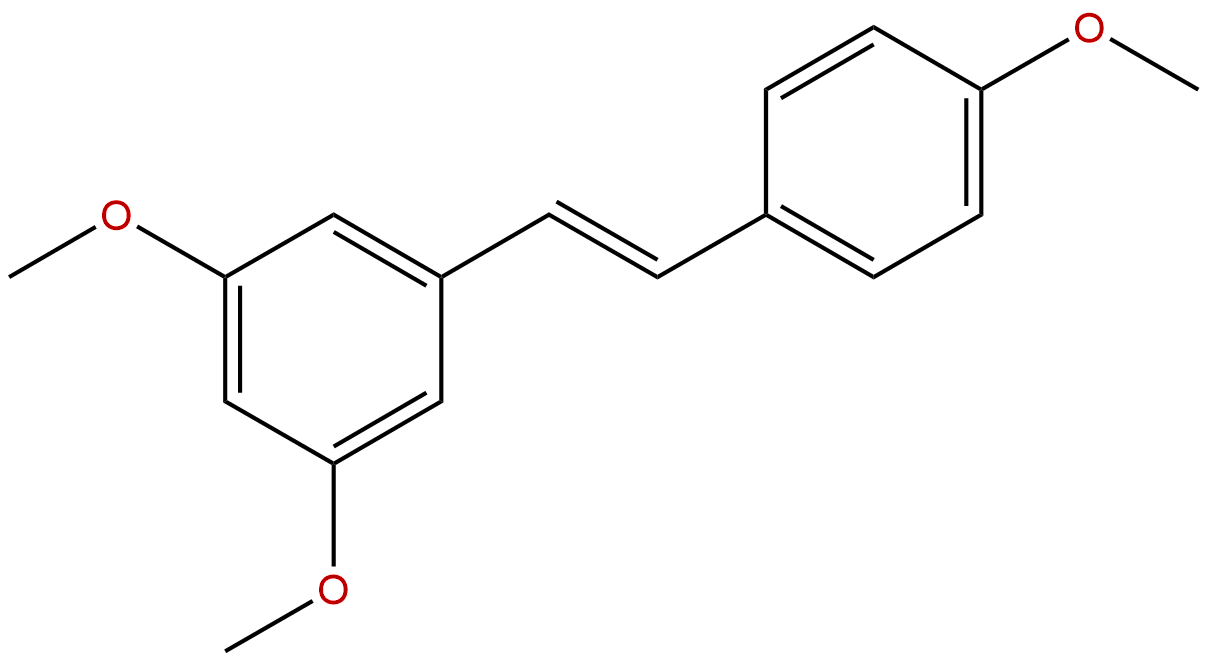
The chemical name of resveratrol trimethyl ether is 3,4 ', 5-trimethoxy styrene, and its CAS number is 22255-22-7. Structurally, it is composed of two benzene rings connected by an vinyl bridge and is a methyl ether derivative of resveratrol. Specifically, it is replaced by methoxy (- OCH ∝) at the 3rd, 5th, and 4th hydroxyl positions of resveratrol. This structural modification significantly altered its physicochemical properties.
Its molecular formula is C ₁₇ H ₁₈ O3, and its molecular weight is 270.3280 g/mol. The introduction of methoxy greatly enhances the hydrophobicity of the molecule, with a calculated lipid water partition coefficient (LogP) of 4.3152, indicating that the compound has high lipophilicity. Consistent with this, its water solubility is extremely low, about 0.0032 mg/mL, which poses a challenge for its formulation development. The topological polar surface area (TPSA) of the molecule is 27.69 Å ², which is a relatively small value, further confirming its hydrophobic properties. It is worth noting that higher lipophilicity and smaller polar surface area are usually advantageous for penetrating biological membranes, and their computational properties predict that they have higher blood-brain barrier permeability, which provides potential advantages for their application in the treatment of central nervous system related diseases. In the preliminary safety screening, the hERG inhibition risk prediction was negative, indicating a low risk of cardiac toxicity; The Ames test value is 0.6, indicating a low risk of mutagenicity, but further experimental verification is needed.
Plant sources and extraction methods
Resveratrol trimethyl ether is not widely present in the plant kingdom. It is mainly found as a derivative or metabolite of resveratrol in specific plants. At present, the reported natural sources are relatively limited, mainly concentrated in a few plant species.
- Grape family plants Trace amounts of TMS can be detected in the roots, skins, or leaves of some grape varieties (Vitis vinifera), which may be the product of resveratrol after being treated by methyltransferase in the plant.
- Liliaceae plants TMS has been isolated from the bulbs of plants such as Ornithogalum.
- Other sources There are also reports of the compound being found in certain moss or fungal cultures.
Due to the scarcity of natural sources, TMS currently used in laboratory research and pharmacological activity evaluation is mainly through chemical synthesis Obtained in large quantities through various channels. The most commonly used synthetic route is to use 3,5-dimethoxybenzaldehyde and 4-methoxybenzyl phosphonic acid ester as starting materials, construct key vinyl bridges through Wittig Horner reaction, and then purify to obtain the target product. This method has a high yield and can meet the needs of basic research.
The method for extracting natural TMS from plants is similar to other hydrophobic polyphenols. Organic solvents such as methanol, ethanol, and ethyl acetate are commonly used for leaching or reflux extraction of dried plant materials. After filtration and concentration, the crude extract can be separated and purified using techniques such as silica gel column chromatography and preparative high-performance liquid chromatography (HPLC), and its structure can be identified through methods such as nuclear magnetic resonance (NMR) and mass spectrometry (MS). Due to the convenience of synthetic pathways, chemical synthesis has become the main way to obtain TMS.
Pharmacological activity research
The pharmacological activity research of resveratrol trimethyl ether reveals its multifaceted biological effects, especially in the fields of antioxidant, anti-inflammatory, and anti-tumor, showing significant potential.
-
antioxidant activity One of the core pharmacological activities of TMS. Although TMS itself is not a potent direct free radical scavenger (as its phenolic hydroxyl group is methylated), research has shown that TMS can Indirect mechanism Play a powerful role in cellular antioxidant defense. It can significantly upregulate the expression of various endogenous antioxidant enzymes and phase II detoxifying enzymes in cells, thereby enhancing the cell's resistance to oxidative stress. Experimental results have shown that TMS pretreatment can effectively protect cells from damage induced by oxidants such as hydrogen peroxide (H ₂ O ₂) and tert butyl hydroperoxide (t-BHP), maintain cell viability, and reduce levels of reactive oxygen species (ROS).
-
anti-inflammatory effect Inflammation is closely related to oxidative stress, and TMS also exhibits good activity in this regard. In the lipopolysaccharide (LPS) - induced macrophage inflammation model, TMS can dose dependently inhibit the production of key pro-inflammatory mediators such as nitric oxide (NO), prostaglandin E2 (PGE2), tumor necrosis factor - α (TNF - α), interleukin-6 (IL-6), etc. Its anti-inflammatory effect is related to the inhibition of classical inflammatory signaling pathways such as nuclear factor kappa B (NF - κ B) activation.
-
Antitumor activity This is one of the most attractive directions in TMS research. A large number of in vitro studies have shown that TMS has significant proliferation inhibition and apoptosis promoting effects on a variety of human cancer cell lines (such as breast cancer, lung cancer, colon cancer, liver cancer, leukemia, etc.), and its activity is even stronger than resveratrol in some models. Its anti-tumor mechanism is complex, involving inducing cell cycle arrest (often occurring in the G2/M phase), activating mitochondrial pathway induced apoptosis, inhibiting cell invasion and migration, etc. It is worth noting that some studies suggest that TMS has relatively low toxicity to normal cells, demonstrating a certain degree of selectivity.
-
Neuroprotective potential Based on its excellent blood-brain barrier penetration prediction and antioxidant and anti-inflammatory properties, TMS has shown promising application prospects in neurodegenerative disease models. Preliminary research suggests that it may have a protective effect against beta amyloid induced neurotoxicity and dopaminergic neuron damage in Parkinson's disease models, but its specific effects and mechanisms still need to be further explored.
Mechanism of action and molecular targets
The multiple pharmacological activities of resveratrol trimethyl ether stem from its regulation of multiple signaling pathways within cells, and its mechanism of action involves multiple molecular targets, particularly closely related to the activation of the antioxidant stress defense system.
-
Core mechanism: Activation of Nrf2/ARE pathway
Nrf2 (encoded by NFE2L2 gene) is a central regulatory factor of cellular antioxidant stress response. In the resting state, Nrf2 binds to its inhibitory protein Keap1 and is degraded by ubiquitination. Under oxidative stress or certain compounds (such as TMS), Nrf2 dissociates from Keap1, translocates to the nucleus, and binds to antioxidant response elements (ARE), initiating the transcription of a series of cell protective genes. TMS has been proven to be an effective activator of the Nrf2 pathway.
- Key targets:NFE2L2/NRF2 TMS exerts antioxidant effects Core target By activating Nrf2, TMS can significantly upregulate the expression of a series of downstream antioxidant enzymes and phase II detoxifying enzymes, including:
- SOD1(Superoxide Dismutase 1) and SOD2 Catalytic conversion of superoxide anion radicals into hydrogen peroxide.
- CAT(Catalase): Decomposes hydrogen peroxide into water and oxygen.
- GPX1(Glutathione Peroxidase 1): Reduces hydrogen peroxide and organic peroxides using reduced glutathione (GSH).
- HMOX1(Heme Oxygenase 1): Degradation of heme produces biliverdin, carbon monoxide, and iron ions with antioxidant and anti-inflammatory effects.
-
Inhibit enzymes related to inflammation and matrix degradation
- MMP1 (matrix metalloproteinase-1) and MMP3 (Matrix Metalloprotease-3)These enzymes can degrade the extracellular matrix and play a critical role in inflammation, tumor metastasis, and tissue remodeling. TMS can inhibit its expression or activity, which is directly related to its anti-inflammatory and tumor invasion and metastasis inhibiting effects.
-
Other potential targets and pathways
- Tyrosinase (TYR) inhibition Studies have shown that TMS may inhibit tyrosinase activity, suggesting its potential use in skin pigmentation disorders or as a food preservative.
- Cell cycle and apoptosis related proteins TMS can induce tumor cell apoptosis by regulating p53, Bcl-2 family proteins, caspase cascade reactions, etc.
- Inhibition of NF - κ B pathway By inhibiting the activity of I κ B kinase (IKK) or the degradation of I κ B α, NF - κ B nuclear translocation is prevented, thereby downregulating the expression of pro-inflammatory cytokines and proliferation related genes.
In summary, TMS exerts its biological effects through multiple targets and pathways, among which the activation of the Nrf2 pathway as the core antioxidant defense system is one of its most important molecular mechanisms.
Evaluation of drug properties and pharmacokinetics
Although resveratrol trimethyl ether exhibits excellent pharmacological activity in vitro, its drug like and pharmacokinetic properties in vivo are key factors determining its ability to be converted into drugs.
-
Analysis of drug properties parameters:
- Advantage Moderate molecular weight (270), in accordance with Lipinski's five rules. A high LogP value (4.32) and a low TPSA value (27.69) indicate excellent membrane permeability, and computational models predict that it can efficiently penetrate the blood-brain barrier, which is a significant advantage over many water-soluble drugs. No hERG inhibition warning reduces early cardiac safety risks.
- challenge:Extremely low water solubility(0.0032 mg/mL) is the primary obstacle faced by its drug formulation. Low solubility can lead to poor oral absorption, low bioavailability, and pose difficulties for the development of injectable formulations. Therefore, it is crucial to develop appropriate formulation strategies (such as nanocrystals, liposomes, cyclodextrin inclusion complexes, solid dispersions, etc.) to improve their solubility and dissolution rate.
-
Pharmacokinetic characteristics(Based on preclinical studies):
- Absorption and distribution Thanks to its high lipophilicity, TMS is well absorbed in the small intestine after oral administration. In animal models, its oral bioavailability Significantly higher than resveratrol The main reason is that the methylation structure avoids metabolic inactivation caused by rapid binding (glucuronidation and sulfation) of resveratrol in the intestine and liver. After absorption, TMS is widely distributed to various tissues and may accumulate in adipose tissue due to its lipophilicity.
- Metabolism and excretion The metabolic pathway of TMS in the body is different from that of resveratrol. Methoxy is relatively stable in the body, but not completely metabolized. Its main metabolic pathways may include demethylation (regeneration of resveratrol or monomethyl ether derivatives), reduction of vinyl double bonds, and hydroxylation. Metabolites are mainly excreted through bile and urine. Its metabolic stability is superior to resveratrol, resulting in a relatively longer half-life in the body.
- Ames test The reported value is 0.6 (usually considered to have a potential mutagenic risk of>1.0), and the preliminary results are optimistic, but it still needs to be confirmed in a more comprehensive genetic toxicity testing system.
Clinical application prospects and prospects
The diverse biological activities of resveratrol trimethyl ether bring potential application prospects in multiple therapeutic fields, but also face challenges.
-
Potential application directions:
- Chemotherapy prevention and adjuvant therapy for tumors Based on its strong Nrf2 activation ability and anti-inflammatory properties, TMS can be used as a chemopreventive agent to reduce the risk of cancer in high-risk populations. Its anti proliferative and pro apoptotic effects also make it promising for development as an anti-tumor drug, especially for tumor types that are insensitive to traditional chemotherapy or prone to metastasis. The combination with existing chemotherapy drugs may produce synergistic effects, reducing chemotherapy dosage and side effects.
- Oxidative stress-related diseases: including neurodegenerative diseases (Alzheimer's disease, Parkinson's disease), cardiovascular diseases (atherosclerosis), metabolic diseases (diabetes and its complications), etc. Its strong cellular protective effect and potential neural penetration ability are its advantages.
- Skin Protection and Disease Topical preparations may be used for skin photoaging, inflammatory skin diseases (such as dermatitis), or as functional cosmetic ingredients to exert antioxidant, anti-inflammatory, and tyrosinase inhibiting effects.
-
challenges faced:
- Solubility and formulation challenges This is the biggest technical bottleneck in advancing its clinical research. An efficient, stable, and secure delivery system must be developed.
- Confirmation of in vivo drug efficacy Most of the activity data comes from in vitro cell experiments, and there is an urgent need to validate its efficacy and safety in more rigorous animal disease models.
- Depth of mechanism of action Although it is known that TMS activates pathways such as Nrf2, the direct interaction mode between TMS and targets such as Keap1, as well as its specificity, still need to be elucidated at the molecular level.
- Long term safety assessment The sustained strong activation of Nrf2 may theoretically have a "double-edged sword" effect that promotes the growth of certain tumors, and comprehensive long-term toxicological studies are needed.
-
Future Prospects:
Future research should focus on: ① developing innovative nano formulations or prodrug strategies to systematically address their water solubility and targeted delivery issues; ② Conduct systematic preclinical pharmacological and toxicological studies to lay the foundation for clinical trials; ③ Thoroughly explore its mechanism of action, identify its direct target of action, and elucidate its role in complex biological networks; ④ Conduct structural optimization research to further improve its drug properties while maintaining its activity. As a derivative of resveratrol, TMS, with its enhanced metabolic stability and unique activity profile, is expected to surpass others and become a highly valuable lead compound for development.
Conclusion
Resveratrol trimethyl ether, as a structural modification of resveratrol, has successfully overcome some defects such as rapid metabolism of the parent compound through simple methylation modification, and demonstrated more extensive and potent pharmacological activities, especially in activating Nrf2 mediated cell defense pathways. Its basic research data in the fields of antioxidant, anti-inflammatory, and anti-tumor are encouraging, and its high predictive blood-brain barrier permeability and metabolic stability provide unique advantages for its treatment of central nervous system diseases. However, its extremely low water solubility is the main obstacle on the road to drug development. Future research requires close collaboration among multiple disciplines such as pharmaceuticals, pharmacology, and toxicology, overcoming their physical and chemical limitations through advanced drug delivery technologies, and verifying their safety and efficacy in rigorous preclinical and clinical studies. In summary, resveratrol trimethyl ether is a natural product derivative with a clear molecular mechanism of action and broad development prospects. Its subsequent research is expected to provide new candidate drugs and strategies for the prevention and treatment of related diseases.