


Product name: Mulberroside A
Synonym name:
Catalogue No.: BP0964
Cas No.: 102841-42-9
Formula: C26H32O14
Mol Weight: 568.528
Botanical Source: Mori cotex
Physical Description:
Type of Compound: Stibene glucosides
Purity: 95%~99%
Analysis Method: HPLC-DAD or/and HPLC-ELSD
Identification Method: Mass, NMR
Packing: Brown vial or HDPE plastic bottle
Storage: Store in a well closed container, protected from air and light. Put into refrigerate or freeze for long term storage.
Whenever possible, you should prepare and use solutions on the same day. However, if you need to make up stock solutions in advance, we recommend that you store the solution as aliquots in tightly sealed vials at -20℃. Generally, these will be useable for up to two weeks.
The product could be supplied from milligrams to grams
Inquire for bulk scale.
Description:
Mulberroside A, the major active anti-tyrosinase compound in the root bark extract of Morus alba L. (Moraceae), is widely employed as an active ingredient in whitening cosmetics. Mulberroside A has neuroprotective, analgesic, anti-inflammatory, antiapoptotic, uricosuric, nephroprotective, hypoglycemic, and antidiabetic effects.It also can protect mice against ethanol-induced hepatic damage.
References:
J Neurosci Res. 2014 Jul;92(7):944-54.
Mulberroside A protects against ischemic impairment in primary culture of rat cortical neurons after oxygen-glucose deprivation followed by reperfusion.
Mulberroside A is a natural polyhydroxylated stilbene compound present at relatively high abundance in the roots and twigs of Morus alba L. It is known for its nephroprotective, hypoglycemic, and antidiabetic effects. Because its metabolite, oxyresveratrol, possessed purported anti-inflammatory and neuroprotective effects, we proposed that Mulberroside A may elicit neuroprotective effects that can be used in the treatment of brain ischemic injury.
METHODS AND RESULTS:
Therefore, we decided to investigate the pharmacological properties of Mulberroside A in primary culture of rat cortical neurons after oxygen-glucose deprivation followed by reperfusion (OGD/R), evaluating its ability to counteract the hypoxia-ischemia impairment. The results showed that Mulberroside A elicited neuroprotective effects comparable to nimodipine. The mechanistic studies showed that Mulberroside A decreased the expressions of tumor necrosis factor-α (TNF-α), interleukin (IL)-1β, and IL-6 and inhibited the activation of NALP3, caspase-1, and nuclear factor-κB and the phosphorylation of extracellular signal-regulated protein kinases, the c-Jun N-terminal kinase, and p38, exhibiting anti-inflammatory antiapoptotic effects. Our results also further demonstrate that the proinflammatory cytokines of IL-1β, IL-6, and TNF-α are promising targets for treatment of cerebral ischemic injury.
CONCLUSIONS:
Although further investigation is required for its development, all of these findings led us to speculate that Mulberroside A is a candidate for the treatment of ischemic stroke, which would act as a multifactorial neuroprotectant.
Planta Med. 2011 May;77(8):786-94.
Mulberroside a possesses potent uricosuric and nephroprotective effects in hyperuricemic mice.
Mulberroside A is a major stilbene glycoside of MORUS ALBA L. (Moraceae), which is effectively used for the treatment of hyperuricemia and gout in traditional Chinese medicine. We examined whether Mulberroside A had effects on renal urate underexcretion and dysfunction in oxonate-induced hyperuricemic mice and investigated the potential uricosuric and nephroprotective mechanisms involved.
METHODS AND RESULTS:
Mulberroside A at 10, 20, and 40 mg/kg decreased serum uric acid levels and increased urinary urate excretion and fractional excretion of uric acid in hyperuricemic mice. Simultaneously, it reduced serum levels of creatinine and urea nitrogen (10-40 mg/kg), urinary N-acetyl- β-D-glucosaminidase activity (10-40 mg/kg), β₂-microglobulin (10-40 mg/kg) and albumin (20-40 mg/kg), and increased creatinine clearance (10-40 mg/kg) in hyperuricemic mice. Furthermore, Mulberroside A downregulated mRNA and protein levels of renal glucose transporter 9 (mGLUT9) and urate transporter 1 (mURAT1), and upregulated mRNA and protein levels of renal organic anion transporter 1 (mOAT1) and organic cation and carnitine transporters (mOCT1, mOCT2, mOCTN1, and mOCTN2) in hyperuricemic mice. This is the first study demonstrating that Mulberroside A exhibits uricosuric and nephroprotective effects mediated in part by cooperative attenuation of the expression alterations of renal organic ion transporters in hyperuricemic mice.
CONCLUSIONS:
These data suggest that Mulberroside A may be a new drug candidate for the treatment of hyperuricemia with renal dysfunction.
Environ Toxicol Pharmacol. 2008 Nov;26(3):325-30.
Protective function of cis-mulberroside A and oxyresveratrol from Ramulus mori against ethanol-induced hepatic damage.
The aim of the study was to investigate the protective effects of oxyresveratrol and cis-Mulberroside A isolated from Ramulus mori on the liver of mice intoxicated with ethanol.
METHODS AND RESULTS:
Animals were pretreated with different doses (30 and 60mg/kg of body weight) of oxyresveratrol and cis-Mulberroside A prior to the ethanol (9g/kg of body weight) orally for 7 days. Ethanol treatment induced the decrease of reduced glutathione level and antioxidant enzymes activities, the elevation of the lipid peroxidation and cytochrome P450 2E1 activity accompanied with the increase of iron concentration and mitochondrial permeability transition. Pretreatment with oxyresveratrol and cis-Mulberroside A restored the changes in the above parameters up to the basal level. The protective effects of the two active compounds were further supported by attenuation of the degree of tissue damage and the regulation of the expression of TNF-α.
CONCLUSIONS:
It could be concluded that oxyresveratrol and cis-Mulberroside A from R. mori could protect mice against ethanol-induced hepatic damage.
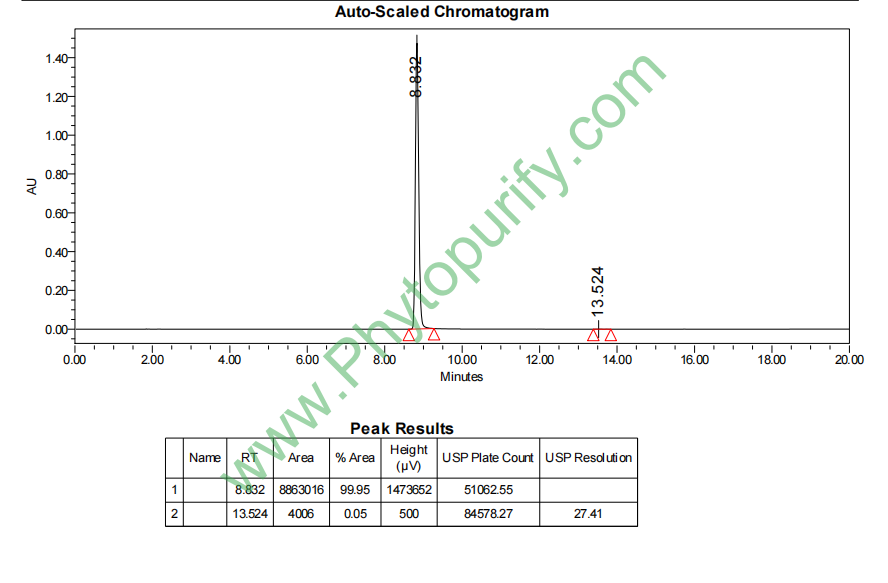
HPLC of Mulberroside A
Storage conditions:Short-term storage at 2~8℃, long-term storage at -20 ~ -80℃
239.2200
-.5717
-.5752
8.3940
.5009
.0599
Low
72.8506
4.6273
Yes
No
No
No
No
No
0.0
Yes
Yes
Yes
Yes
Natural products, as an important source of drug discovery, play an irreplaceable role in human health. Among the numerous natural compounds with biological activity, they are derived from the mulberry tree, a member of the mulberry family(Morus alba L. Mulberroside A has attracted widespread attention in recent years. Mulberry trees, as a traditional medicinal plant, have a long history of application in traditional Chinese medicine theory in their root bark (mulberry bark), leaves, fruits, and other parts. They have the effects of purging the lungs, relieving asthma, promoting diuresis and reducing swelling, clearing heat and improving vision. Modern pharmacological research has revealed that mulberry tree extracts have various biological activities such as anti-inflammatory, antioxidant, hypoglycemic, lipid-lowering, anti-tumor, and neuroprotective effects, which are closely related to the various chemical components they contain. Among them, stilbene glycosides are one of the important active ingredient groups.
Mulberry bark glycoside A, chemical name 5,2 ', 4' - trihydroxy-4- (β - D-glucopyranosyl) - stilbene-2- β - D-glucopyranoside, is one of the most abundant stilbene glycoside components in mulberry trees. Since its isolation and identification, researchers have gradually revealed its significant pharmacological activities in anti-inflammatory, antioxidant, anti apoptotic, tyrosinase inhibition, and anti-tumor aspects. Especially by regulating multiple key signaling pathways such as NF - κ B, MAPK, NLRP3 inflammasome, etc., it exerts multi-target and multi pathway pharmacological effects, making it a potential candidate compound for treating inflammation related diseases, metabolic diseases, and even tumors. This article aims to systematically review the chemical properties, plant sources, extraction processes, pharmacological activities, mechanisms of action, medicinal characteristics, and clinical application prospects of mulberry bark glycoside A, in order to provide comprehensive scientific basis for the in-depth research and development of this natural product.
Mulberry bark glycoside A belongs to the class of stilbene glycosides, and its chemical structure is based on the stilbene nucleus as the skeleton, with sugar and hydroxyl groups connected at specific positions. Specifically, its structural feature is that there is a hydroxyl group at the 5th, 2nd, and 4th positions of stilbene, with a β - D-glucopyranose group attached to the 4th and 2nd positions, respectively. This dual glycosidic structure endows mulberry bark glycoside A with unique physicochemical properties and biological activity. Its molecular formula is C ₂₆ H ∝ ₂ O ₁₄, with a molecular weight of 568.5280 Da. Structurally, mulberry bark glycoside A belongs to the class of stilbene compounds along with resveratrol, but the degree of glycosylation of mulberry bark glycoside A is higher, which significantly affects its solubility, stability, and bioavailability.
In terms of physical and chemical properties, mulberry bark glycoside A exhibits strong hydrophilicity. The calculated lipid water partition coefficient (LogP) is -0.5717, indicating that its solubility in the aqueous phase is much higher than that in the lipid phase. This characteristic is closely related to the presence of multiple hydroxyl groups and two glucose groups in its molecule, which can form hydrogen bonds with water molecules, thereby promoting their dissolution in water. Its topological polar surface area (TPSA) is as high as 239.2200 Å ², further confirming its strong polarity and hydrophilicity. The water solubility parameter is 8.3940, indicating that it has good solubility in aqueous solutions. However, high hydrophilicity also means that mulberry bark glycoside A is difficult to penetrate biological membranes, especially the blood-brain barrier (BBB), and its BBB permeability is evaluated as "low". On the one hand, this characteristic limits its application in the treatment of central nervous system diseases, but on the other hand, it may also reduce central related toxic side effects. In addition, the molecular weight of mulberry bark glycoside A is relatively large (>500 Da) and contains multiple hydrogen bond donors and acceptors, which meets several restrictions on oral drug absorption in the Lipinski Five Rules, indicating that its oral bioavailability may face challenges. In terms of stability, stilbene compounds are usually sensitive to light, heat, and oxidation conditions. The study of the stability of mulberry bark glycoside A is crucial for the development of its formulations and the selection of storage conditions.
Mulberry bark glycoside A mainly comes from plants in the mulberry family, including mulberry trees(Morus alba L. ) is its most abundant and primary source. In addition, in Monsang(Morus mongolica)Chicken Sang(Morus australis)It has also been found in other mulberry plants. There are significant differences in the distribution of mulberry bark glycoside A content in different parts of mulberry trees. Traditionally, mulberry bark (i.e. the dried root bark of mulberry trees) is considered the medicinal part with the highest content of mulberry glycoside A, which is also a commonly used medicinal herb in traditional Chinese medicine clinical practice. However, recent studies have shown that the tender branches (mulberry branches) and leaves of mulberry trees also contain a certain amount of mulberry bark glycoside A, but its content is usually lower than that of the root bark. The accumulation of mulberry bark glycoside A in plants is influenced by various factors, including variety, growth environment, harvest season, tree age, and processing methods. For example, the content of mulberry bark glycoside A may vary several times among different varieties of mulberry trees, and its content in the root bark harvested in autumn is often higher than that in spring.
Researchers have developed various methods for the extraction of mulberry bark glycoside A, aiming to improve extraction efficiency and purity. The traditional extraction method is mainly solvent extraction, usually using ethanol or methanol aqueous solution as the extraction solvent. Due to the strong polarity of mulberry bark glycoside A, high concentrations of alcohol water mixed solvents (such as 50% -70% ethanol) often achieve good extraction results. The extraction process usually includes steps such as raw material crushing, solvent soaking, heating reflux or ultrasound assisted extraction, filtration, concentration, etc. In order to improve extraction efficiency, modern technologies such as ultrasound assisted extraction (UAE) and microwave-assisted extraction (MAE) are widely used. The ultrasonic cavitation effect can destroy plant cell walls, promote solvent penetration and effective ingredient dissolution, thereby significantly shortening extraction time and improving yield. Microwave heating can rapidly heat up and vaporize the water inside the cell, causing the cell wall to rupture, which is also beneficial for the release of target components.
The crude extract obtained contains a large amount of impurities and needs to be separated and purified to obtain high-purity mulberry bark glycoside A. Common purification methods include macroporous adsorption resin column chromatography, silica gel column chromatography, polyamide column chromatography, and preparative high-performance liquid chromatography (Prep HPLC). Macroporous adsorption resin is often used for the initial enrichment and separation of mulberry bark glycoside A due to its advantages of large adsorption capacity, low cost, and reusability. For example, using HPD-100 or AB-8 macroporous resins and gradient elution with ethanol water solutions of different concentrations can effectively enrich mulberry bark glycoside A. Subsequently, by combining silica gel column chromatography or polyamide column chromatography and using solvent systems of different polarities (such as chloroform methanol water) for further separation, high purity mulberry bark glycoside A can be obtained. For studies that require high-purity standards, preparative HPLC is the final purification method, which can obtain mulberry bark glycoside A with a purity of over 98%. In addition, high-speed countercurrent chromatography (HSCCC), as a liquid-liquid distribution chromatography technique, has also shown unique advantages in the separation and purification of mulberry bark glycoside A, avoiding irreversible sample on solid phase carriers. Adsorption.
The pharmacological activity research of mulberry bark glycoside A covers multiple aspects such as anti-inflammatory, antioxidant, anti apoptotic, tyrosinase inhibition, and anti-tumor, demonstrating great potential as a multifunctional natural active molecule.
anti-inflammatory activity It is one of the most prominent pharmacological effects of mulberry bark glycoside A. Numerous in vitro and in vivo studies have confirmed that mulberry bark glycoside A can effectively inhibit the production of various inflammatory factors. In a macrophage model stimulated by lipopolysaccharide (LPS), mulberry bark glycoside A treatment significantly reduced the mRNA and protein expression levels of pro-inflammatory cytokines such as tumor necrosis factor - α (TNF - α), interleukin-1 β (IL-1 β), and interleukin-6 (IL-6). In addition, mulberry bark glycoside A can also inhibit the production of inflammatory mediators such as nitric oxide (NO) and prostaglandin E2 (PGE2), which is related to its inhibitory effect on the expression of inducible nitric oxide synthase (iNOS) and cyclooxygenase-2 (COX-2). In animal models, mulberry bark glycoside A has shown protective effects on various acute and chronic inflammation models, such as reducing ear swelling in mice and inhibiting adjuvant arthritis in rats.
Antioxidant and anti apoptotic activity It is an important basis for mulberry bark glycoside A to exert cell protective effects. The multiple phenolic hydroxyl groups in the molecular structure of mulberry bark glycoside A endow it with the ability to directly scavenge free radicals, such as DPPH free radicals, ABTS cationic free radicals, and hydroxyl free radicals, all of which have good scavenging effects. Meanwhile, it can also upregulate the expression of downstream antioxidant enzymes such as superoxide dismutase (SOD), catalase (CAT), and glutathione peroxidase (GSH Px) by activating the nuclear factor E2 related factor 2 (Nrf2) signaling pathway, thereby enhancing the endogenous antioxidant defense system of cells. In synergy with antioxidant activity, mulberry bark glycoside A exhibits significant anti apoptotic effects. In various cell damage models, such as oxidative stress-induced neuronal injury and myocardial ischemia-reperfusion injury, mulberry bark glycoside A can inhibit the mitochondrial apoptosis pathway, upregulate the expression of anti apoptotic protein Bcl-2, downregulate the expression of pro apoptotic protein Bax, and inhibit the activation of caspase-3 and caspase-9, thereby reducing cell apoptosis and protecting tissue and organ function.
Tyrosinase inhibitory activity This is an important reason why mulberry bark glycoside A has attracted attention in the fields of cosmetics and dermatology. Tyrosinase is a key rate limiting enzyme in the process of melanin synthesis, and its excessive activation can lead to pigmentation disorders such as melasma and freckles. Research has shown that mulberry bark glycoside A has direct inhibitory activity against mushroom tyrosinase, with a half maximal inhibitory concentration (IC ₅₀) of 53.6 μ M. Although this activity is weaker than the classical tyrosinase inhibitor Kojic acid, it originates from natural plants and has relatively high safety. Further mechanistic studies suggest that mulberry bark glycoside A may exert inhibitory effects through chelation with copper ions in the tyrosinase active center or competitive binding with substrates. In addition, mulberry bark glycoside A can also inhibit melanin production at multiple levels by suppressing the expression of microphthalmia related transcription factors (MITF), downregulating the transcription levels of tyrosinase, tyrosinase related protein 1 (TRP-1), and TRP-2.
Antitumor activity It is an emerging direction in the research of mulberry bark glycoside A. Existing studies have shown that mulberry skin glycoside A has different degrees of proliferation inhibition on many tumor cell lines, such as hepatoma cell line (HepG2), breast cancer cell line (MCF-7), lung cancer cell line (A549) and melanoma cell line (B16). Its anti-tumor mechanism involves multiple aspects: firstly, mulberry bark glycoside A can induce tumor cell apoptosis by activating the caspase cascade reaction and regulating Bcl-2 family proteins; Secondly, it can induce cell cycle arrest, blocking tumor cells in the G0/G1 or G2/M phase, thereby inhibiting cell proliferation; In addition, mulberry bark glycoside A also exhibits anti angiogenic activity, which can inhibit the expression of hypoxia inducible factor 1 alpha (HIF-1 alpha) and the secretion of vascular endothelial growth factor (VEGF), thereby cutting off the nutritional supply to tumors. It is worth noting that mulberry bark glycoside A has relatively low toxicity to normal cells and exhibits certain selective anti-tumor potential.
The pharmacological activity of mulberry bark glycoside A is not derived from the action of a single target, but is achieved by regulating multiple interrelated signaling pathways and molecular target networks. A deep understanding of its mechanism of action is of great significance for elucidating its pharmacological substance basis, guiding clinical applications, and optimizing its structure.
NF - κ B signaling pathway It is one of the core targets for mulberry bark glycoside A to exert anti-inflammatory and anti-tumor effects. NF - κ B is a key transcription factor that plays a central regulatory role in inflammatory response, immune response, and cell survival. In the resting state, NF - κ B binds to its inhibitory protein I κ B and exists in an inactive form in the cytoplasm. When cells are stimulated by LPS, TNF - α, etc., I κ B kinase (IKK) is activated, leading to phosphorylation and degradation of I κ B, and the released NF - κ B is immediately transferred to the nucleus, initiating the transcription of downstream pro-inflammatory and anti apoptotic genes. Research has shown that mulberry bark glycoside A can inhibit the activity of IKK, prevent the phosphorylation and degradation of I κ B, thereby blocking the nuclear translocation of NF - κ B, and ultimately downregulating the expression of TNF - α, IL-1 β, IL-6, COX-2, iNOS, as well as anti apoptotic proteins such as Bcl xL and MCL1. This inhibitory effect on the NF - κ B pathway is an important molecular basis for the anti-inflammatory and sensitizing effects of mulberry bark glycoside A on tumor cell chemotherapy.
MAPK signaling pathway It is another cellular signaling pathway significantly regulated by mulberry bark glycoside A. The MAPK family mainly includes extracellular signal regulated kinase (ERK), c-Jun N-terminal kinase (JNK), and p38 MAPK. These kinases are involved in regulating various physiological processes such as cell proliferation, differentiation, stress response, and apoptosis. Mulberry bark glycoside A can inhibit the phosphorylation levels of ERK, JNK, and p38, thereby blocking the downstream transmission of MAPK signals. In inflammation models, inhibiting the MAPK pathway can reduce the synthesis of inflammatory factors; In tumor cells, inhibition of the MAPK pathway may induce cell cycle arrest and apoptosis. It is worth noting that there is extensive cross-talk between the MAPK pathway and the NF - κ B pathway, and the joint inhibition of these two pathways by mulberry bark glycoside A may result in synergistic anti-inflammatory and anti-tumor effects.
NLRP3 inflammasome It is another important target of the anti-inflammatory effect of mulberry bark glycoside A. NLRP3 inflammasome is a multi protein complex, and its assembly and activation are key links in the body's innate immune system response to danger signals. The activated NLRP3 inflammasome can recruit and activate caspase-1, which in turn cleaves pro-IL-1 β and pro-IL-18, producing mature IL-1 β and IL-18, and may induce cell apoptosis. Mulberry bark glycoside A can inhibit the assembly and activation of NLRP3 inflammasomes, manifested by reducing NALP3 protein expression, inhibiting caspase-1 activation, and reducing IL-1 β secretion. This mechanism further enriches the anti-inflammatory spectrum of mulberry skin glycoside A, making it have potential therapeutic value in gout, atherosclerosis, Alzheimer's disease and other NLRP3 related diseases.
STAT3 signaling pathway Plays a crucial role in the occurrence and development of tumors and is an important target for the development of anti-tumor drugs. The sustained activation of STAT3 can promote tumor cell proliferation, inhibit apoptosis, promote angiogenesis, and immune escape. Research has shown that mulberry bark glycoside A can inhibit the phosphorylation of STAT3, thereby blocking its dimerization and nuclear translocation, and downregulating the expression of its target genes such as MCL1, BCL2, MMP2, and VEGF. Among them, MCL1 and BCL2 are key anti apoptotic proteins, and their downregulation helps induce tumor cell apoptosis; MMP2 is a matrix metalloproteinase involved in tumor invasion and metastasis, and downregulation of its expression can inhibit tumor migration ability. In addition, the inhibitory effect of mulberry bark glycoside A on topoisomerase I (TOP1) and topoisomerase II alpha (TOP2A) is also worth noting. These two enzymes are essential for DNA replication and transcription, and their inhibition can lead to DNA damage, thereby exerting anti-tumor effects. The potential effects on estrogen receptor α (ESR1) and aromatase (CYP19A1) suggest that mulberry skin glycoside A may play a role in hormone dependent tumors (such as breast cancer).
Developing natural products with good pharmacological activity into clinical drugs requires a systematic evaluation of their pharmacological properties, among which pharmacokinetic characteristics are one of the key factors determining the success of candidate compounds. The pharmacological characteristics of Sangpi glycoside A present a clear situation of both advantages and challenges.
From the perspective of "drug like properties", the molecular weight of mulberry bark glycoside A is 568.5 Da, exceeding the threshold of molecular weight less than 500 in the "Lipinski Five Rules"; Its LogP is -0.57, far below the upper limit of 5, indicating excessive hydrophilicity; The number of hydrogen bond donors (usually 10 hydroxyl groups) and acceptors (14 oxygen atoms) also far exceeds the regulatory requirements. These features suggest that the oral bioavailability of mulberry bark glycoside A may be low, which is the main challenge facing its pharmacological development. The high hydrophilicity and high molecular weight make it difficult for mulberry bark glycoside A to pass through the small intestinal epithelial cell membrane through passive diffusion. In addition, multiple phenolic hydroxyl groups in its molecule are prone to undergo phase II metabolic reactions in the intestine and liver, such as glucuronidation and sulfation, leading to significant first pass effects and further reducing the amount of the original drug entering the systemic circulation. Therefore, the oral absolute bioavailability of Sangpi glycoside A may be very low, which has been preliminarily confirmed in its animal pharmacokinetic studies.
In terms of distribution, the strong polarity and high TPSA of mulberry bark glycoside A make it difficult to penetrate the blood-brain barrier, and its distribution in the central nervous system is extremely rare. Although this characteristic limits its application in brain diseases, it also means that it has a lower risk of causing central nervous system toxic side effects. Meanwhile, parameters such as plasma protein binding rate, tissue distribution volume, and clearance rate still need to be elucidated through more detailed in vivo experiments. In terms of metabolism, in addition to the II binding reaction, the glycosidic bond of mulberry bark glycoside A may undergo hydrolysis under the action of gut microbiota, generating glycosides or other secondary metabolites. These metabolites may have different biological activities from the prototype drug and may even contribute to some of the in vivo efficacy. Therefore, in-depth research on the metabolic pathways and metabolite activities of mulberry bark glycoside A is crucial for a comprehensive understanding of its in vivo pharmacological substance basis.
In terms of safety evaluation, the existing preliminary data provides a positive signal for the safety of mulberry bark glycoside A. The hERG inhibition test result is' no ', indicating a low risk of causing QT interval prolongation and arrhythmia in the heart. The Ames test result was 0.0, indicating that it did not exhibit mutagenicity in the bacterial recovery mutation test and had a low risk of genetic toxicity. These preliminary safety data support the potential for further development of mulberry bark glycoside A as a lead compound. However, comprehensive preclinical safety evaluation, including acute toxicity, long-term toxicity, reproductive toxicity, and immune toxicity, is still an essential step before entering clinical trials.
Researchers in the fields of medicinal chemistry and pharmacy are exploring various strategies to address the issue of low oral bioavailability of mulberry bark glycoside A. For example, by modifying the structure, such as pre medicating hydroxyl groups (such as acetylation, phosphorylation), their lipid solubility and membrane permeability can be improved; Design nano formulations (such as liposomes, polymer nanoparticles, solid lipid nanoparticles) that can encapsulate mulberry bark glycoside A, improving its oral absorption and targeting; The use of absorption enhancers or in combination with P-glycoprotein inhibitors may also improve their bioavailability to some extent. In addition, developing non oral routes of administration, such as transdermal delivery systems, utilizing their tyrosinase inhibitory activity to develop whitening skincare products, or developing injectable forms for the treatment of acute inflammation or tumors, are also directions worth exploring.
Based on the rich pharmacological activity and preliminary safety data of mulberry bark glycoside A, its clinical application prospects in multiple disease fields are broad, but it also faces a series of challenges from laboratory research to clinical translation.
In Inflammatory diseases In the field, mulberry bark glycoside A exerts potent anti-inflammatory effects by inhibiting multiple pathways such as NF - κ B, MAPK, and NLRP3 inflammasome, making it potentially valuable in the treatment of acute inflammation (such as acute lung injury, sepsis) and chronic inflammation (such as rheumatoid arthritis, inflammatory bowel disease, dermatitis). In particular, its inhibitory effect on NLRP3 inflammasome provides a new idea for the treatment of metabolic inflammation related diseases such as gout, type 2 diabetes, atherosclerosis, etc. However, how to overcome the problem of poor oral absorption and develop a drug delivery system that can achieve effective therapeutic concentrations is the key to promoting its clinical application.
In Dermatology and Beauty In the field, the tyrosinase inhibitory activity and antioxidant activity of mulberry bark glycoside A make it an ideal candidate ingredient for developing new whitening and anti-aging cosmetics. Compared with traditional whitening agents such as hydroquinone and quercetin, mulberry bark glycoside A is derived from natural plants, with less irritation and higher safety. At present, some cosmetic brands have begun to pay attention to and try to apply mulberry bark extract or mulberry bark glycoside A in whitening products. In the future, by using formulation technology to improve its transdermal absorption rate and compounding it with other active ingredients, it is expected to develop efficient and safe skin care products.
In tumor therapy In the field, the multi-target anti-tumor activity of mulberry bark glycoside A, especially its inhibitory effect on key oncogenic signals such as STAT3, NF - κ B, MCL1, BCL2, and anti apoptotic proteins, makes it a potential chemotherapy sensitizer or adjuvant therapy drug. It can be used in combination with conventional chemotherapy drugs to enhance chemotherapy efficacy by inhibiting the drug resistance mechanism of tumor cells, and may reduce the toxic side effects of chemotherapy drugs. In addition, its inhibitory effect on HIF-1 α and VEGF suggests its potential application in anti-tumor angiogenesis. However, the anti-tumor activity of Sangpi glycoside A in vivo requires more rigorous in vivo pharmacological validation, including xenograft tumor models and in situ tumor models.
In Metabolic diseases In the field of medicine, the anti-inflammatory and antioxidant properties of mulberry skin glycoside A also provide a theoretical basis for its application in diabetes and its complications, non-alcoholic fatty liver disease (NAFLD) and other diseases. Chronic low-grade inflammation and oxidative stress are the core links in the occurrence and development of these metabolic diseases. Mulberry bark glycoside A may have beneficial effects on these diseases by improving insulin resistance, reducing liver steatosis, and oxidative damage. In addition, its protective effect on cardiovascular system, such as inhibiting myocardial ischemia reperfusion injury, anti atherosclerosis, etc., is also worth further exploration.
Looking ahead to the future, research on mulberry bark glycoside A should focus on the following directions: firstly, conducting in-depth pharmacokinetic studies to elucidate its absorption, distribution, metabolism, and excretion, especially the impact of gut microbiota on its metabolism and the activity of metabolites. Secondly, using medicinal chemical methods to optimize the structure of mulberry bark glycoside A, while retaining its key pharmacophore groups, improving its physicochemical and pharmacokinetic properties, and searching for derivatives with better drug properties. Thirdly, develop advanced drug delivery systems such as nanoparticles, liposomes, phospholipid complexes, etc. to enhance their bioavailability and targeting. Fourthly, using systems pharmacology and network pharmacology methods, comprehensively reveal its multi-target and multi pathway action network, and elucidate its key targets in different disease models. Fifth, conduct a more comprehensive preclinical safety evaluation, and based on this, design rigorous clinical trials to verify its effectiveness and safety in specific indications.
Mulberry bark glycoside A, as a representative active ingredient of stilbene glycosides in mulberry trees, has shown important research value and broad development prospects due to its pharmacological activities such as anti-inflammatory, antioxidant, anti apoptotic, tyrosinase inhibition, and anti-tumor effects. Its mechanism of action involves multiple key signaling pathways and molecular targets such as NF - κ B, MAPK, NLRP3 inflammasome, and STAT3, reflecting the multi-target and multi pathway characteristics of natural products. However, the strong hydrophilicity and high molecular weight of mulberry bark glycoside A result in low oral bioavailability, which is the main bottleneck restricting its clinical translation. Future research needs to comprehensively utilize drug chemical modifications, new formulation technologies, and other methods based on a thorough elucidation of its pharmacokinetic characteristics and mechanisms of action, in order to overcome its drug forming defects. At the same time, it is necessary to combine modern systems biology and clinical medicine research methods to accurately locate its potential therapeutic indications. It can be foreseen that with the continuous deepening of research, mulberry bark glycoside A and its derivatives are expected to play an important role in the fields of inflammatory diseases, metabolic diseases, dermatology, and even tumor treatment, providing valuable natural lead compounds for the development of innovative drugs.
