


Synonym name: Chrysophanein
Catalogue No.: BP0350
Cas No.: 13241-28-6
Formula: C21H20O9
Mol Weight: 416.382
Botanical Source: Rheum, Rhamnus, Rumex spp. and other plant spp.
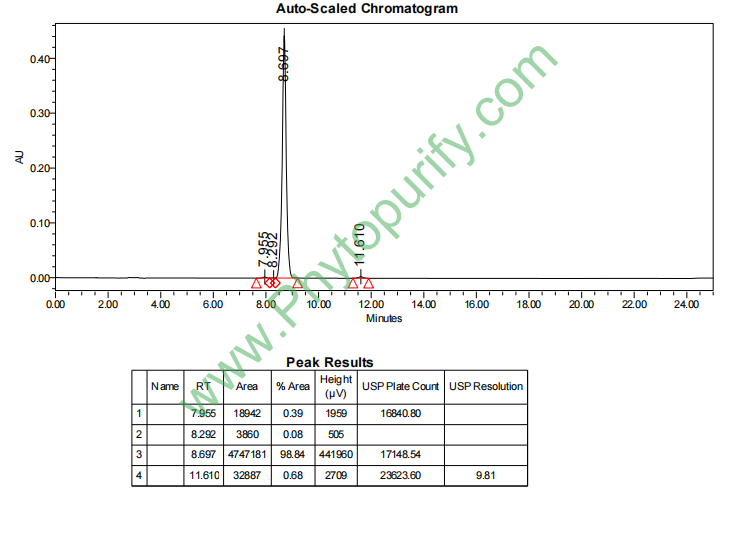
Purity: 95%~99%
Analysis Method: HPLC-DAD or/and HPLC-ELSD
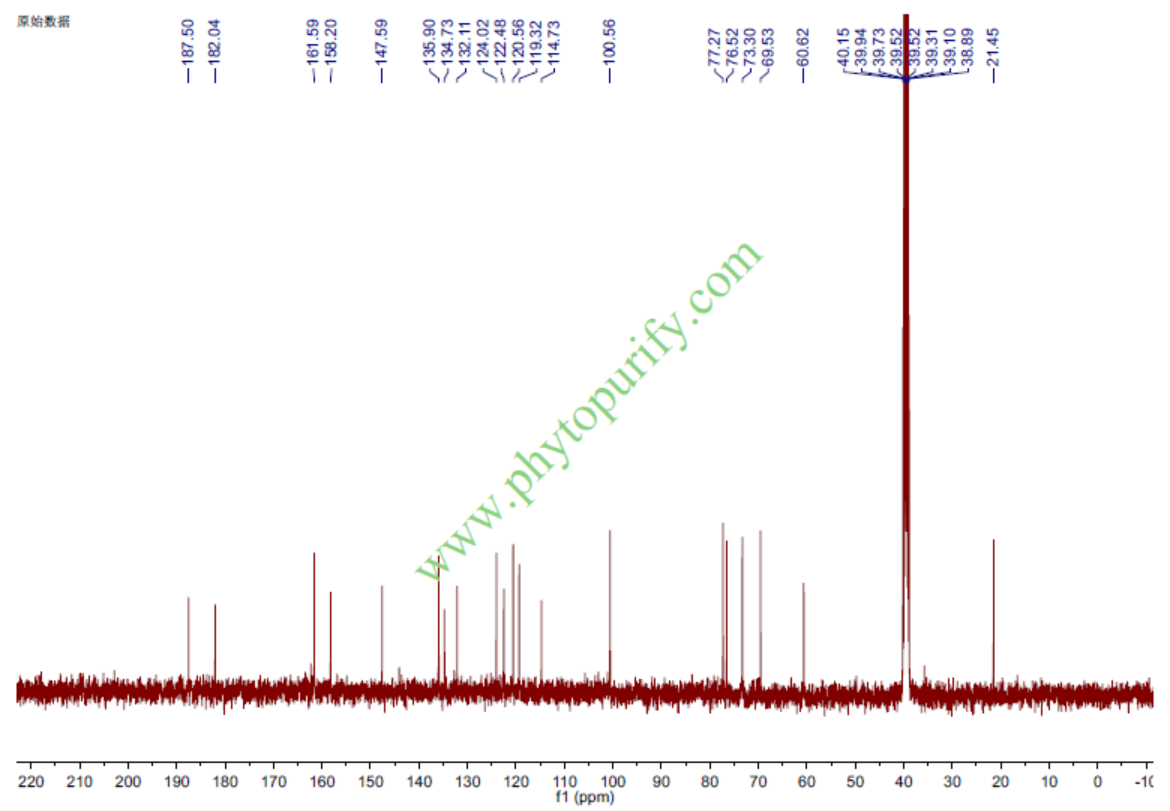
Identification Method: Mass, NMR
Packing: Brown vial or HDPE plastic bottle
Can be supplied from milligrams to grams.
For Reference Standard and R&D, Not for Human Use Directly.
Inquire for bulk scale.
HPLC of Chrysophanol-8-O-beta-D-glucoside
NMR of Chrysophanol-8-O-beta-D-glucoside
Storage conditions:Short-term storage at 2~8℃, long-term storage at -20 ~ -80℃
177.9200
1.5000
-.5000
Low
No
No
No
Unknown
No
No
Chrysophanol-8-O-glucoside (CAS number: 13241-28-6) is a naturally occurring β - D-glucoside compound, whose aglycone is chrysophanol, and the glycosidic bond is attached to the hydroxyl group at position C-8 of the chrysophanol molecule. As a derivative of monohydroxyanthraquinone compounds, emodin 8-O-glucoside not only inherits various biological activities of emodin, but also exhibits unique physicochemical properties and biological effects due to the introduction of sugar groups. In recent years, with the deepening development of natural product pharmacology, the potential value of this compound in anti-tumor, anti-inflammatory, and antioxidant fields has gradually been revealed, especially in the application prospects of lung cancer treatment, which has attracted widespread attention.
Lung cancer is one of the malignant tumors with the highest incidence rate and mortality in the world, and its treatment still faces great challenges. Targeted therapy and molecular mechanism research have become hot topics in the current development of lung cancer drugs. Rhubarb phenol-8-O-glucoside exhibits excellent anti lung cancer potential by regulating multiple signaling pathways and key molecular targets, such as BCL2, STAT3, ESR2, MAPK family, and PI3K/AKT pathway. This article aims to systematically review the chemical structure and physicochemical properties, plant sources and extraction methods, pharmacological activity and mechanism of action, pharmacological evaluation, and clinical application prospects of emodin 8-O-glucoside, providing a theoretical basis and reference for its subsequent research and drug development.
Rhubarb phenol-8-O-glucoside is a glycoside derivative of anthraquinone compounds, with a molecular formula of C21H20O10 and a molecular weight of 416.38. Structurally, emodin, as a glycoside element, belongs to monohydroxyanthraquinone and has a typical anthraquinone tricyclic skeleton. The C-8 hydroxyl group is connected to glucose molecules through a β - D-glucoside bond. This structure combines the biological activity of anthraquinone compounds with the water solubility advantage of glycoside compounds.
In terms of physicochemical properties, the LogP value of emodin 8-O-glucoside is about 1.5, indicating moderate lipophilicity and a certain degree of water and lipid solubility, which is beneficial for absorption and distribution in the body. The topological polar surface area (TPSA) is as high as 177.92 Å ², reflecting its strong polarity and hydrogen bonding ability. The number of hydrogen bond acceptors is 10, indicating its rich potential for hydrogen bond formation when combined with biomolecules. The compound has low blood-brain barrier permeability, low risk of liver toxicity and hERG channel inhibition, and a negative Ames mutagenicity test result, indicating its good safety.
These physicochemical properties provide a basis for the pharmacokinetic behavior and biological activity of emodin 8-O-glucoside, and also suggest its potential advantages in oral administration and targeted therapy.
Rhubarb phenol-8-O-glucoside is mainly found in plants of the Rheum genus (Rheum spp.), especially in the Chinese medicinal herbs Rheum palmatum L., Rheum officinale Baill., etc., where it is abundant. As a traditional Chinese medicine, rhubarb is widely used for its laxative, heat clearing, and detoxifying effects. Modern research has found that its anthraquinone components are the main source of active substances.
The common methods for extracting emodin 8-O-glucoside include solvent extraction, chromatographic separation, etc. Generally, ethanol or methanol aqueous solution is used as the extraction agent to obtain crude extract through reflux extraction or ultrasound assisted extraction. Subsequently, separation and purification were carried out using techniques such as silica gel column chromatography and reverse phase high performance liquid chromatography (RP-HPLC). In recent years, the application of supercritical CO ₂ extraction and molecular imprinting technology has further improved the extraction efficiency and purity.
During the extraction process, factors such as temperature, solvent polarity, and pH value have a significant impact on the yield and stability of the product. Reasonably optimizing the extraction process not only helps to increase the yield of emodin 8-O-glucoside, but also lays the foundation for its large-scale production and medicinal development.
The pharmacological activity research of emodin 8-O-glucoside mainly focuses on anti-tumor, anti-inflammatory, and antioxidant aspects, especially its remarkable performance in lung cancer cell models.
Multiple in vitro studies have shown that emodin 8-O-glucoside can significantly inhibit the proliferation and migration of lung cancer cells, and induce cell apoptosis. Its mechanism of action involves the regulation of multiple signaling pathways, including inhibiting the activity of STAT3 and MAPK signaling pathways, reducing the expression of anti apoptotic protein BCL2, and activating the endogenous apoptotic pathway mediated by caspase 9 (CASP9). In addition, the compound can also regulate the PI3K/AKT pathway, inhibit the survival and drug resistance of tumor cells.
Rhubarb phenol-8-O-glucoside has significant anti-inflammatory activity, which can inhibit the nuclear factor kappa B (NF - κ B) signaling pathway, reduce the release of inflammatory factors such as TNF - α and IL-6, and alleviate inflammatory reactions. Its antioxidant effect is mainly achieved by clearing free radicals and enhancing intracellular antioxidant enzyme activity, which helps to protect cells from oxidative stress damage.
Some studies have also reported that this compound has potential effects in regulating metabolic diseases, neuroprotection, etc., but the relevant mechanisms still need further exploration.
The pharmacological effects of emodin 8-O-glucoside depend on its regulation of multiple molecular targets, especially in the widespread distribution of targets in lung cancer treatment.
Rhubarb phenol-8-O-glucoside exerts anti lung cancer effects through multi-target and multi pathway synergistic regulation. The mechanism mainly includes:
The combined effect of these mechanisms makes emodin 8-O-glucoside a powerful candidate molecule for multi-target therapy of lung cancer.
The evaluation of drug properties is an important step in the development of natural product drugs. Rhubarb phenol-8-O-glucoside performs well in multiple pharmacological parameters:
In terms of pharmacokinetics, existing research is relatively limited, but based on its physicochemical properties, it is speculated that the oral absorption of emodin 8-O-glucoside may be limited by its high polarity and large molecular weight, and the formulation needs to be optimized or special administration routes need to be adopted. Its metabolism may involve the hydrolysis of liver glucosidase, releasing active aglycone emodin, which in turn exerts pharmacological effects. The distribution in the body is mainly concentrated in organs such as the lungs and liver, and the clearance pathway may be mainly through renal excretion.
In the future, it is necessary to combine in vivo pharmacokinetics and toxicology research to improve its safety and efficacy evaluation, and provide support for clinical translation.
Rhubarb phenol-8-O-glucoside, as a natural product derived multi-target anti-tumor candidate drug, has broad clinical application prospects. Its potential in the treatment of lung cancer is particularly outstanding, as it can overcome the problem of single target drug resistance through the synergistic action of multiple signaling pathways. Combining its low toxicity and good safety, it provides a new treatment strategy for lung cancer patients.
In addition, the anti-inflammatory and antioxidant properties of this compound also provide possibilities for its application in chronic inflammatory and metabolic diseases. In the future, structural modification and drug carrier technology can be used to enhance its bioavailability and targeting, and broaden its indications.
However, current preclinical and clinical research on emodin 8-O-glucoside is still limited, and there is an urgent need for systematic pharmacological, pharmacokinetic, and toxicological studies to clarify its mechanism of action and safety. Combining modern drug design and biotechnology methods to promote its clinical translation will open up new paths for the development of natural product drugs.
Rhubarb phenol-8-O-glucoside, as a natural anthraquinone glycoside with unique structure and multiple biological activities, exhibits significant anti lung cancer and anti-inflammatory potential. It exerts synergistic pharmacological effects by regulating multiple key molecular targets and signaling pathways, and has good pharmacological and safety advantages. In the future, by combining modern pharmacology and medicinal chemistry techniques, we can deeply explore its mechanism of action and optimize its pharmacokinetic characteristics, which is expected to achieve its clinical application in the treatment of lung cancer and related diseases. As an important resource for new drug research and development, the study of emodin 8-O-glucoside not only enriches the pharmacological knowledge of anthraquinone compounds, but also provides valuable examples for the development of natural product anticancer drugs.
