


Product name: Emodin-8-glucoside
Synonym name:
Catalogue No.: BP0534
Cas No.: 23313-21-5
Formula: C21H20O10
Mol Weight: 432.381
Botanical Source: Rhamnus frangula, Polygonum spp. and other plant spp. Component of Da Huang
Physical Description: Yellow powder
Type of Compound: Anthraquinones
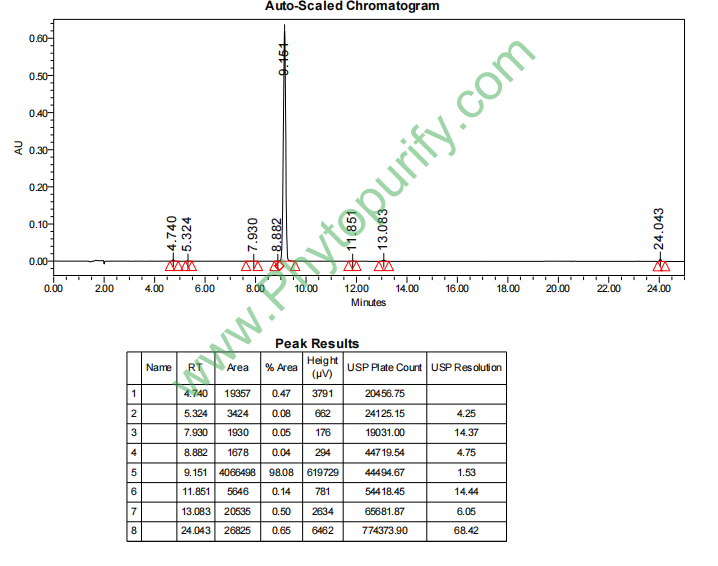
Purity: 95%~99%
Analysis Method: HPLC-DAD or/and HPLC-ELSD
Identification Method: Mass, NMR
Packing: Brown vial or HDPE plastic bottle
Storage: Store in a well closed container, protected from air and light. Put into refrigerate or freeze for long term storage.
Whenever possible, you should prepare and use solutions on the same day. However, if you need to make up stock solutions in advance, we recommend that you store the solution as aliquots in tightly sealed vials at -20℃. Generally, these will be useable for up to two weeks.
The product could be supplied from milligrams to grams, up to kilograms
Inquire for bulk scale.
Descriptions:
Emodin-8-O-beta-D-glucoside extracted from the traditional Chinese medicinal herb Polygonum cuspidatum Sieb. et Zucc is widely used to treat acute hepatitis possibly by antioxidative mechanisms; it is able to provide neuroprotection against cerebral ischemia-reperfused injury and glutamate induced neuronal damage through exerting antioxidative effects and inhibiting glutamate neurotoxicity.[1]
Emodin-8-O-β-D-glucoside can promote proliferation and differentiation of osteoblastic MC3T3-E1 cells.[2]
References:
[1] Wang C, Zhang D, Ma H, et al. Eur J Pharmacol, 2007, 577(1-3):58-63.
[2] Xiang MX, Xu Z, Su HW, et al. Molecules, 2011, 16(1):728-37.
[3] Koyama J, Morita I, Kobayashi N. J Chromatogr A, 2007, 1145(1-2):183-9.
HPLC of Emodin-8-glucoside
Storage conditions:Short-term storage at 2~8℃, long-term storage at -20 ~ -80℃
173.9800
.5733
.4183
2.1018
.4168
.2145
Low
76.1161
3.9360
Yes
No
No
No
Yes
No
1.2
Yes
No
Yes
Yes
Emodin-8-glucoside (CAS number: 23313-21-5) is a typical anthraquinone natural product derivative, mainly isolated from plants such as aloe vera (Aloe spp.). As a natural compound with multiple biological activities, emodin 8-glucoside has attracted much attention due to its significant antioxidant, anti-inflammatory, and anti fibrotic effects. In recent years, with the in-depth study of its molecular targets and mechanisms of action, especially in the regulation of the MAPK signaling pathway and the discovery of its inhibitory activity on various enzymes, it has shown broad application prospects in fields such as anti-tumor, neuroprotection, and metabolic diseases.
The purpose of this review is to systematically summarize the chemical structure and physicochemical properties, plant sources and extraction methods, pharmacological activities and mechanism of action of emodin 8-glucoside, focus on its molecular target interactions related to breast cancer, evaluate its pharmaceutical properties and pharmacokinetic characteristics, and look forward to its clinical application potential, providing theoretical basis and reference for subsequent related research and new drug development.
Emodin 8-glucoside belongs to the anthraquinone class of compounds, which is structurally composed of an anthraquinone core skeleton and a glucose molecule connected by a glycosidic bond. Its molecular formula is C21H20O10 and its molecular weight is 432.3810. The anthraquinone moiety in the structure endows it with polyphenolic biological activity, while the introduction of glucose groups significantly affects its water solubility and bioavailability.
In terms of physicochemical properties, the LogP value of emodin 8-glucoside is 0.5733, indicating its low lipid solubility and favorable water solubility distribution. The polar surface area (TPSA) is as high as 173.98 Å ², reflecting its strong molecular polarity, which may affect its cell membrane permeability and pharmacokinetic behavior. The water solubility is 2.1018, indicating that it has a certain solubility in the aqueous phase, which is beneficial for absorption and distribution in vivo. It is worth noting that although its blood-brain barrier permeability has been evaluated as low, it still has a certain ability to penetrate brain tissue, providing possibilities for its application in neurological diseases. This compound does not exhibit hERG channel inhibitory activity, indicating a low risk of cardiac toxicity. The Ames test result is 1.2, indicating a low risk of genotoxicity.
Emodin 8-glucoside is mainly found in plants of the Aloe genus, especially in the leaves and roots of aloe vera. Aloe vera, as a traditional Chinese medicine and functional plant, contains abundant anthraquinone compounds, among which emodin 8-glucoside is one of its important active ingredients.
The extraction method usually uses organic solvent extraction combined with column chromatography separation technology. The general steps include:
In recent years, the application of new technologies such as supercritical fluid extraction and microwave-assisted extraction has provided technical support for improving the extraction efficiency and purity of emodin 8-glucoside.
Emodin 8-glucoside exhibits a variety of significant pharmacological activities, covering antioxidant, anti-inflammatory, anti fibrotic, and anti-tumor fields.
As a natural anthraquinone product, emodin 8-glucoside has strong free radical scavenging ability. In vitro studies have shown that it can effectively eliminate hydroxyl radicals, superoxide anions, and hydrogen peroxide, reducing oxidative stress damage. The mechanism of antioxidant activity mainly includes direct free radical capture and activation of intracellular antioxidant enzyme systems (such as superoxide dismutase (SOD) and glutathione peroxidase (GPx) expression).
Emodin 8-glucoside can significantly inhibit the release of inflammatory mediators and alleviate inflammatory reactions. It exerts anti-inflammatory effects by inhibiting the activity of the nuclear factor kappa B (NF - κ B) signaling pathway and MAPK pathway, reducing the expression of pro-inflammatory cytokines such as TNF - α, IL-1 β, and IL-6. In addition, its regulation of macrophage activation and chemokines further enhances its anti-inflammatory effect.
Fibrosis is the pathological basis of various chronic diseases, and emodin 8-glucoside inhibits the fibrosis process by blocking the activation of fibroblasts and collagen deposition. Research has shown that it can downregulate transforming growth factor beta (TGF - β) and related signaling molecules, reducing fibrosis in tissues such as the liver, lungs, and kidneys.
Emodin 8-glucoside exhibits inhibitory activity against various key enzymes:
Emodin 8-glucoside achieves its pharmacological effects through multi-target and multi pathway synergistic effects. Especially in tumor fields such as breast cancer, its targets cover multiple key regulatory proteins and signal pathways.
Emodin 8-glucoside inhibits the MAPK pathway, blocks the activation of ERK, JNK, and p38 kinases, and regulates cell proliferation, apoptosis, and inflammatory response. Its inhibitory effect on the NF - κ B pathway further weakens the expression of pro-inflammatory factors, exerting a comprehensive anti-inflammatory and anti-tumor effect.
In addition, its inhibition of topoisomerase II affects DNA replication and repair processes, leading to tumor cell cycle arrest and enhanced apoptosis.
The pharmacological evaluation of emodin 8-glucoside shows certain advantages and challenges:
Emodin-8-glucoside, with its multi target, multi mechanism pharmacological activity, especially its potential in the treatment of breast cancer and other tumors, shows a good prospect of clinical transformation. Its high affinity inhibitory effect on the MAPK pathway provides a new approach for targeted therapy. Meanwhile, its antioxidant, anti-inflammatory, and anti fibrotic properties make it suitable for treating chronic inflammation, fibrotic diseases, and neurodegenerative diseases.
Future research should focus on:
Emodin-8-glucoside, as a natural anthraquinone product derived from aloe vera, has become a hot topic in natural product pharmacology research due to its significant multiple biological activities and multi-target mechanisms of action. Its potential in anti-tumor, anti-inflammatory, and anti fibrotic aspects provides abundant resources and theoretical basis for the development of new drugs. In the future, through in-depth pharmacokinetic research, mechanism elucidation, and preclinical evaluation, it is expected to promote its clinical application and benefit patients with related diseases.
