


Synonym name:
Catalogue No.: BP0533
Cas No.: 38840-23-2
Formula: C21H20O10
Mol Weight: 432.381
Botanical Source: Dermocybe sanguinea, Polygonum cuspidatum , Rhus, Rheum spp. and Guanomyces polythrix
Purity: 95%~99%
Analysis Method: HPLC-DAD or/and HPLC-ELSD
Identification Method: Mass, NMR
Packing: Brown vial or HDPE plastic bottle
Can be supplied from milligrams to grams.
For Reference Standard and R&D, Not for Human Use Directly.
Inquire for bulk scale.
HPLC of Emodin 1-glucoside
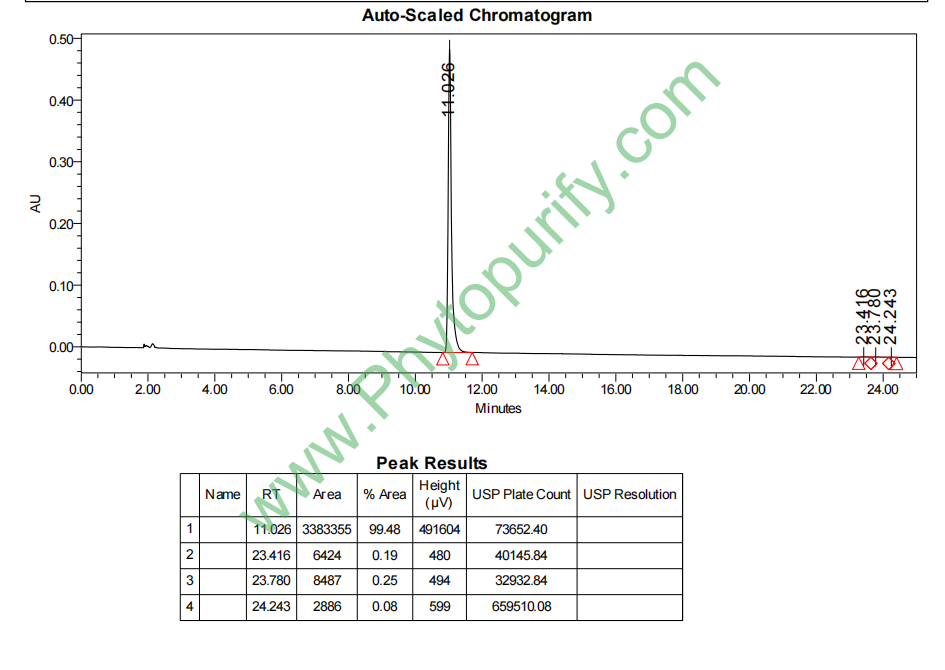
Storage conditions:Short-term storage at 2~8℃, long-term storage at -20 ~ -80℃
Emodin-1-O-glucoside (CAS number: 38840-23-2) is an important natural anthraquinone derivative that has received widespread attention in pharmacology and natural product chemistry due to its diverse biological activities. As a typical representative of anthraquinone compounds, emodin 1-O-glucoside not only has a long history of application in traditional Chinese medicine, but its modern pharmacological research has also revealed its potential value in various aspects such as antiviral, anti-inflammatory, anti-tumor, and metabolic regulation. Especially in the context of the COVID-19 pandemic, emodin-1-O-glucoside is regarded as a promising candidate compound against COVID-19 because it can block the interaction between SARS virus spike protein and host cell receptor angiotensin converting enzyme 2 (ACE2). In addition, the inhibitory effect of this compound on casein kinase 2 (CK2) and its characteristics as a selective 11 β - hydroxysteroid dehydrogenase type 1 (11 β - HSD1) inhibitor provide a theoretical basis for its application in anti-inflammatory, anticancer, and metabolic disease treatment.
This article aims to systematically review the chemical structure, plant sources, extraction methods, pharmacological activities, and mechanisms of action of emodin 1-O-glucoside. Combining its pharmacological evaluation and pharmacokinetic characteristics, it explores its potential and future development directions in clinical applications, providing reference for in-depth research and drug development of this natural product.
Emodin-1-O-glucoside is an anthraquinone glucoside with a molecular formula of C21H20O10 and a molecular weight of 432.3810. Its chemical structure consists of a molecule of Emodin connected to a glucose molecule through a 1-O site to form a glucosidic bond, endowing it with good water solubility and bioavailability. The anthraquinone core in the structure is a tricyclic aromatic structure with multiple hydroxyl substituents. Glucosylation modification significantly enhances its polarity, with a TPSA (topological polar surface area) of up to 173.98 Å ², indicating strong molecular polarity and favorable water solubility.
In terms of physicochemical properties, the LogP value of emodin 1-O-glucoside is 0.5761, indicating its strong hydrophilicity and water solubility of approximately 1.9646, making it suitable for dissolution and transport in aqueous media. Its blood-brain barrier permeability is low, indicating that the compound has limited penetration in the central nervous system and may reduce the occurrence of central side effects. The hERG channel inhibition experiment result was negative, indicating that the compound has a low risk of cardiac toxicity. The Ames test result is 1.2, indicating a low risk of genotoxicity and meeting drug safety requirements.
Emodin-1-O-glucoside is mainly found in various traditional Chinese medicinal materials, especially Rheum spp. and Frangula spp., which are the main sources. In traditional Chinese medicine, Rheum palmatum and its related varieties, which contain abundant anthraquinone compounds, are widely used in the treatment of diarrhea, anti-inflammatory and detoxification. Plants such as Frangula alnus (European rhubarb) also contain a large amount of these glucoside derivatives.
The extraction method usually uses polar solvents such as methanol, water, or ethanol as extractants, and obtains crude extracts through hot reflux extraction or ultrasound assisted extraction. Subsequently, separation and purification techniques such as liquid-liquid distribution, silica gel column chromatography, and high-performance liquid chromatography (HPLC) were used to further isolate and purify emodin 1-O-glucoside. In recent years, the application of supercritical CO2 extraction and membrane separation technology has improved extraction efficiency and purity. During the extraction process, controlling the temperature and pH value is crucial for maintaining the stability of the glucosidic bond and avoiding hydrolysis to generate emodin free radicals.
Emodin-1-O-glucoside has shown significant potential in antiviral research. Especially in the study of SARS-CoV-2 virus infection mechanism, this compound can effectively block the binding of virus spike protein (S protein) to host cell ACE2 receptor, blocking the key step of virus invasion into cells, thereby inhibiting virus replication and transmission. In addition, its inhibitory effect on casein kinase 2 (CK2) further interferes with signal transduction during virus replication, enhancing antiviral efficacy. Both in vitro cell experiments and molecular docking studies support its potential as a candidate drug for COVID-19.
Emodin-1-O-glucoside regulates inflammatory response through multiple signaling pathways and exhibits good anti-inflammatory activity. It can inhibit the expression of pro-inflammatory cytokines such as tumor necrosis factor alpha (TNF - α), interleukin-6 (IL-6), and interleukin-1 β (IL-1 β), reducing inflammation tissue damage. Mechanistically, it involves downregulation of inflammatory signaling pathways such as NF - κ B and MAPK, inhibiting the release of inflammatory mediators and thus exerting a protective effect. Animal model studies have shown that this compound can significantly alleviate inflammatory symptoms, indicating its potential application in chronic inflammatory diseases.
As a natural anthraquinone product, emodin 1-O-glucoside exhibits anti-tumor activity in various cancer models, especially in the field of colon cancer where research is more in-depth. Its main targets include AMPK (PRKAA1), BCL2, STAT3, ABCB1, ALOX5, LCK, TOP1, MAPK1, TNF, and GSK3B, involving cell proliferation, apoptosis, migration, and drug resistance regulation. By activating the AMPK signaling pathway, promote energy metabolism imbalance in cancer cells; Downregulate the anti apoptotic protein BCL2 and induce cell apoptosis; Inhibiting the STAT3 signaling pathway, blocking tumor cell proliferation and immune escape; In addition, it can reverse the activity of multidrug resistance associated protein ABCB1 and enhance chemotherapy drug sensitivity. Both in vitro and in vivo experiments have confirmed its inhibitory effect on the proliferation of colon cancer cells and its ability to reduce tumor volume.
Emodin-1-O-glucoside, as an effective and selective 11 β - HSD1 inhibitor, has an IC50 of 186 nM for human and 86 nM for mouse 11 β - HSD1. 11 β - HSD1 is a key enzyme for the local activation of glucocorticoids, and is involved in the occurrence and development of metabolic syndrome, obesity, type 2 diabetes and other diseases. By inhibiting 11 β - HSD1 and emodin 1-O-glucoside, the levels of active glucocorticoids in tissues are reduced, improving insulin resistance and lipid metabolism abnormalities. Related studies have shown that this compound can significantly improve metabolic disorders in diet induced obese mice, reduce body weight, blood glucose, and lipid levels, indicating its potential application in the treatment of metabolic diseases.
The multi-target mechanism of action of emodin 1-O-glucoside reflects its complex pharmacological characteristics. Its main mechanism of action includes:
Block virus invasion By directly binding to SARS-CoV-2 spike protein or ACE2 receptor, the interaction between the two is blocked to prevent the virus from entering host cells. Molecular docking and cell experiments have shown its high affinity for the S protein-ACE2 binding interface.
Inhibition of casein kinase 2 (CK2)CK2, as an important regulatory factor for various viral replication and cell signaling, its inhibition helps to block the viral lifecycle and regulate inflammatory responses.
Regulating inflammatory signaling pathways By inhibiting signaling pathways such as NF - κ B and MAPK, reducing the expression of pro-inflammatory factors, and alleviating tissue inflammatory damage.
Regulation of anti-tumor signaling Activate the AMPK pathway and induce energy metabolism imbalance in cancer cells; Inhibit STAT3 and BCL2, promote tumor cell apoptosis; Inhibit ABCB1 and reverse multidrug resistance; Regulating TOP1 and GSK3B, affecting DNA damage repair and cell cycle.
Selective inhibition of 11 β - HSD1 Reduce tissue glucocorticoid activity, improve metabolic disorders, alleviate obesity and insulin resistance.
These multi-target and multi pathway mechanisms of action demonstrate the broad potential of emodin 1-O-glucoside in antiviral, anti-inflammatory, anticancer, and metabolic disease treatment.
The pharmacological parameters of emodin 1-O-glucoside indicate that it has a good foundation for drug development. Although the molecular weight of 432.38 is slightly higher than the ideal range of traditional oral drugs, its lower LogP value (0.5761) and higher polarity (TPSA 173.98) are beneficial for improving water solubility and bioavailability. The water solubility index of 1.9646 supports its good solubility in vivo. The low permeability of the blood-brain barrier reduces the potential toxicity risk to the central nervous system. The negative inhibition of hERG channel and low genotoxicity risk in Ames test further support its safety.
In terms of pharmacokinetics, existing research is relatively limited, but based on its structure, it is speculated that after oral administration of emodin 1-O-glucoside, it may undergo intestinal glucosidase mediated hydrolysis, releasing active emodin, which is then metabolized by liver metabolic enzymes. Its glucoside form helps to improve intestinal absorption and stability. Further in vivo pharmacokinetic studies are needed in the future to clarify its absorption, distribution, metabolism, and excretion (ADME) characteristics, providing a basis for clinical applications.
Emodin-1-O-glucoside, as a multifunctional natural product, has shown extensive potential for application in various disease fields. Its anti COVID-19 activity provides a new drug candidate for the current global public health crisis, especially with unique advantages in blocking virus invasion and replication. Combining its anti-inflammatory and immunomodulatory effects, it is expected to serve as an adjuvant therapy to alleviate the inflammatory storm caused by viral infections.
In the treatment of tumors, especially colon cancer, emodin 1-O-glucoside has shown potential as a novel anti-cancer drug by regulating tumor cell proliferation and drug resistance mechanisms through multiple targets. Its inhibitory effect on multidrug resistance protein ABCB1 helps to improve the efficacy of existing chemotherapy regimens.
In the field of metabolic diseases, the development of selective 11 β - HSD1 inhibitors has always been an important direction for the treatment of diabetes and obesity. The performance of emodin 1-O-glucoside in improving diet induced obesity models provides a solid foundation for its clinical translation.
Future research should focus on pharmacokinetic optimization, formulation development, and preclinical safety evaluation. At the same time, combining modern drug design techniques such as structural optimization and nanocarrier delivery can enhance its bioavailability and targeting. The implementation of multicenter clinical trials will be a key step in verifying its efficacy and safety.
Emodin-1-O-glucoside, as a natural anthraquinone product with multiple biological activities, has shown broad application prospects in antiviral, anti-inflammatory, anticancer, and metabolic disease treatment due to its unique chemical structure and multi-target mechanism of action. Its good pharmacokinetic parameters and safety evaluation have laid the foundation for drug development. In the future, through systematic pharmacological mechanism research, pharmacokinetic optimization, and clinical validation, it is expected to develop emodin 1-O-glucoside into a new generation of natural product drugs, contributing new strength to human health.
