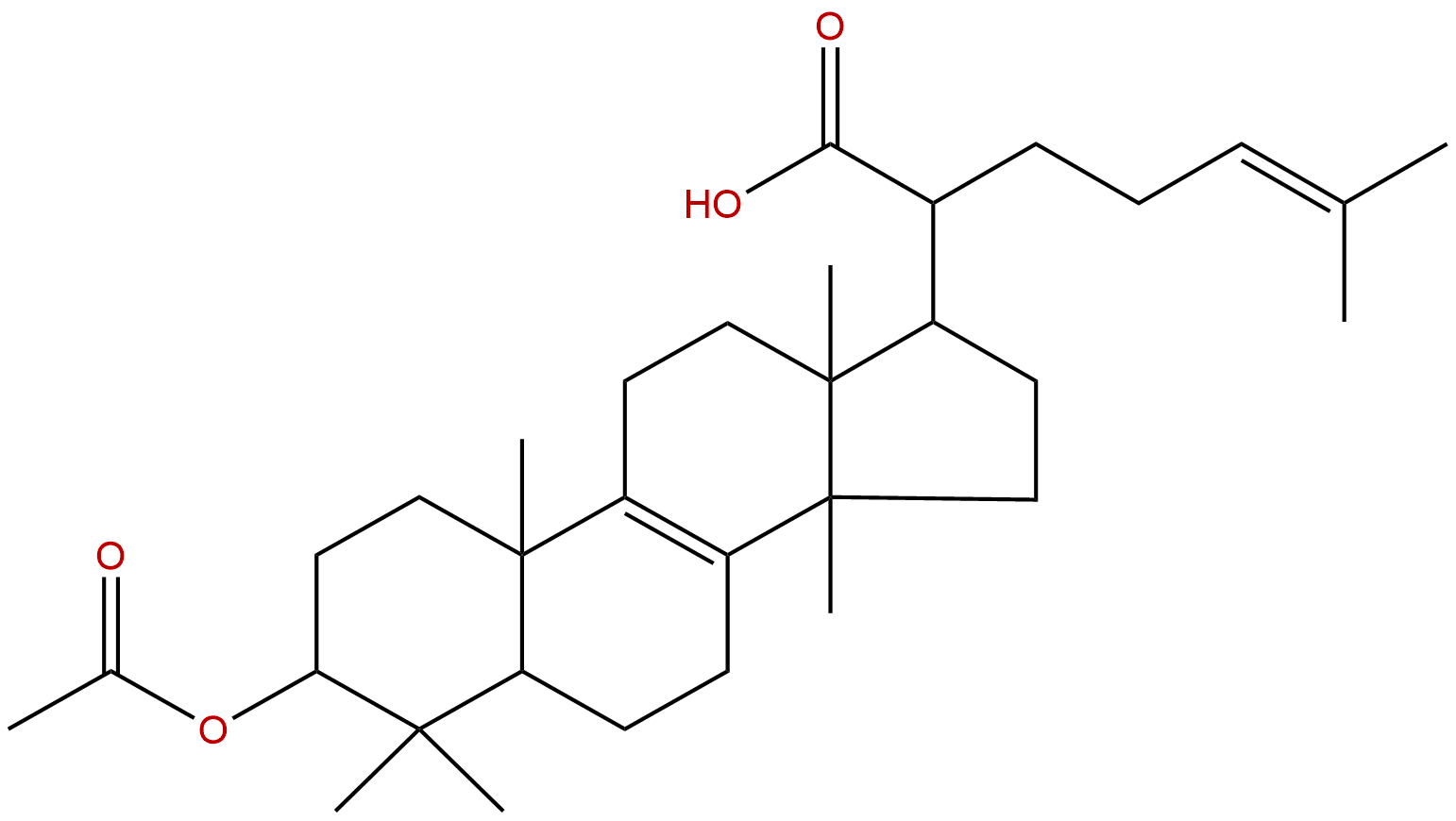


Product name: Tsugaric acid A
Synonym name: 3-α-acetyloxylanosta-8,24-dien-21-oic acid; 3-alpha-Acetoxylanosta-8,24-dien-21-oic acid
Catalogue No.: BP1715
Cas No.: 174391-64-1
Formula: C32H50O4
Mol Weight: 498.748
Botanical Source: Boswellia carteri and Boswellia serrata (Indian olibanum)
Physical Description:
Type of Compound:
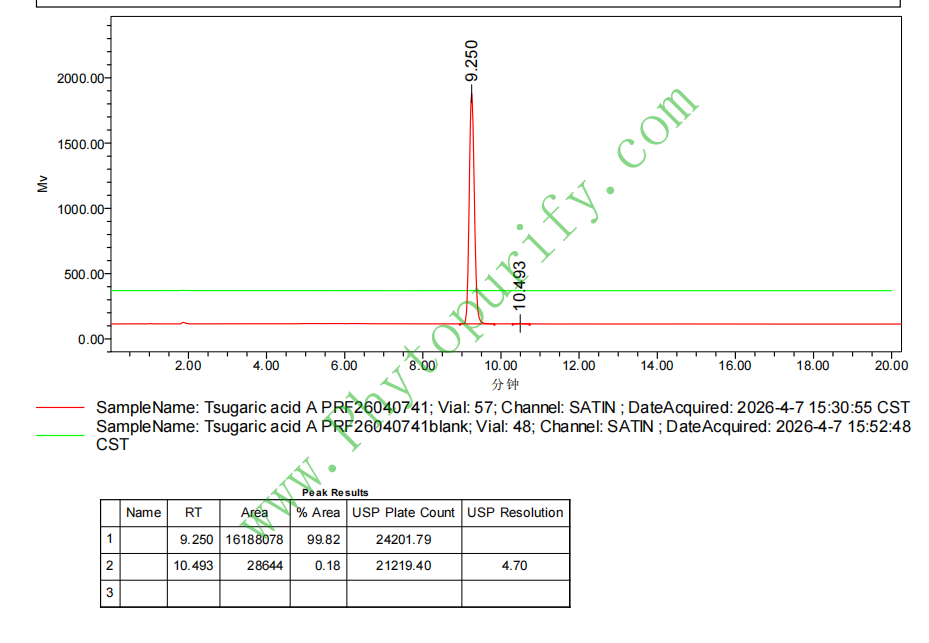
Purity: 95%~99%
Analysis Method: HPLC-DAD or/and HPLC-ELSD
Identification Method: Mass, NMR
Packing: Brown vial or HDPE plastic bottle
The product could be supplied from milligrams to grams. Inquire for bulk scale.
We provide solution to improve the water-solubility of compounds, thereby facilitating the variety of activity tests and clinic uses.
For Reference Standard and R&D, Not for Human Use Directly.
HPLC of Tsugaric acid A
Storage conditions:Short-term storage at 2~8℃, long-term storage at -20 ~ -80℃
63.6000
7.3475
5.3624
.0018
5.9113
1.4941
Low
92.5573
4.7272
No
Yes
Yes
No
No
No
0.0
No
No
No
No
Natural products, as an important source of drug discovery, play an irreplaceable role in the history of human disease prevention and treatment. They have diverse structures and broad biological activities, providing abundant lead compounds for the development of new therapeutic drugs. Among the numerous natural ingredients with biological activity, terpenoids have attracted much attention due to their significant anti-inflammatory, antioxidant, and cell protective effects. Tsugaric acid A (CAS number: 174391-64-1) is one example, which is a diterpenoid acid compound isolated from specific plants. Early research has found that Tsugaric acid A can significantly inhibit the formation of superoxide anions and protect human keratinocytes from ultraviolet B (UVB) - induced photodamage, suggesting its potential application value in the fields of skin photoaging and photodamage protection. Further research has expanded its pharmacological activity spectrum, particularly demonstrating the potential to regulate multiple key signaling pathways and targets in inflammation related disease models such as hepatitis. This article aims to provide a systematic review of the chemical properties, plant sources, pharmacological activities, mechanisms of action, and medicinal properties of Tsugaric acid A, and to explore its clinical application prospects, in order to provide comprehensive scientific references for the in-depth research and development of this compound.
The chemical name Tsugaric acid A is based on its structural characteristics and belongs to the terpenoid class. Its molecular formula is C30H50O4 and its molecular weight is 498.7480. Structurally, it has a typical tricyclic or tetracyclic diterpene skeleton, with carboxylic acid groups attached at specific positions, which is why it is named "acid". The presence of this carboxyl group significantly affects its physicochemical properties and biological activity.
In terms of physicochemical properties, the calculated lipid water partition coefficient (LogP) is 7.3475, indicating that the compound has a high degree of lipophilicity. Its topological polar surface area (TPSA) is 63.6000 Å ², which is relatively small, consistent with the number of polar groups (mainly carboxyl groups) in its structure. The extremely high lipophilicity directly leads to its extremely low water solubility, with a calculated value of about 0.0018 mg/mL. This "oil soluble" characteristic means that the absorption, distribution, and formulation development of Tsugaric acid A in organisms will face challenges, typically requiring the use of solubilization techniques such as making liposomes, micelles, or using organic co solvents. In addition, its ability to penetrate the blood-brain barrier is predicted to be 'low', suggesting that its main pharmacological effects may be concentrated in the peripheral system. In early safety screening, the compound did not show significant hERG potassium channel inhibitory activity (predicted as' no '), and the Ames test predicted a value of 0.0, indicating a low risk of mutagenicity and providing preliminary safety evidence for its further development.
Tsugaric acid A was initially isolated from a specific plant. Although detailed information on its specific plant origin is relatively limited in public literature, based on its name "Tsugaric" (possibly related to the Tsugaru region of Japan) and structural type, it is speculated that it likely originated from plants rich in diterpenes such as the Lamiaceae, Asteraceae, or Euphorbiaceae families. These active ingredients are usually present in the roots, stem bark, or leaves of plants.
Its extraction and separation follow the conventional process of natural product chemistry. Firstly, extract the dried and crushed plant materials using organic solvents. Due to the high lipophilicity of Tsugaric acid A, commonly used extraction solvents include methanol, ethanol, ethyl acetate, or alcohol water mixed solvents in different ratios. Sometimes chloroform or dichloromethane is used for stepwise extraction to enrich low polarity components. After vacuum concentration, the crude extract is separated and purified through a series of chromatographic techniques. Initial separation is often carried out using silica gel column chromatography with solvent systems of different polarities (such as petroleum ether ethyl acetate or chloroform methanol gradient elution). Subsequently, it may be necessary to further purify it with the help of reversed-phase silica gel column chromatography (such as C18 packing, methanol water or acetonitrile water as mobile phase), gel column chromatography (such as Sephadex LH-20) and high performance liquid chromatography (HPLC) until the monomer compound is obtained. Structural identification is accomplished through the comprehensive use of techniques such as nuclear magnetic resonance (NMR, including 1H-NMR, 13C-NMR, 2D-NMR), mass spectrometry (MS), infrared spectroscopy (IR), and X-ray single crystal diffraction.
The pharmacological activity research of Tsugaric acid A has revealed its biological effects in multiple aspects, centered around its powerful antioxidant and anti-inflammatory properties.
Antioxidant and Photoprotective Activities This is the earliest discovered activity of Tsugaric acid A. Research has shown that this compound can significantly inhibit the formation of reactive oxygen species (ROS) such as superoxide anions (O2 •−). Superoxide anions are one of the main ROS produced by pathways such as mitochondrial respiratory chain and NADPH oxidase, and are the initiating factors of oxidative stress. In the field of skin biology, UVB radiation is a key factor that induces excessive ROS production, DNA damage, inflammatory response, and cell apoptosis in skin keratinocytes, leading to skin photoaging, photodamage, and even carcinogenesis. Experimental results have shown that Tsugaric acid A can effectively protect human keratinocytes from UVB induced cell viability decline and apoptosis, and its mechanism is closely related to clearing ROS and reducing oxidative damage.
Anti inflammatory and hepatoprotective activity Based on its antioxidant capacity, the anti-inflammatory potential of Tsugaric acid A has been further explored in hepatitis models. The occurrence and development of hepatitis are closely related to oxidative stress and strong inflammatory reactions. Tsugaric acid A exhibits good liver protective effects in various experimental hepatitis models. It can alleviate pathological damage to liver tissue and reduce serum transaminase (ALT/AST) levels. Its anti-inflammatory effect is not only reflected in the inhibition of inflammatory mediators, but also in the extensive regulation of inflammatory signaling pathways.
Other potential activities As a diterpenoid compound with multi-target regulatory potential, Tsugaric acid A may also have other activities that have not been fully explored, such as affecting metabolism by regulating PPAR γ, or intervening in cell proliferation and survival by affecting pathways such as STAT3, all of which need to be confirmed by future research.
The pharmacological effects of Tsugaric acid A, especially in anti-inflammatory and liver protection, are not achieved through a single target, but involve a complex multi-target regulatory network. Existing information suggests that its function is closely related to the following key targets and pathways:
Inhibiting the inflammatory core signaling pathway NF - κ B Nuclear factor kappa B (NF - κ B) is the core transcription factor of inflammatory response, regulating the expression of a series of pro-inflammatory mediators such as TNF - α, IL-6, iNOS (NOS2), and COX-2 (PTGS2). Tsugaric acid A can inhibit the activation of NF - κ B, thereby blocking the inflammatory "waterfall" response upstream. This may be one of the core mechanisms by which it reduces inflammation infiltration and tissue damage in hepatitis.
Regulating the production of pro-inflammatory mediators:
Affects the balance between cell apoptosis and survival:
Regulating transcription factors and nuclear receptors:
Mechanism integration In summary, the mechanism of action of Tsugaric acid A may begin with its strong antioxidant capacity, which reduces the initial attack of oxidative stress on cells by clearing ROS. Subsequently, it inhibits the activation of core inflammatory signaling pathways such as NF - κ B through multi-target intervention, downregulates the expression of key pro-inflammatory mediators such as TNF - α, IL-6, iNOS, COX-2, and regulates cell apoptosis (Bcl-2/Caspase-3) and metabolism/proliferation related pathways (STAT3, PPAR γ), forming a synergistic network, ultimately achieving a protective effect on cells (such as keratinocytes and liver cells) and combating inflammatory diseases such as UVB damage or hepatitis.
Although Tsugaric acid A has shown good pharmacological activity in vitro and some in vivo models, its drug like evaluation reveals some challenges that need to be overcome.
Physical and chemical properties and absorption distribution As mentioned earlier, the high LogP value (7.3475) and extremely low water solubility are the main obstacles it faces. This may lead to low oral bioavailability, as drugs need to dissolve in the gastrointestinal water environment to be absorbed. Although high lipophilicity may facilitate passive diffusion across membranes, excessive lipophilicity may also lead to excessive binding of lipids or proteins in the intestinal lumen or circulation, thereby limiting their effective concentration. Its low blood-brain barrier permeability limits its application in central nervous system diseases.
Metabolism and excretion At present, there is a lack of publicly available data on the specific metabolic pathways, enzyme interactions (such as CYP450 enzyme system), and excretion modes (bile/urine) of Tsugaric acid A. This is a key blank in its pharmacokinetic evaluation. Diterpenoids are usually easily metabolized by the liver, and their carboxylic acid groups may also undergo glucuronic acid binding reactions, affecting their half-life and activity in vivo.
Preliminary safety The predicted data shows no hERG inhibition and Ames mutagenicity, which is a positive signal. However, comprehensive preclinical safety evaluation, including acute toxicity, long-term toxicity, reproductive toxicity, and broader off target screening, remains an essential step for future development.
Formulation strategy In order to improve its medicinal properties, advanced formulation technology must be utilized. Possible strategies include: making it into nanocrystals to increase dissolution rate; Encapsulation into liposomes, micelles, or nanoemulsions to increase water dispersibility and biofilm permeability; Or it can be prepared as a prodrug (such as ester prodrug), hydrolyzed in the body to release the original drug, in order to improve its absorption and distribution characteristics.
The unique pharmacological activity of Tsugaric acid A brings potential application prospects in multiple therapeutic fields, but it also comes with many challenges.
Potential application directions:
1. External preparations for dermatology Its excellent antioxidant and UVB protection capabilities make it a highly promising candidate ingredient for the development of topical products for anti photoaging, sun protection repair, and treatment of photodermatitis (such as photodermatitis). It can be considered to add it to cream, gel or essence liquid. Local application can avoid its poor oral absorption and directly act on the target site.
2. Adjuvant therapy for inflammatory liver disease Tsugaric acid A can be developed as a multi-target anti-inflammatory antioxidant for liver diseases with significant oxidative stress and inflammation, such as alcoholic hepatitis, drug-induced liver injury, or non-alcoholic steatohepatitis (NASH). It may be necessary to use it in combination with existing hepatoprotective drugs to enhance therapeutic efficacy.
3. Other inflammation related diseases Its multi-target anti-inflammatory mechanism suggests that it may also have certain application value in chronic inflammatory diseases such as arthritis and enteritis, but this requires more in-depth disease model validation.
Challenges faced and future research directions:
1. Systematic pharmacodynamic validation At present, research is mostly focused on cell and partial animal models, and it is necessary to comprehensively evaluate its in vivo efficacy in more rigorous and closer to human disease animal models (such as NASH animal models and chronic skin photodamage models).
2. Pharmacokinetic and Formulation Research This is the biggest bottleneck in its conversion. It is necessary to conduct systematic research on its ADME (absorption, distribution, metabolism, excretion) and invest heavily in the development of new delivery systems to address its solubility and bioavailability issues.
3. Deep analysis of the mechanism of action Although it is known that it is associated with multiple targets, which ones are direct targets and which ones are downstream effects, and what their molecular binding modes are, still need to be precisely elucidated through techniques such as surface plasmon resonance (SPR), cell thermal shift analysis (CETSA), or co crystallization.
4. structural optimization Based on its active skeleton, reasonable medicinal chemical modifications can be carried out, such as modifying its carboxyl group to improve the lipid water partition coefficient, or introducing other functional groups to enhance affinity for specific targets or improve pharmacokinetic properties, which is expected to obtain derivatives with better drug properties.
5. Security system evaluation Complete complete preclinical toxicology studies to pave the way for potential clinical trials.
Tsugaric acid A, as a diterpenoid acid found in natural plants, has shown unique potential in the fields of skin photodamage protection and treatment of inflammatory liver disease due to its significant antioxidant, anti-inflammatory, and cell protective activities. Its pharmacological mechanism involves the regulation of multiple signaling pathways such as NF - κ B, STAT3, PPAR γ, as well as its effects on TNF-α、IL-6、iNOS、COX-2、Bcl-2、Caspase-3 The intervention of multiple key targets reflects the typical characteristics of multi-target synergistic effects of natural products. However, its extremely low solubility and high lipophilicity constitute the main obstacles to its conversion into drugs. Future research should focus on elucidating its precise molecular mechanism of action, systematically evaluating its pharmacokinetic behavior in vivo, and optimizing and improving its structure through modern formulation technology and medicinal chemistry methods. Only by overcoming these challenges of drug formation can Tsugaric acid A truly move from a promising natural active molecule to clinical applications, bringing new treatment options for patients with related diseases.
