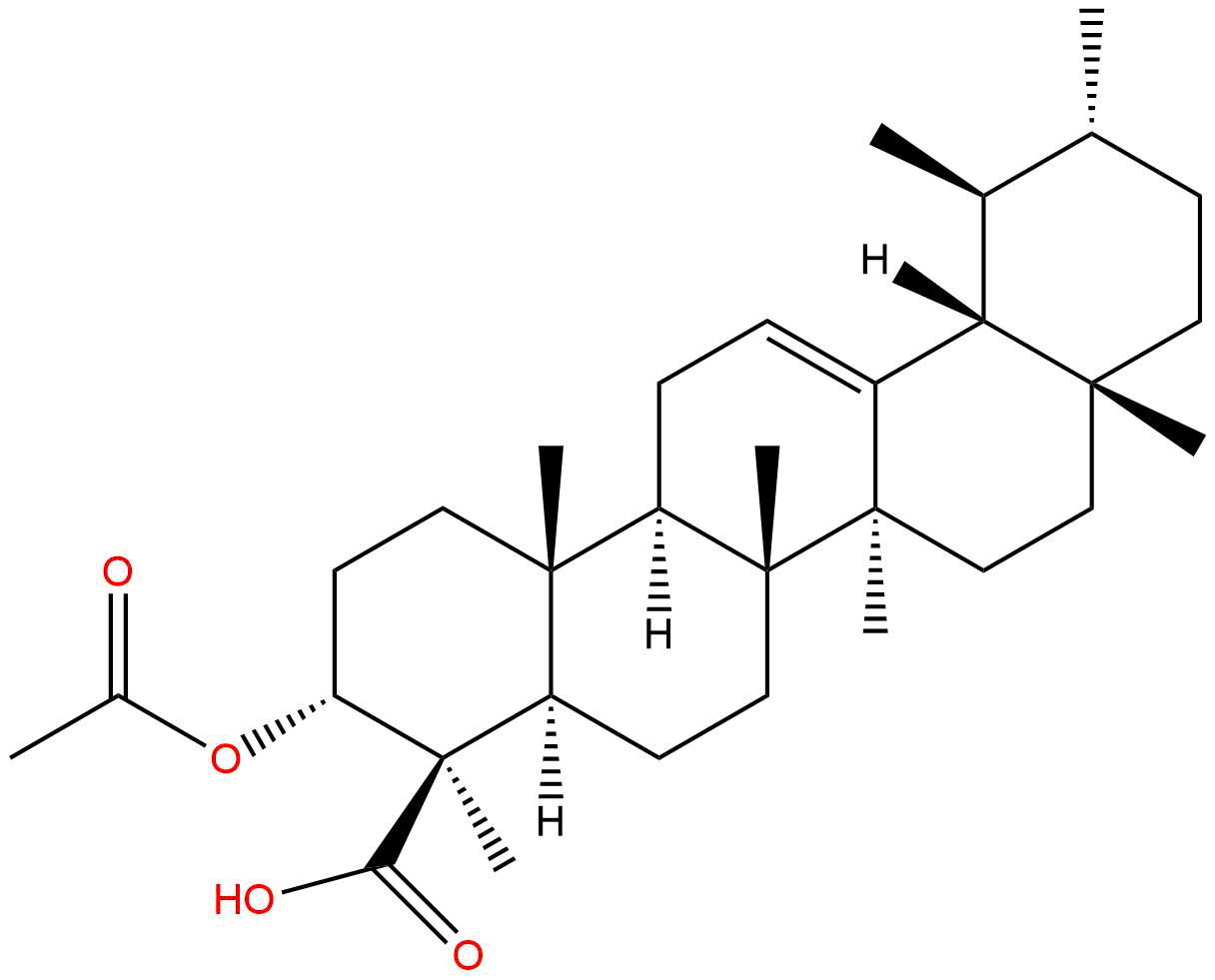


Product name: 3-Acetyl-β-boswellic acid
Synonym name: 3-O-Acetyl-beta-boswellic acid
Catalogue No.: BPF0530
Cas No.: 5968-70-7
Formula: C32H50O4
Mol Weight: 498.748
Botanical Source:
Physical Description:
Type of Compound: Triterpenoids
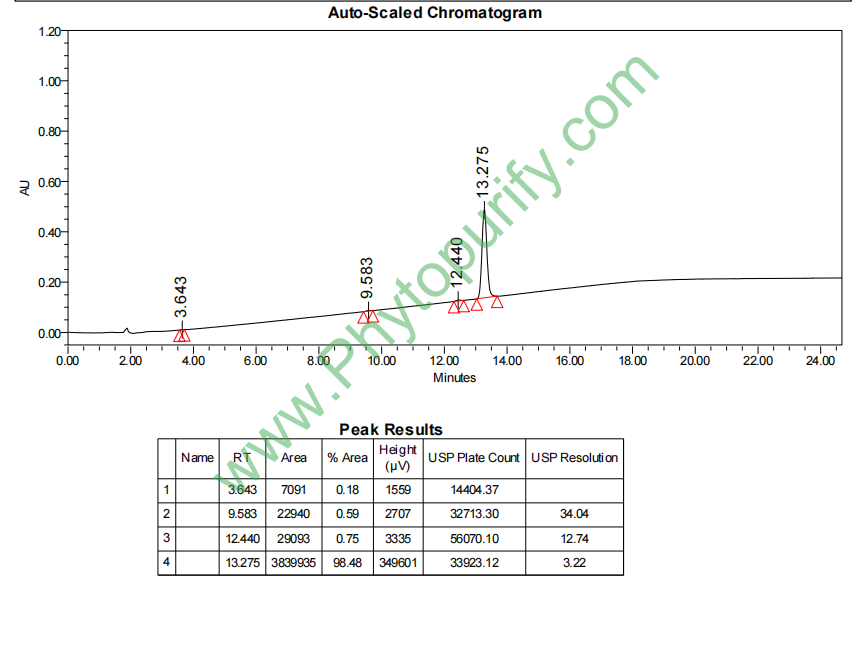
Purity: 95%~99%
Analysis Method: HPLC-DAD or/and HPLC-ELSD
Identification Method: Mass, NMR
Packing: Brown vial or HDPE plastic bottle
The product could be supplied from milligrams to grams
Inquire for bulk scale.
For Reference Standard and R&D, Not for Human Use Directly.
HPLC of 3-Acetyl-β-boswellic acid
Storage conditions:Short-term storage at 2~8℃, long-term storage at -20 ~ -80℃
63.6000
7.1735
5.0832
.0017
4.5389
4.0193
Low
92.9305
4.9066
No
No
Yes
No
No
No
0.0
No
No
No
No
Natural products, as an important source of drug discovery, play an indispensable role in the long history of human fight against diseases. Among numerous natural compounds with biological activity, frankincense acid and its derivatives have attracted much attention due to their significant anti-inflammatory activity. Frankincense, as a traditional medicinal herb with a long history, originates from the frankincense tree in the olive family(Boswellia serrata or Boswellia carterii)Resin has been widely used in ancient Egypt, Greece, Rome, and traditional Chinese medicine, commonly used to treat rheumatism, inflammation, pain, and digestive system diseases. Modern pharmacological research has revealed that the main active ingredients of frankincense are a class of pentacyclic triterpenoids, collectively known as boswellic acids. Among them, 3-acetyl - β - boswellic acid (ABA) is one of the most abundant and biologically active components.
3-acetyl - β - frankincense acid, CAS number 5968-70-7, is a key active molecule isolated from frankincense sawdust resin. Compared with the parent compound β - frankincense, its hydroxyl group at C-3 position is acetylated, which significantly affects its lipophilicity, bioavailability, and interaction with target proteins. For a long time, ABA has been considered the core material basis for frankincense to exert pharmacological effects such as anti-inflammatory, anti arthritis, and anti-tumor effects. Its mechanism of action is unique. Unlike traditional nonsteroidal anti-inflammatory drugs (NSAIDs) that exert anti-inflammatory effects by inhibiting cyclooxygenase (COX), ABA mainly blocks the synthesis of leukotrienes by inhibiting the activity of 5-lipoxygenase (5-LOX). Leukotrienes are key lipid mediators that mediate inflammatory responses, particularly playing important roles in chronic inflammatory diseases such as asthma, rheumatoid arthritis, and inflammatory bowel disease. In addition, recent studies have continuously revealed the complex role of ABA in regulating various inflammatory signaling pathways, cell apoptosis, angiogenesis, and other aspects, making it a highly promising natural lead compound for development.
This article aims to comprehensively review the research progress of 3-acetyl - β - frankincense acid, covering its chemical structure and physicochemical properties, plant sources and extraction methods, pharmacological activity, mechanism of action and molecular targets, drug evaluation and pharmacokinetics, and explore its clinical application prospects and future research directions, in order to provide systematic references for the in-depth research and development of this natural product.
3-acetyl - β - frankincense acid belongs to the pentacyclic triterpenoid class, with a core skeleton of Ursane type structure. Specifically, its chemical structural characteristics are as follows: the parent nucleus is β - frankincense acid, which is 3 α - hydroxy-12-en-24-oic acid. In ABA, the hydroxyl group (- OH) at position C-3 is replaced by an acetyl group (- COOH3) to form an ester bond, which is chemically named 3 α - acetoxy-12-en-24-oic acid. This molecule has a carboxyl group (- COOH) located at C-24, a double bond between C-12 and C-13, and multiple chiral centers, giving it a specific spatial configuration. The molecular formula is C ∝₂ H ₅₀₄, and the molecular weight is 498.7480 g/mol.
From the perspective of physical and chemical properties, ABA exhibits typical lipophilic characteristics. The calculated lipid water partition coefficient (LogP) is 7.1735, which is a relatively high value indicating its extremely low solubility in water and easy solubility in organic solvents such as ethanol, dimethyl sulfoxide (DMSO), chloroform, and ether. In fact, its water solubility is only 0.0017 mg/mL, which constitutes one of the main challenges in its development as an oral drug. The polar surface area (TPSA) is 63.60 Å ², indicating a certain degree of polarity, but overall it is still predominantly non-polar. The pKa value (carboxyl group) of ABA is about 4.5-5.0. Under physiological pH conditions, some carboxyl groups will dissociate into ionic forms, but this does not significantly improve its water solubility. This compound is a white or off white crystalline powder at room temperature, with a melting point between 260-270 ° C (decomposition). Its UV absorption characteristics mainly come from the double bonds and carbonyl groups in the molecule, with weak absorption at around 250 nm. In the infrared spectrum, characteristic peaks of carbonyl (C=O) stretching vibration of acetyl group (about 1735 cm ⁻¹) and carbonyl stretching vibration of carboxyl group (about 1700 cm ⁻¹) can be observed. Nuclear magnetic resonance spectroscopy (NMR) is a key means of identifying the structure of ABA, and its ¹ H and ¹ ³ C NMR spectra have characteristic signals, such as acetyl methyl proton signals (around δ 2.0 ppm), olefin proton signals (around δ 5.3 ppm), and multiple methyl signals.
These physicochemical properties determine the biological behavior of ABA. High lipophilicity makes it easy to penetrate cell membranes and bind to intracellular targets, but it also leads to poor solubility and dissolution in aqueous environments such as blood and gastrointestinal fluids, severely limiting its oral absorption and bioavailability. Therefore, how to improve the water solubility and oral bioavailability of ABA through formulation techniques (such as nanoparticles, liposomes, cyclodextrin inclusion complexes) or prodrug design is the core issue in ABA drug development research.
3-acetyl - β - frankincense acid mainly comes from the Burseraceae genus of frankincense in the olive family(Boswellia)Resin from plants. among which,Boswellia serrata(Indian frankincense) and Boswellia carterii Somali frankincense or Arabic frankincense are the two most important commercial sources. Frankincense resin is an oil gum resin secreted by plants after trauma, which contains about 5-15% volatile oil, 60-70% resin (mainly composed of frankincense acid compounds), and 20-30% gum. In frankincense acid mixtures, ABA typically coexists with β - frankincense acid, 11 keto - β - frankincense acid (KBA), and 3-acetyl-11-one - β - frankincense acid (AKBA), and its content varies depending on plant variety, origin, harvest season, and tree age. Generally speaking,B. serrata The content of ABA in the resin is relatively high, reaching more than 20-30% of the total frankincense acid.
The traditional method of extracting ABA is mainly based on its lipophilicity. The classic process involves crushing frankincense resin and then degreasing it with low polarity solvents such as petroleum ether or n-hexane to remove volatile oils and some lipid soluble impurities. After degreasing, the residue is extracted multiple times with slightly more polar solvents such as ethanol, methanol, or ethyl acetate to dissolve the frankincense acid compounds from the resin matrix. After the extraction solution is concentrated under reduced pressure, crude extract is obtained. In order to obtain high-purity ABA, further separation and purification steps are required. Common methods include:
Acid-base precipitation method By utilizing the carboxyl group property of frankincense acid compounds, they are dissolved in alkaline aqueous solutions (such as sodium hydroxide or sodium bicarbonate solutions) to form salts, and then extracted with organic solvents to remove neutral impurities. Add acid (such as hydrochloric acid) to the aqueous phase to acidify and precipitate frankincense acid. This method can obtain the total extract of frankincense acid, but cannot effectively separate ABA from other frankincense acid analogues.
Column chromatography This is the most commonly used method to obtain high-purity ABA. Silica gel column chromatography is the preferred method, typically using gradient elution systems such as chloroform/methanol or n-hexane/ethyl acetate. Due to the extremely similar structure of ABA and β - frankincense (only one acetyl group is missing), its separation requires precise gradient optimization. In addition, reverse phase silica gel column chromatography (such as C18 column) using methanol/water or acetonitrile/water systems can also achieve effective separation. In recent years, high-speed countercurrent chromatography (HSCCC) and preparative high-performance liquid chromatography (Prep HPLC) have been increasingly used for the efficient and high-purity preparation of ABA.
Crystallization method Purification is achieved through repeated crystallization using the differential solubility of ABA in specific solvents. For example, the crude product is dissolved in hot ethanol or methanol, and after cooling, ABA preferentially crystallizes and precipitates, while other impurities remain in the mother liquor. Multiple recrystallization can obtain ABA with a purity of over 98%.
Modern extraction techniques such as supercritical fluid extraction (SFE, commonly using CO ₂ as a solvent), microwave-assisted extraction (MAE), and ultrasound assisted extraction (UAE) have also been applied to the extraction of frankincense acid. These methods have the advantages of high extraction efficiency, short time, low solvent dosage, and environmental friendliness, but the equipment cost is high and the selective extraction ability for ABA is limited. Therefore, subsequent chromatographic purification steps are usually still required. During the extraction and purification process, attention should be paid to controlling the temperature, avoiding strong acids and bases, and prolonged light exposure to prevent the degradation or structural isomerization of ABA.
The pharmacological activity research of 3-acetyl - β - frankincense acid mainly focuses on anti-inflammatory, anti-tumor, neuroprotective, and antimicrobial aspects, among which anti-inflammatory activity is its most core and deeply studied function.
1. Anti inflammatory activity
The anti-inflammatory effect of ABA is its most notable pharmacological characteristic. Numerous in vitro and in vivo experiments have confirmed that ABA can effectively inhibit various inflammatory models. At the cellular level, ABA can significantly reduce the production of pro-inflammatory cytokines such as tumor necrosis factor - α (TNF - α), interleukin-1 β (IL-1 β), and interleukin-6 (IL-6) in macrophages (such as RAW264.7 cells) stimulated by lipopolysaccharide (LPS). In animal models, oral or intraperitoneal injection of ABA can effectively alleviate carrageenan induced paw swelling in rats, Freund's complete adjuvant induced arthritis in rats, and xylene induced ear inflammation in mice. Unlike traditional NSAIDs, ABA has minimal damage to the gastric mucosa, which makes it potentially advantageous in treating chronic inflammatory diseases. In addition, ABA has also shown a protective effect in the inflammatory bowel disease (IBD) model, which can alleviate colitis and reduce disease activity index.
2. Antitumor activity
More and more studies have shown that ABA has broad-spectrum anti-tumor activity and is involved in various types of cancer, including glioblastoma, leukemia, colon cancer, prostate cancer, liver cancer, and melanoma. Its anti-tumor mechanism is complex and diverse, mainly including:
- Inducing cell apoptosis ABA can kill tumor cells by activating endogenous (mitochondrial) and exogenous (death receptor) apoptotic pathways. It can upregulate the expression of pro apoptotic proteins Bax and Bad, downregulate the expression of anti apoptotic proteins Bcl-2 and Bcl xL, leading to loss of mitochondrial membrane potential, release of cytochrome c, and activation of the Caspase-9 and Caspase-3 cascade reaction. Meanwhile, ABA can also upregulate the expression of death receptors such as Fas and TRAIL-R.
- Inhibit cell proliferation ABA can block tumor cells in the G0/G1 or G2/M phase by regulating the expression of cyclins and cyclin dependent kinases (CDKs), thereby inhibiting their proliferation.
- Inhibit angiogenesis ABA can inhibit the expression and secretion of vascular endothelial growth factor (VEGF), as well as the activity of hypoxia inducible factor-1 alpha (HIF-1 alpha), thereby blocking the formation of tumor neovascularization and cutting off the nutritional supply to the tumor.
- Inhibit invasion and metastasis ABA can downregulate the expression and activity of matrix metalloproteinases (MMPs) such as MMP-2 and MMP-9, and upregulate the expression of their inhibitors TIMPs, thereby inhibiting the invasion and migration ability of tumor cells.
3. Neuroprotective activity
ABA also exhibits protective potential in neurological diseases. In the Alzheimer's disease (AD) model, ABA can reduce the aggregation and deposition of beta amyloid protein (A β), inhibit the excessive phosphorylation of Tau protein, and alleviate neuroinflammatory responses. In the Parkinson's disease (PD) model, ABA has a protective effect on dopaminergic neurons and can alleviate neurotoxicity induced by 1-methyl-4-phenyl-1,2,3,6-tetrahydropyridine (MPTP) or 6-hydroxydopamine (6-OHDA). In addition, ABA can improve cerebral ischemia-reperfusion injury by inhibiting inflammatory response and oxidative stress, reducing the area of cerebral infarction.
4. Other activities
In addition to the above main activities, ABA has also been reported to have anti microbial (such as anti Helicobacter pylori, anti Staphylococcus aureus), antioxidant, liver protection, anti diabetes and immune regulating effects. These activities together form the pharmacological basis of ABA as a multifunctional natural product.
The pharmacological activity of 3-acetyl - β - frankincense acid is the result of its interaction with multiple molecular targets. Its mechanism of action is complex and involves multiple key signaling pathways.
1. Inhibit 5-lipoxygenase (5-LOX)
This is the most classic and unique anti-inflammatory mechanism of ABA. 5-LOX is a key enzyme that catalyzes the conversion of arachidonic acid to leukotriene A ₄ (LTA ₄), which is a potent pro-inflammatory mediator. ABA can non competitively inhibit the activity of 5-LOX, thereby blocking the synthesis of leukotrienes. Research has shown that the binding site between ABA and 5-LOX may be different from other inhibitors, as it may exert inhibitory effects by interacting with the enzyme's calcium binding domain or substrate binding site. This mechanism explains why ABA has a relatively small effect on COX-1/2 in the gastric mucosa while inhibiting inflammation, thus avoiding the common gastrointestinal side effects of NSAIDs.
2. Regulating the NF - κ B signaling pathway
Nuclear factor kappa B (NF - κ B) is a core transcription factor involved in inflammation and immune responses. ABA can inhibit the activation of NF - κ B in various ways. Firstly, ABA can inhibit the activity of I κ B kinase (IKK, especially IKK β), prevent the phosphorylation and degradation of I κ B α, and thus retain NF - κ B (usually a p50/p65 heterodimer) in the cytoplasm, preventing it from entering the nucleus to initiate transcription of target genes. Secondly, ABA can directly interact with subunits of NF - κ B (such as RELA/p65), inhibiting their binding ability to DNA. By inhibiting the NF - κ B pathway, ABA downregulates the expression of numerous pro-inflammatory genes regulated by it, including TNF - α, IL-6, IL-1 β, COX-2, iNOS (NOS2), and various adhesion molecules.
3. Inhibit the STAT3 signaling pathway
Signal transducer and activator of transcription factor 3 (STAT3) is continuously activated in various cancers and inflammatory diseases. ABA has been found to inhibit the phosphorylation of STAT3, particularly at the Tyr705 site, thereby preventing its dimerization and nuclear translocation. ABA may directly inhibit the activity of upstream kinases such as Janus kinase (JAK) or Src kinase, or indirectly inhibit the activation of STAT3 by inducing the expression of protein tyrosine phosphatases (such as SHP-1). Inhibiting the STAT3 signaling pathway is one of the important mechanisms by which ABA exerts anti-tumor and anti-inflammatory effects.
4. Targeting other key molecules
- Caspase-1(CASP1)Caspase-1 is a key effector molecule of inflammasome, responsible for cleaving pro-IL-1 β and pro-IL-18 into mature forms. ABA can inhibit the assembly and activation of NLRP3 inflammasomes, thereby reducing the activity of Caspase-1 and decreasing the secretion of IL-1 β.
- TRPV1 and TRPA1 Transient receptor potential vanillic acid subtype 1 (TRPV1) and anchor protein subtype 1 (TRPA1) are key ion channels for pain and inflammation perception. ABA has been proven to be an antagonist of TRPV1 and TRPA1, which can directly block the activation of these channels, thereby exerting analgesic and anti-inflammatory effects. This provides a molecular basis for ABA treatment of chronic pain.
- Inducible nitric oxide synthase (NOS2/iNOS)ABA inhibits the NF - κ B and STAT3 pathways, downregulates the expression of iNOS, thereby reducing the excessive production of nitric oxide (NO) and alleviating inflammation related oxidative stress damage.
- Cyclooxygenase-1 (PTGS1/COX-1)Although ABA has a weak inhibitory effect on COX-2, studies have shown that it may have a certain direct or indirect inhibitory effect on COX-1, but this is not its main anti-inflammatory mechanism.
In summary, ABA is a natural compound with multiple targets, and its pharmacological activity is not derived from a single mechanism, but rather exerts strong anti-inflammatory, anti-tumor, and neuroprotective effects by simultaneously acting on multiple key nodes such as 5-LOX, NF - κ B, STAT3, Caspase-1, TRP channels, etc.
Despite the remarkable pharmacological activity of 3-acetyl - β - frankincense acid, its medicinal properties face severe challenges, mainly due to its extremely poor physicochemical properties and pharmacokinetic characteristics.
1. Evaluation of drug properties
According to the Lipinski Five Rules, the molecular weight of ABA (498.7) is close to the threshold of 500, LogP (7.17) is much higher than 5, the number of hydrogen bond donors (- OH of 1 carboxyl group) is 1, and the number of hydrogen bond acceptors (4 oxygen atoms) is 4. Its LogP value severely exceeds the standard, indicating that its lipophilicity is too high. In addition, its water solubility is extremely low (0.0017 mg/mL), far below the level considered acceptable (>0.1 mg/mL). These parameters indicate that oral absorption of ABA will be very difficult. In terms of other pharmacological parameters, the Ames test result was 0.0, indicating no significant mutagenicity; HERG inhibition prediction is' no ', indicating a low risk of cardiac toxicity; The prediction of blood-brain barrier penetration is' low ', which to some extent limits its application in central nervous system diseases, but may also imply lower CNS side effects. Overall, ABA is a typical natural product with high activity and low pharmacological properties, and the key to its development lies in overcoming solubility and bioavailability barriers.
2. Pharmacodynamics
Pharmacokinetic studies have confirmed that the oral bioavailability of ABA is extremely low. In animal experiments, after oral administration of ABA, its concentration in plasma is very low, with small peak concentration (Cmax) and area under the drug time curve (AUC). The main reasons include:
- Solubility limit Very low solubility in gastrointestinal fluids, resulting in slow dissolution rate and inability to be effectively absorbed.
- First pass effect Even if a small amount is absorbed, it will be heavily metabolized by cytochrome P450 enzymes (CYP450) and glucuronosyltransferases (UGTs) in the liver and intestines, leading to a further reduction in the amount of medication entering the systemic circulation.
- Outward transportation carrier ABA may be a substrate for efflux transporters such as P-glycoprotein (P-gp), which are expressed on the apical side of intestinal epithelial cells and pump absorbed drugs into the ileal lumen, further reducing absorption.
After absorption, ABA is widely distributed in the body, and due to its high lipophilicity, it tends to distribute to adipose tissue, liver, and kidneys. Its metabolism is mainly carried out through the liver, including oxidation (CYP450 enzyme system) and binding reactions (such as glucuronidation and sulfation). Metabolites usually have increased polarity and are more easily excreted through bile and urine. The half-life (t ₁/₂) of ABA varies greatly among different species and administration methods, but is usually shorter (several hours). Intravenous or intraperitoneal injection can significantly improve its bioavailability, but oral administration is the most expected route for its clinical application.
In order to improve the pharmacokinetic properties of ABA, researchers have explored various strategies:
- Formulation technology Develop nanoparticles, liposomes, solid lipid nanoparticles, self microemulsifying drug delivery systems (SMEDS), and cyclodextrin inclusion complexes to increase their solubility and dissolution rate, and potentially bypass first pass effects through lymphatic absorption.
- Prodrug design Modify the carboxyl or acetyl groups of ABA to prepare more water-soluble prodrugs, such as phosphate esters, amino acid esters, or polyethylene glycol (PEG) esters. After enzymatic hydrolysis or hydrolysis in vivo, the active prodrug is released.
- Structural modification Under the premise of maintaining or enhancing activity, chemical modification is carried out on the parent nucleus of ABA, introducing polar groups (such as hydroxyl, amino, sugar) to reduce LogP value and improve water solubility.
Based on its unique anti-inflammatory mechanism and extensive pharmacological activity, 3-acetyl - β - frankincense acid has shown promising clinical application prospects in multiple therapeutic fields.
1. Chronic inflammatory diseases
This is the most promising application direction of ABA. Given that it exerts anti-inflammatory effects by inhibiting the 5-LOX and NF - κ B pathways, and its irritation to the gastrointestinal tract is much lower than traditional NSAIDs, ABA and its derivatives or standardized extracts (such as frankincense extract) have been developed as dietary supplements or plant medicines for the treatment of:
- Osteoarthritis and rheumatoid arthritis Multiple clinical trials have shown that frankincense extract (rich in ABA) can effectively alleviate joint pain, improve joint function, and reduce morning stiffness. Its effectiveness is comparable to certain NSAIDs and its safety is better.
- Inflammatory bowel disease (IBD)Including ulcerative colitis and Crohn's disease. Preliminary clinical studies have shown that frankincense extract can improve clinical symptoms and endoscopic manifestations in IBD patients, and reduce levels of inflammatory markers.
- asthma ABA can theoretically be used to treat asthma by inhibiting the synthesis of leukotrienes. Some preclinical studies support its effectiveness, but there is still a lack of large-scale clinical trial evidence.
2. Tumor adjuvant therapy
The anti-tumor activity of ABA makes it potential as an adjuvant drug for chemotherapy or radiotherapy. Its advantages lie in:
- Sensitization effect ABA can enhance the killing effect of certain chemotherapy drugs (such as cisplatin, doxorubicin, paclitaxel) on tumor cells and may reverse multidrug resistance (MDR).
- Detoxification effect Due to its low toxicity to normal cells and anti-inflammatory and antioxidant effects, ABA may alleviate the side effects caused by chemotherapy drugs, such as gastrointestinal injury, bone marrow suppression, and neuropathy.
- Prevent recurrence and metastasis ABA may help prevent tumor recurrence and metastasis by inhibiting angiogenesis and invasion.
3. Neurodegenerative diseases
Although ABA has low blood-brain barrier penetration, there are still studies showing its protective effects in AD and PD models. In the future, the concentration of it in the brain can be increased through nano formulations or nasal administration, in order to develop drugs for treating neurodegenerative diseases.
4. Pain management
ABA, as an antagonist of TRPV1 and TRPA1, has a direct analgesic effect. Developing it into topical preparations (such as creams and patches) for the treatment of local pain (such as arthritis and neuropathic pain) is a worthwhile direction to explore, which can avoid the problem of low oral bioavailability.
Outlook and Challenges
Despite its broad prospects, the clinical translation of ABA still faces significant challenges. The primary challenge is its extremely poor pharmacokinetic properties. Developing efficient and secure delivery systems is the key to breaking through bottlenecks. Secondly, the activity of ABA is relatively mild, and as a single drug, it may not be sufficient to treat severe diseases. Its positioning is more likely to be as an adjuvant therapy or for the management of mild to moderate diseases. In addition, research on the long-term toxicity and potential drug interactions of ABA is not yet sufficient. Finally, the large-scale and low-cost production of high-purity ABA from frankincense resin, as well as the establishment of reliable quality control standards, are also issues that industrialization must address. Future research should focus on: 1) developing new formulations to improve bioavailability; 2) Design and synthesize ABA derivatives with stronger activity and better pharmacokinetic properties through structure-activity relationship (SAR) research; 3) Conduct rigorously designed large-scale, multicenter clinical trials to confirm its efficacy and safety in specific diseases; 4) Further explore its synergistic mechanism with other drugs.
3-acetyl - β - frankincense acid, as the core active ingredient in frankincense resin, is a natural pentacyclic triterpenoid compound with unique anti-inflammatory mechanisms and multiple pharmacological activities. It has shown great therapeutic potential in anti-inflammatory, anti-tumor, neuroprotective and other fields by inhibiting multi-target pathways such as 5-LOX, NF - κ B, STAT3, Caspase-1, and antagonizing TRPV1/TRPA1 channels. Its mechanism of action is different from traditional anti-inflammatory drugs, providing valuable lead structures for the development of new and safe anti-inflammatory drugs. However, extremely low water solubility and oral bioavailability are the main obstacles to its drug development, severely limiting its clinical translation. The future research focus will be on using modern medicinal chemistry and pharmaceutical methods, such as structural modification and novel drug delivery systems, to overcome these shortcomings. With the continuous deepening of understanding of the mechanism of action of ABA and the advancement of formulation technology, we have reason to believe that 3-acetyl - β - frankincense and its derivatives are expected to become important drugs or functional ingredients for the treatment of complex diseases such as chronic inflammation and cancer in the future, and contribute to human health. The molecule discovered from ancient resins is now radiating new vitality through modern scientific research.
