


Product name: Alpha-Boswellic acid
Synonym name: α-Boswellic acid; 3-alpha-Hydroxy-12-oleanen-24-oic acid
Catalogue No.: BP0153
Cas No.: 471-66-9
Formula: C30H48O3
Mol Weight: 456.711
Botanical Source: Olibanum
Physical Description:
Type of Compound: Triterpenoids
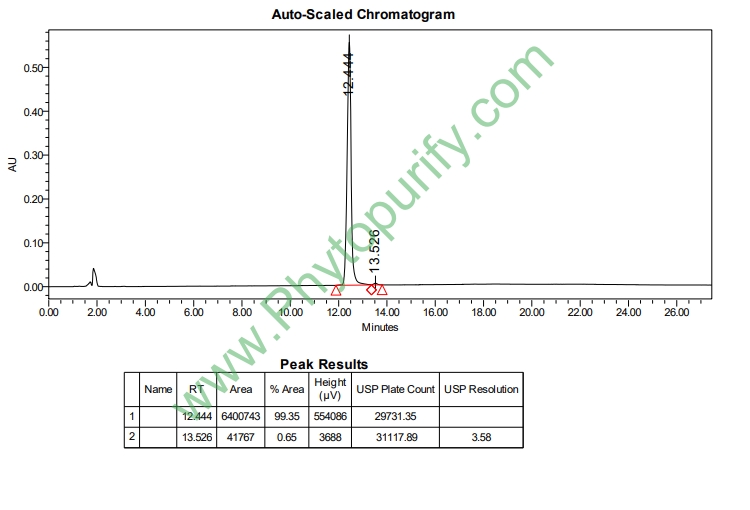
Purity: 95%~99%
Analysis Method: HPLC-DAD or/and HPLC-ELSD
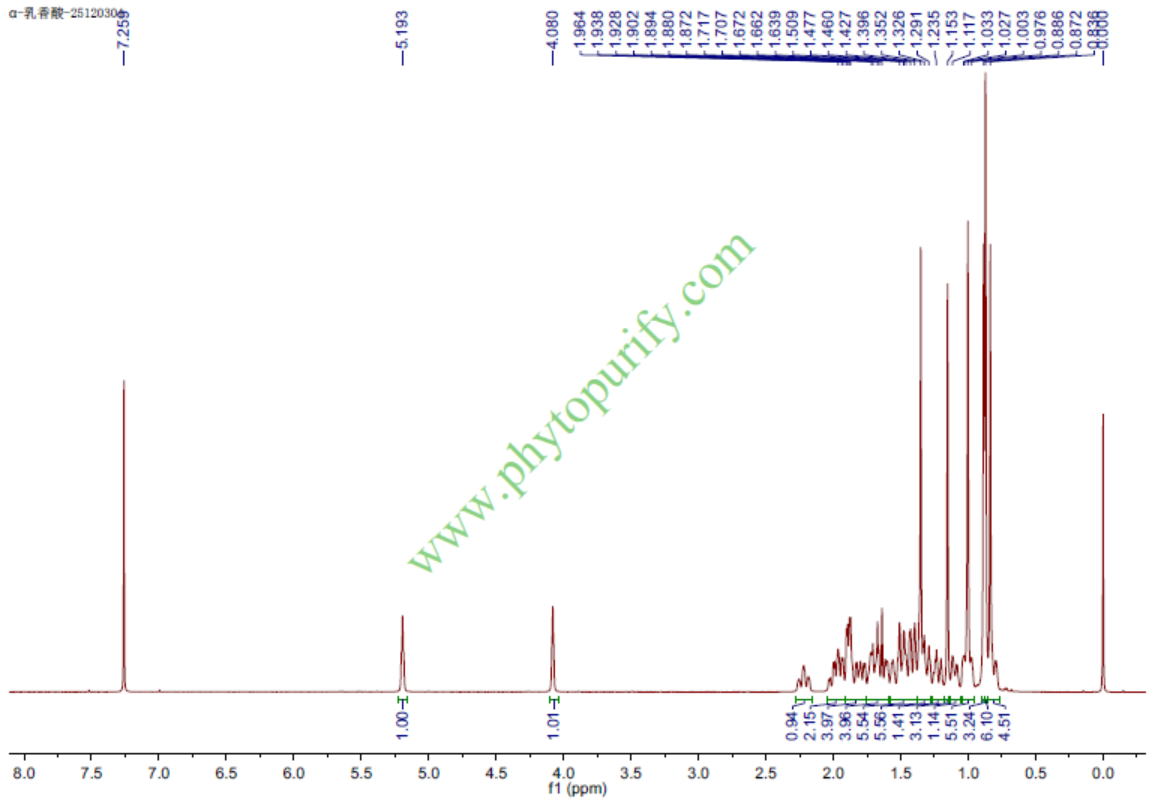
Identification Method: Mass, NMR
Packing: Brown vial or HDPE plastic bottle
Storage: Store in a well closed container, protected from air and light. Put into refrigerate or freeze for long term storage.
Whenever possible, you should prepare and use solutions on the same day. However, if you need to make up stock solutions in advance, we recommend that you store the solution as aliquots in tightly sealed vials at -20℃. Generally, these will be useable for up to two weeks.
The product could be supplied from milligrams to grams
Inquire for bulk scale.
Chengdu Biopurify Phytochemicals Ltd. is a leading company in the research, development, manufacture and marketing of High Quality Phytochemicals and Extracts(especially Active Ingredients from Traditional Chinese Medicine,TCM), Natural Active Pharmaceutical Ingredients worldwide.
The main services:
A. Supply active ingredients and reference standards of TCM, from mgs to kgs scale
B. Custom extraction and purification, target Herb Active Ingredients
C. Custom synthesis and semi-synthesis for Natural Active Ingredients
D. CR(contract research), CM(contract manufacture) and PD(process development) services from lab scale, pilot scale to commercial scale(GMP is also available)
E. TCM compounds library for drug screen,more than 3000 compounds available, many of them are rare and unique.
HPLC of Alpha-Boswellic acid
HNMR of Alpha-Boswellic acid
Storage conditions:Short-term storage at 2~8℃, long-term storage at -20 ~ -80℃
Alpha Boswellic acid (CAS number: 471-66-9) is a typical natural product of pentacyclic triterpenoids, mainly found in the resin of Boswellia plants. As one of the important active ingredients in frankincense, Alpha frankincense acid has attracted much attention in the field of natural medicine research in recent years due to its diverse biological activities and good safety. Its pharmacological effects cover multiple aspects such as anti-inflammatory, antioxidant, anti-tumor, and neuroprotective effects, especially showing significant potential in gastrointestinal protection, liver detoxification, and prevention and treatment of neurodegenerative diseases. This article will provide a systematic review of the chemical structure and physicochemical properties, plant sources and extraction processes, pharmacological activity and mechanism of action, pharmacological evaluation and pharmacokinetic characteristics of Alpha frankincense acid, and explore its clinical application prospects, aiming to provide theoretical basis and research direction for the drug development of this natural product.
Alpha frankincense acid belongs to the pentacyclic triterpenoid class, with a molecular formula of C30H48O3 and a molecular weight of 456.7. Its structural feature is based on a five ring skeleton of triterpenoid parent nuclei, with functional groups such as carboxyl and hydroxyl groups, endowing it with certain polarity and biological activity. Its LogP value is about 6.0, indicating strong lipid solubility, which is beneficial for penetrating cell membranes but may limit its water solubility and bioavailability. The surface area of the molecule (TPSA) is 57.53 Å ², and the number of hydrogen bond acceptors is 3, indicating its hydrophilicity in intermolecular interactions. The low blood-brain barrier permeability of Alpha frankincense suggests that its direct action in the central nervous system may be limited, but it can still exert neuroprotective effects through indirect mechanisms or carrier mediated transport. Toxicological evaluation showed that the LD50 of Alpha frankincense acid was as high as 2000 mg/kg, and there was no significant hepatotoxicity, cardiotoxicity, or hERG channel inhibition. The Ames mutagenicity test result was negative, indicating good safety.
Alpha frankincense acid mainly comes from the resins of frankincense trees (Boswellia genus), especially Boswellia serrata, Boswellia carterii, and other species. Frankincense resin is a dried resin secretion traditionally used in traditional Chinese medicine and Ayurvedic medicine, with anti-inflammatory and analgesic effects. The process of extracting Alpha frankincense acid mainly includes solvent extraction, supercritical CO2 extraction, and column chromatography purification. The commonly used solvents are ethanol, methanol, or ethyl acetate, and the extraction conditions need to be controlled by temperature and time to prevent degradation of the active ingredient. Supercritical CO2 extraction has gradually become the preferred technology for extracting Alpha frankincense acid due to its environmental friendliness, high efficiency, and strong selectivity. After extraction, qualitative and quantitative analysis is performed using high-performance liquid chromatography (HPLC) and mass spectrometry (MS) techniques to ensure product purity and active ingredient content.
Alpha frankincense acid exhibits significant gastroprotective effects by reducing oxidative stress responses and activating the Nrf2/HO-1 signaling pathway. As a key transcription factor for intracellular antioxidant stress, Nrf2 activation promotes the expression of antioxidant enzymes such as HO-1, alleviating gastric mucosal damage. Related in vitro and in vivo experiments have shown that Alpha frankincense acid can effectively inhibit the inflammatory response and oxidative damage of gastric mucosa, and promote gastric mucosal repair.
In the Balb/cA mouse hepatotoxicity model induced by acetaminophen (APAP), Alpha frankincense acid showed good liver protective effects. Its mechanism includes inhibiting oxidative stress, reducing liver cell apoptosis and inflammatory response, and maintaining the stability of liver function indicators. This effect provides a potential natural drug option for adjuvant therapy of clinical liver injury.
The role of Alpha frankincense acid is particularly prominent in the Alzheimer's disease (AD) model. Research has shown that Alpha frankincense acid can reduce the accumulation of highly phosphorylated Tau protein (Ser404) in STZ (streptozotocin) treated astrocytes, lower intracellular ROS (reactive oxygen species) levels, and alleviate oxidative stress. At the same time, Alpha frankincense promotes astrocyte proliferation, improves the neuronal environment, and delays the pathological process of Alzheimer's disease by upregulating the expression of Survivor, a protein that inhibits cell apoptosis. Its anti-inflammatory and antioxidant effects work together in neurodegenerative diseases and have broad application prospects.
Alpha frankincense acid has significant anti-inflammatory activity, which can regulate various inflammation related targets and signaling pathways, including TNF, IL-6, NF - κ B, etc., inhibit the release of inflammatory factors, and alleviate tissue inflammatory responses. Its mechanism of action in acute lung injury (ALI) involves regulating key molecules such as PTPN1, ALOX15, HIF1A, RELA, PPARG, NFKB1, HMOX1, and ICAM1, exerting anti-inflammatory and antioxidant effects. In addition, Alpha frankincense acid has shown activity in inhibiting proliferation, inducing apoptosis, and inhibiting metastasis in various tumor cell lines, indicating its potential value in the development of anti-tumor drugs.
The pharmacological mechanism of Alpha frankincense acid is complex and diverse, mainly achieved by regulating oxidative stress, inflammatory response, and cell apoptosis related signaling pathways. Its key molecular targets include:
The synergistic regulation of these molecular targets enables Alpha frankincense acid to exhibit a wide range of protective effects in various disease models.
Alpha frankincense acid has high lipid solubility (LogP=6.0), which is beneficial for cell membrane penetration, but its water solubility is poor, which may affect oral bioavailability. Its molecular weight is moderate (456.7 Da), meeting some of the requirements of Lipinski's rule. The low permeability of the blood-brain barrier suggests that its direct role in the central nervous system is limited, but it can still exert neuroprotective effects by regulating peripheral nerve cells such as astrocytes. Toxicological data shows that Alpha frankincense acid has good safety, with no significant hepatotoxicity, cardiotoxicity, or mutagenicity. It has a high LD50 and a good drug safety window.
In terms of pharmacokinetics, Alpha frankincense acid is absorbed slowly after oral administration, and its metabolic pathways mainly include liver oxidation and binding reactions. Its bioavailability is limited by its water solubility and first pass effect, and in the future, it needs to be improved through formulation modification or nanocarrier technology to enhance its in vivo stability and targeting. In addition, further in-depth research is needed on the metabolites and pharmacological contributions of Alpha frankincense acid.
Alpha frankincense acid, as a multifunctional natural product, has broad clinical application potential. Its therapeutic effects in gastrointestinal protection, liver detoxification, neurodegenerative diseases, and inflammation related diseases have laid the foundation for its development as a new type of natural medicine. Especially in the research of Alzheimer's disease, Alpha frankincense has shown the potential to delay disease progression through multi-target and multi mechanism effects, and is expected to become an important candidate drug for AD adjuvant therapy in the future.
In addition, research on Alpha frankincense acid in the treatment of acute lung injury and tumors is gradually deepening. Combined with its good safety and multi-target regulation characteristics, it is expected to be developed as a natural medicine with multiple indications. Future research should focus on:
Through interdisciplinary collaborative research, we aim to promote the translation of Alpha frankincense from basic research to clinical practice, and facilitate the innovative development of natural product drugs.
In summary, Alpha frankincense acid, as a pentacyclic triterpenoid natural product derived from frankincense, has demonstrated extensive drug development value due to its significant multiple pharmacological activities such as anti-inflammatory, antioxidant, neuroprotective, and liver protective effects. Its mechanism of action involves the phosphorylation of Nrf2/HO-1, NF - κ B, Tau protein, and the regulation of multiple inflammation related targets, reflecting the advantages of natural product multi-target therapy. Although its water solubility and blood-brain barrier permeability have certain limitations, its good safety and potential clinical application prospects make it an important object of research in natural medicine. In the future, through formulation optimization and in-depth mechanism research, Alpha frankincense acid is expected to become an effective drug for treating gastrointestinal diseases, liver injury, Alzheimer's disease, and inflammation related diseases, promoting progress in natural product pharmacology and drug development.
