


Product Name: Beta-Boswellic acid
Synonym name: β-Boswellic acid; 3-Hydroxy-12-ursen-24-oic acid
Catalogue No.: BP0261
Cas No.: 631-69-6
Formula: C30H48O3
Mol Weight: 456.711
Botanical Source: frankincense (Boswellia spp.), Phellinus pomaceus and olibanum oil
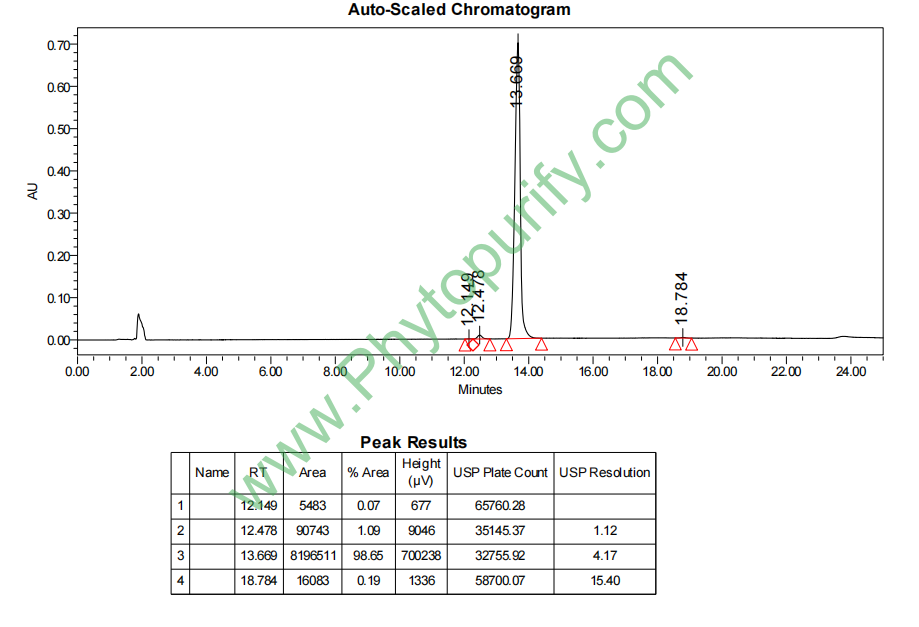
Purity: 95%~99%
Analysis Method: HPLC-DAD or/and HPLC-ELSD
Identification Method: Mass, NMR
Packing: Brown vial or HDPE plastic bottle
Can be supplied from milligrams to grams.
For Reference Standard and R&D, Not for Human Use Directly.
Inquire for bulk scale.
Description:
Beta-boswellic acid and its derivatives (the major constituents of Boswellin) have anti-carcinogenic, anti-tumor, and anti-hyperlipidemic activities. Beta-boswellic acid can significantly enhance neurite outgrowth, branching, and tubulin polymerization dynamics.
References:
Neurol Sci. 2010 Jun;31(3):315-20.
The enhancement effect of beta-boswellic acid on hippocampal neurites outgrowth and branching (an in vitro study).
Increasing evidences implicate impairment of axonal integrity in mechanisms underlying neurodegenerative disorders. Beta-boswellic acid (BBA) is the major component of Boswellia serrata gum. This resin has long been used in Ayurveda (India's traditional medicine) to prevent amnesia.
METHODS AND RESULTS:
In this study, the effect of BBA was examined on neurites outgrowth and branching as well as on polymerization dynamics of tubulin. The morphometric parameters (axonal length and neuritis branching) were examined microscopically after treating the hippocampal cells with BBA. Also the assembly process of tubulin was assessed using UV/V is spectrophotometer through following of absorbance at 350 nm.
CONCLUSIONS:
The results revealed that BBA could significantly enhance neurite outgrowth, branching, and tubulin polymerization dynamics. The obtained results suggest that enhancing effect of BBA on microtubule polymerization kinetics might be the origin of increasing axonal outgrowth and branching.
BioFactors (Oxford, England)2000, 13(1-4):225-230
Anti-tumor and anti-carcinogenic activities of triterpenoid, beta-boswellic acid.
Boswellin (BE), a methanol extract of the gum resin exudate of Boswellia serrata, contains naturally occurring triterpenoids, Beta-boswellic acid and its structural related derivatives, has been used as a traditional medicine for the treatment of inflammatory and arthritic diseases.
METHODS AND RESULTS:
Topical application of BE to the backs of mice markedly inhibited 12-O-tetradecanoylphorbol-13-acetate (TPA)-induced increases in skin inflammation, epidermal proliferation, the number of epidermal cell layers, and tumor promotion in 7,12-dimethylbenz[a]anthracene (DMBA)-initiated mice. Feeding 0.2% of BE in the diet to CF-1 mice for 10-24 weeks reduced the accumulation of parametrial fat pad weight under the abdomen, and inhibited azoxymethane (AOM)-induced formation of aberrant crypt foci (ACF) by 46%. Addition of pure Beta-boswellic acid, 3-O-acetyl-Beta-boswellic acid, 11-keto-Beta-boswellic acid or 3-O-acetyl-11-keto-Beta-boswellic acid to human leukemia HL-60 cell culture inhibited DNA synthesis in HL-60 cells in a dose-dependent manner with IC50 values ranging from 0.6 to 7.1 microM.
CONCLUSIONS:
These results indicate that Beta-boswellic acid and its derivatives (the major constituents of Boswellin) have anti-carcinogenic, anti-tumor, and anti-hyperlipidemic activities.
HPLC of Beta-Boswellic acid
Storage conditions:Short-term storage at 2~8℃, long-term storage at -20 ~ -80℃
Beta Boswellic acid (CAS number: 631-69-6), as one of the main active ingredients in Boswellia serrata gum resin, has received widespread attention in recent years due to its diverse biological activities. Frankincense has been used in traditional medicine since ancient times to treat inflammatory diseases and joint pain. Its main pharmacological effects are attributed to frankincense acid compounds, especially β - frankincense acid. Modern pharmacological studies have shown that β - frankincense acid has significant anti-inflammatory, antioxidant, anticancer, and joint pain relieving effects, and its mechanism of action involves multiple inflammatory signaling pathways and molecular targets. In addition, as a non reducing inhibitor of 5-lipoxygenase (5-LO) with oral activity, β - mastic acid can directly interact with 5-LO or block its translocation, showing its potential therapeutic value in chronic inflammatory diseases such as diabetes and rheumatoid arthritis. This article provides a systematic review of the chemical structure and physicochemical properties, plant sources and extraction methods, pharmacological activity and mechanism of action, pharmacological evaluation and pharmacokinetics of β - frankincense acid, as well as its clinical application prospects. The aim is to provide theoretical basis and research direction for natural product pharmacology research and new drug development.
β - frankincense acid belongs to the pentacyclic triterpenoid class, with a molecular formula of C30H48O3 and a molecular weight of 456.7. Its structural feature is a triterpenoid acid based on a five ring skeleton, containing polar groups such as carboxyl and hydroxyl groups, giving it a certain degree of hydrophilicity. The LogP value of β - frankincense acid is 5.32, indicating its strong lipid solubility, which facilitates its penetration into cell membranes and lipid environments, but may also affect its water solubility and bioavailability. Its topological polar surface area (TPSA) is 57.53 Å ², indicating moderate polarity, and the number of hydrogen bond acceptors is 3, suggesting its ability to form hydrogen bonds in intermolecular interactions. The physicochemical properties of β - frankincense acid make it have good membrane permeability in the body, but its blood-brain barrier penetration ability is low, reducing the risk of central nervous system toxicity. Toxicological evaluation shows that β - frankincense acid has no hepatotoxicity, cardiotoxicity, or hERG channel inhibition effect, and the Ames test result is negative, indicating that its genotoxicity risk is low and has a good safety basis.
β - frankincense acid mainly comes from the resin of the Boswellia serrata tree. Frankincense tree is a plant of the Frankincense family, distributed in India and the Middle East. Its resin has been widely used in traditional medicine since ancient times. The resin contains various isomers of frankincense, among which β - frankincense has a higher content and is one of the main active ingredients.
The traditional methods for extracting β - frankincense acid include solvent extraction, supercritical CO2 extraction, and column chromatography separation. The commonly used solvents are ethanol, methanol, or ethyl acetate, and the combination of ultrasound assisted extraction technology can improve the extraction efficiency. During the extraction process, the resin is first crushed and dissolved in organic solvents. After multiple extractions, the solvent is removed by vacuum concentration, and then purified and separated by silica gel column chromatography or high performance liquid chromatography (HPLC). In recent years, green extraction techniques such as ultrasound assisted extraction, microwave-assisted extraction, and supercritical fluid extraction have been widely used to improve extraction efficiency, reduce the use of organic solvents, and maintain compound activity.
The anti-inflammatory activity of β - frankincense acid is one of its most significant pharmacological effects. It inhibits the activity of 5-lipoxygenase (5-LO), reduces the production of leukotrienes (LTs), and thus suppresses the release of inflammatory mediators. 5-LO is a key enzyme in the inflammatory response, involved in the synthesis of potent inflammatory mediators such as leukotriene B4 (LTB4). β - frankincense acid, as a non reducing inhibitor of 5-LO, directly binds to enzymes or blocks their translocation, significantly reducing inflammatory response. In addition, β - frankincense acid can regulate the nuclear factor kappa B (NF - κ B) signaling pathway, inhibit the expression of pro-inflammatory cytokines such as TNF - α and IL-1 β, and alleviate inflammatory damage.
β - frankincense acid exhibits anti proliferative and pro apoptotic effects in various cancer models. Research has shown that β - frankincense acid can inhibit the synthesis of DNA, RNA, and proteins in human leukemia HL-60 cells, with IC50 values ranging from 0.6 to 7.1 μ M, demonstrating strong cytotoxicity. Its anti-cancer mechanism involves inducing cell cycle arrest, activating mitochondrial pathways to promote apoptosis, and inhibiting tumor related signaling pathways such as STAT3, NF - κ B. In addition, β - frankincense acid can also reduce the invasion and metastasis ability of tumor cells, demonstrating potential anti metastatic activity.
β - frankincense acid has significant antioxidant capacity, can clear free radicals, and alleviate oxidative stress damage to cells. Its antioxidant effect is achieved by enhancing the activity of endogenous antioxidant enzymes such as superoxide dismutase (SOD) and glutathione peroxidase (GPx), protecting cell membrane lipids and DNA from oxidative damage. This characteristic gives it a protective effect in chronic inflammation and metabolic diseases.
β - frankincense acid has shown good efficacy in relieving pain related to rheumatoid arthritis (RA) and osteoarthritis (OA). It reduces joint inflammation and soft tissue swelling, and improves joint function by inhibiting the generation of inflammatory mediators and regulating immune responses. Preclinical studies have shown that β - frankincense acid can reduce inflammatory cell infiltration and matrix metalloproteinases (MMPs) activity in the joint cavity, protect cartilage tissue, and delay joint degeneration.
The mechanism of action of β - frankincense acid is complex, involving multiple signaling pathways and molecular targets. Its main targets include:
The synergistic effect of these targets enables β - frankincense acid to exert multiple effects in anti-inflammatory, anti-tumor, and immune regulation, demonstrating its potential as a multi-target drug.
The pharmacological parameters of β - frankincense acid indicate that it has certain potential for drug development. Its molecular weight is 456.7, slightly higher than the ideal range recommended by Lipinski's rule, but still acceptable. The LogP value is 5.32, indicating that it has good lipid solubility, which is beneficial for cell membrane penetration, but may limit water solubility and oral absorption. The TPSA is 57.53 Å ², suitable for oral absorption. The number of hydrogen bond receptors is 3, which meets the requirement for drug molecules to bind to the target.
Toxicological evaluation shows that β - frankincense acid has no significant hepatotoxicity, cardiotoxicity, or hERG channel inhibition, and the Ames test is negative, indicating high safety. Low blood-brain barrier penetration ability reduces the risk of central nervous system toxicity and side effects.
In terms of pharmacokinetics, the oral bioavailability of β - frankincense acid is relatively low, mainly due to its poor water solubility and first pass effect. The metabolism in the body is mainly through the liver enzyme system, and the activity and clearance pathways of metabolites still need further research. To improve its pharmacokinetic properties, strategies such as nanocarriers, liposome encapsulation, and structural modification are actively being explored.
β - frankincense acid has shown broad application prospects in various clinical diseases due to its significant anti-inflammatory, antioxidant, and anticancer activities. Especially in chronic inflammatory diseases such as rheumatoid arthritis and osteoarthritis, β - frankincense has shown good therapeutic potential by regulating multiple inflammatory signaling pathways, reducing pain and tissue damage. Its regulatory effect on diabetes related inflammation and metabolic disorder also provides a new idea for the treatment of diabetes and its complications.
At present, clinical research on β - frankincense acid and its derivatives is still in its early stages, and some formulations based on frankincense extracts have shown safety and efficacy in clinical trials. In the future, larger scale and multi center clinical trials are needed to systematically evaluate its efficacy and safety. Meanwhile, optimizing the administration route and dosage form design to address its pharmacokinetic deficiencies is crucial for achieving clinical translation.
In addition, based on the multi-target mechanism of action of β - frankincense and combined with modern drug design technology, the development of structurally optimized derivatives or combination therapy regimens is expected to enhance its therapeutic efficacy and expand its indications. With the deepening of molecular biology and pharmacology research, the position of β - frankincense acid in the field of natural product drug development will be further enhanced.
β - frankincense acid, as an important active ingredient in frankincense resin, has become a hot topic in natural product pharmacology research due to its diverse pharmacological activities and good safety. It exhibits multiple effects of anti-inflammatory, anticancer, antioxidant, and joint pain relief by inhibiting 5-LO and regulating multiple inflammation and tumor related signaling pathways. Although its oral bioavailability and pharmacokinetics still have certain limitations, modern drug formulation technology and structural optimization are expected to overcome these obstacles and achieve clinical application translation. In the future, in-depth research on the molecular mechanism, pharmacokinetics, and clinical application of β - frankincense will provide a solid foundation for its development as a new natural medicine and promote its application in the treatment of inflammatory diseases, tumors, and metabolic diseases.
