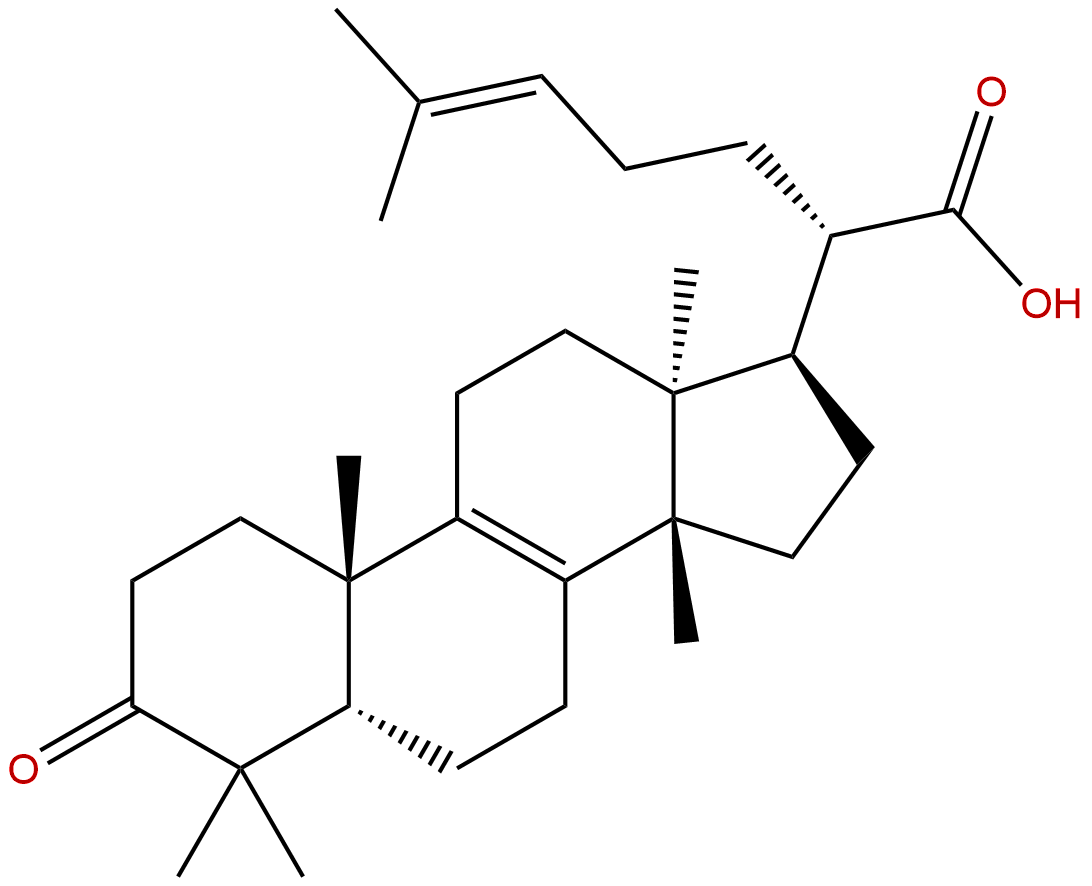


Product name: Beta-Elemonic acid
Synonym name:
Catalogue No.: BP1641
Cas No.: 28282-25-9
Formula: C30H46O3
Mol Weight: 454.695
Botanical Source:
Physical Description:
Type of Compound: Diterpenoids
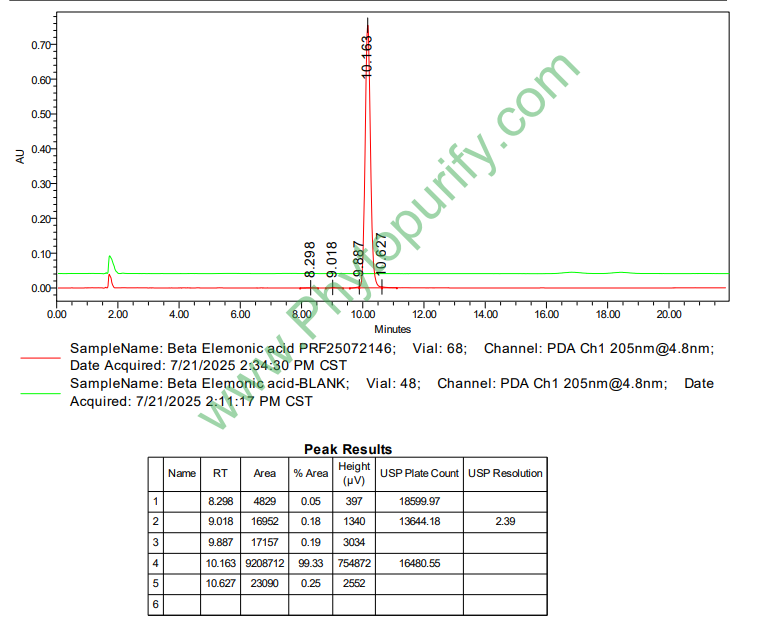
Purity: 95%~99%
Analysis Method: HPLC-DAD or/and HPLC-ELSD
Identification Method: Mass, NMR
Packing: Brown vial or HDPE plastic bottle
The product could be supplied from milligrams to grams. Inquire for bulk scale.
We provide solution to improve the water-solubility of compounds, thereby facilitating the variety of activity tests and clinic uses.
For Reference Standard and R&D, Not for Human Use Directly.
Description:
Beta-Elemonic acid exhibits anti-inflammatory, and anti-cancer effects, it inhibits proliferation by inducing hypoploid cells and cell apoptosis, the anticancer effects of beta-Elemonic acid are related to the MAPK signaling pathway, ROS activation and glutathione depletion in human A549 lung cancer cells. Beta-Elemonic acid exhibits prolyl endopeptidase inhibitory activities.
References:
Oncol Rep. 2016 Jan;35(1):227-34.
β-Elemonic acid inhibits the cell proliferation of human lung adenocarcinoma A549 cells: The role of MAPK, ROS activation and glutathione depletion.
Beta-Elemonic acid, a known triterpene, exhibits anti-inflammatory effects, yet research on the pharmacological effects of Beta-Elemonic acid is rare.
METHODS AND RESULTS:
We investigated the anticancer effects and the related molecular mechanisms of Beta-Elemonic acid on human non-small cell lung cancer (NSCLC) A549 cells. The effects of Beta-Elemonic acidon the growth of A549 cells were studied using a 3-(4,5)-2,5-diphenyltetrazolium bromide (MTT) assay. Apoptosis was detected using Annexin V staining. The effect of Beta-Elemonic acid on the cell cycle of A549 cells was assessed using the propidium iodide method. The change in reactive oxygen species (ROS) was detected using a dichlorodihydrofluorescein diacetate (DCFH-DA) assay with microscopic examination. The expression levels of Bcl-2 family proteins, mitogen-activated protein kinase (MAPK) family proteins and cyclooxygenase 2 (COX-2) were detected using western blot analysis. Our data revealed that β-elemonic acid strongly induced human A549 lung cancer cell death in a dose- and time-dependent manner as determined by the MTT assay. Beta-Elemonic acid-induced cell death was considered to be apoptotic when the phosphatidylserine exposure was observed using Annexin V staining. The death of human A549 lung cancer cells was caused by apoptosis induced by activation of ROS activity, increase in the sub-G1 proportion, downregulation of Bcl-2 expression, upregulation of Bax expression and inhibition of the MAPK signaling pathways.
CONCLUSIONS:
These results clearly demonstrated that Beta-Elemonic acid inhibits proliferation by inducing hypoploid cells and cell apoptosis. Moreover, the anticancer effects of Beta-Elemonic acid were related to the MAPK signaling pathway, ROS activation and glutathione depletion in human A549 lung cancer cells.
HPLC of Beta-Elemonic acid
Storage conditions:Short-term storage at 2~8℃, long-term storage at -20 ~ -80℃
54.3700
6.7252
4.7588
.0018
6.2281
4.5810
High
91.8642
4.6553
No
No
Yes
No
No
No
0.0
No
No
Yes
No
Natural products, as an important treasure trove for drug discovery, play an irreplaceable role in the history of human disease treatment. Among them, triterpenoids have always been a hot topic in medicinal chemistry and pharmacology research due to their structural diversity and wide range of biological activities. Beta Elemonic acid, as a type of limonoid triterpenoid compound with a unique six ring skeleton, has attracted much attention due to its significant anti-inflammatory activity since its structure was elucidated. Its CAS number is 28282-25-9, mainly derived from various traditional medicinal plants. In recent years, with the deepening understanding of inflammation related diseases, especially the pathological mechanisms of arthritis, the role of lanxiangketone acid in regulating key inflammatory signaling pathways (such as NF - κ B, MAPK) and downstream effector molecules (such as TNF - α, IL-6, COX-2) has been gradually revealed, showing great potential as a lead compound for anti arthritis. The purpose of this article is to systematically review the chemical properties, plant sources, pharmacological activities, mechanisms of action, and medicinal properties of lanxiangketone acid, and to look forward to its clinical application prospects, in order to provide comprehensive scientific references for the in-depth research and development of this compound.
Lanxiangketone acid is a highly oxidized limonoid triterpenoid with a molecular formula of C30H46O4 and a molecular weight of 454.6950. Its core structure consists of six rings: A, B, C, D, E, and F. Ring A is a typical cyclohexene structure, ring B is a five membered lactone ring, rings C and D are cyclohexane, ring E is a furan ring, and ring F is a six membered lactone ring. This complex polycyclic system is distributed with multiple oxygen-containing functional groups, including carboxyl, carbonyl, and epoxy groups, which are important structural foundations for its biological activity.
From the analysis of physical and chemical properties, Lanxiang ketone acid exhibits typical hydrophobic characteristics. The calculated lipid water partition coefficient (LogP) is 6.7252, indicating that it has extremely strong lipid solubility. The topological polar surface area (TPSA) is 54.3700 Å ², which is relatively small. These parameters collectively determine its extremely low water solubility, approximately 0.0018 mg/mL, which poses the primary challenge for its formulation development. In pharmacokinetic predictions, lanxiangketone acid showed high blood-brain barrier permeability, suggesting its potential value in central nervous system related inflammatory diseases. In early safety screening, the compound did not show significant hERG potassium channel inhibitory activity (predicted as' no '), and the Ames test predicted a value of 0.0, indicating a low risk of mutagenicity and providing preliminary safety evidence for its subsequent development.
Lanxiang ketone acid is not widely present in the plant kingdom, and its main sources are concentrated in specific genera and species of the Meliaceae and Rutaceae families. These plants are often used in traditional medicine in Asia, Africa, and other regions to treat fever, pain, and inflammatory diseases.
Main plant sources:
Extraction and Separation Methods:
The extraction of Lanxiang ketone acid usually follows the conventional process of natural product chemistry. Firstly, plant materials such as dried bark and seeds are crushed and extracted by cold soaking or hot reflux using medium polarity organic solvents such as methanol, ethanol, or ethyl acetate. After the crude extract is concentrated under reduced pressure, its acidic properties are often used for initial enrichment by acid-base treatment: the extract is dissolved in alkaline water (such as dilute NaOH solution) to dissolve the acidic components into salts, and the aqueous phase is acidified (such as dilute HCl) and then extracted with organic solvents (such as ethyl acetate) to obtain the total acidic sites.
Further purification is highly dependent on chromatographic techniques. Silica gel column chromatography is commonly used for preliminary separation, with different ratios of petroleum ether ethyl acetate or chloroform methanol gradient elution. High performance liquid chromatography (HPLC), especially preparative reverse phase HPLC (using C18 column, methanol water or acetonitrile water as mobile phase), is a key step in obtaining high-purity lanaronic acid. The separation process can be monitored by thin layer chromatography (TLC) or HPLC-UV, and lanaronic acid usually has characteristic absorption under UV light. Structural identification involves the comprehensive use of spectroscopic techniques such as nuclear magnetic resonance (NMR, including 1H, 13C, and 2D NMR), mass spectrometry (MS), and infrared spectroscopy (IR).
A large number of in vitro and in vivo pharmacological studies have shown that the core biological activity of lanxiangketone acid is concentrated in its strong anti-inflammatory effect, and extends to related fields such as anti arthritis and anti-tumor.
Anti inflammatory and anti arthritis activity:
This is the most extensively and prominently studied pharmacological activity of Lanxiang ketone acid. Lanxiang ketone acid has shown significant effects in various animal models of acute and chronic inflammation. For example, in a rat paw swelling model induced by carrageenan or Freund's complete adjuvant, oral administration of lanaronic acid can dose dependently inhibit swelling, and its effect is comparable to classical nonsteroidal anti-inflammatory drugs (NSAIDs). In the collagen induced arthritis (CIA) mouse model - an autoimmune model similar to human rheumatoid arthritis - treatment with lanaronic acid not only improves joint redness and swelling, reduces arthritis scores, but also effectively reduces joint cartilage damage, bone erosion, and synovial hyperplasia, as confirmed by micro CT or histopathological analysis.
Antitumor activity:
Lanxiangnic acid has shown growth inhibition and apoptosis induction effects on a variety of human tumor cell lines, such as breast cancer (MCF-7), lung cancer (A549), colon cancer (HT-29) and prostate cancer (PC-3) cells. Its anti-tumor mechanism involves inducing cell cycle arrest (such as G1 phase or G2/M phase), activating caspase cascade reaction, regulating Bcl-2/Bax protein ratio, and inhibiting tumor cell invasion and metastasis.
Other activities:
Some studies have also reported the potential antibacterial, anti Leishmania, and neuroprotective activities of lanaronic acid, but these studies are relatively preliminary and require further investigation.
The anti-inflammatory and anti arthritis effects of lanxiangketone acid are not achieved through a single target, but through the synergistic action of multiple targets and pathways. Its core lies in inhibiting key inflammatory signaling pathways such as NF - κ B and MAPK, thereby downregulating the expression of a series of pro-inflammatory mediators and destructive enzymes.
Inhibition of NF - κ B signaling pathway:
NF - κ B is the core transcription factor of inflammatory response. In resting cells, NF - κ B (usually p65/p50 dimer) binds to the inhibitory protein I κ B α in the cytoplasm. When stimulated by TNF - α, IL-1 β, etc., the I κ B kinase complex (IKK) is activated, phosphorylating I κ B α, leading to its ubiquitination and degradation, allowing NF - κ B to enter the nucleus and initiate target gene transcription. Research has shown that lanxiangketone acid can effectively inhibit the activity of IKK β, prevent the phosphorylation and degradation of I κ B α, and thus block the nuclear translocation of NF - κ B. This directly leads to transcriptional repression of a series of pro-inflammatory cytokine genes downstream, including TNF-α、IL-6、IL-1βWaiting for cytokines, and COX-2 (encoded by PTGS2 gene)——The key enzyme involved in prostaglandin synthesis.
Regulation of MAPK signaling pathway:
The MAPK pathway (such as p38, JNK, ERK) is also crucial in inflammatory responses. Lanxiangketone acid has been shown to inhibit LPS or IL-1 β - induced phosphorylation of p38 and JNK, thereby weakening the activation of these pathways on transcription factors such as AP-1 and synergistically inhibiting the production of inflammatory mediators.
Inhibition of Matrix Metalloproteinases (MMPs):
In the pathological process of arthritis, MMPs (such as MMP-3 (Matrix Lysin) and MMP-13 (Collagenase-3))It is a key enzyme that leads to the degradation of extracellular matrix (such as collagen II and proteoglycans) in chondrocytes and causes joint damage. Lanxiangketone acid downregulates the expression of MMP-3 and MMP-13 at the transcriptional level by inhibiting the activity of NF - κ B and AP-1. Meanwhile, some studies suggest that it may have a direct inhibitory effect on the enzymatic activity of MMPs.
Inhibition of cyclooxygenase-2 (COX-2):
Lanxiangketone acid can significantly inhibit the expression and activity of COX-2, reduce the production of prostaglandin E2 (PGE2) in inflammatory sites, which is one of the important mechanisms for its anti-inflammatory and analgesic effects. Unlike traditional NSAIDs such as diclofenac, lanaronic acid has a weaker inhibitory effect on COX-1, suggesting that it may have better gastrointestinal safety.
Summary The mechanism network of action of Lanxiang ketone acid can be summarized as: through targeting IKK/NF-κB and MAPK Signal axis, suppressed at multiple levels TNF-α、IL-6、IL-1βWaiting for the production of cytokines, and COX-2、MMP-3、MMP-13 By expressing destructive enzymes, it can comprehensively exert anti-inflammatory and protective effects on cartilage and bone tissue.
Although lanxiangketone acid exhibits excellent pharmacological activity, its potential to develop from an active compound into a drug faces a series of challenges, mainly due to its unfavorable physicochemical properties.
Prediction and Challenges of Absorption, Distribution, Metabolism, and Excretion (ADME):
Optimization strategy for drug properties:
In order to overcome the problem of poor water solubility and improve bioavailability, modern pharmaceutical strategies are crucial:
At present, there is still a lack of preclinical pharmacokinetic studies on the Lanxiang ketone acid system, such as blood concentration time curves, absolute bioavailability, tissue distribution, half-life, etc. in experimental animals. This is a key information gap that must be filled in the process of its drug conversion.
Lanxiangketone acid, as a natural lead compound with a clear multi-target anti-inflammatory mechanism, has a clinical application prospect mainly focused on inflammatory diseases, especially in the field of arthritis.
Potential therapeutic areas:
Development Challenges and Future Directions:
From a broader perspective, the value of lanxiangketone acid lies not only in its potential development as a new drug, but also in its unique chemical structure that can serve as a template for drug chemistry optimization, leading to the discovery of new compounds with stronger activity and better drug properties.
Lanxiang ketone acid is a precious gift from natural products to modern pharmaceutical research. Its complex limonoid structure endows it with excellent multi-target anti-inflammatory activity, especially in regulating the NF - κ B, MAPK pathways and downstream key targets such as TNF - α, IL-6, COX-2, MMPs, etc. It has shown great therapeutic potential in anti arthritis. However, its inherent low water solubility and unsatisfactory pharmacokinetic properties are currently the main bottlenecks in pushing it from an active molecule to clinical drugs. Future research requires close collaboration among multiple disciplines such as chemistry, pharmacology, pharmacy, and toxicology to overcome these obstacles through structural optimization, innovative formulations, and systematic evaluation. With the continuous deepening of research, lanxiangketone acid is expected to not only provide a new candidate drug or lead compound for the treatment of inflammatory diseases, but also further enrich our understanding of the pharmacological effects of natural triterpenoids, demonstrating the sustained vitality of natural products in innovative drug development.
