


Product name: Aloin B
Synonym name: Isobarbaloin; β-Barbaloin
Catalogue No.: BP0150
Cas No.: 28371-16-6
Formula: C21H22O9
Mol Weight: 418.398
Botanical Source: Aloe
Physical Description:
Type of Compound: Anthraquinones
Purity: 95%~99%
Analysis Method: HPLC-DAD or/and HPLC-ELSD
Identification Method: Mass, NMR
Packing: Brown vial or HDPE plastic bottle
Storage: Store in a well closed container, protected from air and light. Put into refrigerate or freeze for long term storage.
Whenever possible, you should prepare and use solutions on the same day. However, if you need to make up stock solutions in advance, we recommend that you store the solution as aliquots in tightly sealed vials at -20℃. Generally, these will be useable for up to two weeks.
The product could be supplied from milligrams to grams
Inquire for bulk scale.
Description:
Dietary supplementation of aloe components (aloin, aloesin and aloe-gel) can ameliorate intestinal inflammatory responses in a 3% dextran sulfate sodium (DSS)-induced ulcerative colitis rat model, in particular, aloesin is the most potent inhibitor. The extract of A. vera and its active ingredient aloin cause melanin aggregation leading to skin lightening via alpha adrenergic receptor stimulation.
References:
J AOAC Int. 2014 Sep-Oct;97(5):1323-8.
Determination of Aloin A and Aloin B in Aloe vera Raw Materials and Finished Products by High-Performance Liquid Chromatography: Single-Laboratory Validation.
A single-laboratory validation (SLV) was conducted on an HPLC method for the detection and quantification of aloin A and Aloin B in Aloe vera raw materials and finished products.
METHODS AND RESULTS:
An extraction procedure using sonication with an acidified solvent was used for solid test materials while liquid test materials only required dilution, if necessary, prior to filtration and analysis. Separation was achieved using a fused core C18 column in 18 min under isocratic elution conditions allowing for a single analyte (aloin A) calibration curve to quantify both aloins. Adequate chromatographic resolution (Rs ≥1) was achieved for aloin A and Aloin B. The calibration curves for aloin A exhibited coefficients of determination (r(2)) of ≥99.9% over the linear range of 0.3-50 μg/mL.
CONCLUSIONS:
The LOD values were 0.092 and 0.087 μg/mL, and LOQ 0.23 and 0.21 μg/mL for aloin A and Aloin B, respectively.
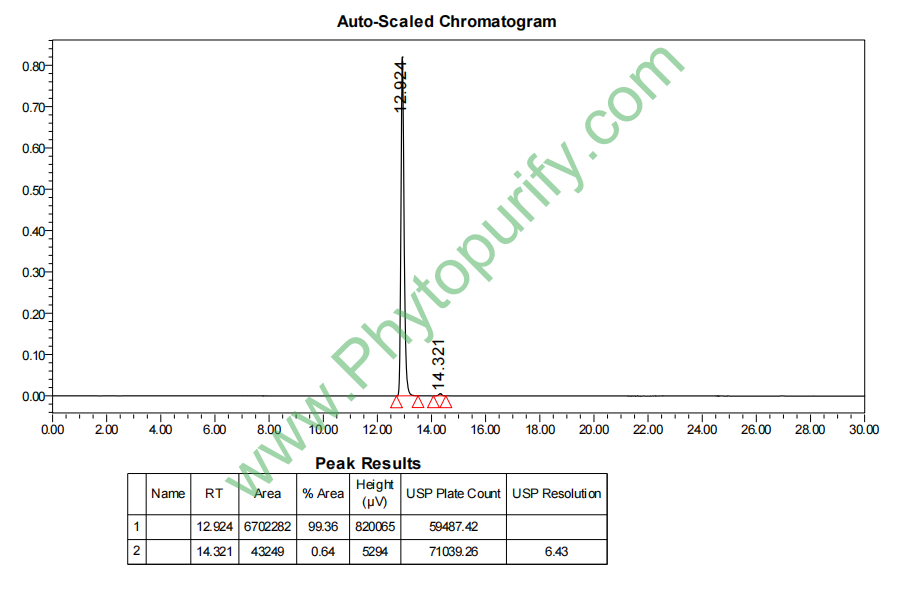
HPLC of Aloin B
Storage conditions:Short-term storage at 2~8℃, long-term storage at -20 ~ -80℃
Aloin B (CAS number: 28371-16-6) is an important natural product, belonging to C-glycosylated anthracene compounds, widely present in plants of the Aloe genus. As one of the representative components of aloin, aloin B has received widespread attention in the field of natural product pharmacology in recent years due to its diverse biological activities and potential medicinal value. It not only has a significant cathartic effect, but also shows multiple pharmacological activities such as anti-inflammatory, anti-tumor, antiviral, etc., especially in the research related to novel coronavirus (SARS-CoV-2), showing potential therapeutic value.
This article will systematically review the chemical structure and physicochemical properties, plant sources and extraction methods, pharmacological activity and mechanism of action, pharmaceutical evaluation and pharmacokinetic characteristics of Aloin B, and discuss its clinical application prospects and future research directions in combination with its target role in cardiovascular disease, inflammation, tumor, COVID-19 and other diseases, so as to provide theoretical basis and scientific guidance for the drug development of this natural product.
Aloe vera glycoside B is a C-glycosyl compound that contains a β - D-glucopyranosyl group in its chemical structure, and its anomeric hydroxyl group is replaced by a 4,5-dihydroxy-2- (hydroxymethyl) -10-oxo-9,10-dihydroanthracene-9-yl moiety (9R diastereomer). Its molecular formula is C21H22O10, with a molecular weight of 434.39, and it belongs to the natural products of phenols, cyclic ketones, and anthracene. The LogP value of aloin B is -0.9, indicating its good hydrophilicity. Its polar surface area (TPSA) is as high as 173.81 Å ², indicating strong molecular polarity. The number of hydrogen bond receptors is 9, suggesting that it may exert biological activity through various hydrogen bond interactions in vivo.
From the perspective of physical and chemical properties, aloin B has low blood-brain barrier permeability, negative liver and cardiac toxicity tests, no significant activity in hERG channel inhibition tests, and negative Ames mutagenicity test results, indicating its high safety and good potential for drug development.
Aloin B is mainly present in plants of the Aloe genus (Aloe vera, etc.), especially in the leaf flesh and bark of aloe vera. As a traditional medicinal plant, aloe is widely used in skin diseases, digestive system diseases and other fields. Its active ingredients include aloe glycoside, aloe vera, aloe gel and other anthraquinone compounds.
The common methods for extracting aloin B include organic solvent extraction, liquid-liquid partitioning, column chromatography separation, etc. The specific steps are usually as follows: first, extract the dried aloe vera leaf powder with ethanol or methanol, then remove impurities through concentration and solvent distribution, and purify it using silica gel column chromatography or high-performance liquid chromatography (HPLC) technology. In recent years, the application of ultrasound assisted extraction and microwave-assisted extraction technologies has improved extraction efficiency and purity, providing technical support for large-scale production.
Aloe vera glycoside B, as a representative component of aloe vera glycosides, has been widely studied for its laxative mechanism. After oral administration, aloin B is broken down by the gut microbiota of rats into aloe emodin 9-anthrone, which is an active metabolite that promotes intestinal peristalsis and water secretion, thereby exerting a laxative effect. This process reflects the prodrug properties of aloin B, which relies on the activation of gut microbiota metabolism.
Aloe vera glycoside B exhibits significant anti-inflammatory activity in various inflammatory models. Research has shown that aloin B can inhibit ear edema and elevated levels of putrescine induced by TPA (12-oxo-13-dehydropalmitate) in mouse skin, and alleviate inflammatory reactions. In addition, aloin B can inhibit tumor promoting effects, indicating its potential preventive and therapeutic value in inflammation related tumor development.
Aloe vera glycoside B, as an oral active inhibitor of SARS-CoV-2 papain like protease (PLpro), exhibits strong enzyme activity inhibition ability. Its IC50 is 16.08 μ M (hydrolytic activity) and 17.51 μ M (de ubiquitination enzyme activity), respectively, indicating that Aloin B can block the viral replication process by inhibiting the viral protease activity, and has the potential to develop therapeutic drugs for COVID-19.
Aloin B and its related aloe ingredients also showed the effect of improving intestinal inflammation, especially in the rat model of ulcerative colitis induced by 3% dextran sodium sulfate (DSS). Aloin, aloe vera and aloe gel can reduce intestinal inflammation, of which aloe vera has the most significant effect. In addition, aloin stimulates alpha adrenergic receptors, causing melanin aggregation and brightening of the skin, demonstrating its potential application value in skin pathological regulation.
The multiple pharmacological activities of aloin B are closely related to its action on multiple molecular targets. Its mechanism of action in anti-inflammatory, anti-tumor, antiviral, and cardiovascular diseases mainly involves the following aspects:
Aloe vera glycoside B inhibits the TPA induced inflammatory signaling pathway, reduces the release of pro-inflammatory cytokines, lowers levels of putrescine, and thus alleviates inflammatory responses. The inhibition of its tumor promoting effect may be related to the regulation of cell proliferation, apoptosis, and oxidative stress-related signaling pathways.
Aloe vera glycoside B inhibits SARS-CoV-2 papain like protease PLpro, blocking the processing and deubiquitination of viral proteins, and inhibiting virus replication. In addition, the highly polar structure of aloin B may enhance its binding affinity with enzyme active sites and improve its inhibitory effect.
The potential targets of aloin B in cardiovascular disease include AMPK(PRKAA1)、BACE1、PTPN1、ESR2、APEX1、PRKCA、AKR1B1、SELP、NFE2L2 And SHBG, etc. These targets involve energy metabolism regulation, oxidative stress response, inflammation regulation, and vascular function maintenance. Aloe vera glycoside B may exert cardiovascular protection and slow down disease progression by regulating the aforementioned targets.
Aloe vera glycoside B is metabolized by the gut microbiota into active metabolites, reflecting its intestinal dependence on pharmacological effects. The gut microbiota not only participates in the realization of laxative effects, but may also affect its other pharmacological activities, indicating that the efficacy of aloin B is closely related to the gut microbiota environment.
The pharmacological evaluation of aloin B shows that it has good safety and drug compatibility. The molecular weight is 434.39, belonging to the category of medium molecular weight compounds, with a LogP value of -0.9, indicating good water solubility and favorable oral absorption. A high TPSA value (173.81 Å ²) suggests strong polarity, which may limit its passage through the blood-brain barrier and reduce central nervous system side effects.
In toxicology assessment, aloin B did not exhibit hepatotoxicity, cardiotoxicity, or hERG channel inhibition, and the Ames mutagenicity test result was negative, indicating a low risk of genetic toxicity. The low permeability of the blood-brain barrier suggests that it mainly acts on peripheral targets, reducing the risk of central toxicity.
In terms of pharmacokinetics, aloe vera glycoside B can be metabolized into active metabolites by gut microbiota after oral administration, indicating that its metabolism in vivo depends on the gut microbiota environment. Further systematic research is needed on its absorption, distribution, metabolism, and excretion (ADME) characteristics to clarify its in vivo dynamic behavior and dosage optimization plan.
Aloe vera glycoside B has shown broad clinical application prospects due to its multi-target and multi mechanism pharmacological activities. Its laxative effect makes it potentially valuable in the field of constipation treatment, and its activation of intestinal microbiota metabolism provides new ideas for the treatment of intestinal diseases. Anti inflammatory and anti-tumor activities provide potential drug candidates for its use in the adjuvant therapy of inflammatory diseases and tumors.
The potential application of Aloin B in COVID-19 infection deserves special attention. As an effective inhibitor of SARS-CoV-2 PLpro, Aloin B may become an important lead compound in the development of anti COVID-19 drugs. In the future, in-depth research on its antiviral mechanism should be strengthened, and its efficacy and safety should be verified through preclinical animal models.
In addition, the regulation of cardiovascular disease-related targets by aloin B suggests its potential application in cardiovascular protection. By regulating key molecules such as AMPK and NFE2L2, aloin B may improve cardiovascular metabolic disorders and oxidative stress, slowing down disease progression.
Future research should focus on the pharmacokinetic optimization, formulation development, and clinical safety evaluation of aloin B, combined with modern drug design techniques to enhance its bioavailability and targeting, and promote its clinical translation.
Aloe vera glycoside B, as a structurally unique C-glycosylated anthracene natural product, has become a hot topic in natural product pharmacology research due to its diverse pharmacological activities and good safety. It shows wide application potential in the fields of cathartic, anti-inflammatory, anti-tumor and anti-virus, especially in the prevention and treatment of COVID-19.
In the future, efforts should be made to strengthen the analysis of the mechanism of action, pharmacokinetic studies, and preclinical evaluations of aloin B, in order to promote its translation into clinical drug development. Combining modern molecular pharmacology and medicinal chemistry methods, aloin B is expected to become an important candidate in the development of natural product drugs, providing new therapeutic strategies for the prevention and treatment of related diseases.
