


Synonym name:
Catalogue No.: BP0147
Cas No.: 33037-46-6
Formula: C21H20O10
Mol Weight: 432.381
Botanical Source: Found in Chinese rhubarb (Rheum palmatum), cascara sagrada (Rhamnus purshiana) and Alexandria senna (Cassia acutifolia)
Purity: 95%~99%
Analysis Method: HPLC-DAD or/and HPLC-ELSD
Identification Method: Mass, NMR
Packing: Brown vial or HDPE plastic bottle
Can be supplied from milligrams to grams.
For Reference Standard and R&D, Not for Human Use Directly.
Inquire for bulk scale.
HPLC of Aloe-emodin-8-O-beta-D-glucopyranoside
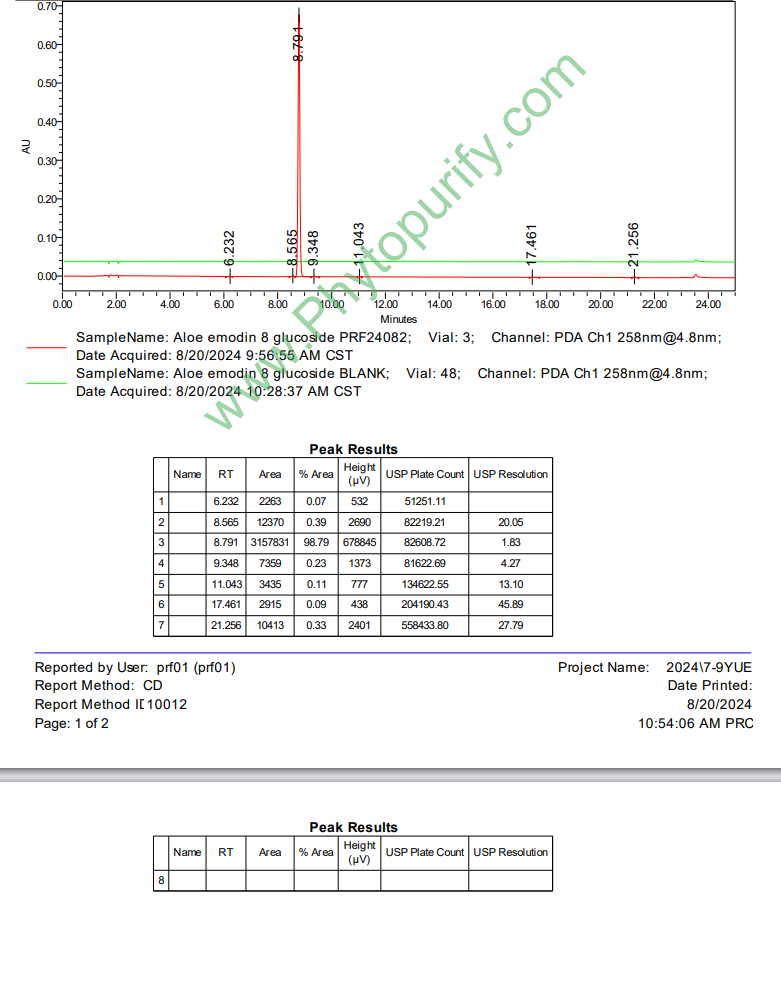
Storage conditions:Short-term storage at 2~8℃, long-term storage at -20 ~ -80℃
Aloe emodin-8-O-beta-D-glucopyranoside (CAS number: 33037-46-6) is a natural anthraquinone glycoside compound mainly isolated from the plant Saussurea lappa. As a glycoside derivative of aloe emodin, this compound has attracted widespread attention in the field of natural product pharmacology. In recent years, with the continuous increase of incidence rate of type 2 diabetes (T2DM), the development of inhibitors targeting its key regulatory target protein tyrosine phosphatase 1B (PTP1B) has become a hot spot in the treatment of diabetes. Aloe emodin 8-O-glucoside, as a mild hPTP1B inhibitor, exhibits potential pharmacological activity and application value.
This article provides a systematic review of the chemical structure and physicochemical properties, plant sources and extraction methods, pharmacological activity, mechanism of action and molecular targets, pharmacological evaluation and pharmacokinetic characteristics of aloe emodin 8-O-glucoside. Finally, it explores its clinical application prospects and future research directions, aiming to provide scientific basis and theoretical support for the drug development of this natural product.
Aloe emodin 8-O-glucoside is a glycoside derivative of anthraquinone compounds, with a molecular formula of C21H24O10 and a molecular weight of 432.37. Its core structure is connected by an O-glycosidic bond formed by the 8-hydroxyl group between aloe emodin and β - D-glucose. This structure endows it with high polarity and water solubility, with a large molecular surface area and a polar surface area (TPSA) of 194.27 Å ². The number of hydrogen bond acceptors reaches 10, indicating its strong ability to form hydrogen bonds.
In terms of physicochemical properties, the LogP value of aloe emodin 8-O-glucoside is -0.56, indicating its strong hydrophilicity, which may affect its cell membrane permeability and bioavailability. Its blood-brain barrier penetration is low, indicating limited distribution in the central nervous system. There is currently no clear data on its safety indicators such as liver toxicity, cardiac toxicity (including hERG channel inhibition), and genotoxicity (Ames test), and further research is needed.
The glycosylation modification of molecular structure not only improves the water solubility of aloe emodin, but also may affect its binding affinity and metabolic stability with target proteins, providing a basis for its pharmacological activity.
Aloe emodin 8-O-glucoside is mainly isolated from the Asteraceae plant Saussurea lappa. Saussurea lappa is a perennial herbaceous plant widely distributed in some parts of Asia. It is traditionally used in traditional Chinese medicine and has various pharmacological effects such as anti-inflammatory, anti-tumor, and metabolic regulation.
The extraction process usually uses dried plant roots and rhizomes as raw materials, first leached with polar solvents such as ethanol or methanol, and then separated and purified by liquid-liquid distribution, column chromatography (such as silica gel column chromatography, reverse phase C18 column chromatography), and other methods. The combination of high-performance liquid chromatography (HPLC) and mass spectrometry (MS) is commonly used for qualitative and quantitative analysis of compounds.
In recent years, green extraction technologies such as ultrasound assisted extraction and microwave-assisted extraction have gradually been applied to the separation of natural products, improving extraction efficiency and purity, providing technical support for the large-scale preparation of aloe emodin 8-O-glucoside.
Aloe emodin 8-O-glucoside showed moderate inhibitory activity against human protein tyrosine phosphatase 1B (hPTP1B) in vitro, with an IC50 value of 26.6 μ M. PTP1B is an important negative regulator of insulin signaling pathway. It inhibits the activity of insulin receptor and its substrate through dephosphorylation, leading to blocked insulin signaling, and is a key target of type 2 diabetes and obesity related insulin resistance.
In addition, aloe emodin 8-O-glucoside has potential regulatory effects on other metabolic disease-related targets such as AMPK (5 'AMP activated protein kinase), GCK (glucokinase), MCL1 (anti apoptotic protein), APP (amyloid precursor protein), AKR1B1 (aldose reductase), NFE2L2 (nuclear factor erythroid 2 related factor 2), etc., suggesting that it may regulate metabolic balance through multi-target synergistic regulation.
Previous studies have shown that this compound can improve insulin sensitivity, inhibit inflammatory responses, alleviate oxidative stress, and have certain metabolic protective effects in cell models. However, there is still a lack of in vivo pharmacological evaluation and long-term safety data, and further animal experiments and preclinical studies are urgently needed.
The main mechanism of action of aloe emodin 8-O-glucoside is focused on the inhibition of hPTP1B. PTP1B negatively regulates insulin receptor (IR) and its substrate IRS (insulin receptor substrate) through dephosphorylation, leading to obstruction of the insulin signaling pathway and triggering insulin resistance. Aloe emodin 8-O-glucoside inhibits the enzymatic activity of PTP1B by binding to its active site, enhances insulin signaling, and helps improve glucose metabolism disorders.
In addition, the compound may activate the AMPK signaling pathway, which acts as a cellular energy sensor to regulate glucose and lipid metabolism and energy balance. Its activation helps to improve insulin sensitivity and promote fatty acid oxidation. The regulation of aloe emodin -8-O-glucoside on AMPK provides a molecular basis for its anti diabetes potential.
Other targets such as GCK participate in glucose phosphorylation and are important enzymes for glucose sensing in pancreatic beta cells; MCL1 regulates cell apoptosis and may affect the survival of pancreatic beta cells; NFE2L2 regulates antioxidant response and alleviates oxidative stress damage. Aloe emodin 8-O-glucoside synergistically improves metabolic function through multi-target action, reflecting its complex pharmacological network.
Molecular docking and dynamic simulation studies have shown that the glycoside portion of the compound binds to key residues of PTP1B through hydrogen bonding, enhancing binding stability and suggesting that glycosylation modification has a significant impact on its activity.
From the perspective of medicinal properties, the molecular weight of aloe emodin 8-O-glucoside is 432.37, slightly higher than the ideal range recommended by Lipinski's rule (<500), but its high polar surface area (TPSA=194.27) and number of hydrogen bond receptors (10) may limit its oral bioavailability and cell membrane permeability.
The LogP value is -0.56, indicating its strong hydrophilicity, which is beneficial for dissolution and transport in the blood, but may reduce its ability to penetrate lipid membranes. The low permeability of the blood-brain barrier reduces the risk of central nervous system side effects, but also limits its potential application in neurometabolic diseases.
At present, there is a lack of detailed pharmacokinetic (PK) data for this compound, including absorption, distribution, metabolism, and excretion (ADME) characteristics. Due to its glycosidic structure, it may be hydrolyzed by glycosidase in the intestine, affecting the in vivo concentration and duration of its bioactive form.
In terms of safety, there is no clear data on liver toxicity, cardiac toxicity (hERG inhibition), and genotoxicity, and a systematic toxicological evaluation is needed. In the future, through structural optimization such as glycosylation or lipidation modification, its pharmacokinetic properties and safety may be improved.
Aloe emodin-8-O-glucoside, as a natural hPTP1B inhibitor, has the potential to be developed as an adjuvant therapy for type 2 diabetes. Its multi-target regulatory effect not only helps to improve insulin resistance, but also may slow down the progress of diabetes complications through anti-inflammatory and antioxidant mechanisms.
Currently, the development of small molecule inhibitors targeting PTP1B faces issues of poor selectivity, low bioavailability, and toxicity. The natural product background and mild activity of aloe emodin 8-O-glucoside provide it with unique advantages. By combining modern drug design techniques such as molecular modification and nanocarrier delivery, it is expected to overcome the limitations of drug development.
Future research should focus on:
In addition, considering its low blood-brain barrier permeability, aloe emodin 8-O-glucoside may be suitable for development as a peripheral metabolic regulator to reduce the risk of central nervous system side effects.
Aloe emodin-8-O-glucoside, as a natural anthraquinone glycoside isolated from Saussurea lappa, shows moderate inhibitory activity and multi-target regulatory potential on human protein tyrosine phosphatase 1B, and has significant anti diabetes pharmacological value. Its unique chemical structure endows it with good water solubility and multiple mechanisms of action, but its drug properties and pharmacokinetic characteristics still require systematic research and optimization.
In the future, through interdisciplinary cooperation, combined with modern pharmaceutical chemistry, molecular biology and pharmacology, it is expected to promote the transformation of aloe emodin-8-O-glucoside into clinical application, and provide new natural drug resources and strategies for the treatment of type 2 diabetes and related metabolic diseases.
