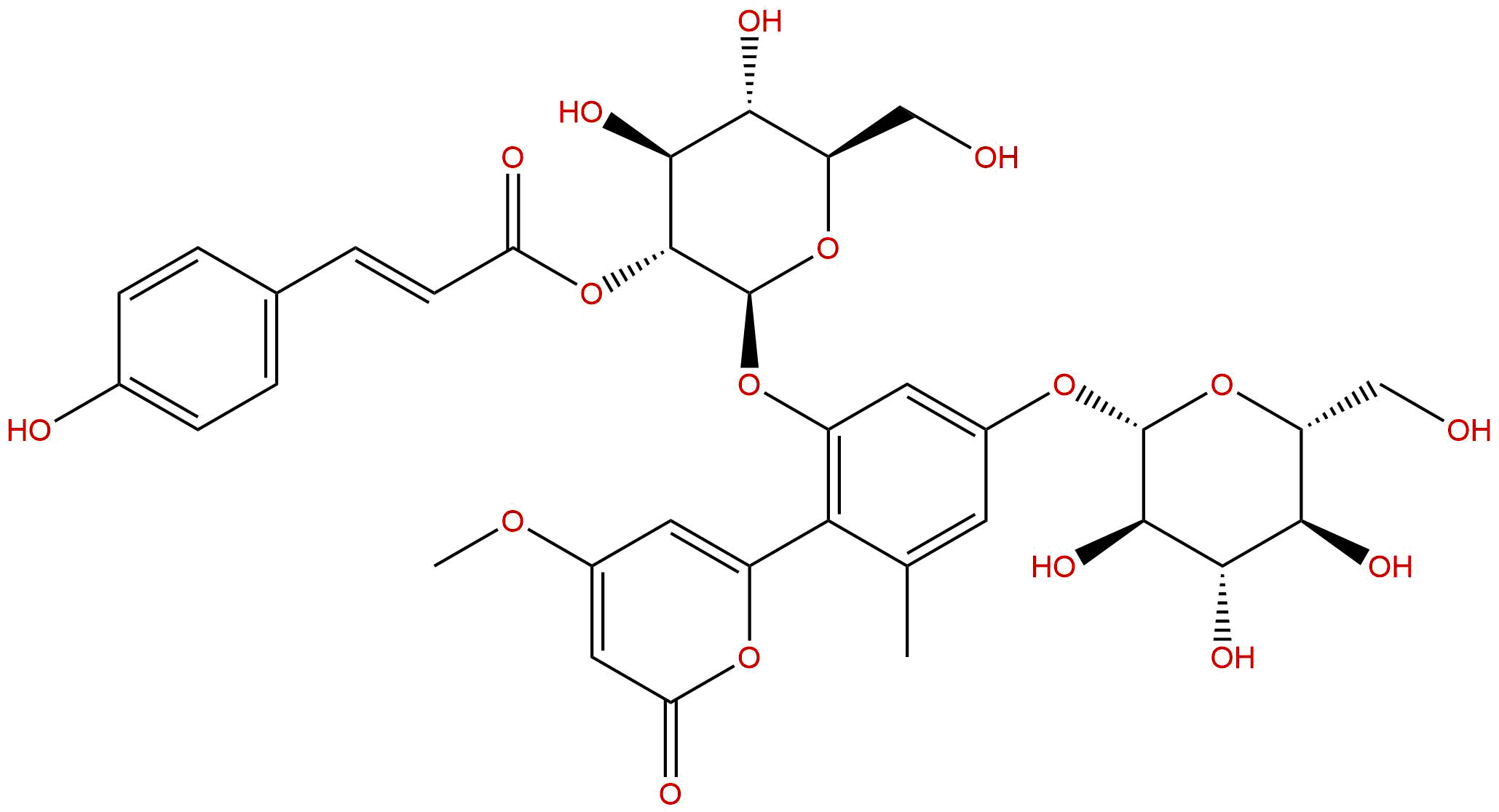
Storage conditions:Short-term storage at 2~8℃, long-term storage at -20 ~ -80℃
Aloe plants have long been of great concern to the scientific community due to their rich bioactive components and extensive medicinal value. Aloenin B, as a natural product extracted from the leaves and roots of Aloe hijazensis, has gradually become a research hotspot in recent years due to its potential anti-tumor activity. Aloe Vera B has a large molecular weight, complex structure, and multiple biological functions, especially in regulating tumor related signaling pathways. This article provides a systematic review of the chemical structure, physicochemical properties, plant sources, and extraction methods of Aloe Vera Ning B. It delves into its pharmacological activity and mechanism of action, evaluates its pharmacological properties and pharmacokinetic characteristics, and looks forward to its clinical application potential, in order to provide theoretical basis and reference for research and development in related fields.
Aloe Ning B (CAS number: 106533-41-9) is a natural product with a complex glycosidic structure, with a molecular weight of 718.6610 and a LogP value of 0.2422, indicating its strong hydrophilicity. Its topological polar surface area (TPSA) is as high as 264.5, indicating that the molecule contains a large number of polar groups, which may affect its cell membrane permeability and bioavailability. The water solubility is 1.0691, indicating that the compound has good solubility in water, which is of positive significance for the preparation of oral and injectable formulations. The low permeability of the blood-brain barrier suggests its limited distribution in the central nervous system. The negative result of hERG channel inhibition experiment indicates a low risk of cardiac toxicity. The Ames mutagenicity test result was 0.0, indicating that the compound has no significant genetic toxicity risk.
From a chemical structure perspective, Aloe Vera B belongs to the anthraquinone derivatives, containing multiple hydroxyl and glycosidic groups. These structural features endow it with excellent biological activity and the ability to bind to protein targets. Its complex polysaccharide chain structure not only increases molecular polarity, but may also affect its metabolic stability and pharmacokinetic characteristics.
Aloe Vera B was initially isolated from the leaves and roots of Aloe hijazensis. Aloe hijazensis is an endemic species of the genus Aloe, mainly distributed in specific regions of the Arabian Peninsula. Due to its unique physiological and ecological adaptability, this plant has accumulated abundant secondary metabolites, especially anthraquinone compounds.
During the extraction process, organic solvents such as methanol or ethanol are usually used to leach the dried leaves and roots. After concentration, the extract is separated and purified using various chromatographic techniques such as silica gel column chromatography and reverse phase high performance liquid chromatography (RP-HPLC). The high purity of Aloe Vera B can be structurally identified by means of mass spectrometry (MS), nuclear magnetic resonance (NMR), and infrared spectroscopy (IR). In recent years, emerging technologies such as supercritical fluid extraction and microwave-assisted extraction have also been applied to improve extraction efficiency and purity.
The pharmacological activity research of Aloe Vera B mainly focuses on its anti-tumor effect. Multiple in vitro cell experiments and in vivo animal model studies have shown that Aloe Vera B can significantly inhibit the proliferation of various tumor cells, induce cell apoptosis, and inhibit tumor metastasis.
In vitro, Aloining B showed a dose-dependent cytotoxicity on a variety of tumor cell lines (such as breast cancer, lung cancer, liver cancer and colorectal cancer cells). The mechanism of induced cell apoptosis involves activation of the mitochondrial pathway and death receptor pathway, accompanied by activation of the caspase enzyme family. Aloe Vera B can also inhibit tumor cell migration and invasion, reduce matrix metalloproteinase (MMPs) activity, and block matrix degradation processes in the tumor microenvironment.
In addition, Aloe Vera B exhibits anti-inflammatory and antioxidant potential, which indirectly support its anti-tumor activity. Some studies have also found that it has a regulatory effect on tumor related signaling pathways, indicating its multi-target nature.
The anti-tumor mechanism of Aloe Vera B is complex and diverse, mainly achieved by regulating multiple key molecular targets. Its known targets include MCL1, BCL2, STAT3, MMP2, TOP1, HIF1A, TOP2A, MAPK1, ESR1, and CYP19A1.
In summary, Aloe Vera B exerts its anti-tumor effect through multi-target and multi pathway synergistic effects, demonstrating the unique multi-target pharmacological advantages of natural products.
The pharmacological evaluation of Aloe Vera B shows that it has good safety and potential clinical application value. Its LogP is 0.2422, indicating moderate hydrophilicity of the molecule, which is beneficial for in vivo distribution and absorption. Although a higher TPSA (264.5) may limit its cell membrane permeability, good water solubility (1.0691) facilitates formulation development and in vivo dissolution.
The low permeability of the blood-brain barrier suggests that it is not easily able to enter the central nervous system, reducing the risk of central toxicity. HERG channel inhibition is negative, reducing the possibility of cardiac toxicity such as arrhythmia. A negative Ames test indicates no significant mutagenicity and high safety.
At present, there is limited pharmacokinetic research on Aloe Vera B, and preliminary data suggests that its oral bioavailability is limited, possibly due to its high molecular weight and strong polarity. The metabolic pathway has not been fully elucidated, and it is speculated that it is mainly metabolized through the liver enzyme system, involving members of the CYP450 family. Further systematic pharmacokinetic and toxicological studies are needed in the future to optimize dosing regimens and dosage form design.
Aloe Ning B, as a multi-target anti-tumor natural product, has broad clinical application prospects. It exhibits unique advantages in regulating tumor cell apoptosis, inhibiting tumor metastasis, and regulating the tumor microenvironment, especially suitable for adjuvant therapy of various solid tumors.
Future research should focus on the following aspects:
With the advancement of natural product pharmacology and modern drug development technology, Aloe Vera B is expected to become an important candidate for new anti-tumor drugs.
Aloe Vera B, as a natural product derived from Aloe hijazensis, has shown great potential as a drug due to its unique chemical structure and multi-target anti-tumor activity. Its mechanism of action in regulating tumor related signaling pathways, inducing cell apoptosis, and inhibiting tumor metastasis is becoming increasingly clear, providing new ideas for the development of anti-tumor drugs. Although there are still some challenges in pharmacokinetics and clinical applications, with the optimization of modern medicinal chemistry and formulation methods, Aloe Vera B is expected to be transformed from laboratory to clinical use. Further in-depth research in the future will reveal its pharmacological mechanisms and promote its widespread application in the field of tumor therapy.