


Product name: Aloin(mixture of A&B)
Synonym name: Barbaloin; Socaloin; Ugandaloin; Jafaloin; Cafaloin
Catalogue No.: BP0151
Cas No.: 8015-61-0
Formula: C21H22O9
Mol Weight: 418.398
Botanical Source: Aloe
Physical Description:
Type of Compound: Anthraquinones
Purity: 95%~99%
Analysis Method: HPLC-DAD or/and HPLC-ELSD
Identification Method: Mass, NMR
Packing: Brown vial or HDPE plastic bottle
Storage: Store in a well closed container, protected from air and light. Put into refrigerate or freeze for long term storage.
Whenever possible, you should prepare and use solutions on the same day. However, if you need to make up stock solutions in advance, we recommend that you store the solution as aliquots in tightly sealed vials at -20℃. Generally, these will be useable for up to two weeks.
The product could be supplied from milligrams to grams
Inquire for bulk scale.
Chengdu Biopurify Phytochemicals Ltd. is a leading company in the research, development, manufacture and marketing of High Quality Phytochemicals and Extracts(especially Active Ingredients from Traditional Chinese Medicine,TCM), Natural Active Pharmaceutical Ingredients worldwide.
The main services:
A. Supply active ingredients and reference standards of TCM, from mgs to kgs scale
B. Custom extraction and purification, target Herb Active Ingredients
C. Custom synthesis and semi-synthesis for Natural Active Ingredients
D. CR(contract research), CM(contract manufacture) and PD(process development) services from lab scale, pilot scale to commercial scale(GMP is also available)
E. TCM compounds library for drug screen,more than 3000 compounds available, many of them are rare and unique.
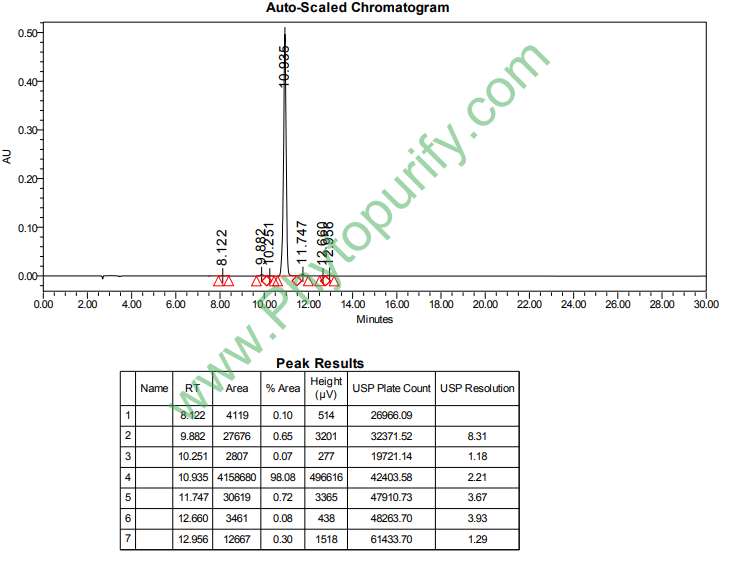
HPLC of Aloin
Storage conditions:Short-term storage at 2~8℃, long-term storage at -20 ~ -80℃
Aloin, also known as aloin, is a natural anthraquinone glycoside found in plants of the Aloe genus. It is mainly composed of two diastereomers, barbaloin A and isobarbaloin B. As one of the main active ingredients in aloe vera leaf exudate, aloin has attracted widespread attention in the field of natural product pharmacology in recent years due to its unique pharmacological activity and diverse biological effects. Its main pharmacological effects include laxative effects, anti-inflammatory effects, anti-tumor effects, bone formation promotion, and neuroprotection, demonstrating good clinical application potential. This article provides a systematic review of the chemical structure, sources and extraction methods, pharmacological activity, mechanism of action, pharmacological evaluation, and clinical application prospects of aloin, aiming to provide theoretical basis and reference for the in-depth research and development of this natural product.
Aloe vera glycoside is an anthraquinone glycoside compound with a molecular formula of C21H22O9 and a molecular weight of 418.39. Its structural feature is that the anthraquinone skeleton is connected to the glucoside part through glycosidic bonds, forming a glycoside structure. Aloe vera glycoside is composed of a mixture of two diastereomers, aloin A and aloin B. There are differences in spatial configuration between the two, but their physicochemical properties are similar. Its appearance is a yellow brown crystalline powder with a bitter taste.
In terms of physical and chemical properties, the LogP value of aloin is 0.19, indicating its strong hydrophilicity and good water solubility. The polar surface area (TPSA) is 180.64 Å ², and the number of hydrogen bond acceptors is 9, indicating that the molecule has strong polarity and hydrogen bond formation ability. The blood-brain barrier has low permeability and no significant hepatotoxicity, cardiotoxicity, or hERG channel inhibition. The Ames mutagenicity test result is negative, indicating good safety and potential for drug development.
Aloe vera glycoside is mainly present in the leaf exudate of plants in the Aloe genus. It has been detected in at least 68 species of aloe vera plants, with a content of up to 6.6% of the dry weight of leaves, accounting for 3% to 35% of the total exudate. In addition, the content of aloin in 17 aloe vera plants is still unclear. The content of aloin is greatly influenced by factors such as plant species, harvesting time, geographical environment, and extraction process.
Traditional extraction methods often use water or ethanol as solvents to separate aloin from aloe vera leaf exudates through techniques such as cold soaking, hot reflux, and ultrasound assisted extraction. The extract is purified through concentration, precipitation, column chromatography, and other steps to obtain high-purity aloin. Modern extraction techniques such as supercritical fluid extraction and membrane separation have also been applied to improve extraction efficiency and purity. The optimization of extraction process not only affects the yield, but also affects the biological activity and stability of aloin.
Aloe vera glycoside was first widely used in the field of laxatives, as a stimulant laxative that stimulates intestinal peristalsis and promotes water secretion, induces defecation, and treats constipation. The mechanism of its laxative action involves the excitation of intestinal smooth muscle and increased secretion of intestinal fluid, promoting fecal excretion. Both clinical and animal experiments have confirmed that aloin has good laxative effects and high safety.
Aloin and its related aloe ingredients (such as aloe vera and aloe gel) show significant anti-inflammatory activity. Research has shown that aloe vera glycoside can significantly improve the intestinal inflammatory response in a rat model of ulcerative colitis induced by dextran sulfate sodium (DSS), alleviate mucosal damage and inflammatory cell infiltration. Its anti-inflammatory mechanism may be closely related to inhibiting the release of inflammatory factors, regulating immune cell function, and antioxidant effects.
Aloe vera glycoside, as a natural anthraquinone glycoside, exhibits strong anti-tumor activity. In vitro experiments have shown that aloin has significant anti proliferative effects on various tumor cells at physiological concentrations, with an IC50 of approximately 97 μ M. Its mechanism of action includes inducing cell cycle arrest in the S phase, promoting apoptosis, and significantly increasing the apoptosis rate of HeLa S3 cells (up to 24%). In addition, aloin has iron chelation activity and can affect tumor cell metabolism and growth by regulating intracellular iron homeostasis.
In recent years, research has found that aloin can promote osteoblast differentiation and has potential therapeutic value for osteoporosis. Aloe vera glycoside induces MC3T3-E1 cells to differentiate into osteoblasts by activating the MAPK mediated Wnt and Bmp signaling pathways. Alkaline phosphatase (ALP), as an early marker of osteoblast differentiation, showed significantly enhanced activity in the aloin treated group, indicating that aloin can promote bone formation and mineralization processes.
Aloe vera glycoside has also shown great potential in the field of neuroprotection. Research has shown that aloin can alleviate brain edema, reduce blood-brain barrier damage, and improve cortical injury in traumatic brain injury (TBI) models. Its neuroprotective effect may be related to anti-inflammatory, antioxidant, and regulation of apoptosis related signaling pathways, providing new ideas for the treatment of traumatic brain injury.
The multiple pharmacological effects of aloin are based on its complex molecular mechanism and multi-target regulation. Its main mechanism of action includes:
Signal pathway regulation
Aloe vera glycoside activates the MAPK signaling pathway, regulates the Wnt and Bmp signaling pathways, and promotes osteoblast differentiation. This mechanism involves the expression regulation of multiple downstream transcription factors and bone formation related genes.
Cell cycle and apoptosis regulation
Aloe vera glycoside induces tumor cell cycle arrest in the S phase, activates endogenous apoptotic pathways, and increases cell apoptosis rate. It may achieve cell fate regulation by regulating apoptosis related proteins such as BCL2 family proteins and MCL1.
Anti inflammatory and immune regulation
Aloe vera glycoside can inhibit the release of pro-inflammatory cytokines, regulate immune cell activity, and alleviate inflammatory reactions. Related targets include immune regulatory factors such as IDO1 and EHMT2.
Iron ion chelation
The iron chelation ability of aloin helps regulate intracellular iron homeostasis, affecting oxidative stress levels and cellular metabolism, thereby exerting anti-tumor and neuroprotective effects.
Regulation of atherosclerosis related targets
Aloin has shown the potential to regulate key targets such as AMPK (PRKAA1), LOX-1 and ABCA1 in atherosclerosis research, which may slow down pathological progress by improving lipid metabolism and inhibiting inflammatory response.
The pharmacological evaluation of aloin shows that it has good potential for drug development. Its molecular weight is moderate (418.39 Da) and its LogP value is low (0.19), indicating that it has good water solubility and moderate fat solubility, which is beneficial for absorption and distribution in vivo. The high number of TPSA and hydrogen bond receptors suggests strong polarity, which may limit the blood-brain barrier penetration ability, but this is consistent with its local neuroprotective mechanism.
Toxicological evaluation shows that aloin has no significant hepatotoxicity, cardiotoxicity, or hERG channel inhibition effect, and the Ames mutagenicity test is negative, indicating high safety. The low permeability of the blood-brain barrier suggests limited distribution in the central nervous system, but effective targeting can be achieved through local administration or modified formulations.
In terms of pharmacokinetics, existing research is relatively limited. Aloe vera glycoside is absorbed quickly after oral administration, but its bioavailability is limited by gastrointestinal metabolism and first pass effects. Further systematic pharmacokinetic studies are needed in the future, including absorption, distribution, metabolism, and excretion (ADME) characteristics, to guide clinical drug use and formulation design.
Aloe vera glycoside, as a multifunctional natural product, has broad clinical application potential. As a stimulant laxative, it has been widely used in clinical practice and is safe and effective. In the future, the development of aloe vera glycosides in the following fields is worth paying attention to:
Anti inflammatory and intestinal diseases
The improvement effect of aloe vera glycoside on inflammatory bowel diseases such as ulcerative colitis provides a basis for the development of new anti-inflammatory drugs. Combined with modern drug delivery technology, targeted therapy is expected to be achieved.
Antitumor therapy
The pro apoptotic and anti proliferative effects of aloin make it a candidate molecule for natural anti-tumor drugs, especially with potential value in the treatment of solid tumors such as cervical cancer. More in vitro and in vivo mechanism research and preclinical safety evaluation are needed in the future.
Osteoporosis and bone repair
By promoting osteoblast differentiation, aloin has the potential to become an adjuvant therapeutic drug for osteoporosis and fracture repair. By combining biomaterials and tissue engineering technology, functional bone repair and replication agents can be developed.
Neuroprotection and Brain Injury
The protective effect of aloe vera glycoside in traumatic brain injury provides new ideas for the field of neural repair, and in the future, its combined application and formulation optimization with other neuroprotective agents can be explored.
Cosmetics application
The tyrosinase inhibitory activity of aloe vera glycoside makes it an ideal whitening agent for treating hyperpigmentation, and has been applied in various cosmetic formulations with broad market prospects.
Although aloin exhibits multiple biological activities, its clinical application still faces some challenges, including low bioavailability, complex in vivo metabolism, and lack of systematic clinical trial data. Future research should strengthen the systematic evaluation of its pharmacokinetics, toxicology, and clinical efficacy, while exploring structural modifications and novel drug delivery systems to enhance its efficacy and safety.
Aloe vera glycoside, as an important active ingredient in plants of the Aloe genus, has shown great potential for natural medicine development due to its unique chemical structure and diverse pharmacological activities. Its research in the fields of laxatives, anti-inflammatory, anti-tumor, bone formation promotion, and neuroprotection continues to deepen, providing new strategies and ideas for the treatment of related diseases. In the future, combining modern drug development technology and interdisciplinary research, it is expected to promote the transformation of aloe vera glycoside from a natural product to a clinical drug, making greater contributions to human health.
