
| Catalog No | Package | Original Price | Price | Inventory | Quantity | Operating |
|---|---|---|---|---|---|---|
| BP0008-100mg | 100mg | $20.00 | Sign in |
|


Product name: 1,8-Dihydroxyanthraquinone
Synonym name: Chrysazin; Dantron; Danthron; Istizin; Danivac; Dorbane
Catalogue No.: BP0008
Cas No.: 117-10-2
Formula: C14H8O4
Mol Weight: 240.214
Botanical Source:
Physical Description:
Type of Compound: Anthraquinones
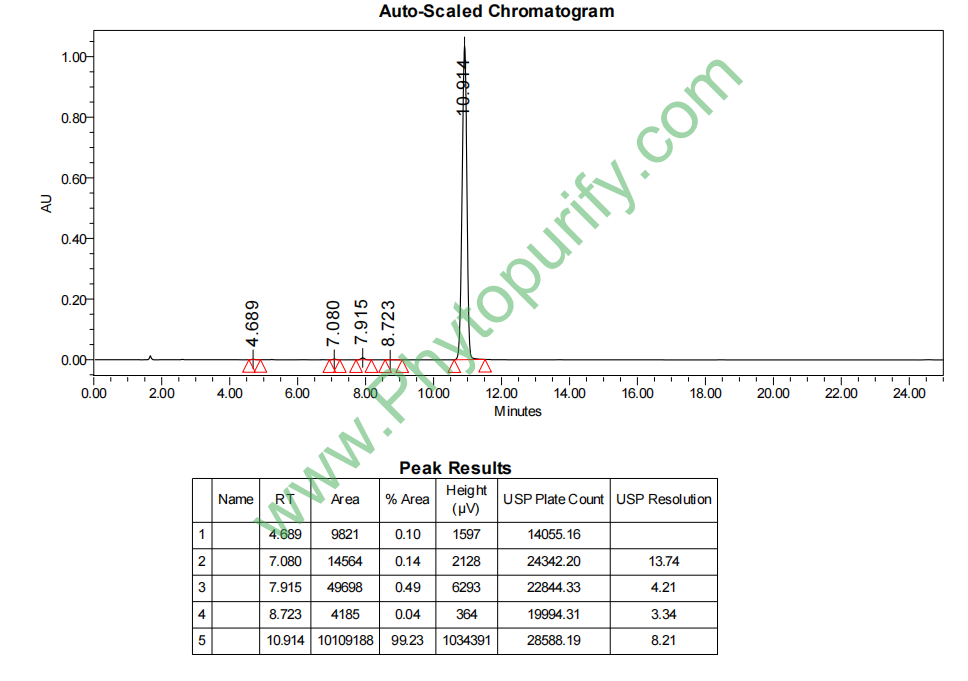
Purity: 95%~99%
Analysis Method: HPLC-DAD or/and HPLC-ELSD
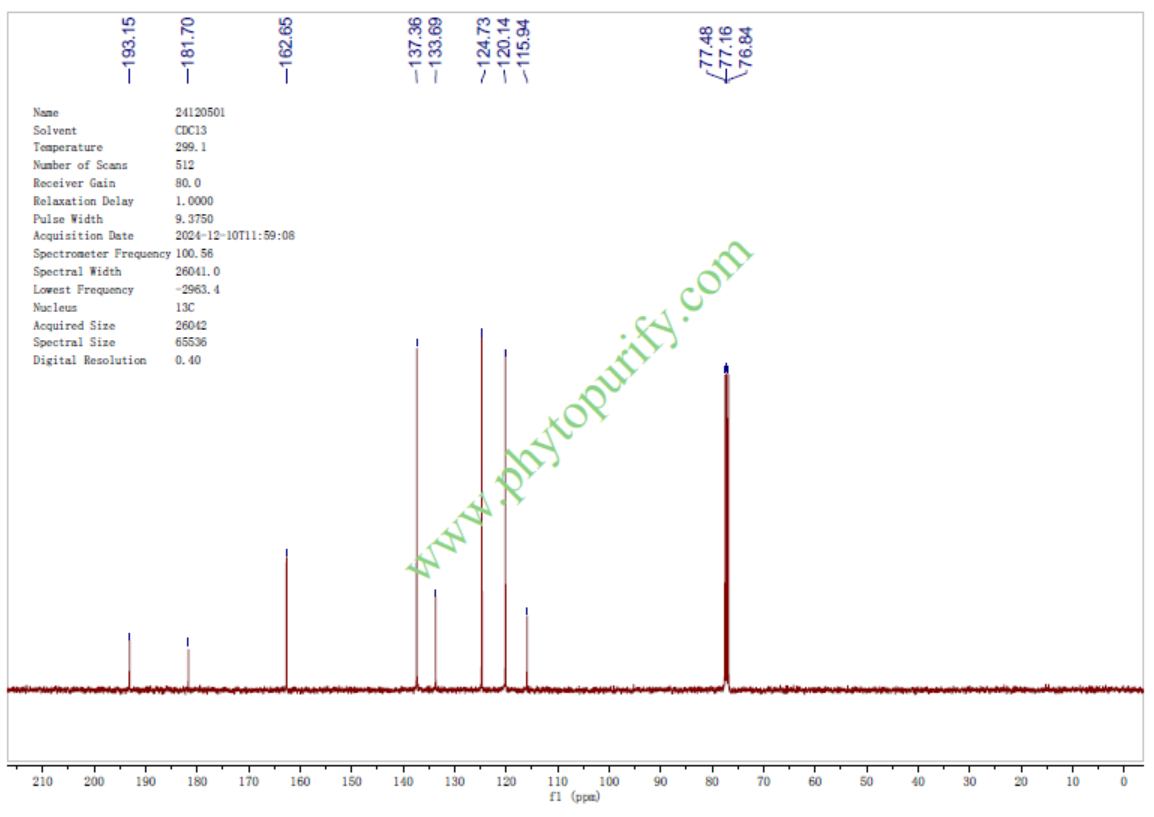
Identification Method: Mass, NMR
Packing: Brown vial or HDPE plastic bottle
Storage: Store in a well closed container, protected from air and light. Put into refrigerate or freeze for long term storage.
Whenever possible, you should prepare and use solutions on the same day. However, if you need to make up stock solutions in advance, we recommend that you store the solution as aliquots in tightly sealed vials at -20℃. Generally, these will be useable for up to two weeks.
The product could be supplied from milligrams to grams
Inquire for bulk scale.
Chengdu Biopurify Phytochemicals Ltd. is a leading company in the research, development, manufacture and marketing of High Quality Phytochemicals and Extracts(especially Active Ingredients from Traditional Chinese Medicine,TCM), Natural Active Pharmaceutical Ingredients worldwide.
The main services:
A. Supply active ingredients and reference standards of TCM, from mgs to kgs scale
B. Custom extraction and purification, target Herb Active Ingredients
C. Custom synthesis and semi-synthesis for Natural Active Ingredients
D. CR(contract research), CM(contract manufacture) and PD(process development) services from lab scale, pilot scale to commercial scale(GMP is also available)
E. TCM compounds library for drug screen,more than 3000 compounds available, many of them are rare and unique.
HPLC of 1,8-Dihydroxyanthraquinone
NMR of 1,8-Dihydroxyanthraquinone
Storage conditions:Short-term storage at 2~8℃, long-term storage at -20 ~ -80℃
74.6000
3.0000
2.8000
Low
Unknown
Unknown
Unknown
Yes
Unknown
Positive
1,8-Dihydroxyanthraquinone (CAS number 117-10-2) is an important natural product and belongs to the dihydroxy derivatives of anthraquinone compounds. Anthraquinone compounds have long been of great interest in pharmacology, natural product chemistry, and drug development due to their diverse biological activities and unique chemical structures. 1,8-Dihydroxyanthraquinone is a derivative of anthracene-9,10-dione formed by substitution of hydroxyl groups at positions 1 and 8. It has significant apoptosis inducing effects and is widely present as a plant metabolite in various plants.
In recent years, with the deepening of research on the molecular mechanisms of tumors, 1,8-dihydroxyanthraquinone has shown potential application value in the field of anti-tumor, especially in the treatment of Hodgkin lymphoma (HL), demonstrating regulatory ability against multiple key molecular targets. This article provides a systematic review of the chemical structure and physicochemical properties, plant sources and extraction methods, pharmacological activity, mechanism of action and molecular targets, pharmacological evaluation and pharmacokinetic characteristics of 1,8-dihydroxyanthraquinone. It also explores its clinical application prospects and future research directions, aiming to provide theoretical basis and research references for the drug development of this natural product.
The molecular formula of 1,8-dihydroxyanthraquinone is C14H8O4, with a molecular weight of 240.21. Its structure is based on the anthracene-9,10-diketone skeleton, with hydroxyl groups introduced at positions 1 and 8 respectively, forming two adjacent hydroxyl substituent groups. This structure endows it with unique chemical properties and biological activity. The molecule contains two carbonyl groups and two hydroxyl groups, which can form hydrogen bonds and enhance its binding ability with biomolecules.
In terms of physical and chemical properties, the LogP value of 1,8-dihydroxyanthraquinone is about 3.0, indicating its moderate lipid solubility, which is beneficial for membrane penetration. The polar surface area (TPSA) is 74.6 Å ², indicating that it has certain water solubility and polarity characteristics in living organisms. The molecule contains four hydrogen bond receptors, which increase its binding potential with the target protein. The low permeability of the blood-brain barrier suggests limited distribution in the central nervous system.
In addition, 1,8-dihydroxyanthraquinone exhibits good tolerance in terms of chemical stability, but it may undergo structural changes under light and oxidation conditions, which should be taken into account during storage and application. Its Ames test is positive, indicating a certain risk of genotoxicity, and its safety needs to be evaluated during the drug development process.
1,8-dihydroxyanthraquinone is widely present in various plants, especially in the roots, stems, and leaves of some traditional medicinal plants. Typical plant sources include Rheum spp., Polygonum multiflorum, Polygonaceae plants, etc. These plants are used in traditional Chinese medicine to treat inflammation, tumors, and liver diseases.
The extraction method mainly adopts organic solvent extraction combined with chromatographic separation technology. Common extraction solvents include ethanol, methanol, ethyl acetate, etc., which can effectively dissolve anthraquinone compounds. The extraction process generally includes the following steps:
In recent years, the application of ultrasound assisted extraction and microwave-assisted extraction technologies has improved extraction efficiency and purity, reduced solvent usage and extraction time, and promoted the industrial production process of 1,8-dihydroxyanthraquinone.
The pharmacological activities of 1,8-dihydroxyanthraquinone are mainly reflected in its anti-tumor, anti-inflammatory, and antioxidant properties. Numerous in vitro cell experiments and some animal model studies have shown that this compound can effectively induce tumor cell apoptosis, inhibit cell proliferation, and exhibit selective toxicity to multiple tumor types.
In Hodgkin's lymphoma cell lines, 1,8-dihydroxyanthraquinone significantly inhibits tumor cell growth by regulating cell cycle proteins and apoptosis related proteins. Its mechanism of action involves multiple signaling pathways, including inhibition of the STAT3 signaling pathway and downregulation of the anti apoptotic protein MCL1. In addition, the compound can induce mitochondrial membrane potential loss, activate the caspase family, and promote cell apoptosis.
1,8-dihydroxyanthraquinone exhibits the ability to inhibit the release of inflammatory factors, reduce the generation of oxygen free radicals, and protect cells from oxidative stress damage in an inflammatory model. These effects lay the foundation for its potential application in chronic inflammation related diseases.
Some studies have indicated that 1,8-dihydroxyanthraquinone also has the potential to regulate neurotransmitter metabolism and may affect nervous system function by regulating targets such as MAOA, but related research is still in its preliminary stage.
The mechanism of action of 1,8-dihydroxyanthraquinone in anti Hodgkin lymphoma involves multiple key molecular targets, as follows:
BLM (Bloom Syndrome Protein)As a DNA helicase, BLM is involved in DNA repair and genome stability. 1,8-dihydroxyanthraquinone may affect the DNA repair ability of tumor cells and increase their sensitivity to DNA damage by regulating BLM activity.
MCL1(Myeloid Cell Leukemia 1)Anti apoptotic proteins regulate cell survival. This compound can downregulate MCL1 expression and promote cell apoptosis.
CDC25A/CDC25B (cell cycle phosphatase)Regulating the progression of the cell cycle. 1,8-dihydroxyanthraquinone inhibits the activity of CDC25A and CDC25B, blocks the cell cycle, and suppresses tumor cell proliferation.
PTPN1 (protein tyrosine phosphatase 1B)Participate in signal transduction regulation. Its regulation helps to regulate cellular metabolism and apoptosis pathways.
STAT3 (Signal Transduction and Transcription Activation Factor 3)Key transcription factors that promote tumor growth and immune escape. 1,8-dihydroxyanthraquinone inhibits the phosphorylation and activation of STAT3, blocking its downstream tumorigenic signals.
MAOA (monoamine oxidase A)Regulating neurotransmitter metabolism may affect the tumor microenvironment.
ESR2 (estrogen receptor beta)Regulating cell proliferation and apoptosis, 1,8-dihydroxyanthraquinone may play a role by modulating the ESR2 mediated signaling pathway.
TOP1 (Topoisomerase I)Inhibitors targeting TOP1 involved in DNA topology regulation have been used in the development of anti-tumor drugs.
Through multiple regulation of the aforementioned targets, 1,8-dihydroxyanthraquinone has achieved a comprehensive inhibitory effect on tumor cells, demonstrating multi-target and multi pathway anti-tumor potential.
The evaluation of drug properties is a crucial step in the development of natural product drugs. The molecular weight of 1,8-dihydroxyanthraquinone is 240.21, which meets the molecular weight requirements in Lipinski's rule; The LogP value is 3.0, indicating that it has suitable lipid solubility, which is beneficial for the oral absorption of the drug. The TPSA is 74.6 Å ², indicating that its polarity is moderate and conducive to membrane penetration.
The number of hydrogen bond receptors is 4, which meets the requirement for drug molecules to bind to target proteins. The low permeability of the blood-brain barrier suggests its limited distribution in the central nervous system, which may reduce the risk of central nervous system toxicity, but limits its application in neurological diseases.
In terms of safety, the Ames test for 1,8-dihydroxyanthraquinone showed a positive result, indicating potential genotoxicity, which needs to be further validated through in vivo toxicology tests and long-term safety assessments. The key safety indicators such as hepatotoxicity, cardiotoxicity, and hERG inhibition are not yet clear, and future research needs to focus on them.
In terms of pharmacokinetics, the relevant data is currently limited. Preliminary in vitro metabolic studies have shown that the compound may be metabolized by the liver cytochrome P450 enzyme system, exhibiting a certain first pass effect. The parameters such as bioavailability, distribution volume, and clearance rate still need to be systematically studied to guide clinical dose design and optimize dosing regimens.
1,8-dihydroxyanthraquinone, as a natural product with multi-target anti-tumor activity, has shown great potential for application, especially in the treatment of Hodgkin lymphoma. It provides a new therapeutic strategy by regulating tumor cell proliferation, apoptosis, and signaling pathways. Combining existing chemotherapy regimens, 1,8-dihydroxyanthraquinone is expected to be used as an adjuvant or combination therapy to improve treatment efficacy and reduce the occurrence of drug resistance.
However, clinical translation still faces many challenges. Firstly, the risk of genotoxicity needs to be reduced through systematic safety assessment and structural modification; Secondly, the incomplete pharmacokinetic properties limit the development of dosage forms and the diversification of administration methods; In addition, the lack of systematic preclinical animal models and clinical trial data limits its clinical promotion.
Future research directions should include:
Through interdisciplinary collaboration, 1,8-dihydroxyanthraquinone is expected to become an important candidate for the next generation of natural product anti-tumor drugs.
In summary, 1,8-dihydroxyanthraquinone, as a natural product with unique structure and significant activity, has shown broad application prospects in the field of anti-tumor treatment, especially in the treatment of Hodgkin lymphoma. Its multi-target and multi mechanism mode of action provides new ideas for tumor treatment. However, the issues of drug formulation and safety still require further research, and the lack of pharmacokinetic data limits the clinical translation process. In the future, we should strengthen structural optimization, mechanism research, and preclinical evaluation to promote its clinical application. The development of 1,8-dihydroxyanthraquinone not only enriches the research content of natural product pharmacology, but also provides new opportunities for the innovation of cancer treatment drugs.
