


Product name: Aloe emodin
Synonym name: Rhabarberone
Catalogue No.: BP0146
Cas No.: 481-72-1
Formula: C15H10O5
Mol Weight: 270.24
Botanical Source: Found in aloes, also bark of cascara sagrada, in Cassia alata, Rhamnus purshiana, Rhamnus alaternus, Rheum palmatum, Rheum undulatum, Rumex orientalis, Asphodelus microcarpus, Asphodelus fistulosus, Xanthorrhoea australis and Oroxylum indicum
Physical Description: Powder
Type of Compound: Anthraquinones
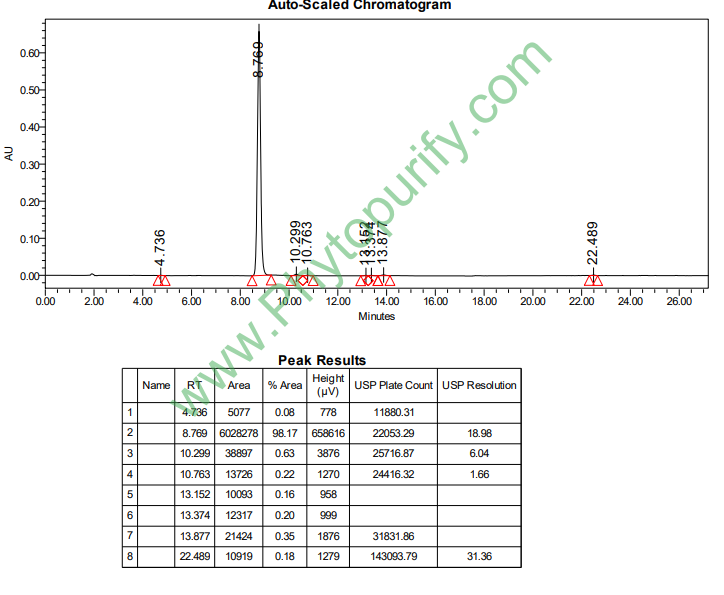
Purity: 95%~99%
Analysis Method: HPLC-DAD or/and HPLC-ELSD
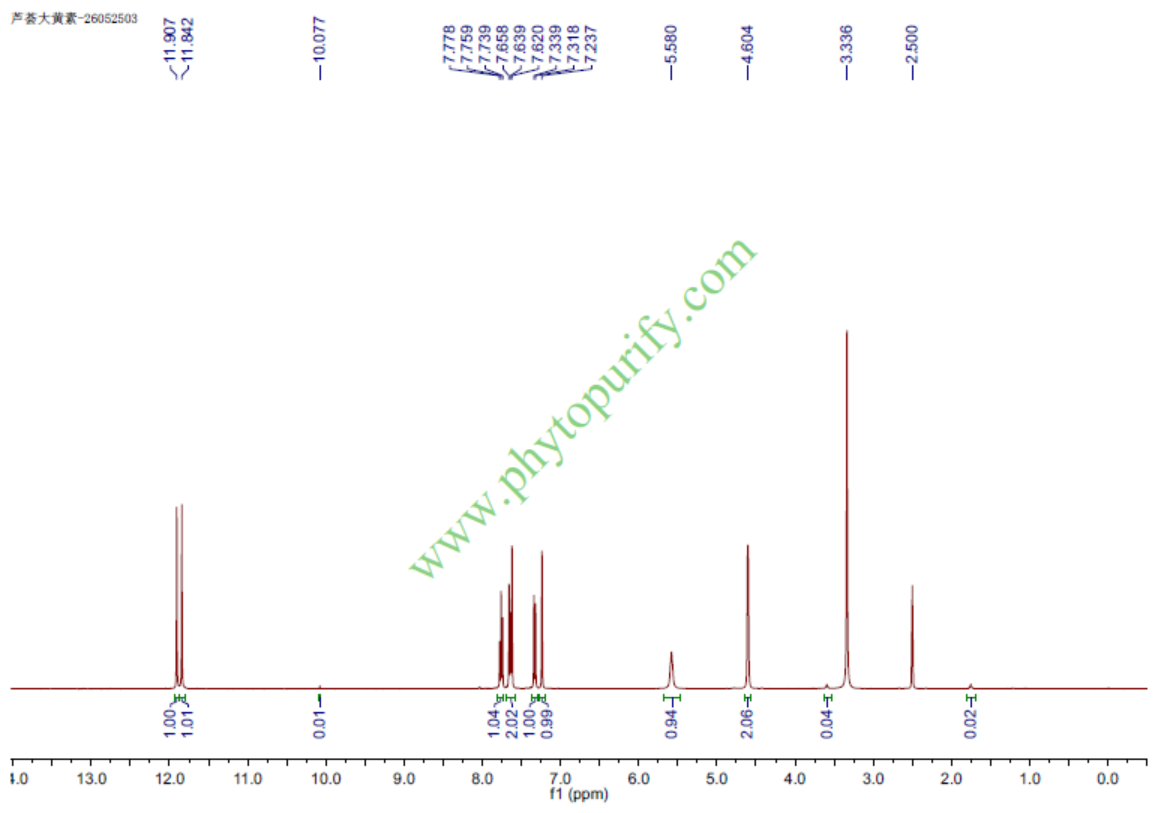
Identification Method: Mass, NMR
Packing: Brown vial or HDPE plastic bottle
Storage: Store in a well closed container, protected from air and light. Put into refrigerate or freeze for long term storage.
Whenever possible, you should prepare and use solutions on the same day. However, if you need to make up stock solutions in advance, we recommend that you store the solution as aliquots in tightly sealed vials at -20℃. Generally, these will be useable for up to two weeks.
The product could be supplied from milligrams to grams, up to kilograms
Inquire for bulk scale.
Descriptions:
Aloeemodin is able to interact with DNA under certain in vitro conditions, however, in vivo it is negative did not indicate a genotoxic potential, thus, it may be assumed that a genotoxic risk for man might be unlikely.[1]
Aloeemodin has inhibition of β-amyloid aggregation, and has neuroprotective effect on primary hippocampal cells against β-amyloid induced toxicity.[2]
Aloeemodin has anti-fibrotic effects, perhaps through downregulation of the expression of Smad2 mRNA and TGF-β1,TIMP1,and type Ⅰ and Ⅲ collagen proteins,and upregulation of the expression of Smad7 mRNA.[3]
Aloeemodin might have therapeutic effects on liver fibrosis induced by Schistosoma of liver through the effects of TGF-β1,VEGF and FAK expression.[4]
Aloeemodin can suppress the proliferation of HGC-27 cell to induce apoptosis and block cell cycle.[5]
References:
[1] Heidemann A, V?lkner W, Mengs U. Mutation Research/fundamental & Molecular Mechanisms of Mutagenesis, 1996, 367(3):123-33.
[2] Ho S L, Poon C Y, Lin C, et al. Current Alzheimer Research, 2015, 12(5):424-33.
[3] Wu Y Y, He S S. World Chinese Journal of Digestology, 2009, 17(27):2778-83.
[4] Dan X U, Zhou W, Hong-Gang Y U. Chinese Journal of Integrated Traditional & Western Medicine on Liver Diseases, 2012, 22(02):107-9.
[5] Nan J, Qin Y X, Liu J, et al. J Modern Oncol, 2008, 16(06):919-21.
[6]Chen C S, Sang X F. Chinese Journal of Health Laboratory Technology, 2011(05):1088-9.
HPLC of Aloe emodin
HNMR of Aloe emodin
Storage conditions:Short-term storage at 2~8℃, long-term storage at -20 ~ -80℃
94.8300
2.0062
1.7283
.1676
4.1347
3.2479
Low
86.9991
2.3104
Yes
No
No
No
Yes
Yes
1.5
Yes
No
Yes
No
Natural products, as an important treasure trove for drug discovery and development, play an irreplaceable role in the long history of human fight against diseases. Among them, anthraquinone compounds have attracted much attention due to their wide range of biological activities. Aloe emodin (AE), chemical name 1,8-dihydroxy-3- (hydroxymethyl) anthraquinone, CAS number 481-72-1, is a typical natural product of dihydroxyanthraquinone. It was originally isolated from the traditional medicinal plant Aloe vera L. and is also widely present in various Polygonaceae and leguminous plants such as rhubarb and cassia seed. In history, plants containing aloe vera emodin were often used for diarrhea, heat clearing, and detoxification. With the deepening of modern pharmacological research, its role has shifted from traditional laxative components to lead compounds with significant anti-tumor, antiviral, anti-inflammatory, and antibacterial activities, especially showing great potential in the field of anti-tumor. This article aims to systematically review the chemical properties, plant sources, pharmacological activities, molecular mechanisms of action, pharmacological evaluation, and clinical application prospects of aloe emodin, in order to provide comprehensive scientific references for the in-depth research and development of this compound.
The molecular formula of aloe emodin is C15H10O5, with a molecular weight of 270.24 g/mol. Its basic skeleton is anthraquinone (9,10-anthraquinone), with two phenolic hydroxyl groups at positions 1 and 8, and one hydroxymethyl group (- CH2OH) at position 3. This structure makes it a derivative of hydroxyanthraquinone, closely related in function to 1,8-dihydroxyanthraquinone (Chrysazine).
Its physicochemical properties profoundly affect its biological activity and pharmacokinetic behavior. Aloe emodin appears as orange yellow needle shaped crystals or powder. Its lipid water partition coefficient (LogP) is about 2.01, indicating that it has moderate lipophilicity and is conducive to transmembrane transport. The topological polar surface area (TPSA) is 94.83 Å ², reflecting the presence of polar groups (hydroxyl and carbonyl) in the molecule. Its water solubility is poor, about 0.1676 mg/mL, which to some extent limits its bioavailability. This compound is relatively stable at room temperature, but its phenolic hydroxyl structure gives it a certain antioxidant capacity and may also serve as a site for metabolic modification. The spectral characteristics are obvious, with characteristic absorption in the UV visible region and darkening color in alkaline solutions. These properties are commonly used for qualitative and quantitative analysis.
Aloe emodin is not unique to plants of the reed genus, but is widely distributed in various plants.
1. Main plant sources:
* Aloe genus Aloe vera, such as Aloe vera and Aloe ferox, mainly exist in the latex layer of the leaf skin.
* Rhubarb genus Rheum palmatum and Rheum tanguticum are among the main active ingredients of traditional Chinese medicine rhubarb.
* Jueming genus Such as Cassia obtusifolia and Cassia occidentalis.
* Rhamnus genus Such as Rhamnus fragula and other medicinal plants.
In these plants, aloe emodin often exists in the form of free aglycones or anthraquinone glycosides synthesized with sugars.
Numerous in vitro and in vivo studies have confirmed that aloe emodin has diverse pharmacological activities.
Antitumor activity This is the most popular activity of aloe emodin. It exhibits significant growth inhibition and pro apoptotic effects on various human tumor cell lines, including but not limited to:
Antiviral activity Research has shown that aloe emodin has an inhibitory effect on influenza A virus, possibly by interfering with a certain link in the virus replication cycle. In addition, there have been preliminary research reports on its resistance to herpes simplex virus (HSV), human immunodeficiency virus (HIV), and other viruses.
Antibacterial and anti-inflammatory activity Aloe emodin has inhibitory effects on various Gram positive bacteria (such as Staphylococcus aureus, Bacillus subtilis) and some Gram negative bacteria. Its anti-inflammatory effect is related to the inhibition of pro-inflammatory factors (such as TNF - α, IL-6) production and inflammatory signaling pathways.
Other activities It also includes potential activities such as antioxidant, immune regulation, liver protection, and anti fibrosis. Its traditional laxative effect is mainly attributed to its stimulation of colonic peristalsis and impact on intestinal water and electrolyte balance.
The pharmacological effects of aloe emodin, especially its anti-tumor effect, are achieved through multi-target and multi pathway synergy.
Inducing cell cycle arrest Aloe emodin can block tumor cells at different stages of the cell cycle, such as G0/G1 phase or G2/M phase, which is usually associated with regulating the expression of cyclins, cyclin dependent kinases (CDKs), and CDK inhibitory proteins (such as p21, p27).
Inducing cell apoptosis This is one of the core mechanisms of its anti-tumor effect.
Inhibit cell invasion and metastasis By downregulating matrix metalloproteinases (MMPs, such as MMP-2 and MMP-9), inhibiting epithelial mesenchymal transition (EMT) process, and regulating related signaling pathways (such as Wnt/β - catenin), the migration and invasion of tumor cells are inhibited.
Inhibit angiogenesis Inhibiting tumor angiogenesis by reducing the expression of vascular endothelial growth factor (VEGF).
Regulating key signaling pathways and targets:
Autophagy regulation Aloe emodin can induce protective autophagy in some cases, while in others it may inhibit autophagy, and its role is context dependent.
Although aloe emodin has a wide range of activities, its medicinal properties still face challenges, with pharmacokinetic properties being its main bottleneck.
Absorption, distribution, metabolism, excretion (ADME):
safety evaluation:
Optimization strategy for drug properties:
The transition of aloe emodin from laboratory research to clinical translation presents both opportunities and challenges.
Potential clinical application directions:
challenges faced:
Future research prospects:
Aloe emodin, as a natural hydroxy anthraquinone derived from traditional medicinal plants, has become a hot molecule in modern natural product pharmacology research due to its extensive anti-tumor, antiviral, anti-inflammatory and other pharmacological activities. Its mechanism of action involves inducing cell apoptosis, cycle arrest, inhibiting metastasis and angiogenesis, and achieving multi-target regulation by intervening in multiple key signaling pathways such as mTORC2, PI3K/Akt, NF - κ B. However, drug defects such as poor solubility and low bioavailability, as well as long-term safety issues that need to be clearly defined, constrain its direct translation into clinical drugs. In the future, through structural optimization, innovative drug delivery system development, and rational combination therapy strategies, it is expected to overcome these bottlenecks. With the continuous deepening of understanding of its molecular mechanism and the advancement of formulation technology, aloe emodin is expected to develop from a promising lead compound into a new drug or effective adjuvant for the treatment of major diseases such as tumors, demonstrating the sustained vitality of natural products in the field of drug research and development.
