Introduction/Overview
Natural products, as an important treasure trove for drug discovery, play an irreplaceable role in the history of human disease prevention and treatment. Aloe vera(Aloe As a traditional medicinal plant, spp has a long history of application. Modern research has isolated and identified various bioactive components such as anthraquinone, polysaccharides, and chromogens from it. Among them, chromogenic ketone compounds have attracted much attention due to their unique chemical structures and extensive pharmacological activities. Aloeresin D (CAS number: 105317-67-7) is a representative chromogenic ketone carbon glycoside isolated from plants of the Aloe genus. Early studies have revealed its activity in inhibiting β - secretase 1 (BACE1), suggesting its potential value in the treatment of Alzheimer's disease. However, in recent years, the research perspective has significantly expanded, especially in the complex pathological network of inflammatory bowel diseases (such as colitis), where aloxin D exhibits the potential for multi-target and multi pathway regulation. This article aims to systematically review the chemical properties, plant sources, pharmacological activities of aloe vera glycoside D, and focus on exploring its key molecular targets and mechanisms of action in the prevention and treatment of colitis. At the same time, its pharmacological properties are evaluated, in order to provide comprehensive scientific references for the in-depth research and development of this compound.
Chemical structure and physicochemical properties
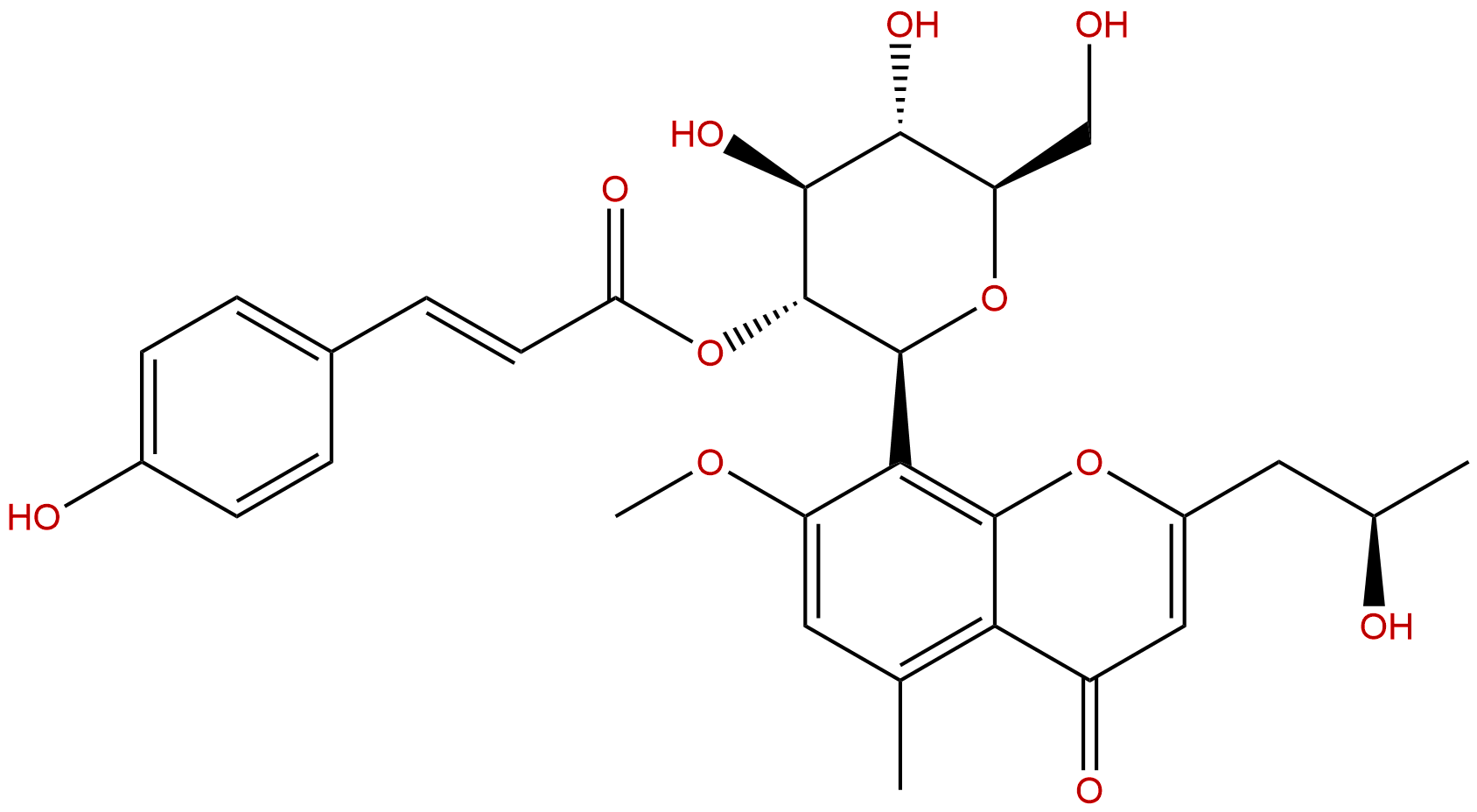
Aloe vera glycoside D is a chromogenic ketone glycoside compound with a molecular formula of C27H32O13 and a molecular weight of 556.5640. Its core structure is the chromogen ketone nucleus, which is connected to the glycoside group through carbon carbon bonds to form a stable carbon glycoside structure. This structure has stronger acid hydrolysis stability compared to oxygen glycosides. Its chemical structure contains multiple phenolic hydroxyl and methoxy groups, which are crucial for its physicochemical properties and biological activity.
According to the provided pharmacological parameters, the lipid water partition coefficient (LogP) of aloe vera glycoside D is 1.5410, indicating that it has a certain degree of lipophilicity, but overall it still leans towards hydrophilicity, which is consistent with its glycoside structure. Its topological polar surface area (TPSA) is as high as 176.1200 Å ², mainly attributed to the abundant oxygen atoms (sugar and phenolic hydroxyl groups) in the molecule. High TPSA usually means strong hydrogen bonding ability, but may also affect its transmembrane permeability. The water solubility value is 0.4603 (usually measured in mg/mL or log mol/L, which should be understood in context as moderate to low water solubility), which is related to its larger molecular weight and partially hydrophobic structure. Based on the comprehensive LogP and TPSA values, it meets a few of the Rule of Five criteria for drugs, but its molecular weight slightly exceeds 500, indicating that its oral bioavailability may face challenges. In addition, preliminary toxicity predictions showed no risk of hERG inhibition (hERG inhibition: no) and mutagenicity risk (Ames test: 0.0), providing preliminary positive signals for its safety. However, its blood-brain barrier permeability is predicted to be 'low', which contradicts the goal of treating central nervous system diseases such as Alzheimer's disease by inhibiting BACE1, but may be more advantageous for its role in peripheral systems such as the gastrointestinal tract.
Plant sources and extraction methods
Aloe vera glycoside D is mainly derived from plants in the lily family and the genus Aloe, especially in the Curacao aloe(Aloe barbadensis Miller, Also known as Aloe vera)Aloe Vera and Cape of Good Hope(Aloe ferox)The leaf bark (i.e. the green outer layer of the leaves) and dried leaf juice are relatively abundant in content. The medicinal part of aloe is usually its leaf gel (transparent inside), but many phenolic compounds with biological activity, including chromone glycosides, such as aloe neoglycoside D, are more concentrated in the leaf skin and latex.
The extraction and separation method follows the conventional process of natural product chemistry. Firstly, the dried aloe vera leaf skin is crushed and extracted using a medium polarity solvent (such as methanol, ethanol, or acetone water mixed solvent) for extraction or ultrasound assisted extraction to fully extract the phenolic glycosides. After the crude extract is concentrated under reduced pressure, liquid-liquid extraction method (such as fractional extraction with ethyl acetate and n-butanol) is often used for preliminary enrichment. Further purification relies on various chromatographic techniques. Silica gel column chromatography and reverse phase C18 column chromatography (such as ODS) are commonly used for separation, and combined with high-performance liquid chromatography (HPLC) or preparative thin layer chromatography (PTLC) for final purification. Structural identification is accomplished through spectroscopic techniques such as nuclear magnetic resonance (NMR, including 1H-NMR, 13C-NMR, 2D-NMR such as HSQC, HMBC), mass spectrometry (MS, such as ESI-MS, HR-ESI-MS), and ultraviolet (UV) spectroscopy. Optimizing the extraction process (such as solvent ratio, temperature, time) and improving the yield and purity of the target compound are the basis for subsequent pharmacological research and application development.
Pharmacological activity research
The pharmacological activity research of aloe vera glycoside D has expanded from the initial single enzyme inhibition to multiple disease fields, demonstrating diverse biological effects.
-
Neuroprotective and Anti Alzheimer's Disease Potential Its earliest reported activity was inhibition of β - secretase 1 (BACE1), with an IC50 value of 39 μ M. BACE1 is a key rate limiting enzyme for the generation of β - amyloid protein (A β), and abnormal aggregation of A β is a core link in the pathology of Alzheimer's disease. Therefore, aloe vera glycoside D, as a natural BACE1 inhibitor, provides lead compound clues for the development of anti Alzheimer's disease drugs.
-
Anti inflammatory and immune regulatory activity This is currently the most active area of research on aloe vera glycoside D, especially in relation to colitis. In various experimental colitis models (such as DSS induced and TNBS induced colitis in mice), oral or intraperitoneal administration of aloxin D can significantly alleviate colon tissue damage, reduce disease activity index, and decrease the production of pro-inflammatory cytokines (such as TNF - α, IL-1 β, IL-6). Its anti-inflammatory effect is not limited to the intestine, but can also effectively inhibit lipopolysaccharide (LPS) - induced inflammatory responses in macrophages (such as RAW264.7 cells) and microglia.
-
Antioxidant activation Aloe vera glycoside D can scavenge free radicals (such as DPPH, ABTS free radicals) and enhance intracellular antioxidant defense capabilities. In inflammatory states such as colitis, oxidative stress and inflammatory response intensify each other, and its antioxidant capacity is an important component of its overall protective effect.
-
Other potential activities Preliminary studies suggest that aloe vera glycoside D may also have antibacterial, antifungal, and mild analgesic activities, but these activities require further systematic research to confirm.
Mechanism of action and molecular targets
The therapeutic effect of aloe vera glycoside D on colitis is not achieved through a single target, but through a complex multi-target network that works synergistically. Based on the provided target information, explain its mechanism of action:
-
Regulating inflammatory signaling pathways:
- TLR4/NF - κ B pathway Toll like receptor 4 (TLR4) is a key receptor that recognizes patterns of pathogenic molecules such as LPS and initiates innate immunity. Aloe vera glycoside D can inhibit the overactivation of TLR4, thereby downregulating the nuclear translocation and activity of its downstream key transcription factor NF - κ B (whose subunit is RELA/p65). The inhibition of NF - κ B directly leads to a decrease in transcription of pro-inflammatory cytokine genes such as TNF - α, IL-1 β, IL-6, which is one of the core mechanisms of its anti-inflammatory effect.
- NLRP3 inflammasome pathway Caspase-1 (CASP1) is an effector protein activated by inflammasomes such as NLRP3 inflammasome, responsible for cleaving pro-IL-1 β and pro-IL-18 into mature active forms. Aloe vera glycoside D has been shown to inhibit the activation of CASP1, thereby reducing the release of IL-1 β and IL-18 and blocking this strong pro-inflammatory pathway.
-
Enhance antioxidant defense system:
- Activate Nrf2 pathway Nuclear factor E2 related factor 2 (NFE2L2/Nrf2) is the central regulator of cellular antioxidant response. Aloe vera glycoside D can promote the transfer of Nrf2 from cytoplasm to nucleus, upregulate the expression of downstream antioxidant enzymes and phase II detoxifying enzymes (such as HO-1 and NQO1), thereby enhancing the cell's resistance to oxidative stress and reducing inflammation related oxidative damage.
-
Regulating lipid metabolism and signaling:
- Sphingosine kinase 1 (SPHK1)SPHK1 catalyzes the generation of sphingosine-1-phosphate (S1P), which is an important lipid signaling molecule involved in cell proliferation, survival, and inflammation regulation. In colitis, the SPHK1/S1P axis is often abnormally activated. Aloe vera glycoside D may regulate immune cell migration and inflammatory response by modulating SPHK1 activity and affecting S1P levels.
- Fatty acid amide hydrolase (FAAH) and lysophosphatidic acid receptor 2 (LPAR2)FAAH is an enzyme that degrades endogenous cannabinoids (such as anandamide), and its inhibition can enhance the anti-inflammatory and analgesic effects of endogenous cannabinoids. LPAR2 is a receptor for lysophosphatidic acid (LPA), involved in epithelial barrier function and inflammatory response. Aloe vera glycoside D may indirectly exert intestinal protective effects by affecting these lipid signaling pathways.
-
Affects nuclear receptors and protein kinases:
- Farnesol X receptor (NR1H4/FXR)FXR is a key regulatory nuclear receptor for bile acid homeostasis and intestinal inflammation. Activating FXR has anti-inflammatory and maintenance effects on intestinal barrier integrity. Aloe vera glycoside D may act as a regulator of FXR, involved in improving bile acid metabolism and intestinal inflammation.
- Protein kinase C alpha (PRKCA/PKC alpha)PKC α is involved in various cellular processes, including inflammatory signal transduction and intestinal epithelial barrier function. Aloe vera glycoside D may strengthen the intestinal epithelial barrier by regulating the activity of PKC α, affecting the expression and distribution of tight junction proteins.
- Carboxyesterase 1 (CES1)CES1 is involved in the metabolism of various endogenous and exogenous ester substances. Its specific role in colitis is not fully understood, but it may involve the metabolism of inflammatory mediators. The interaction between aloe vera glycoside D and CES1 may affect the biotransformation of local drugs or inflammatory mediators.
In summary, aloe vera glycoside D forms a synergistic network against colitis by simultaneously acting on multiple key targets such as TLR4, NF - κ B, CASP1, NFE2L2, and SPHK1, from multiple dimensions including inhibiting excessive inflammation, enhancing antioxidant capacity, regulating lipid signaling, and maintaining barrier function.
Evaluation of drug properties and pharmacokinetics
Based on existing data, a preliminary evaluation of the pharmacological properties of aloe vera glycoside D is conducted
- Absorption and oral bioavailability The molecular weight (556.6) is slightly higher than the ideal oral drug range (<500), and the higher TPSA (176) and moderate LogP (1.54) suggest that it may have moderate membrane permeability, but the larger molecular weight and polarity may limit its passive diffusion. Its water solubility is average, which may affect its dissolution and absorption in the gastrointestinal tract. It is predicted that its oral bioavailability may be moderate to low and needs to be optimized through formulation techniques such as nanocrystals, phospholipid complexes, cyclodextrin inclusion complexes, or structural modifications.
- distribution The blood-brain barrier permeability is predicted to be "low", mainly due to its high TPSA and molecular weight. This is a disadvantageous factor for treating central nervous system diseases such as Alzheimer's disease, but it may help reduce central side effects and be a potential advantage for treating peripheral inflammatory diseases such as colitis. Its specific distribution in inflamed colon tissue needs to be experimentally verified.
- Metabolism and excretion As a glycoside compound, aloe vera glycoside D may undergo hydrolysis under the action of glycosidases in intestinal microbiota or intestinal epithelial cells, generating aglycones. The physicochemical properties and activities of aglycones may differ from those of the prototype drug, which increases the complexity of their in vivo metabolism. The interaction between it and metabolic enzymes such as CES1 also needs attention. The main excretion pathways (kidney or biliary tract) of the prototype drug and its metabolites are not yet clear.
- Preliminary Safety Prediction The absence of hERG inhibition and the risk of Ames mutagenicity are important early safety signals, reducing their potential risks of cardiac toxicity and genetic toxicity. However, a comprehensive safety assessment, including acute toxicity, chronic toxicity, reproductive toxicity, etc., still needs to be completed through standardized preclinical studies.
At present, there are very limited public reports on the pharmacokinetic studies of the aloe vera glycoside D system (such as absolute bioavailability, tissue distribution, half-life, clearance rate, etc.), which is a key data gap that must be filled in the process of drug development.
Clinical application prospects and prospects
The clinical application prospects of aloe vera glycoside D mainly focus on the prevention and treatment of inflammatory bowel disease (IBD), especially ulcerative colitis. Its multi-target mechanism of action is highly compatible with the complex pathological network of IBD, and may have better efficacy and lower resistance risk than single target drugs. In addition, it also has exploratory value in neuroinflammatory related diseases (although BBB penetration is poor), skin inflammation, and other fields.
However, developing it from a lead compound into a candidate drug and even a marketed drug still faces a series of challenges and future research directions:
- Structural optimization and derivative development To address the issues of low oral bioavailability and relatively weak BACE1 inhibitory activity (IC50 39 μ M), structural modification can be carried out through medicinal chemical methods. For example, optimizing the sugar moiety, modifying phenolic hydroxyl groups, introducing specific functional groups to improve lipid solubility and target affinity, while exploring the activity of its glycosides.
- In depth mechanism research It is necessary to use techniques such as gene knockout/knockdown, reporter genes, molecular docking, and surface plasmon resonance (SPR) to accurately verify the direct interaction sites and modes of action (excitation/antagonism) with the aforementioned targets (such as TLR4, Nrf2, CASP1).
- Systematic pharmacokinetics and formulation research A complete ADME (absorption, distribution, metabolism, excretion) study must be conducted to clarify its in vivo fate. Develop new drug delivery systems (such as colon targeted delivery systems, nano formulations) to increase local drug concentration, reduce systemic exposure, and mitigate side effects.
- Preclinical efficacy and safety verification It is necessary to validate its long-term efficacy in animal models closer to human diseases, such as IL-10 gene knockout mice and humanized immune system mice, and complete GLP compliant toxicology studies.
- Exploring the potential of combination therapy Consider combining aloe vera glycoside D with existing IBD treatment drugs (such as 5-ASA, immunosuppressants) to study its synergistic or attenuated effects, which may provide new strategies for clinical treatment.
Conclusion
Aloe vera glycoside D, as a chromogenic ketone glycoside derived from the traditional medicinal plant aloe vera, has entered the research field due to its inhibitory activity on BACE1. Its more remarkable value lies in its multi-target and multi-channel pharmacological action network in combating colitis. It can synergistically regulate inflammatory pathways such as TLR4/NF - κ B and NLRP3/CASP1, activate Nrf2 antioxidant defense, and affect multiple targets related to intestinal homeostasis such as SPHK1 and FXR, demonstrating great potential for development. Despite challenges such as poor oral bioavailability and low blood-brain barrier penetration in drug development, preliminary safety predictions are positive. Future research should focus on improving its pharmacokinetic properties through structural optimization and formulation innovation, and fully explore its potential as a new anti-inflammatory drug, especially for the treatment of inflammatory bowel disease, through in-depth and systematic mechanism and preclinical studies, to promote the transformation process of this natural active molecule from laboratory to clinical application.