


Product name: Protodioscin
Synonym name: Saponin C
Catalogue No.: BP1156
Cas No.: 55056-80-9
Formula: C51H84O22
Mol Weight: 1049.21
Botanical Source: Dioscoreae Nipponicae Rhizoma
Physical Description:
Type of Compound: Steroids
Purity: 95%~99%
Analysis Method: HPLC-DAD or/and HPLC-ELSD
Identification Method: Mass, NMR
Packing: Brown vial or HDPE plastic bottle
Storage: Store in a well closed container, protected from air and light. Put into refrigerate or freeze for long term storage.
Whenever possible, you should prepare and use solutions on the same day. However, if you need to make up stock solutions in advance, we recommend that you store the solution as aliquots in tightly sealed vials at -20℃. Generally, these will be useable for up to two weeks.
The product could be supplied from milligrams to grams
Inquire for bulk scale.
Description:
Protodioscin has been shown to exhibit multiple biological actions, such as anti-hyperlipidemia, anti-cancer, sexual effects and cardiovascular properties. It appears to possess aphrodisiac activity probably due to its androgen increasing property, it will be useful in developing health food supplement(s) and/or drug(s) against hyperlipidemia.
References:
Antihyperlipidemic effect of protodioscin, an active ingredient isolated from the rhizomes of Dioscorea nipponica.
Developing drugs against metabolic-related disorders, including obesity and hyperlipidemia, is of importance for human health. Here, a bioactive phytochemical, Protodioscin, isolated from the rhizomes of Dioscorea nipponica (Rhizoma Dioscoreae Nipponicae), was identified for its anti-hyperlipidemic effect. In hyperlipidemic rats, the post-administration of Protodioscin significantly reduced the time of blood coagulation. In addition, the blood levels of triglyceride, cholesterol, low-density and high-density lipoproteins were also changed accordingly. Taken together, this was the first report of an antihyperlipidemic effect of Protodioscin. Its great availability in various vegetables and medicinal plants will be useful in developing health food supplement(s) and/or drug(s) against hyperlipidemia.
Protodioscin (NSC-698 796): its spectrum of cytotoxicity against sixty human cancer cell lines in an anticancer drug screen panel.
Protodioscin (NSC-698 796) is a furostanol saponin isolated from the rhizome of Dioscorea collettii var. hypoglauca (Dioscoreaceae), a Chinese herbal remedy for the treatment of cervical carcinoma, carcinoma of urinary bladder and renal tumor for centuries. To systematically evaluate its potential anticancer activity, Protodioscin was tested for cytotoxicity in vitro against 60 human cancer cell lines in the NCI's (National Cancer Institute, USA) anticancer drug screen. As a result, Protodioscin was cytotoxic against most cell lines from leukemia and solid tumors in the NCI's human cancer panel, especially selectively against one leukemia line (MOLT-4), one NSCLC line (A549/ATCC), two colon cancer lines (HCT-116 and SW-620), one CNS cancer line (SNB-75), one melanoma line (LOX IMVI), and one renal cancer line (786 - 0) with GI50 < or = 2.0 microM. In the general view of mean graphs, leukemia, colon cancer and prostate cancer are the most sensitive subpanels, while ovarian cancer is the least sensitive subpanel. Based on an analysis of COMPARE computer program with Protodioscin as a seed compound, no compounds in the NCI's anticancer drug screen database have cytotoxicity patterns (mean graphs) similar to those of Protodioscin, indicating that a potential novel mechanism of anticancer action is involved.
Quantification of protodioscin and rutin in asparagus shoots by LC/MS and HPLC methods.
A liquid chromatography/mass spectrometry (LC/MS) method with selected ion monitoring was developed and validated to analyze the contents of Protodioscin and rutin in asparagus. The distribution of rutin and Protodioscin within the shoots was found to vary by location, with the tissue closest to the rhizome found to be a rich source of Protodioscin, at an average level of 0.025% tissue fresh weight in the three tested lines, while the upper youngest shoot tissue contained the highest amount of rutin at levels of 0.03-0.06% tissue fresh weight. The lower portions of the asparagus shoots that are discarded during grading and processing should instead be considered a promising source of a new value-added nutraceutical product.
A comparative tissue-specific metabolite analysis and determination of protodioscin content in Asparagus species used in traditional Chinese medicine and Ayurveda by use of laser microdissection, UHPLC-QTOF/MS and LC-MS/MS.
To compare tissue-specific metabolites and Protodioscin content of Asparagus cochinchinensis (Lour.) Merr. and Asparagus racemosus Willd. used in China and India. METHODS: Metabolite analysis of laser-dissected tissues was carried out using UHPLC-QTOF/MS and LC-MS/MS. The Protodioscin contents were determined and the method was validated as per the International Conference on Harmonisation of Technical Requirements for Registration of Pharmaceuticals for Human Use guidelines. Although the metabolite profiles were similar, the content of Protodioscin was found to be higher in Chinese than Indian species. CONCLUSION: The study provided a suitable methodology for metabolite profiling and Protodioscin content determination of Asparagus by use of LMD, UHPLC-QTOF/MS and LC-MS/MS. The similarities in metabolite profiles indicate that Asparagus species from India and China can serve as substitute for each other in various therapeutic and pharmaceutical applications.
Aphrodisiac properties of Tribulus Terrestris extract (Protodioscin) in normal and castrated rats.
Tribulus terrestris (TT) has long been used in the traditional Chinese and Indian systems of medicine for the treatment of various ailments and is popularly claimed to improve sexual functions in man. Sexual behaviour and intracavernous pressure (ICP) were studied in both normal and castrated rats to further understand the role of TT containing Protodioscin (PTN) as an aphrodisiac. Adult Sprague-Dawley rats were divided into five groups of 8 each that included distilled water treated (normal and castrated), testosterone treated (normal and castrated, 10 mg/kg body weight, subcutaneously, bi-weekly) and TT treated (castrated, 5 mg/kg body weight, orally once daily). Decreases in body weight, prostate weight and ICP were observed among the castrated groups of rats compared to the intact group. There was an overall reduction in the sexual behaviour parameters in the castrated groups of rats as reflected by decrease in mount and intromission frequencies (MF and IF) and increase in mount, intromission, ejaculation latencies (ML, IL, EL) as well as post-ejaculatory interval (PEI). Compared to the castrated control, treatment of castrated rats (with either testosterone or TT extract) showed increase in prostate weight and ICP that were statistically significant. There was also a mild to moderate improvement of the sexual behaviour parameters as evidenced by increase in MF and IF; decrease in ML, IL and PEI. These results were statistically significant. It is concluded that TT extract appears to possess aphrodisiac activity probably due to androgen increasing property of TT (observed in our earlier study on primates).
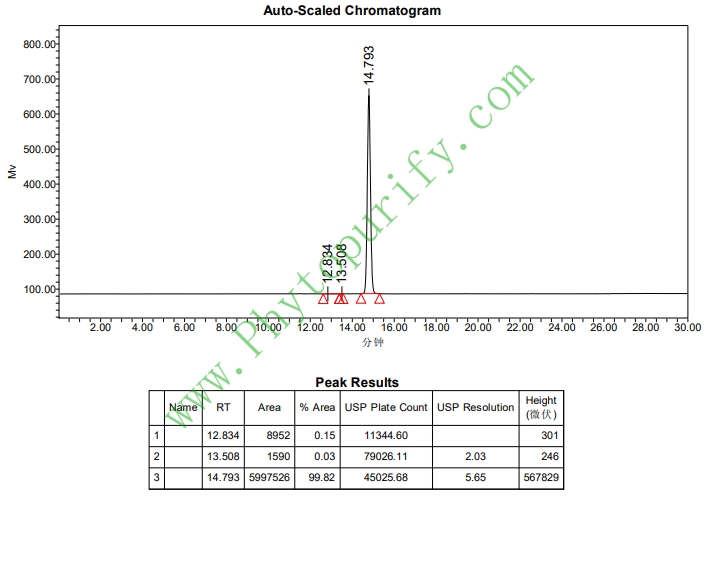
HPLC of Protodioscin
Storage conditions:Short-term storage at 2~8℃, long-term storage at -20 ~ -80℃
346.0600
1.4348
1.4347
.2397
.4573
.3639
Low
61.4610
6.7850
No
No
No
No
No
No
0.0
Yes
No
No
Yes
In the field of natural product chemistry and pharmacology research, steroidal saponins have attracted much attention due to their structural diversity and wide range of biological activities. Protodioscin (CAS number: 55056-80-9), as a typical furostanol type steroidal saponin, is a compound of Huluba(Trigonella foenum-graecum L. One of the main active ingredients in traditional medicinal plants, such as ________. With the advancement of modern separation and identification technology and the deepening of molecular pharmacology research, the various pharmacological activities of dioscin, especially its significant effects in anti-tumor, blood lipid regulation, and cardiovascular protection, have made it stand out from many natural compounds and become a hot candidate molecule for drug development. This article aims to systematically review the chemical structure, plant origin, pharmacological activity, mechanism of action, and pharmacological research progress of dioscin, in order to provide comprehensive academic references for the in-depth research and development of this compound.
The chemical structure of dioscin is clear and belongs to the class of furostanol glycosides. Its molecular formula is C51H84O22 and its molecular weight is 1049.2110. Its core skeleton is 3 β, 22-dihydroxyfuranost-5-ene, which is connected to a trisaccharide chain at the C-3 hydroxyl group. The trisaccharide chain is composed of α - L-rhamnose - (1 → 4) - [α - L-rhamnose - (1 → 2)] - β - D-glucose. In addition, there is a β - D-glucopyranose group attached to the hydroxyl group at position C-26, which is a typical feature that distinguishes furostanol saponins from spirostanol saponins (glycosylation at position C-26). This complex glycosylation structure has a decisive impact on its water solubility and biological activity.
From the analysis of parameters related to drug properties, the theoretical lipid water partition coefficient (LogP) of original dioscin is 1.4348, indicating its lipophilicity. However, the presence of multiple sugar groups in the molecule makes its overall polarity relatively high, with a topological polar surface area (TPSA) of up to 346.0600 Å ². Its water solubility value is 0.2397, belonging to the category of slight solubility, which suggests that solubilization strategies may need to be considered in formulation development. Preliminary pharmacokinetic predictions indicate that it has low blood-brain barrier permeability and mainly acts on the peripheral system. In the preliminary safety screening, the hERG inhibition risk was negative, and the Ames test result was also 0.0, indicating a low potential risk of cardiac and genetic toxicity, laying a good safety foundation for subsequent development.
Original dioscin is widely present in various plants such as Dioscoreaceae, Liliaceae, and Leguminosae. Its main plant sources include:
1. Huluba(Trigonella foenum-graecum)Seeds are rich in content and are the main raw materials for studying this component.
2. Dioscorea plants(Dioscorea spp.)Such as Dioscorea nipponica and Chinese yam, their rhizomes are the traditional source for extracting dioscin and related saponins (including original dioscin).
3. Asparagus(Asparagus officinalis)Its roots and tender stems also contain this ingredient.
4. Other Some fungi and folk medicinal plants are also distributed.
The extraction method is mainly based on the properties of its saponin compounds. The standard process includes:
1. Solvent extraction Methanol, ethanol, or ethanol water mixed solvents are commonly used for heating reflux or ultrasound assisted extraction of dried and crushed plant materials. High concentration ethanol is beneficial for extraction, but an appropriate proportion of water can help improve the dissolution of polar saponins.
2. Purification and Separation After the crude extract is concentrated under reduced pressure, it is sequentially degreased and purified with weakly polar solvents such as petroleum ether and ethyl acetate, while retaining the saponin components in the water or alcohol layer. Further purification relies on macroporous adsorption resin (such as D101, AB-8) column chromatography, using gradient elution with ethanol water solutions of different concentrations to enrich the original dioscin. The final high-purity preparation requires the use of techniques such as silica gel column chromatography, reverse phase silica gel column chromatography (such as ODS), high performance liquid chromatography (HPLC), and preparative liquid chromatography.
3. appraisal Structural confirmation was performed using techniques such as thin-layer chromatography (TLC), high-performance liquid chromatography-mass spectrometry (HPLC-MS), and nuclear magnetic resonance (NMR).
A large number of in vitro and in vivo studies have confirmed that dioscin has multiple pharmacological activities.
The multiple pharmacological effects of dioscin stem from its regulation of multiple signaling pathways within cells and its influence on multiple key target molecules, especially in the field of anti-tumor mechanisms, which have been systematically studied.
Although the pharmacological activity of dioscin is significant, its medicinal properties, especially pharmacokinetic properties, are the key factors that restrict its conversion into drugs.
The diverse biological activities of dioscin provide broad prospects for its application in multiple therapeutic fields.
Future research should focus on:
* In depth mechanism exploration By utilizing omics techniques, gene editing, and other methods, new targets and signaling networks have been discovered, particularly in the mechanisms of tumor microenvironment regulation and immune regulation.
* Pharmacokinetic optimization Strengthen the research on its in vivo ADME process, focus on breaking through the bottleneck of oral absorption, and improve its bioavailability through new formulation technologies or structural modification strategies.
* Preclinical and clinical research Promote the completion of preclinical safety and efficacy evaluation of the system, and gradually carry out early clinical trials to verify its efficacy and safety in humans.
* Interdisciplinary research Combining cutting-edge technologies such as synthetic biology, computational chemistry, and materials science to achieve efficient biosynthesis, rational structural modification, and intelligent delivery.
As a natural and abundant source of furostanol saponins, dioscin has shown great potential for development in fields such as anti-tumor, cardiovascular and cerebrovascular protection, and neuroprotection due to its wide pharmacological activity and multi-target action characteristics. Despite facing challenges in drug development, especially in oral absorption, these bottlenecks are gradually being overcome with the rapid development of modern pharmaceutical, medicinal chemistry, and molecular pharmacology technologies. Systematic and in-depth basic and translational research is expected to promote the development of dioscin from a promising natural active ingredient into clinical therapeutic drugs or high-value health products, contributing to the cause of human health. The continuous research on it not only has important scientific significance, but also meets the current strategic demand for finding innovative drugs from natural resources.
