


Synonym name:
Catalogue No.: BP0939
Cas No.: 54522-52-0
Formula: C52H86O22
Mol Weight: 1063.24
Botanical Source:
Purity: 95%~99%
Analysis Method: HPLC-DAD or/and HPLC-ELSD
Identification Method: Mass, NMR
Packing: Brown vial or HDPE plastic bottle
Can be supplied from milligrams to grams.
For Reference Standard and R&D, Not for Human Use Directly.
Inquire for bulk scale.
Description:
Methyl protodioscin has anti-thrombosis, antiosteoporotic, anti-myocardial infarction, and cytotoxic activities. Methyl protodioscin shows strong cytotoxicity against most cell lines from solid tumors with GI50 ≤10.0 microM, but moderate cytotoxicity is shown against leukemia cell lines with GI50 10-30 microM. It potentially increase HDL cholesterol while reducing LDL cholesterol and triglycerides, it also can treat diverse inflammatory pulmonary diseases.
References:
Pharmacogn Mag. 2014 Jul;10(39):318-24.
Methyl protodioscin induces G2/M cell cycle arrest and apoptosis in A549 human lung cancer cells.
Methyl protodioscin (MPD) is a furostanol bisglycoside with antitumor properties. It has been shown to reduce proliferation, cause cell cycle arrest. The present study elucidates the mechanism underlying MPD's apoptotic effects, using the A549 human lung cancer cell line.
METHODS AND RESULTS:
The human pulmonary adenocarcinoma cell line A549 was obtained from the Cell Bank of the Animal Experiment Center, North School Region, Sun Yat-Sen University. All of the cells were grown in RPMI 1640 supplemented with 10% fetal calf serum (Hyclone, Logan, UT, USA), penicillin (10,000 U/l), and streptomycin (100 mg/l) at 37°C in a 5% CO2 humidified atmosphere. The induction of apoptosis was observed in flow cytometry and fluorescent staining experiments. MPD showed growth inhibitory effects in A549 cells in a dose- and time-dependent manner. The significant G2/M cell cycle arrest and apoptotic effect were also seen in A549 cells treated with MPD. MPD-induced apoptosis was accompanied by a significant reduction of mitochondrial membrane potential, release of mitochondrial cytochrome c to cytosol, activation of caspase-3, downregulation of Bcl-2, p-Bad, and upregulation of Bax.
CONCLUSIONS:
Our results show that the induction of apoptosis by MPD involves multiple molecular pathways and strongly suggest that Bcl-2 family proteins signaling pathways. In addition, mitochondrial membrane potential, mitochondrial cytochrome c and caspase-3 were also closely associated with MPD-induced apoptotic process in human A549 cells.
Cancer Invest. 2003 Jun;21(3):389-93.
The cytotoxicity of methyl protodioscin against human cancer cell lines in vitro.
Methyl protodioscin (NSC-698790) was a furostanol saponin isolated from the rhizome of Dioscorea collettii var. hypoglauca (Dioscoreaceae), a Chinese herbal remedy for the treatment of cervical carcinoma, carcinoma of the urinary bladder, and renal tumors for centuries.
METHODS AND RESULTS:
To systematically evaluate its potential anticancer activity, Methyl protodioscin was tested cytotoxicity in vitro against human cancer cell lines by the NCI's (National Cancer Institute) anticancer drug screen. As a result, Methyl protodioscin showed strong cytotoxicity against most cell lines from solid tumors with GI50 < or = 10.0 microM, especially selectively against one colon cancer line (HCT-15) and one breast cancer line (MDA-MB-435) with GI50 < 2.0 microM but moderate cytotoxicity was shown against leukemia cell lines with GI50 10-30 microM.
CONCLUSIONS:
The data are consistent with the fact that the rhizome of D. collettii var. hypoglauca has been employed for the treatment of solid tumors rather than leukemia in China for centuries. Based on an analysis using the COMPARE computer program with Methyl protodioscin as a seed compound, no compounds in the NCI's anticancer drug screen database have cytotoxicity patterns similar to those of Methyl protodioscin, indicating a potential novel mechanism of anticancer action.
Phytomedicine. 2015 May 15;22(5):568-72.
Dioscin and methylprotodioscin isolated from the root of Asparagus cochinchinensis suppressed the gene expression and production of airway MUC5AC mucin induced by phorbol ester and growth factor.
The root of Asparagus cochinchinensis (Lour.) Merr. has been utilized as mucoregulators and expectorants for controlling the airway inflammatory diseases in folk medicine. We investigated whether dioscin and Methyl protodioscin isolated from the root of Asparagus cochinchinensis (Lour.) Merr. suppress the gene expression and production of airway MUC5AC mucin induced by phorbol ester and growth factor.
METHODS AND RESULTS:
Confluent NCI-H292 cells were pretreated with dioscin or Methyl protodioscin for 30 min and then stimulated with EGF or PMA for 24 h. The MUC5AC mucin gene expression was measured by RT-PCR. Production of MUC5AC mucin protein was measured by ELISA. (1) Dioscin and Methyl protodioscin suppressed the expression of MUC5AC mucin gene induced by EGF or PMA; (2) dioscin suppressed the production of MUC5AC mucin induced by either EGF at 10(-5) M (p < 0.05) and 10(-6) M (p < 0.05) or PMA at 10(-4) M (p < 0.05), 10(-5) M (p < 0.05) and 10(-6) M (p < 0.05); (3) Methyl protodioscin also suppressed the production of MUC5AC mucin induced by either EGF at 10(-4) M (p < 0.05) or PMA at 10(-4) M (p < 0.05).
CONCLUSIONS:
These results suggest that dioscin and Methyl protodioscin isolated from the root of Asparagus cochinchinensis suppress the gene expression and production of MUC5AC mucin, by directly acting on airway epithelial cells, and the results are consistent with the traditional use of Asparagus cochinchinensis as remedy for diverse inflammatory pulmonary diseases.
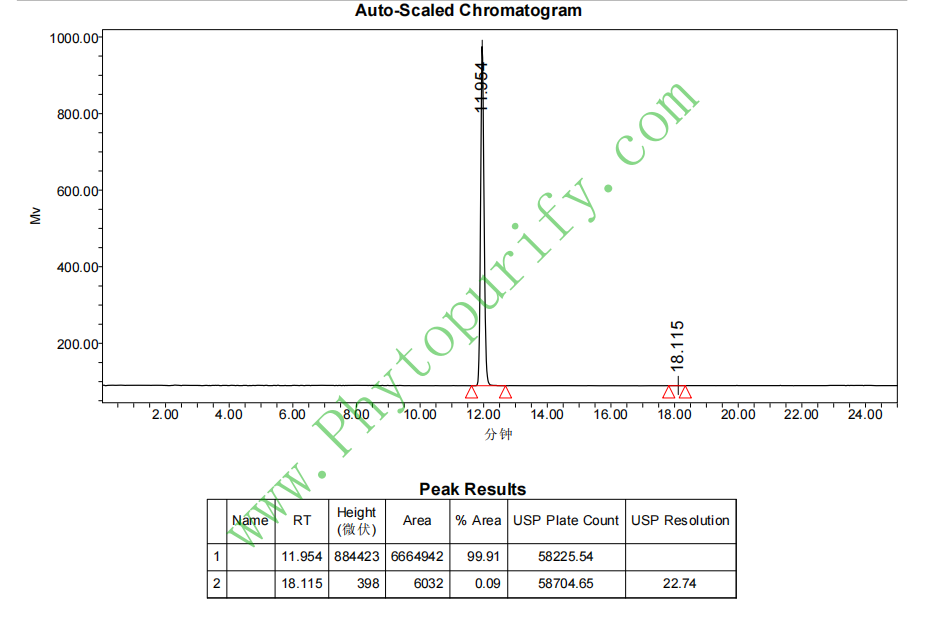
HPLC of Methyl protodioscin
Storage conditions:Short-term storage at 2~8℃, long-term storage at -20 ~ -80℃
Methylprotodioscin (CAS number: 54522-52-0), also known as NSC-698790 or Smilax saponin B, is an important active ingredient in a class of steroidal saponins, widely present in plants of the Dioscoreaceae family. As a multi-target steroidal glycoside inhibitor, methyl protodioscin has received high attention in the field of natural product pharmacology due to its significant anti-tumor, anti-inflammatory, and anti restenosis activities. In recent years, with the in-depth study of its mechanism of action, methylprotodioscin has gradually emerged as an important candidate molecule for the development of natural drugs in the treatment of lung cancer, prostate cancer, pancreatic cancer and other tumors, airway inflammation, enteritis and other inflammatory diseases.
This review aims to systematically summarize the chemical structure and physicochemical properties, plant sources, and extraction methods of methyl protodioscin, with a focus on analyzing its pharmacological activity and molecular mechanism of action, evaluating its pharmacological properties and pharmacokinetic characteristics, and exploring its clinical application prospects and future research directions, providing scientific basis for natural product pharmacology and new drug development.
Methyl protodioscin belongs to the class of steroidal saponins, with a molecular formula of C51H84O22 and a molecular weight of 1063.2380. The core of its structure is the steroid skeleton, which is connected by multiple sugar residues to form a steroidal glycosidic structure. The LogP value of this compound is 1.7162, indicating that it has moderate lipid solubility, which is beneficial for cell membrane penetration. The total polar surface area (TPSA) is 335.0600, indicating its high polarity, which may affect its oral absorption and bioavailability.
The water solubility is 0.2032, which belongs to moderate to low water solubility, indicating that there may be certain solubility limitations when distributed in vivo. The low permeability of the blood-brain barrier indicates its limited distribution in the central nervous system, which helps to reduce the risk of central toxicity. The hERG channel inhibition experiment showed a negative result, indicating a low risk of cardiac toxicity. The Ames mutagenicity test showed a value of 0.0, indicating a low risk of genetic toxicity and meeting safety requirements.
From a chemical perspective, the steroid skeleton of methyl protodioscin endows it with stable chemical properties, while the presence of sugar groups enhances its water solubility and biological activity. Its complex glycosidic linkage provides a molecular basis for its multi-target action.
Methyl protodioscin is mainly found in plants of the Dioscoreaceae family, especially in the rhizomes and tubers of Dioscorea spp. and Smilax spp. Common plant sources include Dioscorea nipponica, Clematis chinensis, and Smilax glabra. In traditional Chinese medicine, these plants are widely used to treat tumors, inflammation, and immune related diseases.
The extraction method usually uses alcohol (such as methanol, ethanol) or a mixture of water and alcohol solvents for reflux or ultrasonic extraction of dried plant tubers. After concentration, separation, and multi-step chromatographic separation (such as silica gel column and reverse phase C18 column chromatography), the extract was purified and identified using high-performance liquid chromatography (HPLC) and mass spectrometry (MS) techniques. In recent years, the application of supercritical CO2 extraction and membrane separation technology has improved extraction efficiency and purity.
The optimization of extraction process not only improves the yield of methyl protodioscin, but also lays the foundation for its large-scale production and drug development.
Methyl protodioscin exhibits broad-spectrum anti-tumor activity, significantly inhibiting the proliferation, migration, and invasion of various cancer cell lines, and inducing cell apoptosis. Its anti-tumor effects cover lung cancer, prostate cancer, pancreatic cancer and breast cancer, showing good tumor inhibition potential.
In vitro experiments have shown that methyl protodioscin can induce G2/M phase cell cycle arrest in cancer cells, block cell division processes, and thus inhibit tumor cell proliferation. The induced cell apoptosis is closely related to the regulation of Bcl-2 family proteins, manifested by downregulation of Bcl-2 expression and upregulation of Bax expression, promoting mitochondrial mediated apoptosis. In addition, methyl protodioscin also regulates the growth and metabolism of tumor cells by inhibiting the Akt1/c-Myc signaling axis and MAPK/ERK pathway.
Animal experiments further confirmed its anti-tumor effect, and methyl protodioscin can significantly inhibit tumor volume growth, prolong the survival of tumor model animals, and have low toxic side effects.
Methyl protodioscin has shown good anti-inflammatory effects in inflammatory disease models. The mechanism mainly involves inhibiting the JNK/c-Jun signaling pathway, reducing the expression of pro-inflammatory cytokines IL-6 and TNF - α, and alleviating the inflammatory response. This effect is of great significance in alleviating diseases such as airway inflammation and enteritis.
In addition, methyl protodioscin can induce FOXO1 expression, inhibit cholesterol synthesis, indirectly regulate the inflammatory microenvironment, and demonstrate multi-level anti-inflammatory regulatory capabilities.
Vascular restenosis is a common complication after vascular intervention therapy. Methylprotodioscin regulates the proliferation and migration of vascular smooth muscle cells, inhibits ADAM15 expression, and effectively reduces the occurrence of vascular restenosis, thus having potential cardiovascular protective effects.
The multi-target mechanism of action of methyl protodioscin is the basis for its diverse pharmacological activities. Mainly involving the following signaling pathways and molecular targets:
cell cycle regulation
Methyl protodioscin induces G2/M phase cell cycle arrest and blocks cell division, mainly by regulating the activity of cell cycle proteins and their kinases.
Regulation of apoptotic pathway
By downregulating the anti apoptotic protein Bcl-2 and upregulating the pro apoptotic protein Bax, mitochondrial dependent apoptotic signaling is activated to promote programmed cell death in cancer cells.
Akt1/c-Myc signal axis suppression
Inhibit Akt1 kinase activity, reduce c-Myc expression, block cell metabolism and proliferation signals, and inhibit tumor growth.
Regulation of MAPK/ERK signaling pathway
Inhibiting the MAPK/ERK pathway, reducing cell proliferation and migration ability, and blocking tumor metastasis process.
JNK/c-Jun pathway inhibition
Reduce the expression of pro-inflammatory factors IL-6 and TNF - α, and alleviate the inflammatory response.
FOXO1 induction
Promote FOXO1 expression, regulate cholesterol metabolism, and improve the inflammatory microenvironment.
ADAM15 downregulation
Inhibit the proliferation and migration of vascular smooth muscle cells to prevent vascular restenosis.
In tumors such as breast cancer, methyl protodioscin also acts on multiple targets such as AMPK, STAT3, ESR2, ABCB1, ABCG2, PRKCA, MAPT, MMP2 and LCK, reflecting its complex multi-target synergistic regulation characteristics.
Methyl protodioscin has moderate lipid solubility (LogP 1.7162) and high polarity (TPSA 335.0600), which poses certain challenges to its oral absorption and in vivo distribution. Its low water solubility (0.2032) suggests the need for appropriate solubilization or nanocarrier technology in drug formulation design to improve bioavailability.
The low permeability of the blood-brain barrier reduces the potential toxicity risk to the central nervous system. The hERG channel has no inhibitory effect and reduces the risk of cardiac toxicity. The Ames test is negative, indicating a low risk of genetic toxicity and meeting safety requirements.
At present, there is limited research on the pharmacokinetics of methyl protodioscin, and further systematic studies are needed on its metabolic pathways, half-life, tissue distribution, and excretion mode in vivo. Preliminary data suggests that it undergoes enzymatic metabolism in the liver, possibly involving the CYP450 enzyme system.
Based on comprehensive pharmacological evaluation, methyl protodioscin has a good safety foundation, but its in vivo stability and bioavailability need to be improved through formulation optimization and structural modification to meet clinical application requirements.
Methyl protodioscin, as a multi-target natural product, exhibits extensive anti-tumor and anti-inflammatory potential and has good clinical development prospects. In the field of tumor treatment, especially in the refractory tumors such as lung cancer, prostate cancer, pancreatic cancer and breast cancer, methylprotodioscin is expected to become a candidate molecule of new anti-cancer drugs through multi pathway synergy.
In addition, its anti-inflammatory and anti restenosis activities provide new ideas for the treatment of chronic inflammatory diseases and cardiovascular diseases. In the future, the combination application of it with existing chemotherapy drugs or immune modulators can be explored to achieve synergistic effects.
However, the clinical translation of methyl protodioscin still faces many challenges, including low bioavailability, complex metabolism in vivo, and insufficient evaluation of efficacy and safety. It is necessary to strengthen pharmacokinetic, toxicological, and preclinical research, optimize dosage forms and administration routes, and conduct systematic clinical trials to verify its efficacy and safety.
In addition, based on its multi-target characteristics, combined with modern molecular docking, network pharmacology, and systems biology methods, in-depth analysis of its action network can help guide the development of precision medicine and personalized treatment strategies.
Methyl protodioscin, as a typical natural product of steroidal saponins, has shown great potential in the fields of anti-tumor, anti-inflammatory, and anti vascular restenosis due to its multi-target and multi mechanism pharmacological activities. Its complex mechanism of action and good safety provide a solid foundation for the development of new drugs.
Future research should focus on optimizing its pharmacokinetic properties, deepening mechanism studies, expanding indications, and promoting clinical translation processes. Through interdisciplinary integration, methyl protodioscin is expected to become a star molecule in the field of natural product pharmacology, contributing new strength to the treatment of human diseases.
