


Product name: Dioscin
Synonym name: Collettinside III
Catalogue No.: BP0503
Cas No.: 19057-60-4
Formula: C45H72O16
Mol Weight: 869.055
Botanical Source: Allium ampeloprasum (leek), Brachiaria decumbens, Dioscorea colletti var. hypoglauca, Dioscorea tokora, Paris dunniana, Paris tetraphylla, Trillium grandiflorum and Trillium tschonoskii
Physical Description: Powder
Type of Compound: Steroids
Purity: 95%~99%
Analysis Method: HPLC-DAD or/and HPLC-ELSD
Identification Method: Mass, NMR
Packing: Brown vial or HDPE plastic bottle
Storage: Store in a well closed container, protected from air and light. Put into refrigerate or freeze for long term storage.
Whenever possible, you should prepare and use solutions on the same day. However, if you need to make up stock solutions in advance, we recommend that you store the solution as aliquots in tightly sealed vials at -20℃. Generally, these will be useable for up to two weeks.
The product could be supplied from milligrams to grams, up to kilograms
Inquire for bulk scale.
Descriptions:
Dioscin, a saponin extracted from the root of Polygonatum Zanlanscianense Pamp, can markedly inhibit proliferation of Hela cells, underwent apoptosis in dose- and time-dependent manner.[1]
Dioscin shows remarkable protective effect against acetaminophen-induced liver damage in vitro and in vivo by adjusting mitochondrial function.[2]
Dioscin induces generation of reactive oxygen species through mitochondria dysfunction, is capable of inducing apoptosis in mammalian cells, in which the mitochondria-initiated apoptosis pathway plays an important role.[3]
Dioscin can restore the activity of the anticancer agent adriamycin in multidrug-resistant human leukemia K562/adriamycin cells by down-regulating MDR1 via a mechanism involving NF-κB signaling inhibition.[4]
Dioscin shows little inhibition activity of tyrosinase, whereas oxyresveratrol, a known tyrosinase inhibitor, shows a strong tyrosinase inhibitory activity , and a mixture of oxyresveratrol and dioscin (IC50 = 5.1 and 5.7 μg/ml) highly increases the inhibition of tyrosinase activity with l-tyrosine or l-DOPA as the substrate as compared to either oxyresveratrol (IC50 = 7.8 and 10.9 μg/ml) or dioscin (IC50 > 100 and 100 μg/ml) alone.[5]
Dioscin has been shown to promote anticancer activity against several forms of cancers, it induces apoptosis in cancer cells through the induction of oxidative stress, peroxiredoxins 1and 6 (PRDX 1 and 6) are key targets in the process of dioscin-induced apoptosis that involves intracellular elevated ROS.[6]
Rhizoma Dioscoreae septemlobae (RDSE) and its main component dioscin (DIS) display a weak xanthine oxidase (XO) inhibition activity compared with allopurinol, therefore, they processed uricosuric and nephroprotective actions by regulation of mOAT1, mURAT1 and mOCT2.[7]
References:
[1] Cai J, Liu M, Wang Z, et al. Biol Pharml Bull, 2002, 25(2):193-6.
[2] Zhao X, Cong X, Zheng L, et al. Toxicol Lett, 2012, 214(1):69-80.
[3] Wang Y, Che C M, Chiu J F, et al. J Proteome Res, 2007, 6(12):4703-10.
[4] Wang L, Meng Q, Wang C, et al. J Nat Prod, 2013, 76(5):909-14.
[5] Liang C, Lim J H, Kim S H, et al. Food Chem, 2012, 134(2):1146-8.
[6] Wang Z, Cheng Y, Wang N, et al. Cancer Biol Ther, 2012, 13(3):138-47.
[7] Su J, Wei Y, Liu M, et al. Arch Pharm Res, 2014, 37(10):1336-44.
[8] Dong-Xiang L I, Qing L I, Guan X Y, et al. Chinese J Pharm Anal, 2012, 32(4):596-8.
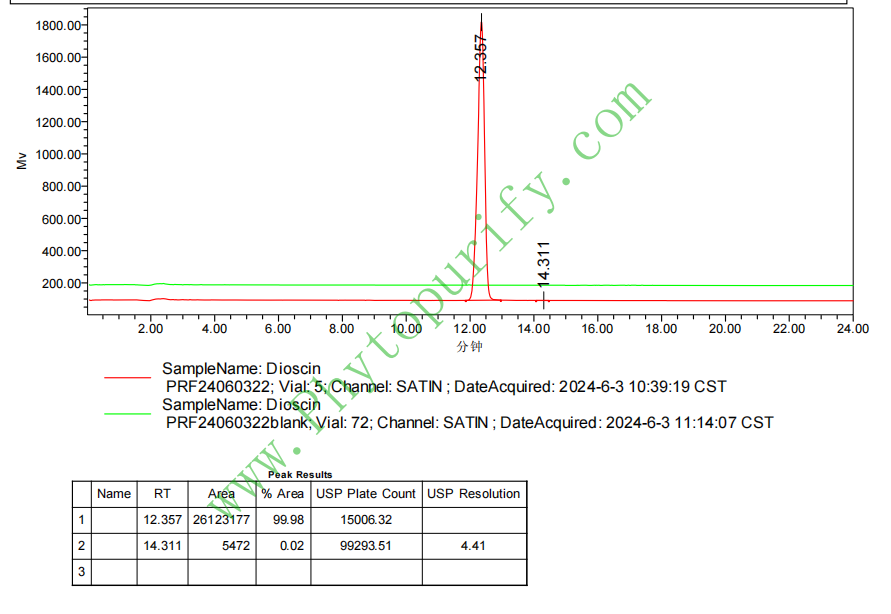
HPLC of Dioscin
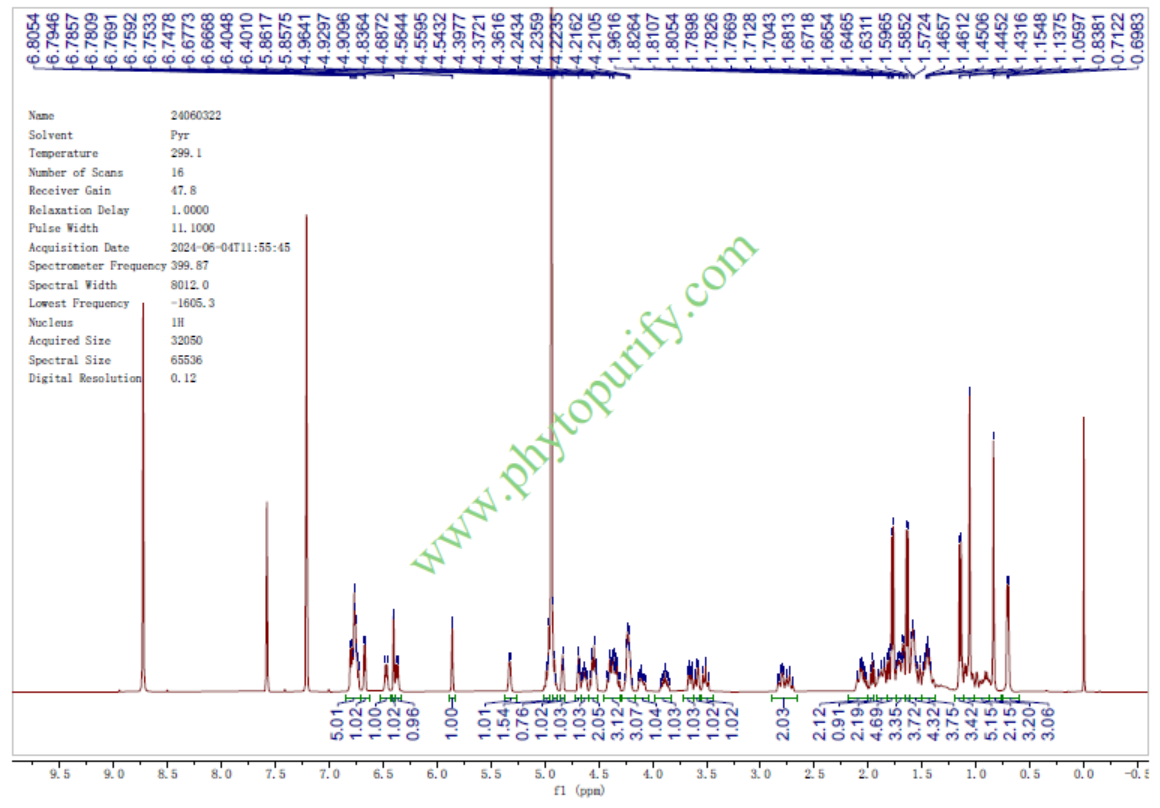
HNMR of Dioscin
Storage conditions:Short-term storage at 2~8℃, long-term storage at -20 ~ -80℃
235.6800
2.4235
2.4237
.0366
.6092
.4780
Low
70.3231
6.6751
No
No
No
No
No
No
0.0
Yes
No
Yes
No
Natural products have always been an important source of innovative drug discovery, among which steroidal saponins have attracted much attention due to their wide range of biological activities. Dioscin, CAS number 19057-60-4, is a natural steroidal saponin with significant anti-cancer potential. Since its discovery, numerous studies have revealed its strong inhibitory activity against various malignant tumor cells, including cervical cancer, liver cancer, lung cancer, colon cancer, etc., in both in vitro and in vivo models. Its function is not limited to direct cytotoxicity, but also involves inducing cell apoptosis, cycle arrest, inhibiting invasion and metastasis, and reversing multidrug resistance at multiple levels. Dioscin exerts its multi-target anti-tumor effect by regulating the complex signaling network within cells, particularly pathways related to oxidative stress, mitochondrial dysfunction, and DNA damage. Although its medicinal properties face challenges, as a lead compound or drug candidate, dioscin has shown broad application prospects in the field of anti-tumor drug development. This article aims to systematically review the chemical properties, plant sources, pharmacological activities, molecular mechanisms of action, pharmacological evaluation, and clinical translation potential of dioscin, in order to provide comprehensive scientific references for the in-depth research and development of this compound.
The molecular formula of dioscin is C45H72O16, with a molecular weight of 869.0550. Its chemical structure consists of a classic spirostanol steroidal sapogenin (Diosgenin) and a sugar chain. The sugar chain is usually connected to the hydroxyl group at position C-3 of sapogenin, forming a disaccharide chain by linking one molecule of xylose and one molecule of glucose in a (1 → 2) or (1 → 4) manner, which is one of the key pharmacophores for its biological activity.
In terms of physical and chemical properties, the lipid water partition coefficient (LogP) of dioscin is 2.4235, indicating that it has a certain degree of lipophilicity, but not high lipid solubility. Its topological polar surface area (TPSA) is as high as 235.68 Å ², which is mainly attributed to the abundant hydroxyl groups and oxygen atoms on the sugar ring in the molecule, resulting in its high polarity. The water-soluble data is 0.0366 mg/mL, which belongs to poorly soluble compounds, posing a major challenge for their oral absorption and formulation development. Dioscin is a white or off white crystalline powder at room temperature, with good solubility in organic solvents such as methanol, ethanol, and dimethyl sulfoxide (DMSO), but extremely low solubility in water. These physicochemical properties directly affect its pharmacokinetic behavior and subsequent formulation design strategies.
Dioscin is widely present in various plants such as Dioscoreaceae, Liliaceae, and Smilacaceae, especially in the Dioscoreaceae genus(Dioscorea)Plants are rich in content. Common sources of plants include pangolins(Dioscorea nipponica)Dioscorea nipponica var. mongolica(Dioscorea zingiberensis)Mount Huangshan Medicine(Dioscorea panthaica)And the Chinese medicinal herb Xiebai(Allium macrostemon)The bulbs, etc. These plants are often used in traditional medicine to expel phlegm, relieve cough, promote blood circulation and relieve pain, while modern research attributes their active parts to the steroidal saponins they contain.
The extraction and separation of dioscin are usually carried out using solvent extraction combined with modern chromatographic techniques. The classic process is as follows: first, the dried plant raw materials are crushed, heated with ethanol or methanol for reflux or ultrasound assisted extraction, and concentrated to obtain the crude extract of total saponins. Subsequently, macroporous adsorption resins (such as D101, AB-8) were used for preliminary enrichment and decolorization, followed by water washing to remove polar impurities such as polysaccharides and proteins, and then elution with different concentrations of ethanol to obtain saponin enriched sites. Further purification relies on techniques such as silica gel column chromatography, reverse phase silica gel column chromatography (such as ODS), and preparative high-performance liquid chromatography (HPLC) to achieve high-purity separation of dioscin monomers by optimizing the mobile phase (often using methanol water or acetonitrile water systems). In recent years, green and efficient technologies such as supercritical fluid extraction and high-speed countercurrent chromatography have also been applied in the extraction and separation of dioscin to improve yield and purity.
The most notable pharmacological activity of dioscin is its broad-spectrum and highly effective anti-tumor effect. Research has shown that it has significant proliferative inhibitory activity against various human cancer cell lines, with a half maximal inhibitory concentration (IC50) often in the micromolar or even nanomolar range.
The anti-tumor effect of dioscin involves a complex multi-target and multi pathway regulatory network. One of its core mechanisms is to induce excessive generation of reactive oxygen species (ROS), leading to oxidative stress and subsequently causing DNA damage and mitochondrial dysfunction.
In summary, dioscin interweaves into a synergistic anti-tumor network by simultaneously acting on multiple key targets such as MCL1, BCL2, STAT3, MMP2, TOP1, HIF1A, TOP2A, etc.
Although dioscin has significant in vitro activity, there are obvious shortcomings in its drug like properties, mainly based on its calculation and preliminary experimental data:
In order to improve its drug efficacy, current research strategies include: ① developing novel drug delivery systems, such as nanoparticles (liposomes, polymer micelles), solid dispersions, self microemulsions, etc., to enhance solubility and bioavailability; ② Perform structural modifications to synthesize derivatives or prodrugs with better water solubility or targeting.
The transition of dioscin from laboratory research to clinical application presents both opportunities and challenges.
prospect:
1. As a new candidate for anti-tumor drugs Its multi-target and multi pathway mechanism of action helps overcome the resistance problem of single target drugs and has unique advantages in combination therapy or combating complex malignant tumors.
2. As a chemotherapy sensitizer Its role in reversing multidrug resistance makes it promising to be used in combination with conventional chemotherapy drugs to improve efficacy, reduce chemotherapy drug dosage and side effects.
3. Modernization of Traditional Chinese Medicine and Quality Markers As the main active ingredient of various traditional Chinese medicines, clarifying the toxic substance basis and mechanism of action of dioscin can help improve the quality control standards and scientific interpretation of clinical efficacy of related Chinese medicines.
Challenges and Prospects:
1. Optimization of drug properties This is the biggest challenge we are currently facing. Future research should focus on utilizing advanced drug delivery technologies or rational drug chemical modifications to systematically address issues such as poor water solubility, difficulty in oral absorption, and metabolic instability.
2. In depth mechanism research Although multiple targets have been identified, the most central and direct molecular target (possibly a protein or nucleic acid) still needs further identification. The application of systems biology methods such as proteomics and chemical proteomics will help to comprehensively reveal their functional networks.
3. System preclinical evaluation It is necessary to strictly follow the requirements of the Good Laboratory Practice (GLP) for non clinical drug research, complete standardized pharmacological (more in vivo models), pharmacokinetic, and toxicological evaluations, clarify the treatment window and potential toxicity, and provide solid data for clinical trial applications.
4. Explore clinical indications While promoting anti-tumor indications, its potential applications in the treatment of non tumor diseases (such as metabolic diseases and fibrosis diseases) can also be explored based on its anti-inflammatory, hepatoprotective and other activities.
5. Conduct clinical trials On the basis of sufficient preclinical research, gradually advancing Phase I (safety, pharmacokinetics), Phase II (efficacy exploration), and Phase III (confirmatory) clinical trials is the ultimate path to verify its clinical value.
Dioscin, as a plant derived steroidal saponin, has become a star molecule in the field of natural product anti-tumor research due to its broad-spectrum and powerful anti-tumor activity and unique multi-target mechanism of action. It exhibits multiple effects in cell and animal models, including inhibiting proliferation, inducing apoptosis, blocking the cell cycle, anti metastasis, and reversing drug resistance, by inducing ROS generation, causing DNA damage, disrupting mitochondrial function, regulating key signaling pathways such as STAT3, MAPK, and HIF-1 α. However, its inherent physicochemical properties (low water solubility, high polarity) have led to poor drug development, especially its extremely low oral bioavailability, which constitutes the main barrier on its clinical translation path. The core of future research will focus on overcoming these deficiencies through innovative formulation technology and structural optimization strategies, while combining deeper mechanism exploration and systematic preclinical development, ultimately driving this highly promising natural molecule from the laboratory to the hospital bed, providing new weapons or strategies for the treatment of malignant tumors. The research process of dioscin once again confirms that discovering and optimizing lead compounds from traditional medicinal plants is a promising and effective way for modern innovative drug development.
