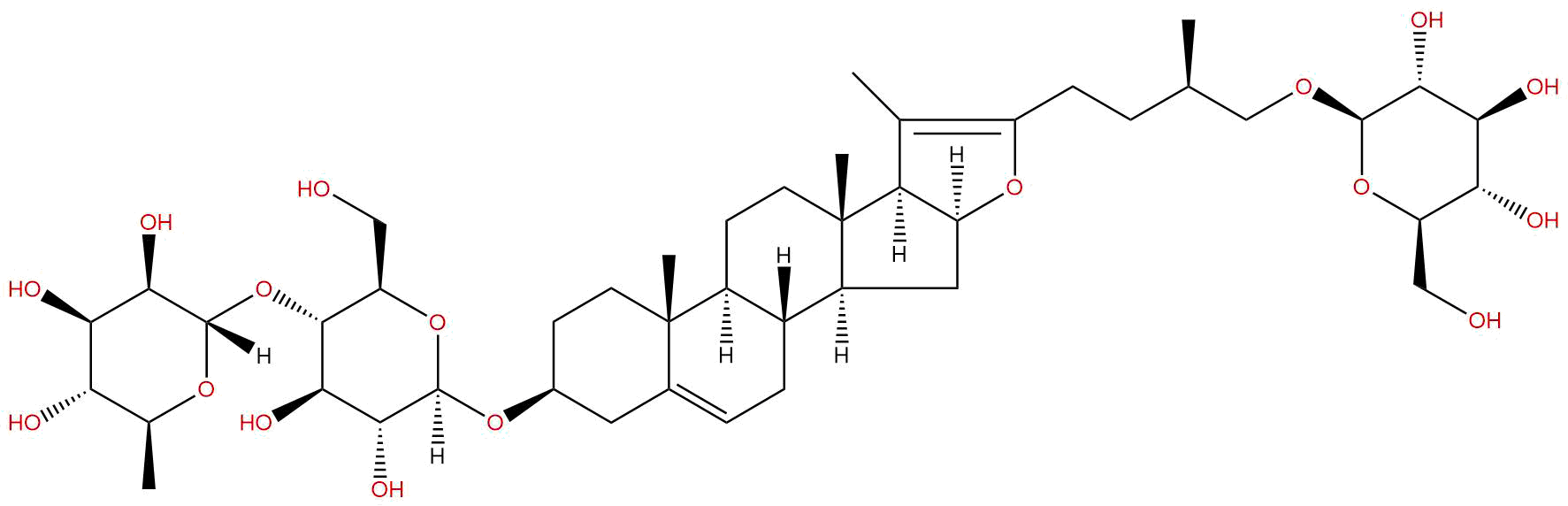


Product name: Isoproprotogracillin
Synonym name: (3β,25R)-26-(β-D-Glucopyranosyloxy)furosta-5,20(22)-dien-3-yl 4-O-(6-deoxy-α-L-mannopyranosyl)-β-D-glucopyranoside; Furostan, β-D-glucopyranoside deriv
Catalogue No.: BP2156
Cas No.: 117457-34-8
Formula: C45H72O17
Mol Weight: 885.054
Botanical Source:
Type of Compound: Steroids
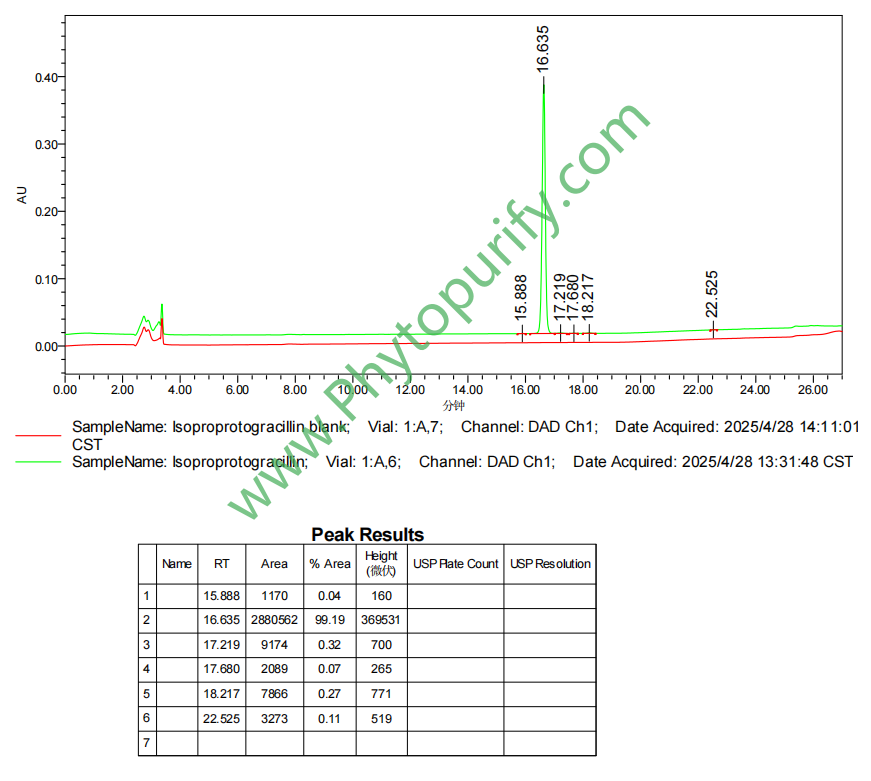
Purity: 95%~99%
Analysis Method: HPLC-DAD or/and HPLC-ELSD
Identification Method: Mass, NMR
Packing: Brown vial or HDPE plastic bottle
Storage: Store in a well closed container, protected from air and light. Put into refrigerate or freeze for long term storage.
Whenever possible, you should prepare and use solutions on the same day. However, if you need to make up stock solutions in advance, we recommend that you store the solution as aliquots in tightly sealed vials at -20℃. Generally, these will be useable for up to two weeks.
The product could be supplied from milligrams to grams
Inquire for bulk scale.
For Reference Standard and R&D, Not for Human Use Directly.
HPLC of Isoproprotogracillin
Storage conditions:Short-term storage at 2~8℃, long-term storage at -20 ~ -80℃
266.9100
1.9308
1.9306
.1243
.5324
.6238
Low
67.3657
6.2406
No
No
No
No
No
No
0.0
Yes
No
No
No
Osteoporosis is a systemic bone disease characterized by reduced bone mass, destruction of bone microstructure, and increased bone fragility. It is one of the main causes of fractures, disability, and death in the elderly. With the global population aging, its incidence rate is increasing year by year, which has become a major public health problem. At present, first-line clinical drugs mainly include bisphosphonates, selective estrogen receptor modulators, RANKL inhibitors, and parathyroid hormone analogues. Although these drugs can effectively inhibit bone resorption or promote bone formation, long-term use often accompanies side effects such as mandibular necrosis, atypical femoral fractures, increased cardiovascular risk, and high treatment costs. Therefore, searching for efficient and low toxicity new anti osteoporosis lead compounds from natural products has always been an important direction in drug development.
Steroid saponins are a type of natural active ingredient widely found in plants such as Dioscoreaceae and Liliaceae. They have diverse structures and possess various pharmacological activities, including anti-inflammatory, anti-tumor, immune regulation, and regulation of bone metabolism. Isoprotoprotogracillin B (CAS: 117457-34-8) is a type of furostane steroid saponin isolated from Dioscorea plants in recent years. Preliminary studies have shown that the compound exhibits significant anti osteoporosis potential, and its effects involve regulating osteoblast differentiation and bone formation, inhibiting osteoclastogenesis and bone resorption, and other key processes. Through interactions with key targets such as estrogen receptor alpha (ESR1) and vitamin D receptor (VDR), it regulates downstream complex signaling networks. This article aims to provide a systematic review of the chemical structure, plant origin, pharmacological activity, mechanism of action, and pharmacological properties of saponins from Dioscorea heterophylla, in order to provide comprehensive scientific references for the in-depth research and development of this compound as a candidate drug for anti osteoporosis.
Isogenic slender Dioscorea saponins belong to the class of furostane type steroidal saponins. Its molecular formula is C ₄₅ H ₇₄ O ₁₈, and its molecular weight is 885.0540. Its basic skeleton consists of a spirostane core (containing one furan ring) with 27 carbon atoms and two sugar chains. Compared with common derivatives of dioscin, its structural characteristics lie in the connection position and type of sugar groups. Usually, its sugar chain is connected to the C-3 and C-26 positions of the mother nucleus (characterized by the furane type). The C-3 position usually connects to an inner sugar chain composed of glucose, rhamnose, etc., while the C-26 position connects to a glucose group, which is the structural basis for naming its "primary saponin" or "secondary saponin". The "Yi" in "Yiyuan slender yam saponins B" may refer to the isomerism of sugar linkage configuration or position, "slender yam" indicates its plant origin, and "saponins B" indicates its serial number in the same series of isolates.
From the analysis of parameters related to drug properties, the topological polar surface area (TPSA) of this compound is as high as 266.9100 Å ², which is mainly attributed to the presence of multiple hydroxyl and sugar groups in the molecule, making it highly hydrophilic. The calculated LogP value is 1.9308, indicating that its lipid water partition coefficient is moderate and biased towards hydrophilicity. The theoretical water solubility is 0.1243 mg/mL, which belongs to the category of slight solubility. The higher TPSA and moderate LogP values together determine that its transmembrane permeability may be limited. Preliminary pharmacokinetic predictions indicate that its ability to cross the blood-brain barrier is low, which is unfavorable for its use in central nervous system diseases. However, for anti osteoporosis drugs that mainly act on the peripheral skeletal system, it may help reduce the risk of central nervous system side effects. In addition, preliminary toxicity predictions indicate that the hERG channel inhibition risk is "no", and the Ames test mutagenicity prediction value is 0.0, suggesting that it may have good cardiac safety and low genetic toxicity risk, but these conclusions need to be further validated through experiments.
Isogenic slender Dioscorea saponins mainly come from the Dioscoreaceae family and Dioscorea genus(Dioscorea)Plants, especially slender yams(Dioscorea gracillima)And its closely related species. Dioscorea plants are a natural treasure trove of steroidal saponins, and many types are important raw materials for synthesizing steroid hormone drugs. This compound is usually present in the rhizomes or tubers of plants.
Its extraction and separation follow the conventional process of natural product chemistry. Firstly, dry and crushed plant materials are subjected to reflux extraction or ultrasound assisted extraction using medium polarity solvents such as methanol, ethanol, or aqueous ethanol to fully extract polar components including saponins. The extract is concentrated under reduced pressure to obtain a crude extract. Subsequently, preliminary enrichment was carried out using macroporous adsorption resin (such as D101, AB-8) column chromatography, with commonly used water ethanol gradient elution. Saponins are usually concentrated in the 30% -70% ethanol elution site.
After obtaining the saponin enrichment site, various chromatographic techniques need to be used for fine separation and purification. Usually, normal phase silica gel column chromatography is used first, with gradient elution using solvent systems such as chloroform methanol water, and grouping is based on polarity differences. Further purification relies heavily on reverse phase chromatography techniques, such as reverse phase silica gel (C18 or C8) column chromatography, medium pressure liquid chromatography (MPLC), or high performance liquid chromatography (HPLC), using methanol water or acetonitrile water as the mobile phase. Preparation type high performance liquid chromatography (Prep HPLC) is a key step in obtaining high-purity monomers of dioscin from Dioscorea nipponica. The structural identification of compounds involves the comprehensive use of spectroscopic methods such as nuclear magnetic resonance (NMR, including ¹ H-NMR, ¹ ³ C-NMR, 2D-NMR such as HSQC, HMBC, COSY), mass spectrometry (MS, such as ESI-MS, HR-ESI-MS), and infrared spectroscopy (IR). The planar and stereoisomers are determined by comparing with literature data or by de novo analysis.
A large number of in vitro and in vivo pharmacological experiments have confirmed that the core pharmacological activity of saponins from Dioscorea opposita is concentrated in the field of anti osteoporosis, and its action has the characteristics of multi-target and multi pathway.
1. Promote osteoblast differentiation and bone formation:
In cell models, saponins from Dioscorea opposita can significantly promote the proliferation, differentiation, and mineralization of pre osteoblasts (such as MC3T3-E1, hFOB1.19). It can upregulate the expression of key transcription factors RUNX2 and SP7 (Osterix) in osteogenic differentiation, thereby enhancing the expression of downstream osteogenic marker genes, including type I collagen (COL1A1, the main component of bone matrix) and osteocalcin (BGLAP, a marker of bone mineralization maturity). This compound can also antagonize osteoblast apoptosis induced by dexamethasone, TNF - α, etc., and protect osteoblast function.
2. Inhibit osteoclastogenesis and bone resorption:
In the osteoclastogenesis system induced by receptor activator of nuclear factor kappa B ligand (RANKL) and macrophage colony-stimulating factor (M-CSF), dioscin can dose dependently inhibit the differentiation of osteoclast precursor cells into mature multinucleated osteoclasts. It can downregulate key regulatory factors of osteoclast differentiation (such as NFATc1) and significantly inhibit the expression of osteoclast specific genes, such as tissue protease K (CTSK, responsible for degrading bone organic matrix). On mature osteoclasts, this compound can also inhibit the formation of actin rings and the ability to generate bone resorption cavities.
3. Regulating bone metabolism related factors:
Research has shown that saponins from Dioscorea opposita can upregulate the levels of osteoprotegerin (OPG, encoded by the TNFRSF11B gene) in serum and bone tissue, while downregulating the expression of RANKL, thereby reducing the RANKL/OPG ratio. This regulatory effect is crucial for inhibiting osteoclast activation. In addition, it can downregulate the expression of sclerosing protein (SOST), an osteogenic inhibitory factor secreted by bone cells, and relieve its inhibition of the Wnt/β - catenin signaling pathway, thereby promoting osteogenesis.
4. In vivo anti osteoporosis effect:
Long term administration of dioscin can effectively prevent bone loss in postmenopausal osteoporosis rat or mouse models induced by ovariectomy (OVX). Micro CT analysis showed that the bone mineral density (BMD), number of trabeculae (Tb. N), and thickness of trabeculae (Tb. Th) in the treatment group were significantly higher than those in the model group, while the degree of trabecular separation (Tb. Sp) decreased. Three point bending and other biomechanical tests have shown that it can improve the ultimate load and stiffness of bones, and enhance their ability to resist fractures. Histomorphometrics further confirms that it can increase bone formation rate and reduce bone resorption parameters.
The anti osteoporosis effect of dioscin from Dioscorea opposita is not achieved through a single pathway, but by acting on multiple molecular targets, regulating a complex signaling network, and ultimately reshaping bone metabolism balance.
1. Estrogen receptor alpha (ESR1) pathway:
As a compound derived from plants, isogenic slender yam saponins may have phytoestrogenic activity. Research has shown that it can interact with ESR1 and mimic some of the functions of estrogen. Activated ESR1 can directly regulate the transcription of downstream osteogenic related genes (such as RUNX2 and COL1A1) through classical genomic pathways. At the same time, it can also rapidly activate signaling pathways such as MAPK/ERK and PI3K/Akt through non genomic pathways, promote the survival, proliferation, and differentiation of osteoblasts, and inhibit their apoptosis. This is an important mechanism for combating bone loss caused by postmenopausal estrogen deficiency.
2. Vitamin D receptor (VDR) pathway:
VDR is one of the core nuclear receptors that regulate calcium and phosphorus metabolism and bone homeostasis. Isogenic slender dioscin may act as a regulator of VDR, enhancing the binding of 1,25- (OH) ₂ D3 to VDR or affecting its transcriptional activity. Activated VDR can upregulate the expression of intestinal calcium absorption related proteins, increase blood calcium levels, and provide raw materials for bone mineralization. Meanwhile, VDR can directly promote the expression of osteogenic differentiation markers and indirectly affect the RANKL/OPG system.
3. Wnt/β - catenin signaling pathway:
This pathway is a classic pathway that regulates osteoblast differentiation and bone formation. Isogenic slender yam saponins downregulate the expression of SOST (sclerosing protein), relieve its inhibition of LRP5/6 co receptors, and enable Wnt signaling. Stable β - catenin enters the nucleus and binds to TCF/LEF transcription factors, activating target genes such as RUNX2 and Cyclin D1, strongly driving osteogenic differentiation.
4. RANKL/RANK/OPG system:
This is the central system that regulates osteoclast differentiation and activation. This compound upregulates OPG (TNFRSF11B) expression in osteoblasts/stromal cells, while potentially inhibiting RANKL expression and reducing effective RANKL concentration. This reduces the binding of RANKL to RANK on osteoclast precursor cells, thereby inhibiting the activation of downstream key signals such as NF - κ B, MAPK, and c-Fos/NFATc1, ultimately blocking the differentiation and function of osteoclasts. The inhibition of CTSK is a direct manifestation of its ability to inhibit osteoclast bone resorption.
5. Other potential mechanisms:
This compound can also inhibit the activity of matrix metalloproteinase-9 (MMP9). MMP9 plays an important role in osteoclast migration and bone matrix degradation, and its inhibition helps reduce bone resorption. In addition, its anti-inflammatory properties may also be involved in bone protection, as chronic inflammatory states such as elevated TNF - α levels can exacerbate osteoporosis.
In summary, the saponins of Dioscorea nipponica var. heterophylla synergistically act on multiple targets such as ESR1, VDR, SOST, and OPG, positively regulating osteogenic pathways such as Wnt/β - catenin and negatively regulating osteoclast pathways such as RANKL/RANK/OPG, exerting anti osteoporosis effects from both "open source" (promoting bone formation) and "throttling" (inhibiting bone resorption) perspectives.
Although the pharmacological activity of saponins from Dioscorea opposita is clear, whether they can be used as drugs still requires systematic pharmacological evaluation.
1. Physical, chemical, and biopharmaceutical properties:
As mentioned earlier, its molecular weight is high (>500) and TPSA is high (>140), which meets the warning criteria in the "Five Rules for Classified Drugs", indicating that its oral absorption may face challenges. Moderate LogP values and slightly soluble properties may be key factors limiting its bioavailability due to its solubility and permeability in the gastrointestinal tract. As a steroidal saponin, it may undergo enzymatic hydrolysis by the gut microbiota, undergoing deglycosylation and conversion into secondary glycosides or aglycones. This may affect the blood concentration of its prototype drug and may also produce metabolites with different activities.
2. Pharmacokinetic characteristics:
At present, there are few reports on pharmacokinetic studies of this compound system. Based on the common properties of similar steroidal saponins, it can be inferred that the absorption rate of the original drug in the intestine may be lower after oral administration. If absorbed, due to its strong polarity and molecular size, it may mainly enter the systemic circulation through the lymphatic system rather than the portal vein. In the body, it may bind extensively to plasma proteins, with limited distribution volume, mainly distributed in tissues and organs with abundant blood flow, but difficult to penetrate the blood-brain barrier. In terms of metabolism, the liver's Phase I (such as CYP450 enzyme system) and Phase II (such as glucuronic acid binding and sulfation) reactions, as well as the hydrolysis of intestinal microbiota, are its main metabolic pathways. Excretion may be a combination of renal excretion (mainly metabolites) and bile excretion (prototype and metabolites).
3. Preliminary safety assessment:
The calculated toxicology prediction shows no risk of hERG inhibition and Ames mutagenicity, which is a good starting point. However, steroidal saponins can sometimes cause hemolysis or irritation to the gastrointestinal tract due to their surface activity. Therefore, it is necessary to comprehensively evaluate its safety window through systematic preclinical safety assessment, including studies on acute toxicity, long-term toxicity, reproductive toxicity, etc.
4. Prospects for formulation strategies:
To improve its oral bioavailability, advanced formulation technology may be required. For example, it can be made into solid dispersions, cyclodextrin inclusion complexes, liposomes, nanocrystals, or self microemulsion delivery systems to improve solubility and stability, promote intestinal lymphatic transport, reduce first pass effects and microbial degradation.
As a natural steroidal saponin with multi-target anti osteoporosis activity, isogenic slender Dioscorea saponins have broad clinical application prospects, but also face many challenges.
Potential application directions:
1. Prevention and treatment of postmenopausal osteoporosis: Its phytoestrogenic mechanism of action makes it a potential natural alternative or supplement for hormone replacement therapy (HRT), especially for female patients who have contraindications or concerns about traditional HRT.
2. Treatment of senile osteoporosis and glucocorticoid induced osteoporosis: It has a dual effect of promoting osteogenesis and inhibiting osteoclast, and has potential therapeutic effects on bone loss caused by various reasons.
3. As an additive for bone repair materials: It can be considered to load it into bone tissue engineering scaffolds or bone cement, locally release it, promote bone integration around the implant, and be used for bone defect repair after orthopedic surgery.
4. Combination therapy: Given its unique multi-target mechanism, when used in combination with existing single agent anti osteoporosis drugs such as bisphosphonates or teriparatide, it may produce synergistic effects, improve efficacy, or reduce individual dosages and side effects.
Challenges and future research directions:
1. In depth mechanism research: It is necessary to use surface plasmon resonance (SPR), isothermal titration calorimetry (ITC), co crystallization and other techniques to clarify the direct binding mode and precise binding sites with targets such as ESR1 and VDR. The necessity of using gene knockout or knockdown techniques to validate various targets in cell and animal models.
2. System drug optimization: Comprehensive ADMET (absorption, distribution, metabolism, excretion, toxicity) research must be conducted. Based on its structure, reasonable chemical modifications (such as glycosylation modification and parent nucleus modification) can be carried out to improve its solubility, metabolic stability, and oral bioavailability while maintaining its activity.
3. Preclinical and clinical studies: Complete standardized GLP toxicology evaluation, establish appropriate disease animal models for long-term pharmacological and safety validation. Ultimately advancing to clinical trials to validate its effectiveness, safety, and pharmacokinetic characteristics in humans.
4. Sustainable sources and synthesis: Plant extraction is limited by resources, seasons, and content. In the future, it is necessary to explore plant cell culture, synthetic biology (such as yeast heterologous synthesis), or whole chemical synthesis pathways to achieve sustainable and large-scale supply of this compound.
Yiyuan slender yam saponins are a type of furostane steroid saponins with significant anti osteoporosis potential discovered from traditional medicinal plants. Its mechanism of action breaks through the limitations of traditional drugs with a single target, by synergistically regulating multiple signaling pathways closely related to bone metabolism, such as ESR1, VDR, Wnt/β - catenin, and RANKL/RANK/OPG, while promoting bone formation and inhibiting bone resorption, reflecting the characteristics of natural products with multiple components and targets. Despite facing the common challenges of typical large molecule polar natural products in terms of physicochemical properties and pharmacokinetics, the development of modern medicinal chemistry, pharmacy, and synthetic biology provides powerful tools for solving these problems. In the future, through in-depth mechanism elucidation, rational structural optimization, innovative formulation development, and systematic clinical verification, isogenic slender dioscin is expected to develop from a promising natural lead compound into a new generation of safe, efficient, and multi-target innovative anti osteoporosis drugs, bringing new treatment hope to hundreds of millions of osteoporosis patients worldwide.
