


Synonym name: Linalol; Linalyl alcohol; Licareol; Coriandrol; Beta-Linalool; 3,7-Dimethyl-1,6-octadien-3-ol
Catalogue No.: BP0867
Cas No.: 78-70-6
Formula: C10H18O
Mol Weight: 154.253
Botanical Source: Prod. synthetically by several routes
Purity: 95%~99%
Analysis Method: HPLC-DAD or/and HPLC-ELSD
Identification Method: Mass, NMR
Packing: Brown vial or HDPE plastic bottle
Can be supplied from milligrams to grams.
For Reference Standard and R&D, Not for Human Use Directly.
Inquire for bulk scale.
HPLC of Linalool
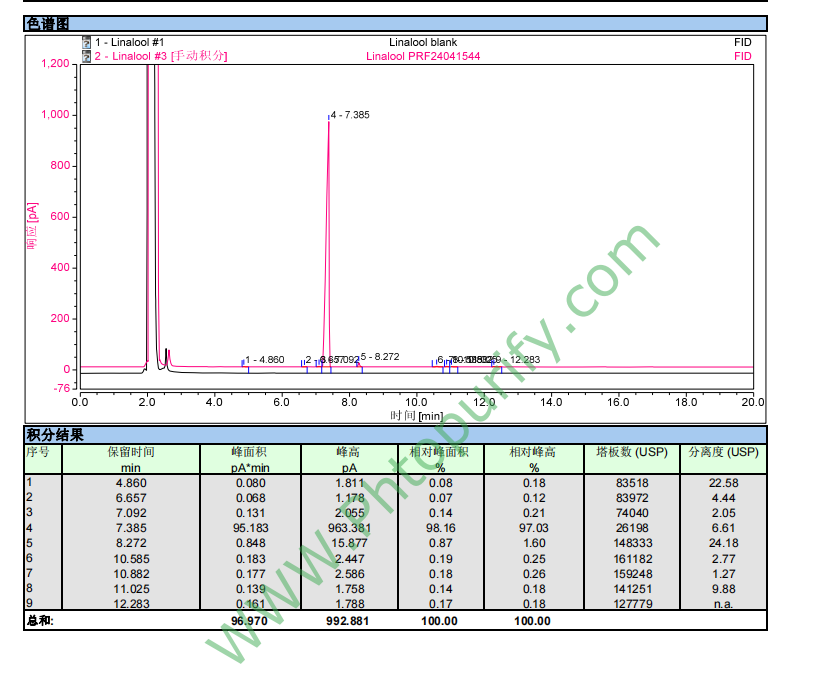
Storage conditions:Short-term storage at 2~8℃, long-term storage at -20 ~ -80℃
20.2300
3.0998
3.1001
.8407
6.3542
9.7462
High
70.0815
3.4325
Yes
Yes
No
No
No
No
0.0
No
Yes
Yes
Yes
Linalool (CAS number: 78-70-6) is a natural monoterpene compound widely found in various aromatic plants, which has attracted much attention due to its unique aromatic odor and diverse biological activities. As a natural product with oral activity and the ability to cross the blood-brain barrier, linalool has demonstrated rich pharmacological potential in the field of natural product pharmacology, including multiple biological effects such as anti-cancer, antibacterial, anti-inflammatory, neuroprotective, anti anxiety, anti depression, anti stress, and multi organ protection. In recent years, with the advancement of molecular biology and pharmacology techniques, the mechanism of action and molecular targets of linalool have gradually been revealed, providing a theoretical basis for its clinical application.
This article will provide a systematic review of the chemical structure and physicochemical properties, plant sources, and extraction methods of linalool, with a focus on exploring its diverse pharmacological activities and mechanisms of action, evaluating its pharmacological parameters and pharmacokinetic characteristics, and finally looking forward to its clinical application prospects, aiming to provide comprehensive scientific basis for the further development and application of linalool.
Cinnamol is a monoterpene alcohol compound with the molecular formula C10H18O and a molecular weight of 154.2530. Its chemical structure consists of a cyclic monoterpene skeleton containing hydroxyl groups, with two chiral centers. Common optical isomers include (R) - linalool and (S) - linalool. The structural formula of linalool is as follows:
The physicochemical properties of linalool enable it to function in a lipid environment and also have a certain water phase distribution, making it suitable for various routes of administration, especially oral and inhalation.
Cinnamol is widely present in various aromatic plants, especially in the essential oils of plants such as Cinnamomum camphora, Lavandula angustifolia, Cymbopogon citratus, Ocimum basilicum, and Citrus aurantium. Its natural forms are mainly in the free and esterified states, usually coexisting with other monoterpenes and sesquiterpenes.
distillation
The traditional steam distillation method is the main method for extracting linalool, which is suitable for extracting essential oils from oil containing plants. This method is easy to operate and can effectively separate linalool and its isomers, but some components may undergo thermal degradation due to high temperature.
Solvent Extraction Method
Using organic solvents such as ethanol and ether for extraction is suitable for extracting linalool and other volatile components from plants. This method has high extraction efficiency, but attention should be paid to solvent residue.
Supercritical carbon dioxide extraction
As a green and environmentally friendly technology, supercritical CO2 extraction can extract linalool at lower temperatures, maintain its chemical stability and biological activity, and have no solvent residue, making it suitable for industrial production.
Microwave assisted extraction and ultrasound assisted extraction
In recent years, microwave and ultrasound technologies have been applied to the extraction of linalool, significantly improving extraction efficiency and purity, and shortening extraction time.
After extraction, linalool is usually qualitatively and quantitatively analyzed by gas chromatography-mass spectrometry (GC-MS) to ensure its purity and isomer composition.
The pharmacological activities of linalool cover multiple aspects such as antibacterial, anticancer, anti-inflammatory, neuroprotective, and multi organ protection, and its mechanism of action involves multiple molecular targets and signaling pathways.
Linalool exhibits significant inhibitory effects on various bacteria and fungi, especially against Gram positive bacteria and certain drug-resistant strains. Its antibacterial targets include:
Linalool exhibits broad-spectrum antibacterial effects by binding to the aforementioned targets, disrupting the metabolism and structural integrity of bacteria and fungi.
Linalool exhibits inhibitory effects on cell proliferation and induces apoptosis in various cancer cell lines. Research has shown that it can regulate cell cycle related proteins, activate mitochondrial dependent apoptosis pathways, and inhibit tumor cell migration and invasion. In addition, linalool indirectly exerts anti-tumor effects by regulating oxidative stress and inflammatory responses.
Linalool can significantly inhibit the release of inflammatory mediators such as tumor necrosis factor alpha (TNF - α), interleukin-6 (IL-6), and nitric oxide (NO), reducing tissue inflammatory responses. Its anti-inflammatory mechanism mainly involves the inhibition of NF - κ B and MAPK signaling pathways, reducing the activation and chemotaxis of inflammatory cells.
As a competitive NMDA receptor antagonist, linalool can regulate glutamatergic neurotransmission, reduce excitotoxicity, and protect nerve cells from damage. Its excellent blood-brain barrier penetration gives it potential in the field of neuroprotection.
In addition, linalool exhibits anti anxiety, anti depression, and anti stress activation properties, which may improve emotional disorders by regulating the neurotransmitter system (such as GABA, 5-HT) and downregulating neuroinflammation.
Linalool exhibits protective effects on the heart, liver, kidneys, and lungs, mainly through antioxidant, anti-inflammatory, and anti apoptotic mechanisms, reducing tissue damage. For example:
The multiple pharmacological effects of linalool depend on its interactions with multiple molecular targets, and the specific mechanisms are as follows:
NMDA receptor antagonistic effect
Linalool, as a competitive NMDA receptor antagonist, blocks glutamate mediated overactive signals, reduces neurotoxicity, and protects neurons.
Antibacterial targets
Linalool inhibits the biosynthetic pathway of bacteria and fungi by binding to key enzymes such as GYRA, FABI, DHFR, ERG11, etc., leading to microbial death.
Regulation of anti-inflammatory signaling pathway
Inhibiting the NF - κ B and MAPK signaling pathways, reducing the expression of inflammatory factors, and lowering the inflammatory response.
Antioxidant effect
By activating the Nrf2/ARE signaling pathway, cell antioxidant enzyme activity is increased, free radicals are cleared, and oxidative damage is reduced.
Regulation of cell apoptosis
Regulating the expression of Bcl-2 family proteins, activating the mitochondrial apoptosis pathway, and promoting cancer cell apoptosis.
Neurotransmitter regulation
Affects the GABAergic and 5-hydroxytryptamine (5-HT) systems, improves mood and behavioral abnormalities.
Linalool has good pharmacological parameters:
After oral administration, linalool is well absorbed and rapidly reaches its peak plasma concentration. Due to its strong lipid solubility, it can effectively cross the blood-brain barrier and exert central nervous system effects. Its metabolism is mainly through oxidation and binding reactions in the liver, and the solubility of metabolites increases, making them easier to excrete. Linalool has a moderate half-life and is suitable for multiple administrations to maintain its efficacy.
At present, the distribution, metabolic enzyme system, and excretion pathway of linalool in the body have been preliminarily clarified, but further in-depth research is needed on its pharmacokinetic parameters and metabolic kinetic models.
Linalool, with its multi-target and multi mechanism pharmacological activity, has demonstrated broad clinical application potential:
Anti infection field
As a natural antibacterial agent, linalool can be used to combat multidrug-resistant bacterial infections, especially in skin, respiratory, and digestive tract infections, with potential application value. By combining modern nanotechnology and drug delivery systems, its targeting and efficacy can be improved.
Neurological disorders
Its NMDA receptor antagonism and neuroprotective effects make it a candidate drug for treating neurological and psychiatric disorders such as Alzheimer's disease, Parkinson's disease, depression, and anxiety. In the future, its safety and effectiveness can be verified through clinical trials.
tumor therapy
The anticancer activity of linalool provides the possibility for it to be used as an adjuvant anti-tumor drug. By combining chemotherapy drugs or developing their derivatives, the anti-tumor effect can be improved and toxic side effects can be reduced.
Multi organ protection
The protective effect of linalool is worth exploring in cardiovascular disease, liver and kidney disease, and lung disease, especially in the prevention and treatment of chronic inflammation and oxidative stress-related diseases.
Mental Health and Functional Disorders
Its anti anxiety, anti depression, and anti stress activation properties provide new ideas for the application of linalool in functional neurological disorders and mental health.
Future research should focus on preclinical safety evaluation, formulation development, pharmacokinetic optimization, and clinical trial design of linalool, in order to promote its transition from laboratory research to clinical practice.
As a natural monoterpene compound, linalool exhibits diverse and significant pharmacological activities due to its unique chemical structure and excellent physicochemical properties. Its neuroprotective effects as a competitive NMDA receptor antagonist, as well as broad-spectrum antibacterial, anti-inflammatory, and multi organ protective effects, have made it a hot topic in natural product pharmacology research.
Through systematic pharmacological mechanism research and pharmacological evaluation, linalool has good clinical development potential. In the future, by combining modern drug development technology and conducting in-depth pharmacokinetic, toxicological, and clinical research, it is expected to promote linalool as a new natural medicine for multi field treatment and contribute new strength to human health.
