


Product Name: 1,8-Cineole
Synonym name: Eucalyptol; Eucapur; Soledum; Terpane; Zineol; Cineole; Cyneol; Cajeputol
Catalogue No.: BP0568
Cas No.: 470-82-6
Formula: C10H18O
Mol Weight: 154.253
Botanical Source: Occurs in eucalyptus, lavender, sage and many other oils. Detected in the Black Sea bryozoan Conopeum seuratum
Purity: 95%~99%
Analysis Method: HPLC-DAD or/and HPLC-ELSD
Identification Method: Mass, NMR
Packing: Brown vial or HDPE plastic bottle
Can be supplied from milligrams to grams.
For Reference Standard and R&D, Not for Human Use Directly.
Inquire for bulk scale.
HPLC of 1,8-Cineole
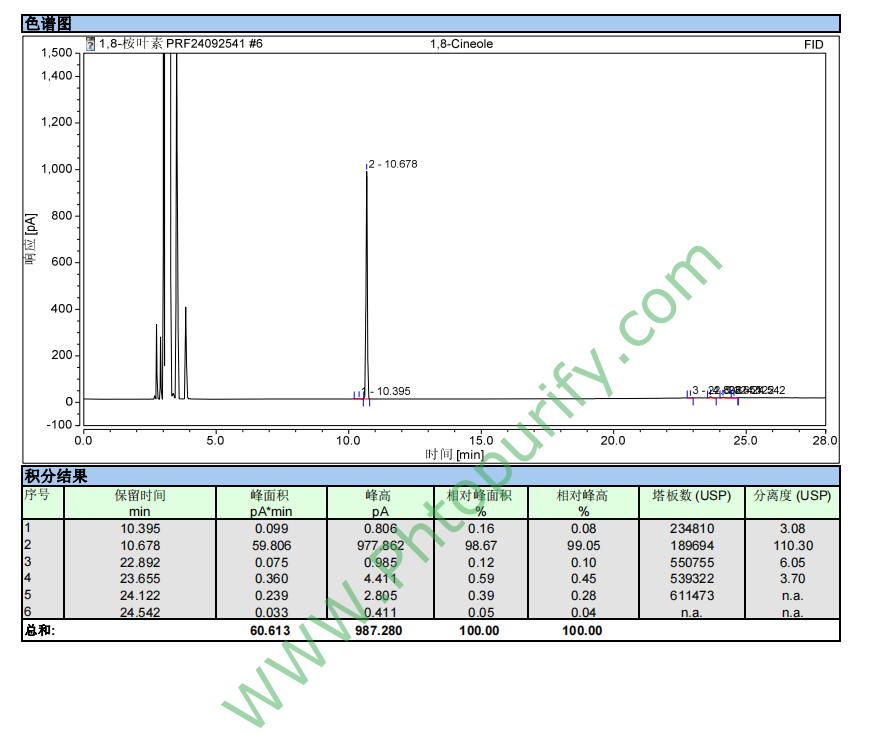
Storage conditions:Short-term storage at 2~8℃, long-term storage at -20 ~ -80℃
1,8-Cineole, also known as eucalyptol, is a natural monoterpene ether widely found in various aromatic plants. Its CAS number is 470-82-6, molecular formula is C10H18O, and molecular weight is approximately 154.25. 1,8-Eucalyptus leaves have long been used in the food, cosmetics, and spice industries due to their unique cool aroma and seasoning properties. In recent years, with the deepening development of natural product pharmacology, 1,8-eucalyptol has become a research hotspot due to its significant biological activity, especially in the field of respiratory anti-inflammatory potential.
This review aims to systematically sort out the chemical structure and physicochemical properties, plant sources and extraction processes, pharmacological activity and mechanism of action, pharmacological evaluation and pharmacokinetic characteristics of 1,8-eucalyptol, and comprehensively analyze its clinical application prospects, providing theoretical basis and reference for subsequent drug development and clinical research.
1,8-Eucalyptol is a monocyclic monoterpene ether with a cyclic ether group connected by an oxygen bridge in its chemical structure. Its molecular formula is C10H18O. Its structural characteristics endow it with unique volatility and lipid solubility. The molecular weight is 154.2530 and the LogP value is 3.6672, indicating strong lipophilicity, which is beneficial for its penetration of cell membranes and the blood-brain barrier (BBB). Its topological polar surface area (TPSA) is 9.23 Å ², and the extremely low polar surface area further supports its good membrane permeability.
The low water solubility (0.3532 mg/mL) limits its solubility in aqueous phase, but also ensures its stable existence in lipid environment. The hERG channel inhibition experiment result was negative, indicating that 1,8-eucalyptol is not prone to induce arrhythmia related cardiac toxicity. The Ames test result is 0.0, indicating no significant genotoxicity risk.
In summary, the physicochemical properties of 1,8-eucalyptol demonstrate its excellent potential for bioavailability and safety, making it suitable for further pharmacological activity development.
1,8-Eucalyptol is mainly present in the essential oils of various aromatic plants such as Eucalyptus spp., Rosmarinus officinalis, Thymus vulgaris, and Laurus nobilis. Especially in eucalyptus leaf oil, the content is the highest, often exceeding 60%, which is its main active ingredient.
The traditional extraction method mainly relies on steam distillation, which heats plant materials to evaporate volatile components with steam, and separates essential oils after condensation. Modern extraction techniques include supercritical CO2 extraction, microwave-assisted extraction, and solvent extraction, which have shown excellent performance in improving extraction efficiency and reducing the degradation of thermosensitive components.
During the extraction process, attention should be paid to temperature and time control to avoid thermal decomposition and isomerization of 1,8-eucalyptol. The extracted essential oil is qualitatively and quantitatively analyzed using gas chromatography-mass spectrometry (GC-MS) technology to ensure its purity and active ingredient content.
The pharmacological activity research of 1,8-Eucalyptol mainly focuses on its anti-inflammatory, antibacterial, antitussive, expectorant, and neuroprotective properties. Especially in the anti-inflammatory treatment of respiratory diseases, it has shown significant effects.
A large number of in vitro and in vivo experiments have shown that 1,8-eucalyptol can effectively inhibit respiratory inflammatory reactions. It reduces the inflammatory damage of airway mucosa by downregulating the expression of pro-inflammatory cytokines such as tumor necrosis factor alpha (TNF - α), interleukin-6 (IL-6), interleukin-1 β (IL-1 β), etc.
Animal model studies have shown that 1,8-eucalyptol can significantly alleviate airway inflammation induced by smoke, bacteria, or allergens, improve lung function, reduce inflammatory cell infiltration and mucus secretion. In addition, its potential as an adjuvant therapy for chronic obstructive pulmonary disease (COPD) and asthma is gradually being recognized.
1,8-Eucalyptol exhibits inhibitory effects on various Gram positive and negative bacteria, particularly against common respiratory pathogens such as Staphylococcus aureus and Streptococcus pneumoniae. Its antiviral activity is mainly reflected in its inhibition of influenza virus and coronavirus, which may be achieved by destroying the virus envelope or inhibiting virus replication.
Both clinical and experimental studies have confirmed that 1,8-eucalyptus extract has cough suppressant and expectorant effects. It stimulates the ciliary movement of the respiratory mucosa, accelerates the discharge of sputum, and reduces cough reflex sensitivity, alleviating cough symptoms.
Partial studies suggest that 1,8-eucalyptol has neuroprotective effects, can alleviate oxidative stress and inflammation mediated nerve damage, and has the potential to be used as an adjuvant therapy for neurodegenerative diseases. In addition, its antioxidant, anti-tumor, and immune regulatory effects are constantly being revealed.
The biological activity of 1,8-eucalyptol is mainly achieved by regulating multiple inflammatory signaling pathways. Its key molecular targets include:
Molecular mechanism studies have shown that 1,8-eucalyptol inhibits the activity of upstream signaling molecules (such as IKK complexes), blocks the translocation of NF - κ B from cytoplasm to nucleus, and thus suppresses the expression of inflammatory genes. In addition, its antioxidant activity reduces oxidative stress by clearing reactive oxygen species (ROS), indirectly regulating inflammatory pathways.
The combined effect of these mechanisms enables 1,8-eucalyptol to exert a multi-target and multi pathway synergistic therapeutic effect in respiratory inflammation and related diseases.
The pharmacological parameters of 1,8-eucalyptol indicate that it has good potential for drug development. Its LogP value is 3.6672, indicating that it has moderate lipid solubility, which is beneficial for oral absorption and cell membrane penetration. The TPSA value is as low as 9.23 Å ², supporting its good biofilm permeability, especially the high blood-brain barrier (BBB) permeability, indicating its potential application in central nervous system diseases.
The low water solubility (0.3532 mg/mL) may limit its oral bioavailability, but its dissolution and absorption performance can be improved through formulation optimization (such as nanocarriers, liposomes, etc.).
In terms of toxicological evaluation, 1,8-eucalyptol did not exhibit hERG channel inhibition, reducing the risk of cardiac toxicity; The Ames test is negative, indicating no significant mutagenicity and high safety.
Pharmacokinetic studies have shown that 1,8-eucalyptol is rapidly absorbed after oral administration, with a moderate plasma half-life. It is mainly metabolized by the liver, and the metabolites are excreted by the kidneys. Its high lipid solubility leads to its accumulation in adipose tissue, and attention should be paid to the accumulation effect of long-term medication.
1,8-Eucalyptol, as a natural monoterpene ether, has shown broad application prospects in the adjuvant treatment of respiratory diseases due to its good safety and multiple pharmacological activities. It can improve patients' symptoms and quality of life in chronic obstructive pulmonary disease, asthma, acute and chronic bronchitis and other diseases through anti-inflammatory, antitussive, expectorant and antibacterial effects.
In addition, the excellent blood-brain barrier penetration ability of 1,8-eucalyptol has led to its increasing research in the field of neurological diseases, and it is expected to develop new therapeutic drugs for neuroinflammation and neurodegenerative diseases in the future.
Currently, clinical applications mostly exist in the form of compound essential oils or oral preparations, and systematic clinical research on single components is not yet sufficient. In the future, it is necessary to strengthen the pharmacokinetics, dose optimization, and long-term safety evaluation of 1,8-eucalyptol, and promote its transformation from laboratory research to clinical application.
By combining modern formulation technologies such as nanocarriers and sustained-release systems, it is expected to enhance their bioavailability and targeting, and improve therapeutic efficacy. The multi-target mechanism of action also provides a basis for its combination therapy with other drugs, promoting multidimensional disease management.
1,8-Eucalyptol, as an important natural monoterpene ether, exhibits various pharmacological activities due to its unique chemical structure and excellent physicochemical properties, especially in the field of respiratory anti-inflammatory, with significant potential. It exerts a multi-target synergistic anti-inflammatory effect by regulating key inflammatory targets such as TNF, PTGS2, NFKB1, IL6, and IL1B, and has good safety and drug efficacy.
Future research should focus on in-depth analysis of its molecular mechanism, optimization of extraction and formulation processes, systematic clinical evaluation, and promotion of the transformation of 1,8-eucalyptol into new natural medicines. With the continuous revelation of its biological activity and pharmacokinetic characteristics, 1,8-eucalyptol is expected to become an important natural drug resource in the treatment of respiratory system diseases and related inflammatory diseases, contributing new treatment options to human health.
