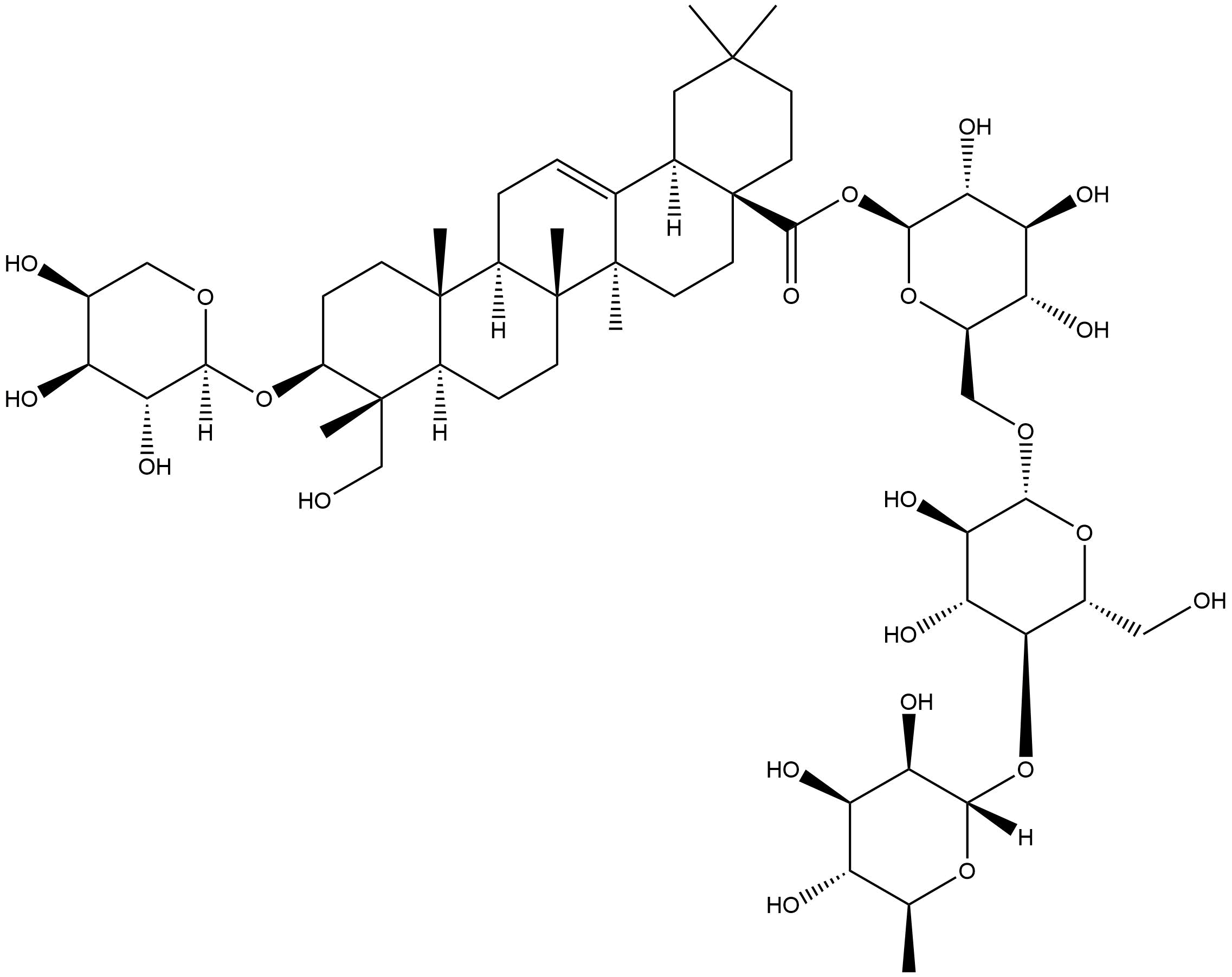


Product name: Cauloside D
Synonym name: Hederoside G
Catalogue No.: BP2105
Cas No.: 12672-45-6
Formula: C53H86O22
Mol Weight: 1075.25
Botanical Source: Hedera helix
Type of Compound: Triterpenoids
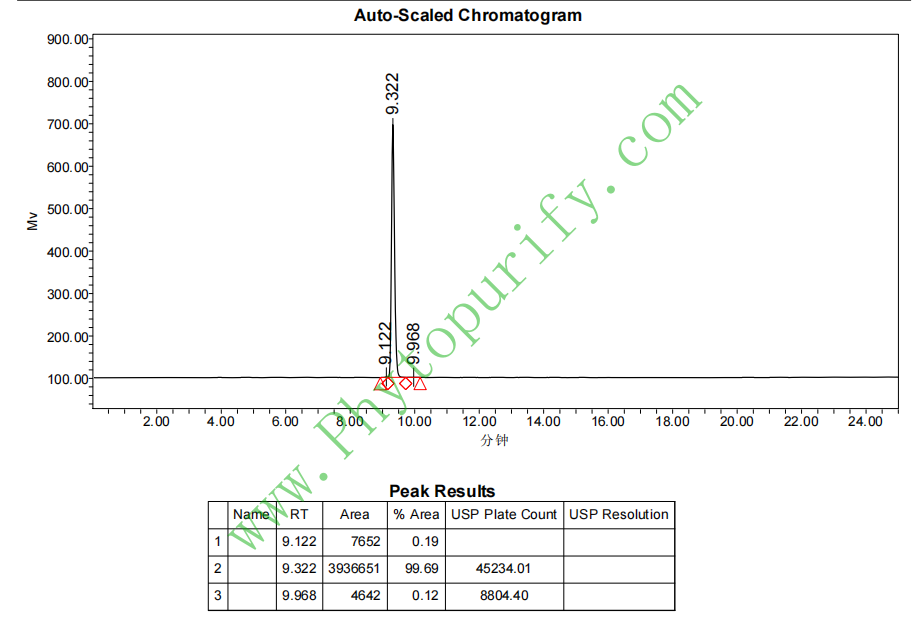
Purity: 95%~99%
Analysis Method: HPLC-DAD or/and HPLC-ELSD
Identification Method: Mass, NMR
Packing: Brown vial or HDPE plastic bottle
Storage: Store in a well closed container, protected from air and light. Put into refrigerate or freeze for long term storage.
Whenever possible, you should prepare and use solutions on the same day. However, if you need to make up stock solutions in advance, we recommend that you store the solution as aliquots in tightly sealed vials at -20℃. Generally, these will be useable for up to two weeks.
The product could be supplied from milligrams to grams
Inquire for bulk scale.
For Reference Standard and R&D, Not for Human Use Directly.
HPLC of Cauloside D
Storage conditions:Short-term storage at 2~8℃, long-term storage at -20 ~ -80℃
353.9000
2.0240
2.0237
.2109
.5842
.1829
Low
73.5836
6.7856
Yes
No
No
No
No
No
0.0
Yes
No
No
Yes
Cauloside D is a natural triterpenoid saponin derived from the traditional Chinese medicine Caulophyllum robustum Max. It has received widespread attention in recent years due to its significant biological activity. As a triterpenoid saponin with a complex structure, red hair seven saponin D exhibits unique potential in multiple pharmacological effects such as anti-inflammatory and anti-tumor, especially in the treatment research of malignant tumors such as ovarian cancer. This article aims to systematically review the chemical structure, sources, pharmacological activities, and mechanisms of action of red hair seven saponins D. Combined with its pharmacological parameters, it explores its clinical application prospects and development directions as a new natural medicine candidate molecule.
Red hair saponin D belongs to the triterpenoid saponin class, with a complex molecular formula and a triterpenoid skeleton modified by polysaccharide chains. Its molecular weight is 1075.2490, with a LogP value of 2.0240, indicating moderate lipophilicity that facilitates membrane penetration. The polar surface area (TPSA) is as high as 353.9, indicating that the molecule has a large number of polar groups, which may affect its oral bioavailability and membrane permeability. The water solubility is 0.2109, indicating that its water solubility is low, but it still has a certain degree of solubility. The low permeability of the blood-brain barrier means that its impact on the central nervous system is limited, reducing the potential risk of neurotoxicity. The hERG inhibition experiment result was negative, indicating that the inhibitory effect of red hair seven saponins D on cardiac potassium channels is weak and safe. The Ames mutagenicity test result was 0.0, indicating no significant genotoxicity and meeting the basic requirements for safe drug use.
Red hair seven saponins D are mainly isolated from the rhizome of red hair seven (Caulophyllum robustum Max). Hongmao Qi is a plant of the Ranunculaceae family, widely distributed in Northeast and Southwest China. In traditional Chinese medicine, it is used to promote blood circulation, remove blood stasis, regulate menstruation, and relieve pain. During the extraction process, ethanol or methanol is usually used as solvents for extraction, followed by purification through liquid-liquid distribution, silica gel column chromatography, and high-performance liquid chromatography (HPLC) techniques. In recent years, the application of ultrasound assisted extraction and microwave-assisted extraction techniques has significantly improved the extraction efficiency and purity of red hair saponin D, laying the foundation for its large-scale preparation.
The pharmacological activities of red hair seven saponins D mainly focus on anti-inflammatory and anti-tumor aspects. Multiple in vitro and in vivo experiments have shown that red hair saponin D can significantly inhibit the expression of inducible nitric oxide synthase (iNOS), reduce the secretion of pro-inflammatory cytokines such as TNF - α, IL-1 β, and IL-6, and thus exert anti-inflammatory effects. Its anti-inflammatory mechanism involves regulating the nuclear factor kappa B (NF - κ B) signaling pathway and reducing tissue damage caused by inflammatory reactions.
In the field of oncology, especially in ovarian cancer models, red hair seven saponin D exhibits anti-cancer potential through multi-target regulation. It can regulate the expression of apoptosis related protein BCL2 and promote cancer cell apoptosis; Simultaneously inhibiting the STAT3 signaling pathway, blocking the proliferation and metastasis of tumor cells. In addition, the inhibition of multidrug resistance associated protein ABCB1 by red hair saponin D helps to reverse chemotherapy resistance. Its effect on the oxidative stress regulator NFE2L2 also suggests its role in antioxidant stress. TOP1 and TOP2A, as DNA topoisomerases, further inhibit the activity of cancer cells' DNA replication and repair processes. The regulation of MAPK1 and ESR1 involves cell signal transduction and hormone receptor-mediated tumor growth regulation. Overall, red hair seven saponins D have broad application prospects in the treatment of ovarian cancer through multi-target and multi pathway synergistic effects.
The mechanism of action of red hair seven saponins D mainly revolves around its regulation of inflammation and tumor related signaling pathways. It inhibits the expression of iNOS (NOS2), reduces the excessive production of nitric oxide (NO), lowers the release of inflammatory mediators, and alleviates inflammatory reactions. At the same time, red hair saponin D can downregulate the expression of pro-inflammatory cytokines TNF - α, IL-1 β, and IL-6, inhibit the activation of NF - κ B and STAT3 signaling pathways, and block the transmission of inflammatory signals.
In tumor cells, red hair saponin D promotes mitochondrial mediated apoptosis by regulating BCL2 family proteins. Its inhibition of STAT3 not only reduces the proliferation of tumor cells, but also inhibits tumor immune escape. The inhibitory effect of ABCB1 helps to increase the intracellular concentration of chemotherapy drugs and enhance their efficacy. The regulation of NFE2L2 improves cellular antioxidant capacity and protects normal cells from oxidative damage. Inhibition of TOP1 and TOP2A blocks DNA topoisomerase activity, interferes with DNA replication and transcription, and inhibits tumor cell proliferation. The regulation of MAPK1 signaling pathway affects the cell cycle and apoptosis process, while the regulation of ESR1 may affect the growth of hormone dependent tumors. As a key component of the PI3K/AKT signaling pathway, PIK3CA regulation helps to inhibit the survival and migration of tumor cells.
In summary, the synergistic regulation of red hair seven saponins D through multiple targets and signaling pathways exerts its comprehensive anti-inflammatory and anti-tumor effects, providing a new approach for targeted therapy.
From the perspective of medicinal properties, red hair seven saponins D exhibit certain advantages and challenges. Its molecular weight is relatively large (1075.2490), exceeding the ideal range of traditional oral medications, which may limit its oral absorption. A high TPSA value (353.9) suggests strong molecular polarity, which may affect the permeability and bioavailability of the cell membrane. The LogP is 2.024, indicating moderate lipid water affinity and favorable distribution in the body.
Low water solubility (0.2109) may affect formulation design and in vivo solubility, but can be improved through drug delivery systems such as nanocarriers and liposomes. The low permeability of the blood-brain barrier reduces the risk of central nervous system toxicity, but limits its application in brain diseases. The negative inhibition and non mutagenicity of hERG channel (Ames test 0.0) provide a good guarantee for its safety.
At present, the pharmacokinetic data of red hair seven saponin D is not yet complete, and it is speculated that its in vivo metabolism may involve glycoside hydrolysis of liver enzyme system and oxidative modification of triterpenoid skeleton. In the future, systematic ADME (absorption, distribution, metabolism, excretion) research needs to be conducted to clarify its in vivo kinetic characteristics and provide a basis for clinical applications.
Red hair seven saponin D, as a natural triterpenoid saponin with multiple biological activities, has shown significant potential in anti-inflammatory and anti-tumor fields. It provides new targets and strategies for the treatment of malignant tumors such as ovarian cancer by regulating multiple key molecular pathways. Combined with its good safety indicators, red hair seven saponin D is expected to become an important candidate molecule for natural drug development.
However, current research is mostly focused on in vitro cell and animal models, lacking systematic preclinical and clinical trial data. In the future, it is necessary to strengthen in-depth research on its pharmacokinetics, toxicology, and pharmacodynamics, optimize its drug formulation and administration route. At the same time, combining modern drug design techniques such as structural modification and nanocarrier delivery can enhance its bioavailability and targeting.
In addition, the potential application of red hair seven saponins D in combination chemotherapy, immune regulation, and chronic inflammatory diseases also deserves further exploration. Interdisciplinary research collaboration will promote its transition from the laboratory to clinical practice, driving the development of natural product drugs.
Red hair seven saponins D, as a natural triterpenoid saponin with a clear source and unique structure, has demonstrated broad medicinal value due to its significant anti-inflammatory and anti-tumor activities. Its multi-target and multi mechanism mode of action provides new ideas for the treatment of complex diseases. Although there are still certain challenges in drug development and clinical translation, with the deepening of research and technological progress, red hair seven saponin D is expected to become an important breakthrough in the field of natural product pharmacology, contributing to the innovative development of natural medicines. Future research should focus on systematic pharmacokinetic evaluation, mechanism analysis, and preclinical validation to promote its clinical application.
