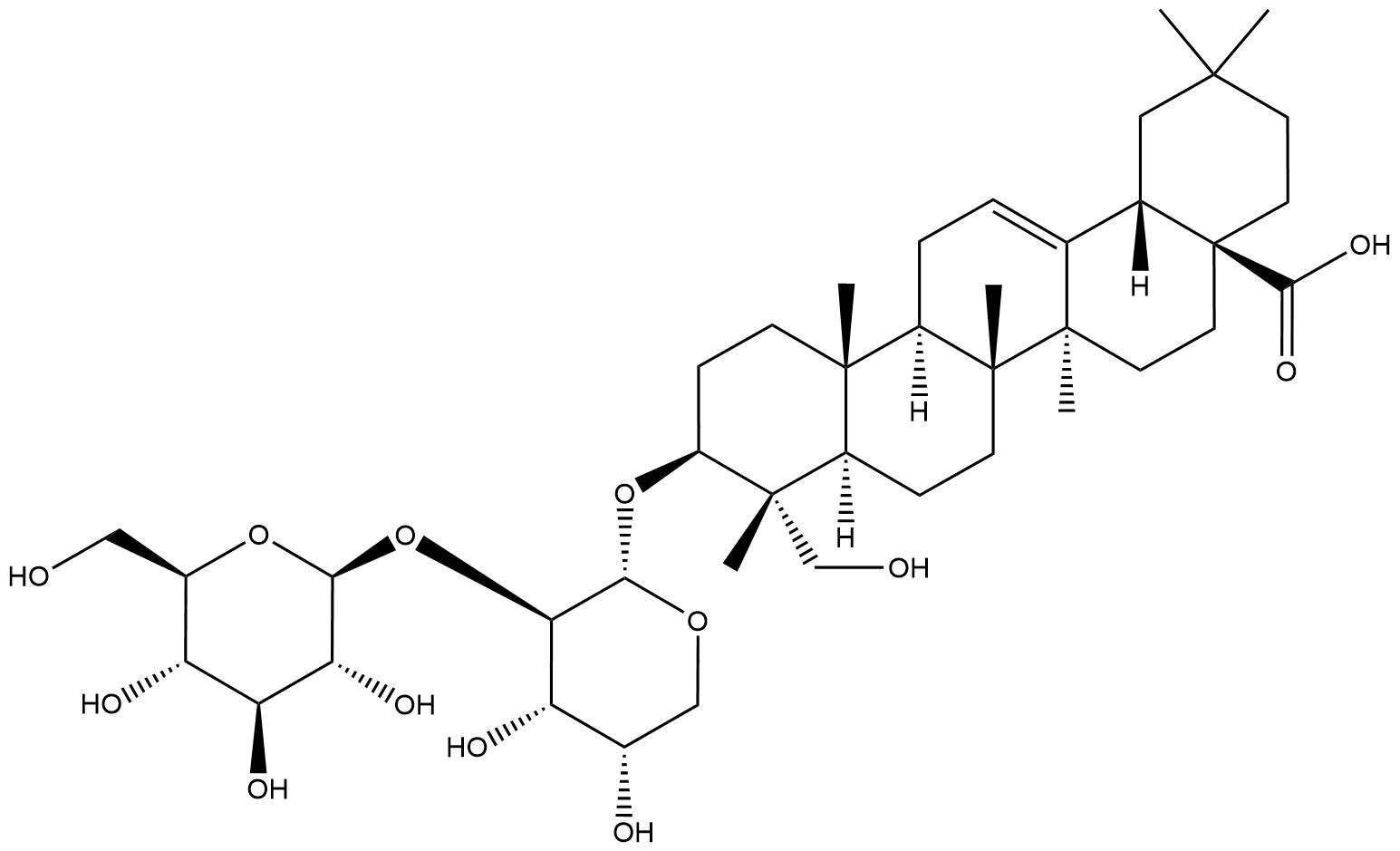


Product name: Hederoside D2
Synonym name: Akebia saponin C; Calthoside D; Cauloside C; Fatsiaside D1
Catalogue No.: BP2030
Cas No.: 20853-58-1
Formula: C41H66O13
Mol Weight: 766.966
Botanical Source: Hedera helix
Physical Description: Off-white Powder
Type of Compound: Triterpenoids
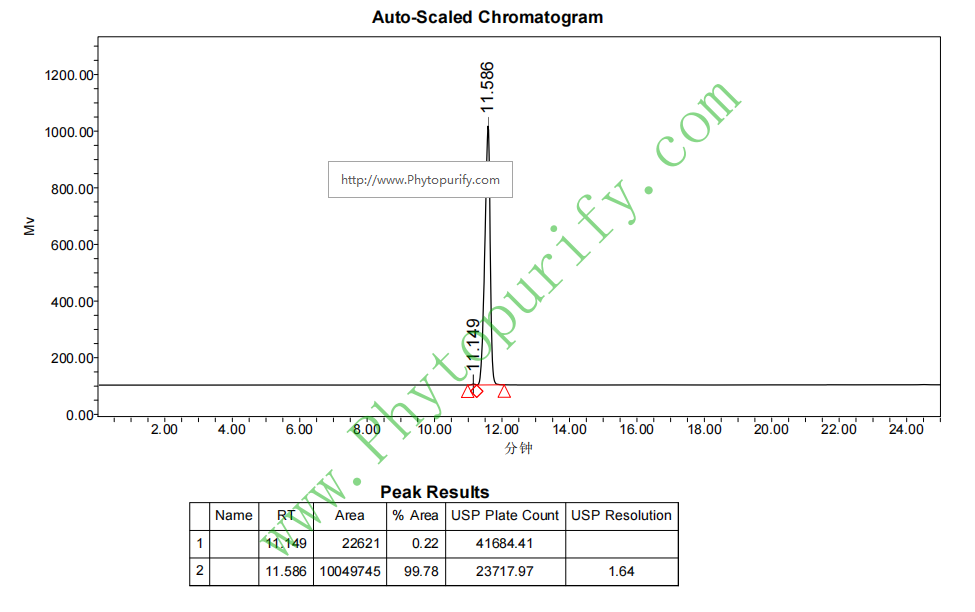
Purity: 95%~99%
Analysis Method: HPLC-DAD or/and HPLC-ELSD
Identification Method: Mass, NMR
Packing: Brown vial or HDPE plastic bottle
The product could be supplied from milligrams to grams. Inquire for bulk scale.
For Reference Standard and R&D, Not for Human Use Directly.
HPLC of Hederoside D2
Storage conditions:Short-term storage at 2~8℃, long-term storage at -20 ~ -80℃
215.8300
2.5807
.7928
.0827
.6157
.1637
Low
83.7003
5.7869
No
No
No
No
No
No
0.0
Yes
No
No
No
Hederoside D2 is a natural triterpenoid saponin derived from plants of the ivy genus. Due to its unique chemical structure and diverse biological activities, it has received widespread attention in the field of natural product pharmacology in recent years. As an important member of triterpenoids, Ivy saponin D2 not only shows significant anti-inflammatory, anti-tumor and immunomodulatory effects, but also shows potential clinical value in the treatment of pancreatic cancer and other malignant tumors. Pancreatic cancer has become a difficult point in global tumor research because of its high invasiveness and poor prognosis. Drug development targeting key molecules such as BCL2, STAT3, EGFR, etc. urgently needs new natural product candidate molecules. This article will systematically review the chemical structure, sources, pharmacological activity, and mechanism of action of ivy saponin D2, evaluate its pharmacological properties and clinical application prospects, aiming to provide theoretical basis and research direction for its subsequent drug development and clinical translation.
Ivy saponin D2 (CAS number: 20853-58-1) belongs to the triterpenoid saponin class, with a molecular weight of 766.9660. Its structure is based on a pentacyclic triterpenoid skeleton, connected by multiple sugar groups, giving it high polarity and water solubility. Its chemical formula is complex, containing multiple hydroxyl and glycosidic bonds, and its typical saponin structure gives it surface activity and biological activity.
In terms of physical and chemical properties, the LogP value of ivy saponin D2 is 2.5807, indicating that it has moderate lipid solubility, which is beneficial for cell membrane penetration but not too hydrophobic. The polar surface area (TPSA) is as high as 215.83 Å ², reflecting its strong polarity characteristics, which are closely related to the presence of its sugar groups. The water solubility is 0.0827, indicating that its solubility in water is low, but it still has a certain degree of hydrophilicity. The low permeability of the blood-brain barrier suggests limited distribution in the central nervous system. The negative result of hERG channel inhibition experiment indicates a low risk of cardiac toxicity. The Ames test result is 0.0, indicating no significant mutagenicity and good safety.
In summary, the physicochemical properties of ivy saponin D2 indicate that it has a certain pharmacological activity basis and is suitable for further pharmacological research and drug development.
Ivy saponin D2 is mainly found in Hedera spp., especially in European ivy (Hedera helix) and Asian ivy (Hedera nepalensis). Ivy plants are widely distributed in temperate regions and have traditionally been used to treat respiratory and inflammatory diseases.
The process of extracting ivy saponin D2 usually includes the following steps:
Raw material collection and pretreatment Select mature ivy leaves or whole plants, clean them thoroughly, dry them, and grind them into fine powder.
Solvent extraction Using polar organic solvents such as ethanol or methanol for reflux extraction, the extraction time is generally several hours to more than ten hours to fully dissolve the saponin components.
Liquid-liquid separation After concentration, the extract is separated into layers using solvents such as water and ethyl acetate to remove non-polar impurities.
Column chromatography separation Separate and purify ivy saponin D2 using silica gel column chromatography or reverse phase high performance liquid chromatography (RP-HPLC) technology, combined with gradient elution.
Structural Identification Modern analytical techniques such as mass spectrometry (MS) and nuclear magnetic resonance (NMR) were used to confirm its structure and purity.
In recent years, new technologies such as ultrasound assisted extraction and microwave-assisted extraction have also been introduced to improve extraction efficiency and product purity, reduce solvent consumption and environmental impact.
Ivy saponin D2 exhibits significant pharmacological activity in various in vitro and in vivo models, mainly covering anti-tumor, anti-inflammatory, antioxidant, and immune regulation aspects.
Pancreatic cancer, as the key target of Ivy saponin D2 research, its anti-tumor mechanism involves the regulation of multiple signal pathways. Many studies have shown that Ivy saponin D2 can inhibit the proliferation, migration and invasion of pancreatic cancer cells, induce apoptosis, and enhance the sensitivity of chemotherapy drugs.
Cell proliferation inhibition Ivy saponin D2 regulates cell cycle related proteins, blocks cancer cell cycle progression, and reduces cell proliferation rate.
Promoting apoptosis effect This compound can activate the mitochondrial pathway to induce apoptosis, regulate the expression of BCL2 family proteins, and promote programmed cell death.
Anti transfer ability By downregulating the expression of matrix metalloproteinase MMP9, the matrix degradation and metastasis ability of cancer cells are inhibited.
Chemotherapy sensitization: When used in combination with traditional chemotherapy drugs, Ivy saponin D2 can reverse multidrug resistance (MDR), enhance the accumulation of drugs in pancreatic cancer cells, and improve the efficacy.
Ivy saponin D2 exhibits good anti-inflammatory effects in inflammatory models, mainly by inhibiting the production of inflammatory mediators and activating signaling pathways.
Inhibit inflammatory factors Reduce the expression of nitric oxide synthase NOS2 and pro-inflammatory cytokines such as TNF - α and IL-6.
Regulating immune response By regulating the TLR4 and STAT3 signaling pathways, we can modulate the activity of immune cells and alleviate chronic inflammation.
In addition, ivy saponin D2 also exhibits potential for antioxidant, antibacterial, and cardiovascular system protection, but related research is still in the preliminary stage and needs further validation.
The biological activity of Ivy saponin D2 depends on its regulation of multiple key molecular targets, especially in the treatment of pancreatic cancer.
BCL2 protein, as a member of the anti apoptotic family, can be downregulated by ivy saponin D2, disrupting the anti apoptotic barrier of cancer cells and promoting mitochondrial pathway apoptosis.
TLR4 is a key receptor in the immune response, and ivy saponin D2 reduces inflammation and blocks the formation of a pro tumor inflammatory microenvironment by inhibiting TLR4 mediated signaling.
STAT3, as a transcription factor, plays an important role in tumor cell proliferation, survival, and immune escape. Ivy saponin D2 inhibits the phosphorylation and nuclear translocation of STAT3, blocks its downstream gene expression, and suppresses tumor growth.
ABCB1 is a multidrug resistance related protein. Ivy saponin D2 can inhibit its function, reverse the drug tolerance of pancreatic cancer cells, and increase the intracellular concentration of chemotherapy drugs.
Topoisomerase I (TOP1) plays a crucial role in DNA replication and transcription. Ivy saponin D2 may interfere with the DNA metabolism of cancer cells and inhibit their proliferation by regulating TOP1 activity.
Excessive nitric oxide production mediated by NOS2 promotes inflammation and tumor progression, while ivy saponin D2 reduces oxidative stress and inflammatory response by inhibiting NOS2 expression.
PIK3CA encodes the catalytic subunit of PI3K, participates in the PI3K/Akt signaling pathway, and regulates cell growth and survival. Ivy saponin D2 interferes with this pathway, preventing abnormal proliferation of tumor cells.
MMP9 participates in extracellular matrix degradation, promoting tumor invasion and metastasis. Ivy saponin D2 inhibits MMP9 expression and limits the migration ability of cancer cells.
The epidermal growth factor receptor (EGFR) is a key driver of various tumors. Ivy saponin D2 blocks the proliferation and survival signals of tumor cells by inhibiting the EGFR signaling pathway.
The activation of tumor suppressor gene TP53 contributes to cell cycle arrest and apoptosis. Ivy saponin D2 may promote programmed cell death of tumor cells by regulating the expression and activity of TP53.
In summary, ivy saponin D2 exerts its anti-tumor and anti-inflammatory effects through the synergistic action of multiple targets and pathways, demonstrating a complex molecular mechanism.
The pharmacological analysis of ivy saponin D2 shows that it has certain potential for drug development, but there are also challenges.
The molecular weight of 766.9660 is slightly higher than the ideal range for traditional small molecule drugs, which may affect their oral absorption and bioavailability. The LogP value of 2.58 is moderate and favorable for membrane penetration, but high TPSA (215.83 Å ²) suggests strong polarity and may limit passive diffusion. The water solubility is low, and the formulation needs to be optimized to improve solubility and stability.
At present, there is limited in vivo pharmacokinetic data on ivy saponin D2. Its low blood-brain barrier permeability indicates minimal impact on the central nervous system and reduces the risk of central toxicity. The absence of hERG channel inhibition and negative Ames test results indicate good safety.
The existing in vitro and in vivo experiments have not shown significant toxic side effects, and there is no mutagenicity, which meets the basic requirements for safe medication. However, further systematic evaluation is needed for long-term toxicity and immune toxicity.
Due to the impact of ivy saponin D2 on multiple signaling pathways, there may be a risk of interaction with other drugs, especially when used in combination with chemotherapy drugs, which requires careful evaluation.
As a multi target natural product, Ivy vine saponin D2 shows a broad application prospect in the treatment of pancreatic cancer and other malignant tumors. Its anti-tumor activity and ability to reverse multidrug resistance provide new adjuvant strategies for clinical chemotherapy. Meanwhile, its anti-inflammatory and immune regulatory effects also provide the possibility for improving the tumor microenvironment.
Future research should focus on the following directions:
Pharmacokinetic and pharmacodynamic studies Systematically evaluate its absorption, distribution, metabolism, and excretion characteristics in the body, and clarify the effective dosage and administration route.
Structural optimization and formulation development By chemical modification or nanocarrier technology, its bioavailability and targeting can be improved, and potential toxicity can be reduced.
In depth analysis of the mechanism Using multi omics techniques and molecular biology methods to further reveal its functional network and key targets.
Preclinical and clinical trials Carry out animal model validation and safety evaluation, gradually advance to the clinical trial stage, and evaluate its therapeutic effect and safety.
Combination therapy strategy Explore the combined application of existing chemotherapy drugs, targeted drugs, and immunotherapy to improve treatment efficacy and overcome drug resistance issues.
Ivy vine saponin D2, as a natural product of triterpene saponins with multi target effect, has shown great potential in the treatment of pancreatic cancer and other malignant tumors by virtue of its unique chemical structure and significant biological activity. Its multidimensional mechanism of action provides new ideas for tumor treatment, while its good safety and drug development foundation lay a solid foundation for drug development. In the future, through in-depth pharmacological research, structural optimization and clinical verification, Ivy vine saponin D2 is expected to become an important candidate molecule for the development of natural product anti-tumor drugs, bringing new therapeutic hope to pancreatic cancer patients.
