


Product name: Alpha-Hederin
Synonym name:
Catalogue No.: BP0154
Cas No.: 27013-91-8
Formula: C41H66O12
Mol Weight: 750.967
Botanical Source: Hedera helix; Chinese ivy; Hedera nepalensis K,Koch var.sinensis (Tobl.) Rehd
Physical Description: Powder
Type of Compound: Triterpenoids
Purity: 95%~99%
Analysis Method: HPLC-DAD or/and HPLC-ELSD
Identification Method: Mass, NMR
Packing: Brown vial or HDPE plastic bottle
Storage: Store in a well closed container, protected from air and light. Put into refrigerate or freeze for long term storage.
Whenever possible, you should prepare and use solutions on the same day. However, if you need to make up stock solutions in advance, we recommend that you store the solution as aliquots in tightly sealed vials at -20℃. Generally, these will be useable for up to two weeks.
The product could be supplied from milligrams to grams, up to kilograms
Inquire for bulk scale.
Descriptions:
Alpha-hederin as a pro-drug, has cytotoxic and apoptotic/necrotic effects in a dose- and time-dependent manner on on four human cancer cell lines [A549 (lung carcinoma), HEp-2 (larynx epidermoid carcinoma), HT-29 (colon adenocarcinoma) and MIA PaCa-2 (pancreas carcinoma)] .[1]
Alpha-hederin is a saponin isolated from ivy, has anti-oxidant activity and acute anti-inflammatory activity in carrageenan-induced rat paw edema.[2]
Alpha-hederin, chlorophyllin and ascorbic acid have protective effects towards the induction of micronuclei by doxorubicin in cultured human lymphocytes.[3]
Alpha-hederin has antileishmanial activity ,exhibits a strong antiproliferative activity on all stages of development of the parasite by altering membrane integrity and potential in Leishmania .[4]
Alpha-hederin affects the binding behavior, dynamics, and regulation of beta 2-adrenergic receptors.[5]
Alpha-Hederin can increase isoprenaline-induced relaxation indirectly, probably by inhibiting heterologous desensitization induced by high concentrations of muscarinic ligands like .[6]
Alpha-hederin at sub-IC(50) cytotoxic concentrations enhances 5-fluorouracil (5-FU) cytotoxicity about 3.3-fold, suggests that it is possible to optimize colorectal cancer cell sensitivity to 5-FU with alpha-hederin.[7]
Alpha-hederin has anticancer effect on breast cancer cells.[8]
References:
[1] Rooney S, Ryan M F. Anticancer Res, 2005, 25(3B):2199-204.
[2] Gepdiremen A, Mshvildadze V, S?leyman H, et al. Phytomedicine, 2005, 12(6-7):440-4.
[3] Gül?in I, Mshvildadze V, Gepdiremen A,et al. Planta Med, 2004, 70(6):561-3.
[4] Amara-Mokrane Y A, Lehucher-Michel M P, Balansard G, et al. Mutagenesis, 1996, 11(2):161-7.
[5] Delmas F, Di G C R, Gasquet M, et al. Planta Med, 2000, 66(4):343-7.
[6] Sieben A, Prenner L, Sorkalla T, et al. Biochemistry, 2009, 48(15):3477-82.
[7] Anne Wolf, Reinoud Gosens, Herman Meurs, et al. Phytother Res Ptr, 2008, 22(10):1299-302.
[8] Cheng L, Xia T S, Wang Y F, et al. Int J Oncol, 2014, 45(2):757-63.
[9] Li Y, Li J, Huang J, et al. Chinese Agr Sci Bull, 2014, 30(13):190-3.
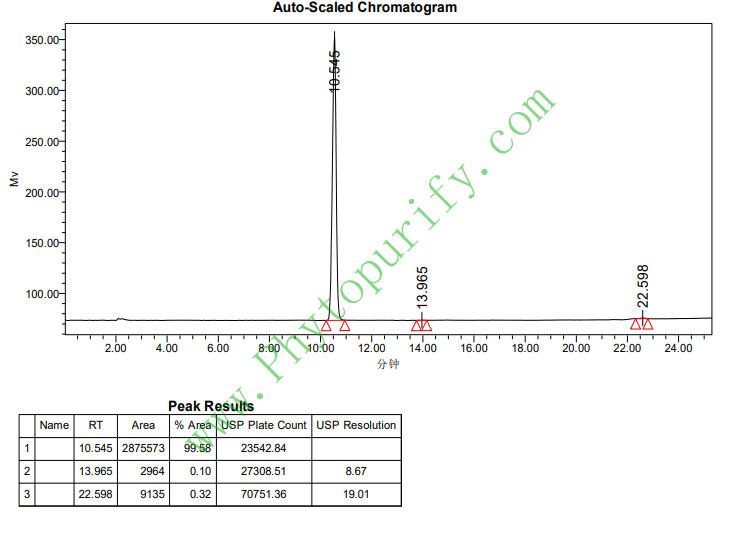
HPLC of Alpha-Hederin
Storage conditions:Short-term storage at 2~8℃, long-term storage at -20 ~ -80℃
Alpha Hederin is a typical natural triterpenoid saponin, first isolated from the stem bark of Kalopanax pictus. As a derivative of hederagenin formed by glycosidic bonds connecting specific disaccharide residues, Alpha hederagenin plays an important role in plant metabolites. In recent years, with the rapid development of natural product pharmacology, Alpha ivy saponins have attracted widespread attention due to their diverse biological activities, especially in the fields of anti-inflammatory, anti-tumor, antiparasitic, and metabolic diseases, demonstrating unique pharmacological potential. This article aims to systematically review the chemical structure, sources, pharmacological activities, and mechanisms of action of Alpha Ivy saponins, evaluate their pharmacological properties and clinical application prospects, and provide theoretical basis and reference for related research and new drug development.
The chemical structure of Alpha Ivy saponins belongs to the pentacyclic triterpenoid saponins, with a molecular formula of C42H66O12 and a molecular weight of approximately 734.96. Its core structure is hederagenin, which is connected to the third hydroxyl group through a glycosidic bond. The connected sugar group is a 2-O - (6-deoxy - α - L-mannopyranosyl) - α - L-arabinopyranosyl residue, forming a single bridged triterpenoid saponin structure. This structure endows it with high polarity, expanding its potential for interaction with biomolecules.
In terms of physical and chemical properties, the LogP value of Alpha Ivy Saponin is 3.5, indicating moderate lipophilicity and facilitating membrane penetration. Its topological polar surface area (TPSA) is 213.75 Å ², and the number of hydrogen bond acceptors is as high as 12, indicating its good solubility and strong hydrogen bond binding ability in aqueous environments. The ability to penetrate the blood-brain barrier is relatively low, indicating a lower risk of central nervous system side effects. There is currently no clear data on its safety indicators such as hepatotoxicity, cardiotoxicity, and hERG channel inhibition, and further research is needed.
Alpha ivy saponins are mainly isolated from the stem bark of Kalopanax pictus. Kalopanax pictus is a plant of the Araliaceae family, widely distributed in East Asia, traditionally used to treat rheumatism, arthritis, and various inflammatory diseases. Its stem bark is rich in various triterpenoid saponins, among which Alpha ivy saponins have a higher content.
The extraction method usually uses solvent extraction combined with column chromatography separation technology. The specific steps include:
In recent years, new green extraction technologies such as ultrasound assisted extraction and microwave-assisted extraction have gradually been applied to the extraction of Alpha ivy saponins, improving extraction efficiency and purity while reducing solvent consumption and environmental pollution.
Alpha ivy saponins exhibit various significant biological activities, covering fields such as anti-inflammatory, anti-tumor, antiparasitic, and metabolic regulation.
Multiple in vitro and in vivo experiments have shown that Alpha ivy saponins have significant anti-inflammatory effects. It showed significant anti-inflammatory effects in the carrageenan induced rat foot swelling model, inhibiting the release of inflammatory mediators and the infiltration of inflammatory cells. In addition, Alpha Ivy saponins exhibit strong antioxidant activity, capable of clearing free radicals, reducing tissue damage caused by oxidative stress, and further enhancing their anti-inflammatory effects.
Alpha ivy saponins exhibit inhibitory effects on various tumor cell lines, particularly in gastric cancer cells where they demonstrate excellent anti proliferative and pro apoptotic activity. The mechanism mainly activates the mitochondrial dependent apoptosis pathway, inducing the generation of reactive oxygen species (ROS) in cells, leading to a decrease in glutathione (GSH) levels, disrupting the cellular redox balance, and ultimately triggering cell apoptosis. In addition, Alpha Ivy saponins can also inhibit the migration and invasion of tumor cells, demonstrating potential anti metastatic ability.
Alpha ivy saponins exhibit strong anti proliferative activity against Leishmania parasites. Its mechanism of action involves disrupting the membrane integrity and membrane potential of parasites, affecting multiple stages of their growth and development. In addition, Alpha Ivy saponins also have insecticidal and acaricidal effects, with potential applications in agriculture and veterinary fields.
Alpha Ivy Saponins also exhibit anti spasmodic effects, which can alleviate smooth muscle spasms, possibly by regulating neurotransmitter receptors and ion channels. In addition, it can indirectly enhance the diastolic response induced by isoproterenol, possibly by inhibiting heterologous desensitization induced by high concentrations of muscarinic ligands, suggesting its potential role in cardiovascular system regulation.
The multi-target mechanism of action of Alpha ivy saponins is the basis of their pharmacological activity. Research has revealed that metabolic diseases such as non-alcoholic steatohepatitis (NASH) may exert their effects by regulating multiple signaling pathways, including:
In the field of anti-tumor, Alpha Ivy saponins induce mitochondrial membrane potential loss, activate cytochrome C release, initiate caspase cascade reaction, and promote cell apoptosis. In addition, the generation of ROS and depletion of glutathione are important mechanisms for inducing oxidative stress-induced cell death.
The pharmacological parameters of Alpha Ivy saponins indicate that they have certain potential for drug development. The molecular weight is 734.96, slightly higher than the Lipinski rule recommendation of 500 or less, but its LogP value is 3.5, indicating moderate lipid solubility and facilitating cell membrane penetration. High TPSA (213.75) and hydrogen bond receptor count (12) suggest good water solubility, but may affect oral bioavailability and membrane permeability.
The low penetration ability of the blood-brain barrier reduces the risk of central nervous system toxicity, but also limits its application in central nervous system diseases. There is still a lack of systematic research on safety indicators such as hepatotoxicity, cardiotoxicity, and hERG channel inhibition. In the future, it is necessary to clarify these indicators through in vitro and in vivo toxicological evaluations and preclinical safety trials.
In terms of pharmacokinetics, there are currently few literature reports, and it is speculated that its large molecular weight and polar structure may lead to limited oral absorption. The metabolic pathway in the body may involve the liver enzyme system, and excretion is mainly through bile or urine. To improve its bioavailability, drug delivery strategies such as nanocarriers, liposome encapsulation, and structural modification deserve further research.
Alpha ivy saponins have shown extensive clinical potential due to their multi-target and multi mechanism pharmacological activities. Its anti-inflammatory and antioxidant properties make it a candidate drug for treating chronic inflammatory diseases such as non-alcoholic steatohepatitis (NASH) and rheumatoid arthritis. By regulating key molecules such as AMPK, STAT3, NFE2L2, Alpha Ivy Saponins are expected to improve metabolic disorders and inflammatory microenvironment.
In the field of tumor therapy, the ability of Alpha Ivy saponins to induce mitochondrial dependent apoptosis provides a new approach for adjuvant therapy of gastric cancer and other solid tumors. Its anti parasitic activity also provides natural medicinal resources for the prevention and treatment of parasitic diseases.
However, current clinical research on Alpha Ivy saponins is still in its infancy and lacks systematic clinical trial data. In the future, the focus should be on conducting pharmacokinetic, safety evaluation, and dosage form optimization research, combined with modern drug delivery technology, to enhance its bioavailability and targeting. In addition, based on its multi-target characteristics, the development of combination therapy strategies and structurally modified derivatives is also an important direction.
Alpha ivy saponins, as a natural triterpenoid saponin with rich biological activity, have shown broad application prospects in anti-inflammatory, anti-tumor, antiparasitic, and metabolic disease regulation. Its unique chemical structure and multi-target mechanism of action provide valuable molecular frameworks and research foundations for the development of new drugs. Although its pharmacological and clinical applications still face certain challenges, with the continuous advancement of extraction and purification technology, drug delivery systems, and molecular pharmacology research, Alpha Ivy Saponins are expected to become an important candidate for future natural product drug development. Future research should focus on the pharmacokinetics, safety evaluation, and clinical validation of the system, promoting its transition from laboratory to clinical application and benefiting human health.
