


Synonym name: Eleutheroside M; Hederacoside B; Hederacolchiside C; Tauroside G2; Glycoside L-G2; Akebasaponin PJ3; Kizutasaponin K12
Catalogue No.: BP0711
Cas No.: 36284-77-2
Formula: C59H96O25
Mol Weight: 1205.39
Botanical Source: Eleutherococcus (Acanthopanax) senticosus (Siberian ginseng), Hedera colchica, Hedera conariensis and Hedera taurica
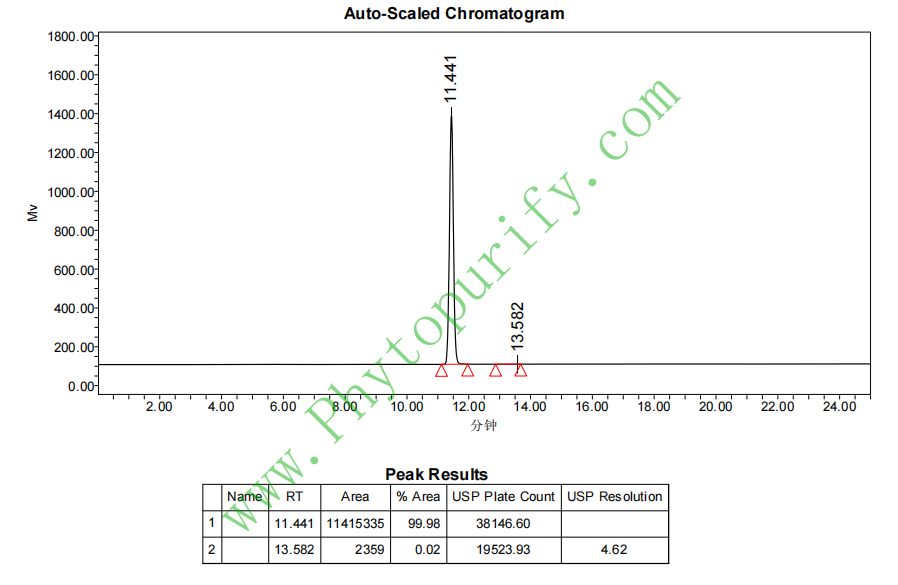
Purity: 95%~99%
Analysis Method: HPLC-DAD or/and HPLC-ELSD
Identification Method: Mass, NMR
Packing: Brown vial or HDPE plastic bottle
Can be supplied from milligrams to grams.
For Reference Standard and R&D, Not for Human Use Directly.
Inquire for bulk scale.
HPLC of Hederasaponin B
Storage conditions:Short-term storage at 2~8℃, long-term storage at -20 ~ -80℃
Hederasaponin B is a compound derived from ivy(Hedera helix)Natural triterpenoid saponins isolated from the middle. In recent years, with the increasing importance of natural products in drug development, ivy saponin B has gradually become a research hotspot due to its unique chemical structure and diverse biological activities, especially its broad-spectrum antiviral activity against enterovirus 71 (EV71) and its various subtypes. In addition, more and more studies reveal its potential therapeutic value in breast cancer and other diseases, involving multiple key molecular targets. This article aims to systematically review the chemical structure, pharmacological activity, mechanism of action, pharmacological evaluation, and clinical application prospects of ivy saponin B, with the hope of providing theoretical basis and research direction for its subsequent drug development and clinical translation.
The molecular formula of ivy saponin B is C58H92O26, with a molecular weight of 1205.3920, and it belongs to the typical triterpenoid saponin class. The core of its structure is a pentacyclic triterpenoid skeleton, which connects multiple glycosidic groups to form a complex sugar chain structure. The LogP value of this compound is 2.3168, indicating its moderate lipid solubility, which facilitates membrane penetration and bioavailability. The total polar surface area (TPSA) is as high as 392.59 Å ², indicating its strong molecular polarity, which may affect its transmembrane transport and absorption characteristics. The water solubility is 0.2212, which belongs to low water solubility compounds, indicating that solubility improvement strategies need to be considered in drug formulation design. The low permeability of the blood-brain barrier indicates its limited distribution in the central nervous system. The hERG channel inhibition test result was negative, indicating a low risk of cardiac toxicity. The Ames mutagenicity test result is 0.0, indicating that its genotoxicity risk is relatively low and has a good safety basis.
Ivy saponin B mainly comes from ivy(Hedera helix)Leaves and stems. Ivy is an evergreen climbing plant widely distributed in parts of Europe, Asia, and North America. Its leaves contain abundant triterpenoid saponins, which are the main raw materials for extracting ivy saponin B.
The extraction process usually involves solvent extraction combined with chromatographic separation. Firstly, the dried ivy leaves are crushed and subjected to reflux extraction with ethanol or methanol. The extract is concentrated and then subjected to liquid-liquid distribution using a water ethanol gradient solvent to remove lipid soluble impurities. Subsequently, the extract was separated and purified using techniques such as silica gel column chromatography and reverse phase high performance liquid chromatography (RP-HPLC) to obtain high-purity ivy saponin B. In recent years, the application of ultrasound assisted extraction and microwave-assisted extraction technologies has improved extraction efficiency and purity, and reduced production costs.
Ivy saponin B exhibits significant inhibitory effects on enterovirus 71 (EV71) and its various subtypes. EV71 is the main pathogen causing hand, foot, and mouth disease and severe neurological complications, and there is a lack of effective specific antiviral drugs. In vitro cell experiments have shown that ivy saponin B can effectively reduce the replication and infection ability of EV71 virus, and inhibit virus related cellular lesions. Its antiviral activity is broad-spectrum and has low cytotoxicity, demonstrating good therapeutic potential.
In recent years, the research of ivy saponin B in the field of breast cancer has gradually deepened. A number of experiments in vitro and in vivo showed that Ivy saponin B could inhibit the proliferation, migration and invasion of breast cancer cells and induce apoptosis by regulating multiple signal pathways. Its function involves regulating the cell cycle, inhibiting the expression of tumor associated matrix degrading enzymes (such as MMP2), and affecting the immune cell function in the tumor microenvironment.
Ivy saponin B has certain anti-inflammatory activity, which can inhibit the release of inflammatory factors such as TNF - α and IL-6, and alleviate inflammatory reactions. In addition, its regulatory effect on immune cell function also provides a theoretical basis for its application in immune related diseases.
The biological activity of Ivy saponin B is mainly achieved by regulating a variety of molecular targets and signal pathways, especially in the treatment of breast cancer.
AMPK (PRKAA1) activation
AMPK, as a key regulatory factor in cellular energy metabolism, can activate the AMPK signaling pathway, promote energy metabolism disorders in tumor cells, and inhibit their proliferation and survival.
BCL2 family protein regulation
By downregulating the expression of anti apoptotic protein BCL2, Ivy saponin B can promote the apoptosis of breast cancer cells and enhance the sensitivity of chemotherapy drugs.
STAT3 signaling pathway inhibition
STAT3 is an important regulatory factor for the proliferation and immune escape of various tumor cells. Ivy saponin B inhibits the phosphorylation and nuclear translocation of STAT3, blocks its transcriptional activity, and suppresses tumor progression.
Regulation of estrogen receptor beta (ESR2)
By regulating ESR2, Ivy saponin B affects the hormone dependent growth of breast cancer cells and plays an anti-tumor role.
Inhibition of multidrug resistance associated proteins (ABCB1, ABCG2)
Ivy saponin B can inhibit the expression of ABCB1 and ABCG2 in tumor cells, reverse multidrug resistance, and improve the efficacy of chemotherapy drugs.
Regulation of protein kinase C alpha (PRKCA) and microtubule associated protein Tau (MAPT)
By regulating PRKCA and MAPT, ivy saponin B affects cytoskeletal stability and signal transduction, inhibiting tumor cell migration and invasion.
Inhibition of Matrix Metalloproteinase 2 (MMP2)
MMP2 is involved in the degradation and metastasis of tumor cell matrix, and ivy saponin B inhibits its expression, preventing the process of tumor metastasis.
LCK kinase regulation
LCK, as a key tyrosine kinase in the T cell receptor signaling pathway, may be regulated by ivy saponin B, which may affect the tumor immune microenvironment and enhance immune surveillance.
From the perspective of medicinal properties, ivy saponin B has certain advantages and challenges. Its molecular weight is relatively high (1205.3920), exceeding the recommended range of Lipinski's rules, which may limit oral absorption. The LogP value is moderate (2.3168), which is beneficial for cell membrane penetration, but high TPSA (392.59) indicates strong polarity, which may reduce membrane permeability and oral bioavailability. The low water solubility (0.2212) suggests that the development of formulations requires the use of solubilization or nanocarrier technology to improve dissolution and absorption.
The low permeability of the blood-brain barrier reduces the risk of central nervous system toxicity, but limits its application in neurological diseases. The negative results of hERG channel inhibition and Ames test indicate good safety, with low risks of cardiac toxicity and genotoxicity.
At present, there is limited pharmacokinetic data on ivy saponin B. Preliminary studies have shown that it has good metabolic stability in vivo, but its oral bioavailability is low, mainly metabolized through the liver metabolic enzyme system, and excreted mainly through bile and feces. Further systematic pharmacokinetic and toxicological studies are needed in the future to optimize dosing regimens and dosage form design.
Ivy saponin B, as a natural product with broad-spectrum antiviral activity and anti-tumor potential, has good clinical translation prospects. Its inhibitory effect on EV71 virus provides a new candidate drug for the treatment of viral diseases such as hand, foot, and mouth disease. Especially in the context of frequent occurrence of viral diseases worldwide, the development of safe and effective antiviral drugs is of great significance.
In the field of tumor treatment, Ivy saponin B has shown good anti-tumor activity by regulating the proliferation and metastasis of breast cancer cells through multiple targets and pathways. Its ability to reverse multidrug resistance provides a new strategy for overcoming chemotherapy resistance. The combination of targeted drugs and immunotherapy in the future may further enhance its clinical efficacy.
However, ivy saponin B has limitations in drug formation due to its high molecular weight and low bioavailability, and its pharmacokinetic properties need to be improved through structural modification, nanocarrier encapsulation, and other means. In addition, the lack of preclinical safety evaluation and clinical trial data of the system is still a key bottleneck for its clinical application.
Future research should focus on the following aspects:
1. Thoroughly analyze its molecular mechanisms of antiviral and anti-tumor effects, and explore more potential targets.
2. Optimize the extraction and purification process to improve yield and purity, and reduce production costs.
3. Develop new drug delivery systems to enhance oral bioavailability and targeting.
4. Improve pharmacokinetic and toxicological studies to ensure safety.
5. Conduct preclinical and clinical studies to verify its efficacy and safety.
Ivy saponin B, as a natural triterpenoid saponin derived from ivy, exhibits broad potential for drug development due to its broad-spectrum antiviral activity and multi-target anti-tumor effects. Its unique chemical structure and diverse biological activities provide important examples for the pharmacological research of natural products. Although there are still challenges in drug development and clinical translation, with the deepening of research and advances in technology, ivy saponin B is expected to become a new candidate drug in the fields of antiviral and anti-tumor. The future interdisciplinary collaborative research will drive it from the laboratory to clinical practice, bringing new hope for the treatment of related diseases.
